TruAgents Review (2026): Email Marketing Pricing, Limits & Alternatives
Bottom line
TruAgents is a Web SaaS tool for Email Marketing (AI Email Marketing & Lifecycle Journeys) in Lifecycle & CDP. Pricing: Custom / enterprise pricing. Best suited to CRM & Lifecycle Marketers, eCommerce Growth Teams and Customer Experience Directors. Editor ratings: AI autonomy L3 (conditional automation); moat score 4.2/5.0 (Proprietary moat). Fact-checked by Julie Brot on Oct 11, 2026.
Autonomous customer engagement platform orchestrating personalized multi-channel lifecycle journeys across email, SMS, and voice using context-aware AI.
TruAgents buyer fit verdict: when to choose vs. when to walk away
Choose TruAgents if (Best Fit)
- Target ICP & Stack Fit: You operate as CRM & Lifecycle Marketers, eCommerce Growth Teams and Customer Experience Directors requiring a Web SaaS deployment for Email Marketing, with verified ecosystem connectivity for Outreach.
- L3 Architecture & Defensibility: Proprietary conversation safety guardrails coupled with dynamic multi-channel journey synthesis across voice, email, and SMS, anchored by seed-stage backing.
- Commercial Model Fit: Your procurement budget aligns with Custom / enterprise pricing.
Walk away from TruAgents if (Deal-Breakers)
- Walk away if you require transparent self-serve monthly billing or your budget ceiling is under $1,000/mo (TruAgents requires sales-gated custom quoting).
- Walk away if your workflow cannot tolerate deliverability and domain warmup constraints: Generating unique, un-templated copy variations per recipient degrades reputation monitoring on shared IP pools, requiring meticulous domain warmup cycles.
- Walk away if CRM schema synchronization latency is a deal-breaker for your team: High-volume transactional event pipelines can introduce pipeline latency, risking out-of-sequence messaging if customer profile states lag upstream database commits.
TruAgents key facts & scorecard
| Pricing | Custom / enterprise pricing |
|---|---|
| Free plan | No / not disclosed |
| Delivery | Web SaaS |
| Audience | CRM & Lifecycle Marketers, eCommerce Growth Teams, Customer Experience Directors |
| AI autonomy level | L3 · Conditional automationEditor-verified |
| Moat tier & score | 4.2 / 5.0 · Proprietary moatEditor-verified |
| Funding | Seed |
| Total funding | $3.4MBacked by Plug and Play, Cultivation Capital, ManchesterStory Group, Unum Group |
| Founders | Korash Hernandez, Majd Maksad |
| Company size | 2-10 employees |
| Ecosystem integrations | Outreach |
| Governance & docs | Trust & Security ↗ · Terms ↗ · Privacy ↗ |
| Headquarters | New York, NY |
| Founded | 2024 |
| Last verified |
TruAgents pros & cons: strengths vs. operational limitations
Pros: core strengths & capabilities
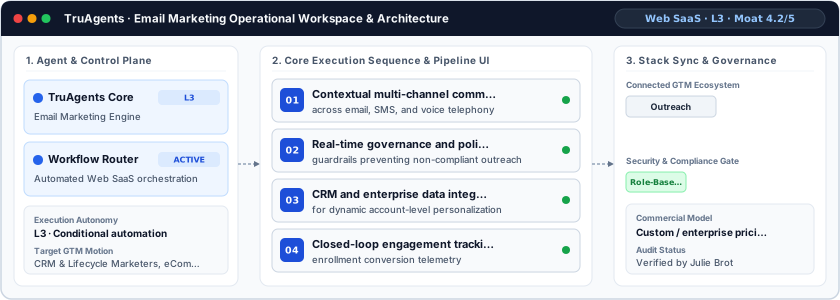
- Contextual multi-channel communication generation: across email, SMS, and voice telephony
- Real-time governance and policy: guardrails preventing non-compliant outreach
- CRM and enterprise data integration: for dynamic account-level personalization
- Closed-loop engagement tracking and: enrollment conversion telemetry
Cons: operational limitations & risks
- Deliverability and Domain Warmup Constraints: Generating unique, un-templated copy variations per recipient degrades reputation monitoring on shared IP pools, requiring meticulous domain warmup cycles.
- CRM Schema Synchronization Latency: High-volume transactional event pipelines can introduce pipeline latency, risking out-of-sequence messaging if customer profile states lag upstream database commits.
- Voice Channel Escalation Bottlenecks: Multi-channel voice telephony handoffs lack deterministic human agent failovers when conversational intent drifts beyond pre-configured guardrail parameters.
TruAgents TCO & deal-breaker stress test
Simulate 12-month stepped TCO, hidden cost multipliers, contract lock-in exposure, and stack failure modes using only facts verified by Julie Brot on · Capture SHA 7fc94af1.
TruAgents triggers high-severity friction under your 5-seat / $800/mo constraints. Benchmark the verified subtrack alternatives below before committing.
| Plan / Tier | Verified Rate | Scale Fit | Scope & Quota Notes |
|---|---|---|---|
| Enterprise / Custom | Custom quote | 15–50+ seats (Enterprise SLA) | Sales-negotiated annual contract for custom volume, SSO/RBAC governance, and dedicated SLA. |
- Moat Score
- 4.2 / 5.0
- AI Autonomy
- L3
- Free Tier / Trial
- None disclosed
Triggered audit signals & failure modes
- Opaque Enterprise Quoting vs. SMB/Mid-Market BudgetVerified Pricing Ledger
TruAgents does not disclose a public self-serve floor (Custom / enterprise pricing). Buyers with a $800/mo cap face high sales-qualification friction.
- Sales-Gated Contract TermsFact-checked by Julie Brot
Commercial pricing is available on request through tailored enterprise sales quotes based on organizational scale and seats.
- Primary Operational Bottleneck: Deliverability and Domain Warmup ConstraintsAudit by Julie Brot
Generating unique, un-templated copy variations per recipient degrades reputation monitoring on shared IP pools, requiring meticulous domain warmup cycles.
Hidden TCO Multipliers & Quota Gates
- Deliverability and Domain Warmup Constraints: Generating unique, un-templated copy variations per recipient degrades reputation monitoring on shared IP pools, requiring meticulous domain warmup cycles.
- CRM Schema Synchronization Latency: High-volume transactional event pipelines can introduce pipeline latency, risking out-of-sequence messaging if customer profile states lag upstream database commits.
When to Walk Away & Negotiation Levers
- Walk away if you require transparent self-serve monthly billing or your budget ceiling is under $1,000/mo (TruAgents requires sales-gated custom quoting).
- Walk away if your workflow cannot tolerate deliverability and domain warmup constraints: Generating unique, un-templated copy variations per recipient degrades reputation monitoring on shared IP pools, requiring meticulous domain warmup cycles.
- Walk away if CRM schema synchronization latency is a deal-breaker for your team: High-volume transactional event pipelines can introduce pipeline latency, risking out-of-sequence messaging if customer profile states lag upstream database commits.
- Demand a 30- to 60-day paid pilot opt-out clause in the TruAgents order form before signing a 12-month enterprise commitment.
- Require a sandbox proof-of-concept testing deliverability and domain warmup constraints against your live CRM/data schema before annual sign-off.
Ask a custom procurement or TCO stress-test question about TruAgents
Lower 5-seat floor (~$100/mo vs. Custom Quote) · Transparent self-serve entry without mandatory annual lock-in
Lower 5-seat floor (~$100/mo vs. Custom Quote) · Transparent self-serve entry without mandatory annual lock-in
TruAgents key entities, modules & ecosystem stack
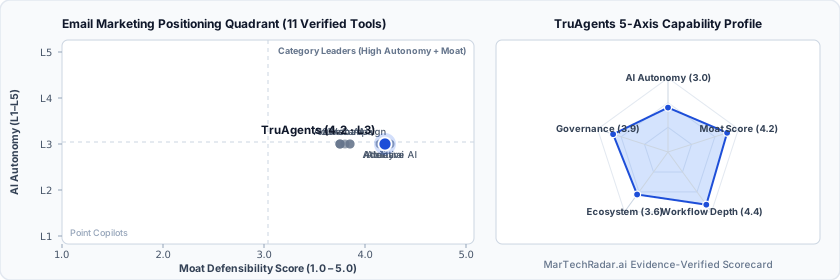
TruAgents moat & subtrack positioning
Proprietary conversation safety guardrails coupled with dynamic multi-channel journey synthesis across voice, email, and SMS, anchored by seed-stage backing.
Editorial review
Fact-checked by Julie Brot (Enterprise SaaS Governance & Procurement Editor) on .
Background
Backing its market entry with $3.4M in venture capital funding, TruAgents was founded in 2024 in New York, NY, to replace static customer outreach with autonomous engagement agents. Target buyers include enterprise lifecycle marketing leaders and customer experience executives in regulated verticals such as insurance and financial services. Rather than relying on traditional deterministic broadcast rules, the platform deploys autonomous agents designed to orchestrate individual customer conversations across disparate operational touchpoints.
How TruAgents works
TruAgents operates by ingesting structured CRM records and real-time event streams into an LLM-driven orchestration framework that synthesizes outbound copy on an individual recipient basis. The pipeline eliminates template merge fields by dynamically constructing customized narratives for email, SMS, and voice channels. Contextual retrieval modules ingest historical interactions and policy constraints, while runtime guardrail layers inspect generated content for compliance and accuracy before triggering transactional messaging APIs.
Limitations
Operational considerations and platform boundaries include:
- Deliverability and Domain Warmup Constraints: Generating unique, un-templated copy variations per recipient degrades reputation monitoring on shared IP pools, requiring meticulous domain warmup cycles.
- CRM Schema Synchronization Latency: High-volume transactional event pipelines can introduce pipeline latency, risking out-of-sequence messaging if customer profile states lag upstream database commits.
- Voice Channel Escalation Bottlenecks: Multi-channel voice telephony handoffs lack deterministic human agent failovers when conversational intent drifts beyond pre-configured guardrail parameters.
TruAgents pricing
Commercial pricing is available on request through tailored enterprise sales quotes based on organizational scale and seats. Contracts reflect bespoke volume commitments covering computational inference allowances, CRM connector entitlements, and outbound channel message consumption. Dedicated deployment support and custom guardrail rule engineering require customized professional services agreements.
How TruAgents compares
Within automated lifecycle orchestration, TruAgents targets multi-channel conversational execution, distinguishing itself from conversion testing tools like AB Tasty and workflow engines like Ability.ai or 10Web AI. While web-centric platforms emphasize front-end experience optimization, TruAgents prioritizes personalized outbound channel engagement. It is best aligned with enterprise marketing and retention teams in high-compliance sectors requiring continuous guardrail validation across complex lifecycle interactions.
Direct competitors & market radar
Top algorithmic competitors based on category positioning, capability overlap, and ICP alignment.
Frequently asked questions about TruAgents
How much does TruAgents cost and does it require a custom enterprise quote?
Published pricing summary for TruAgents: Custom / enterprise pricing. A permanent free plan is not disclosed for TruAgents. Commercial pricing is available on request through tailored enterprise sales quotes based on organizational scale and seats. Contracts reflect bespoke volume commitments covering computational inference allowances, CRM connector entitlements, and outbound channel message consumption.
How does TruAgents work and how autonomous is its AI architecture?
Autonomous customer engagement platform orchestrating personalized multi-channel lifecycle journeys across email, SMS, and voice using context-aware AI. Within Email Marketing (AI Email Marketing & Lifecycle Journeys), MarTechRadar rates its execution architecture at L3 · Conditional automation with a verified Moat Score of 4.2 / 5.0 (Proprietary moat). Proprietary conversation safety guardrails coupled with dynamic multi-channel journey synthesis across voice, email, and SMS, anchored by seed-stage backing. Corporate profile: Founded by Korash Hernandez, Majd Maksad, operating at 2-10 employees scale.
What are the main limitations of TruAgents and when should buyers walk away?
Based on our editorial technical audit, key operational considerations and boundaries for TruAgents include: (1) Deliverability and Domain Warmup Constraints: Generating unique, un-templated copy variations per recipient degrades reputation monitoring on shared IP pools, requiring meticulous domain warmup cycles. (2) CRM Schema Synchronization Latency: High-volume transactional event pipelines can introduce pipeline latency, risking out-of-sequence messaging if customer profile states lag upstream database commits. (3) Voice Channel Escalation Bottlenecks: Multi-channel voice telephony handoffs lack deterministic human agent failovers when conversational intent drifts beyond pre-configured guardrail parameters. Primary procurement walk-away rule: Walk away if you require transparent self-serve monthly billing or your budget ceiling is under $1,000/mo (TruAgents requires sales-gated custom quoting).
What integrations, compliance certifications, and contract terms apply to TruAgents?
Verified ecosystem and stack integrations include Outreach. First-party governance and developer endpoints verified on domain include: Trust/Security (https://trust.truagents.com). Key TCO multiplier to watch: Deliverability and Domain Warmup Constraints (Generating unique, un-templated copy variations per recipient degrades reputation monitoring on shared IP pools, requiring meticulous domain warmup cycles.) Before signing a contract, procurement teams should demand a 30- to 60-day paid pilot opt-out clause in the TruAgents order form before signing a 12-month enterprise commitment.
What are the best TruAgents alternatives and head-to-head competitors in 2026?
Top fact-checked alternatives to TruAgents in Email Marketing (AI Email Marketing & Lifecycle Journeys) include Braze AI (Custom / enterprise pricing), Klaviyo (AI) (Custom / enterprise pricing), Iterable (Custom / enterprise pricing), Customer.io AI (From $100/mo). Within automated lifecycle orchestration, TruAgents targets multi-channel conversational execution, distinguishing itself from conversion testing tools like AB Tasty and workflow engines like Ability.ai or 10Web AI.
Verified sources & evidence trail
- Official product domain: https://truagents.com/
- Commercial pricing verification: Verified against official vendor pricing policy (Custom / enterprise pricing)
- Verified corporate entity profiles (
sameAs): LinkedIn Company Profile · Crunchbase Entity Record - First-party governance & documentation links: Trust & Security · Terms · Privacy
- Editorial audit sign-off: Fact-checked by Julie Brot on under the MarTechRadar Evidence-Ledger Protocol.