Trellis.co Review (2026): DCO Pricing, Pros & Cons
Bottom line
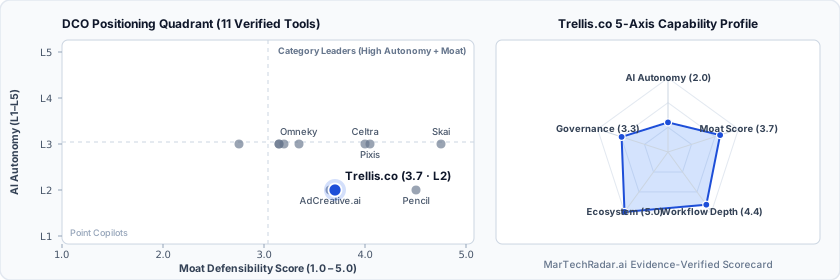
Trellis.co is a Web SaaS tool for DCO (Dynamic Creative Optimization / DCO) in AdTech & Paid Media. Pricing: Custom / enterprise pricing. Best suited to DTC / eCommerce and Enterprise Brands. Editor ratings: AI autonomy L2 (workflow copilot); moat score 3.7/5.0 (Proprietary moat). Fact-checked by MarTechRadar Research Desk on Oct 14, 2026.
E-commerce digital agency and creative orchestration platform powering catalog synchronization, automated campaign generation, and dynamic commerce.
Is Trellis.co worth it in 2026? Buyer fit & when to walk away
Choose Trellis.co if (Best Fit)
- Target ICP & Stack Fit: You operate as DTC / eCommerce and Enterprise Brands requiring a Web SaaS deployment for DCO, with verified ecosystem connectivity for Salesforce, Shopify, Twilio Segment, Google Ads.
- L2 Architecture & Defensibility: Deep implementation capabilities bridging digital commerce platforms like Shopify and BigCommerce with marketplace advertising engines, bolstered by enterprise integration infrastructure under Zaelab.
- Commercial Model Fit: Your procurement budget aligns with Custom / enterprise pricing.
Walk away from Trellis.co if (Deal-Breakers)
- Walk away if you need published self-serve pricing: Trellis.co is sold by custom quote.
- Walk away if your workflow cannot tolerate catalog schema fragility: Dynamic creative rendering depends entirely on clean source metadata; unstandardized parent-child product variations or unexpected null attributes in ERP data feeds frequently break asset generation pipelines.
- Walk away if retail media API rate limits is a deal-breaker for your team: Bulk asset pushes to third-party endpoints, including Amazon and Google Ads, can trigger API throttling during peak shopping events, delaying rapid promotional changes.
Trellis.co pricing, free plan & scorecard at a glance
| Pricing | Custom / enterprise pricing |
|---|---|
| Free plan | No / not disclosed |
| Delivery | Web SaaS |
| Audience | DTC / eCommerce, Enterprise Brands |
| AI autonomy level | L2 · Workflow copilotEditor-verified |
| Moat tier & score | 3.7 / 5.0 · Proprietary moatEditor-verified |
| Funding | AcquiredAcquired by Zaelab |
| Founders | Isaiah Bollinger, Patrick Bean |
| Company size | 11-50 employees |
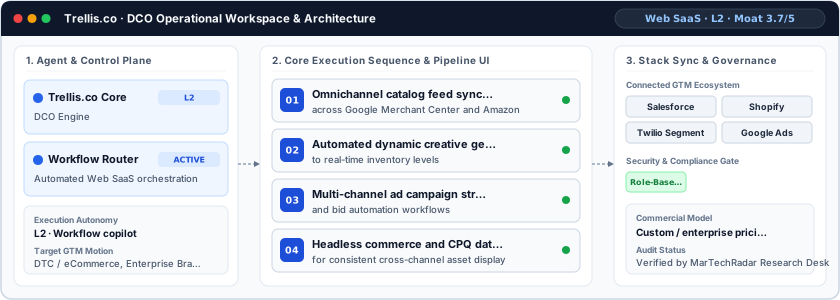
| Ecosystem integrations | Salesforce, Shopify, Twilio Segment, Google Ads, Amazon Ads |
| Governance & docs | Privacy ↗ |
| Headquarters | Westport, Connecticut |
| Founded | 2010 |
| Last verified | Oct 14, 2026 |
Trellis.co pros & cons: strengths vs. operational limitations
Pros: core strengths & capabilities
- Omnichannel catalog feed synchronization: across Google Merchant Center and Amazon
- Automated dynamic creative generation linked: to real-time inventory levels
- Multi-channel ad campaign structuring and bid automation workflows
- Headless commerce and CPQ data mapping: for consistent cross-channel asset display
Cons: operational limitations & risks
- Catalog Schema Fragility: Dynamic creative rendering depends entirely on clean source metadata; unstandardized parent-child product variations or unexpected null attributes in ERP data feeds frequently break asset generation pipelines.
- Retail Media API Rate Limits: Bulk asset pushes to third-party endpoints, including Amazon and Google Ads, can trigger API throttling during peak shopping events, delaying rapid promotional changes.
- Creative Template Constraints: Automated generation relies on rigid structural templates, limiting arbitrary bespoke layouts and requiring front-end developer assistance when building non-standard display formats.
Trellis.co TCO & deal-breaker stress test
Simulate 12-month stepped TCO, hidden cost multipliers, contract lock-in exposure, and stack failure modes using only facts verified by MarTechRadar Research Desk on 2026-10-14.
Trellis.co triggers high-severity friction under your 5-seat / $800/mo constraints. Benchmark the verified subtrack alternatives below before committing.
- Moat Score
- 3.7 / 5.0
- AI Autonomy
- L2
- Free Tier / Trial
- None disclosed
Triggered audit signals & failure modes
- Opaque Enterprise Quoting vs. SMB/Mid-Market BudgetVerified Pricing Ledger
Trellis.co does not disclose a public self-serve floor (Custom / enterprise pricing). Buyers with a $800/mo cap face high sales-qualification friction.
- Sales-Gated Contract TermsFact-checked by MarTechRadar Research Desk
Commercial access is delivered via customized enterprise licensing structures.
- Primary Operational Bottleneck: Catalog Schema FragilityAudit by MarTechRadar Research Desk
Dynamic creative rendering depends entirely on clean source metadata; unstandardized parent-child product variations or unexpected null attributes in ERP data feeds frequently break asset generation pipelines.
Test a custom Trellis.co budget or stack constraint
Lower 5-seat floor (~$14/mo vs. Custom Quote) · Transparent self-serve entry without mandatory annual lock-in
Verified DCO peer (Custom / enterprise pricing · Moat 3.7/5.0)
Trellis.co integrations, API, security & compliance stack
Trellis.co AI moat & DCO positioning
Deep implementation capabilities bridging digital commerce platforms like Shopify and BigCommerce with marketplace advertising engines, bolstered by enterprise integration infrastructure under Zaelab.
Trellis.co in-depth review, pricing & architecture analysis
Editor sign-off: Oct 14, 2026. How profiles are made.
What is Trellis.co? Overview & background
Operating within the digital commerce architecture ecosystem, Trellis.co was established in 2010 in Westport, Connecticut, and was acquired by enterprise digital commerce advisory firm Zaelab. The solution addresses the operational friction encountered by digital merchandisers and performance marketers managing high-velocity product catalogs across fragmented retail media networks and storefronts. As an acquisition within Zaelab's broader customer-to-cash portfolio, Trellis.co targets mid-market and enterprise e-commerce operators seeking to synchronize dynamic promotional content directly with backend inventory and commercial data pipes.
How Trellis.co works: architecture & workflow
At Level 2 autonomy, the platform ingests live product data, pricing tiers, and stock status from core e-commerce platforms such as Shopify, BigCommerce, and custom ERP endpoints. Its dynamic pipeline normalizes disparate catalog feeds and converts structured product attributes into formatted creative variations for ad networks like Google Shopping and Amazon Ads. Algorithmic rules govern creative updates, triggering copy or visual template switches when catalog thresholds fluctuate, which removes manual interventions during stock-outs or localized promotional price revisions, alongside native workflow integrations for Salesforce.
Trellis.co limitations, drawbacks & risks
Operational considerations and platform boundaries include:
- Catalog Schema Fragility: Dynamic creative rendering depends entirely on clean source metadata; unstandardized parent-child product variations or unexpected null attributes in ERP data feeds frequently break asset generation pipelines.
- Retail Media API Rate Limits: Bulk asset pushes to third-party endpoints, including Amazon and Google Ads, can trigger API throttling during peak shopping events, delaying rapid promotional changes.
- Creative Template Constraints: Automated generation relies on rigid structural templates, limiting arbitrary bespoke layouts and requiring front-end developer assistance when building non-standard display formats.
Trellis.co pricing, plans & cost breakdown
Commercial access is delivered via customized enterprise licensing structures. Contracts are determined on request through tailored enterprise sales quotes that vary according to product catalog complexity, total managed SKU volume, integrated storefront instances, and accompanying system implementation services provided by parent entity Zaelab.
| Plan / Tier | Verified Price & Billing | Included Scope & Contract Terms |
|---|---|---|
| Enterprise / Custom | Custom quote | Custom-quoted plan; terms come from the vendor's sales team. |
How Trellis.co compares vs. competitors & alternatives
Within dynamic creative optimization, Trellis.co operates alongside solutions like AdCreative.ai, Abyssale, and 7Pi within the DCO segment. While AdCreative.ai focuses on pre-trained conversion-oriented template generation and Abyssale specializes in automated API-first image and banner generation, Trellis.co emphasizes deeper integration with enterprise commerce backends, catalog feeds, and marketplace merchandising. The solution is best suited for complex retail brands operating multi-channel storefronts that require synchronized dynamic promotional assets tied directly to commercial pricing rules and real-time inventory databases.
Frequently asked questions about Trellis.co
Does Trellis.co publish pricing or require an enterprise quote?
Trellis.co pricing: Custom / enterprise pricing. No free plan is publicly disclosed. Commercial access is delivered via customized enterprise licensing structures.
What are the top Trellis.co alternatives in DCO?
Verified DCO alternatives include Koah Labs (Custom / enterprise pricing), Nextech AR Solutions (Custom / enterprise pricing), Taiv (Custom / enterprise pricing), Vaudit (Formerly BlokID) (Custom / enterprise pricing). Within dynamic creative optimization, Trellis.co operates alongside solutions like AdCreative.ai, Abyssale, and 7Pi within the DCO segment.
What are the main limitations and trade-offs of Trellis.co?
Operational considerations and platform boundaries include: Catalog Schema Fragility: Dynamic creative rendering depends entirely on clean source metadata; unstandardized parent-child product variations or unexpected null attributes in ERP data feeds frequently break asset generation pipelines. Walk away if you need published self-serve pricing: Trellis.co is sold by custom quote.
Verified sources & evidence trail
- Official product domain: https://trellis.co
- Commercial pricing verification: Verified against official vendor pricing policy (Custom / enterprise pricing)
- Verified corporate entity profiles (
sameAs): LinkedIn Company Profile · Crunchbase Entity Record - First-party governance & documentation links: Privacy
- Editor sign-off: Oct 14, 2026 (how profiles are made).
