Tempo Review (2026): DCO Pricing, Pros & Cons
Bottom line
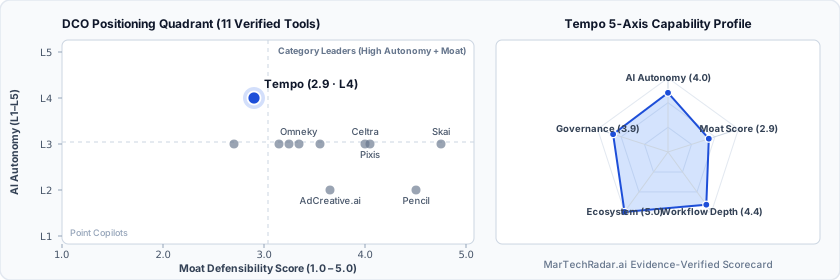
Tempo is a Web SaaS tool for DCO (Dynamic Creative Optimization / DCO) in AdTech & Paid Media. Pricing: $99–$250/seat/mo · Enterprise plan. Editor ratings: AI autonomy L4 (autonomous agent); moat score 2.9/5.0 (Workflow-embedded). Fact-checked by MarTechRadar Research Desk on Oct 26, 2026.
Autonomous agentic ad creative and growth engine for Shopify e-commerce brands that plans, designs, and publishes on-brand Meta ads.
Is Tempo worth it in 2026? Buyer fit & when to walk away
Choose Tempo if (Best Fit)
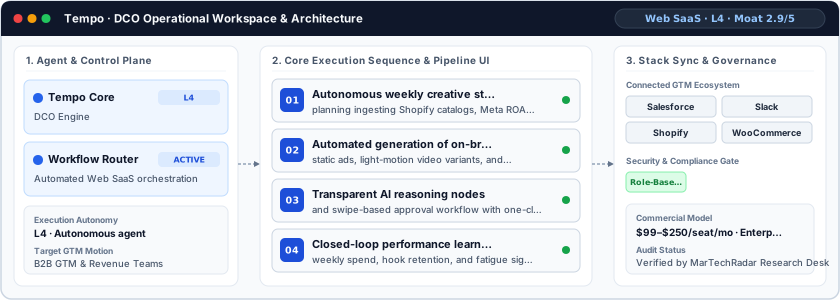
- Target ICP & Stack Fit: You operate as DCO teams requiring a Web SaaS deployment for DCO, with verified ecosystem connectivity for Salesforce, Slack, Shopify, WooCommerce.
- L4 Architecture & Defensibility: Tempo builds a differentiated e-commerce creative automation moat through its closed-loop Learn-Plan-Create-Improve agent architecture, transparent reasoning nodes, and $4.9M Seed backing from Liquid 2 Ventures and Upfront Ventures.
- Commercial Model Fit: Your procurement budget aligns with $99–$250/seat/mo · Enterprise plan and want trial evaluation before contract sign-off.
Walk away from Tempo if (Deal-Breakers)
- Walk away if your workflow requires uncapped enterprise volume on the $99–$250/seat/mo · Enterprise plan entry plan without upgrading tiers.
- Walk away if your workflow cannot tolerate primary operational trade-off: In practical e-commerce deployments, the primary trade-off is that Tempo is currently engineered exclusively for Shopify stores advertising on Meta, meaning merchants running on BigCommerce, Magento, WooCommerce, or Salesforce Commerce Cloud must join a waitlist before onboarding.
- Walk away if functional scope boundary is a deal-breaker for your team: Tempo is not built for long-form YouTube documentary video editing, B2B cold outbound email sequencing, or programmatic CTV media buying.
Tempo pricing, free plan & scorecard at a glance
| Pricing | $99–$250/seat/mo · Enterprise planVendor pricing page |
|---|---|
| Free plan | No / not disclosed |
| Delivery | Web SaaS |
| Audience | — |
| AI autonomy level | L4 · Autonomous agentEditor-verified |
| Moat tier & score | 2.9 / 5.0 · Workflow-embeddedEditor-verified |
| Funding | Seed |
| Total funding | $4.9MBacked by Liquid 2 Ventures, Upfront Ventures, Heirloom Ventures |
| Founders | Colyn Montgomery, Jason Brooks, Joe Devoy |
| Company size | 2-10 employees |
| Ecosystem integrations | Salesforce, Slack, Shopify, WooCommerce, Magento, Meta Ads |
| Headquarters | New York, New York, United States |
| Founded | 2024 |
| Last verified | Oct 26, 2026 |
Tempo pros & cons: strengths vs. operational limitations
Pros: core strengths & capabilities
- Autonomous weekly creative strategy: planning ingesting Shopify catalogs, Meta ROAS telemetry, customer reviews, and competitor angles
- Automated generation of on-brand: static ads, light-motion video variants, and email hero assets powered by Gemini Nano Banana Pro
- Transparent AI reasoning nodes: and swipe-based approval workflow with one-click publishing directly into Meta Ads Manager
- Closed-loop performance learning where: weekly spend, hook retention, and fatigue signals write the next week's creative roadmap
Cons: operational limitations & risks
- Primary Operational Trade-Off: In practical e-commerce deployments, the primary trade-off is that Tempo is currently engineered exclusively for Shopify stores advertising on Meta, meaning merchants running on BigCommerce, Magento, WooCommerce, or Salesforce Commerce Cloud must join a waitlist before onboarding.
- Functional Scope Boundary: Tempo is not built for long-form YouTube documentary video editing, B2B cold outbound email sequencing, or programmatic CTV media buying.
- Deployment & Governance Considerations: Additionally, while Tempo achieves an average 78% ad approval rate via its swipe-based review queue, brands with strict legal compliance rules or highly regulated health claims must still review generated copy hooks and visual nodes before one-click publishing to Meta.
Tempo TCO & deal-breaker stress test
Simulate 12-month stepped TCO, hidden cost multipliers, contract lock-in exposure, and stack failure modes using only facts verified by MarTechRadar Research Desk on 2026-10-26 · Capture SHA 2ea3f888.
Tempo aligns with your 5-seat / $800/mo profile. Review the walk-away triggers and contract levers below before deployment.
- Moat Score
- 2.9 / 5.0
- AI Autonomy
- L4
- Free Tier / Trial
- Free trial
Triggered audit signals & failure modes
- Published Self-Serve Entry FloorVerified Pricing Ledger
Tempo publishes a transparent entry point ($99–$250/seat/mo · Enterprise plan) with a free trial for initial validation before committing.
- Linear Per-Seat Scaling (5 Seats × $99/seat/mo)Commercial Model Audit
Base license scales linearly with operator headcount ($495/mo for 5 seats on Starter).
- Primary Operational Bottleneck: Primary Operational Trade-OffAudit by MarTechRadar Research Desk
In practical e-commerce deployments, the primary trade-off is that Tempo is currently engineered exclusively for Shopify stores advertising on Meta, meaning merchants running on BigCommerce, Magento, WooCommerce, or Salesforce Commerce Cloud must join a waitlist before onboarding.
Test a custom Tempo budget or stack constraint
Lower 5-seat floor (~$14/mo vs. $495 / mo)
Lower 5-seat floor (~$30/mo vs. $495 / mo)
Tempo integrations, API, security & compliance stack
Tempo AI moat & DCO positioning
Tempo builds a differentiated e-commerce creative automation moat through its closed-loop Learn-Plan-Create-Improve agent architecture, transparent reasoning nodes, and $4.9M Seed backing from Liquid 2 Ventures and Upfront Ventures.
Tempo in-depth review, pricing & architecture analysis
Audited by MarTechRadar Research Desk (Evidence-Ledger Verified) on Oct 26, 2026.
What is Tempo? Overview & background
Tempo (operated by Kinn Technologies Inc.) is an autonomous agentic ad creative and growth engine built for DTC performance marketers, Shopify e-commerce founders, and paid social strategists. Founded in 2024 by Colyn Montgomery, Jason Brooks, and Joe Devoy and headquartered in New York, NY, the company operates with a team of 2 to 10 employees, powers more than 300 consumer brands, and has raised $4.9M in Seed funding backed by Liquid 2 Ventures, Upfront Ventures, and Heirloom Ventures. It eliminates manual creative briefs and blank prompt boxes by autonomously planning, designing, and launching on-brand paid social ads, addressing commercial demand for autonomous ad creative software, AI ecommerce ad generator, Shopify Meta ad automation, and Pencil alternatives.
How Tempo works: architecture & workflow
At the technical core of Tempo is a closed-loop four-stage agentic architecture—Learn, Plan, Create, and Improve—that connects directly to a merchant's Shopify product catalog, Meta Ads Manager performance telemetry, customer reviews, and Klaviyo lifecycle data via native API integration pipelines. Rather than generating generic templates, the platform combines multimodal foundation models—including Gemini Nano Banana Pro—with brand voice and historical ROAS context to formulate weekly creative hypotheses across persona angles, hooks, and merchandising offers. Every generated asset exposes a transparent AI reasoning node showing the exact product insight, customer angle, and performance hypothesis behind the design, allowing marketers to inspect or edit nodes in the workflow and push approved ads directly into Meta ad accounts.
Tempo limitations, drawbacks & risks
Operational considerations and platform boundaries include:
- Primary Operational Trade-Off: In practical e-commerce deployments, the primary trade-off is that Tempo is currently engineered exclusively for Shopify stores advertising on Meta, meaning merchants running on BigCommerce, Magento, WooCommerce, or Salesforce Commerce Cloud must join a waitlist before onboarding.
- Functional Scope Boundary: Tempo is not built for long-form YouTube documentary video editing, B2B cold outbound email sequencing, or programmatic CTV media buying.
- Deployment & Governance Considerations: Additionally, while Tempo achieves an average 78% ad approval rate via its swipe-based review queue, brands with strict legal compliance rules or highly regulated health claims must still review generated copy hooks and visual nodes before one-click publishing to Meta.
Tempo pricing, plans & cost breakdown
Tempo publishes transparent subscription tiers on its homepage pricing section (withtempo.ai/#pricing), with every plan backed by a 7-day free trial. The Starter plan costs $99/mo and includes 10 ads generated for review each week, a weekly creative strategy plan, one-click publishing to Meta, 1,000 credits (up to 100 additional self-serve ads), and 2 user seats. The Growth plan costs $250/mo and delivers 30 ads per week—including 10 light-motion video ads per week—alongside 5,000 credits and unlimited seats, while the Scale tier offers custom pricing for 50+ ads per week and dedicated Slack onboarding.
| Plan / Tier | Verified Price & Billing | Target Seat / Scale Fit | Included Scope & Contract Terms |
|---|---|---|---|
| Starter | $99/seat/mo | 1–2 seats | Verified $99/seat/mo Starter tier from vendor pricing schedule. |
| Growth | $250/seat/mo | 5 seats | Verified $250/seat/mo Growth tier from vendor pricing schedule. |
| Enterprise / Custom | Custom quote | 15–50+ seats (Enterprise SLA) | Sales-negotiated annual contract for custom volume, SSO/RBAC governance, and dedicated SLA. |
| Contract Watchout: Per-Seat Linear Scaling | Tempo prices licenses on a per-user/seat basis ($99–$250/seat/mo · Enterprise plan); expanding from 2 to 15+ operators multiplies base recurring spend linearly. | ||
How Tempo compares vs. competitors & alternatives
In the AI ad creative and dynamic creative optimization market, Tempo competes with Pencil, Omneky, AdCreative.ai, and Smartly.io within the Autonomous Ad Creative segment, alongside verified subtrack peers such as Celtra and Madgicx. Compared to prompt-heavy design tools vs. brittle custom n8n workflows that require constant manual asset uploading, Tempo differentiates itself through zero-brief weekly strategy generation and transparent node-level creative editing. Shopify DTC brands should evaluate Tempo vs. traditional creative agencies to 10x weekly ad testing volume and combat Meta creative fatigue.
Frequently asked questions about Tempo
How much does Tempo cost in 2026?
Tempo pricing: $99–$250/seat/mo · Enterprise plan. No permanent free tier is listed; trial evaluation is offered. Published tiers: Starter ($99/seat/mo); Growth ($250/seat/mo); Enterprise / Custom (Custom quote). Tempo publishes transparent subscription tiers on its homepage pricing section (`withtempo.ai/#pricing`), with every plan backed by a 7-day free trial.
What are the top Tempo alternatives in DCO?
Verified DCO alternatives include Pencil (From $14/mo), Zeely ($29.95–$149.95/mo), Clippable (Custom / enterprise pricing), LEAPFROG A.I. (Custom / enterprise pricing). In the AI ad creative and dynamic creative optimization market, Tempo competes with Pencil, Omneky, AdCreative.ai, and Smartly.io within the Autonomous Ad Creative segment, alongside verified subtrack peers such as Celtra and Madgicx.
Verified sources & evidence trail
- Official product domain: https://withtempo.ai
- Commercial pricing verification: https://www.withtempo.ai/#pricing
- Verified corporate entity profiles (
sameAs): LinkedIn Company Profile · Crunchbase Entity Record - Editorial audit sign-off: Audited by MarTechRadar Research Desk (Evidence-Ledger Verified) on Oct 26, 2026.
