tday Review (2026): AI Marketing Agent Pricing, Limits & Alternatives
Bottom line
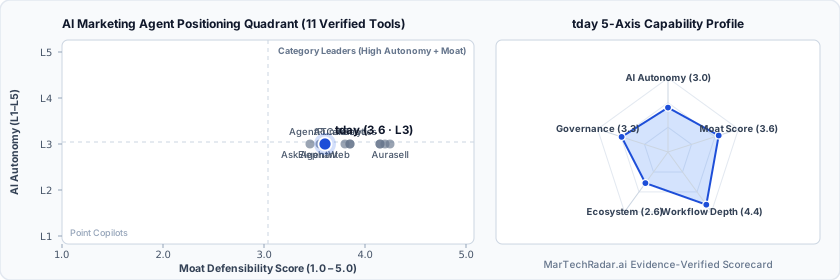
tday is a Web SaaS tool for AI Marketing Agent (Autonomous Marketing Agents & Digital Coworkers) in Agent & Marketing Ops. Pricing: Custom / enterprise pricing. Best suited to GTM Operations Teams, Enterprise Marketing Executives and Automated Ops Teams. Editor ratings: AI autonomy L3 (conditional automation); moat score 3.6/5.0 (Proprietary moat). Fact-checked by Vasilia Xia on Oct 15, 2026.
Autonomous digital marketing coworker coordinating cross-platform campaign planning, multi-step LLM reasoning, and bidirectional martech workflow execution.
tday buyer fit verdict: when to choose vs. when to walk away
Choose tday if (Best Fit)
- Target ICP & Stack Fit: You operate as GTM Operations Teams, Enterprise Marketing Executives and Automated Ops Teams requiring a Web SaaS deployment for AI Marketing Agent.
- L3 Architecture & Defensibility: Proprietary multi-step marketing agent orchestration pipelines and closed-loop execution layers connecting campaign analytics directly to creative and channel optimization.
- Commercial Model Fit: Your procurement budget aligns with Custom / enterprise pricing.
Walk away from tday if (Deal-Breakers)
- Walk away if you require transparent self-serve monthly billing or your budget ceiling is under $1,000/mo (tday requires sales-gated custom quoting).
- Walk away if your workflow cannot tolerate API rate limits and gateway throttling: High-frequency campaign adjustments can trigger API rate limiting across external advertising networks and messaging providers, causing execution lag during aggressive optimization bursts.
- Walk away if schema drift across connected martech is a deal-breaker for your team: Unannounced schema updates or permissions shifts in third-party marketing automation platforms disrupt the agent's deterministic tool-calling chains, requiring administrative re-authentication.
tday key facts & scorecard
| Pricing | Custom / enterprise pricing |
|---|---|
| Free plan | No / not disclosed |
| Delivery | Web SaaS |
| Audience | GTM Operations Teams, Enterprise Marketing Executives, Automated Ops Teams |
| AI autonomy level | L3 · Conditional automationEditor-verified |
| Moat tier & score | 3.6 / 5.0 · Proprietary moatEditor-verified |
| Funding | Pre-seed |
| Headquarters | Australia |
| Founded | 2026 |
| Last verified |
tday pros & cons: strengths vs. operational limitations
Pros: core strengths & capabilities
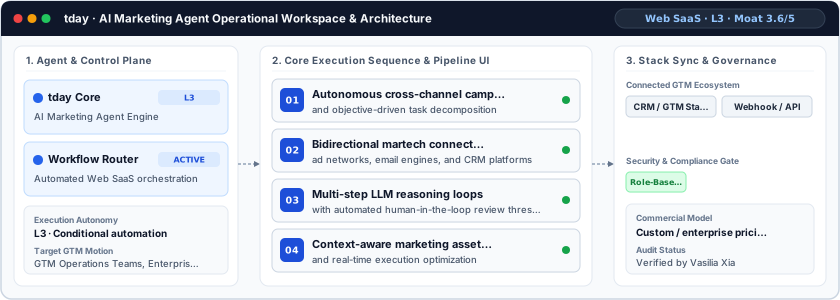
- Autonomous cross-channel campaign planning: and objective-driven task decomposition
- Bidirectional martech connectors synchronizing: ad networks, email engines, and CRM platforms
- Multi-step LLM reasoning loops: with automated human-in-the-loop review thresholds
- Context-aware marketing asset drafting: and real-time execution optimization
Cons: operational limitations & risks
- API Rate Limits and Gateway Throttling: High-frequency campaign adjustments can trigger API rate limiting across external advertising networks and messaging providers, causing execution lag during aggressive optimization bursts.
- Schema Drift Across Connected MarTech: Unannounced schema updates or permissions shifts in third-party marketing automation platforms disrupt the agent's deterministic tool-calling chains, requiring administrative re-authentication.
- Attribution Window Lag: Closed-loop optimization logic faces degradation in long-sales-cycle B2B environments where conversion feedback signals exhibit multi-week reporting latency.
tday TCO & deal-breaker stress test
Simulate 12-month stepped TCO, hidden cost multipliers, contract lock-in exposure, and stack failure modes using only facts verified by Vasilia Xia on .
tday triggers high-severity friction under your 5-seat / $800/mo constraints. Benchmark the verified subtrack alternatives below before committing.
| Plan / Tier | Verified Rate | Scale Fit | Scope & Quota Notes |
|---|---|---|---|
| Enterprise / Custom | Custom quote | 15–50+ seats (Enterprise SLA) | Sales-negotiated annual contract for custom volume, SSO/RBAC governance, and dedicated SLA. |
- Moat Score
- 3.6 / 5.0
- AI Autonomy
- L3
- Free Tier / Trial
- None disclosed
Triggered audit signals & failure modes
- Opaque Enterprise Quoting vs. SMB/Mid-Market BudgetVerified Pricing Ledger
tday does not disclose a public self-serve floor (Custom / enterprise pricing). Buyers with a $800/mo cap face high sales-qualification friction.
- Sales-Gated Contract TermsFact-checked by Vasilia Xia
Commercial access to tday is provisioned through custom enterprise pricing available on request via sales engagements. Commercial agreements are structured around organizational scale, volume of connected channels, and active digital coworker seats rather than fixed public tiers.
- Primary Operational Bottleneck: API Rate Limits and Gateway ThrottlingAudit by Vasilia Xia
High-frequency campaign adjustments can trigger API rate limiting across external advertising networks and messaging providers, causing execution lag during aggressive optimization bursts.
Hidden TCO Multipliers & Quota Gates
- API Rate Limits and Gateway Throttling: High-frequency campaign adjustments can trigger API rate limiting across external advertising networks and messaging providers, causing execution lag during aggressive optimization bursts.
- Schema Drift Across Connected MarTech: Unannounced schema updates or permissions shifts in third-party marketing automation platforms disrupt the agent's deterministic tool-calling chains, requiring administrative re-authentication.
When to Walk Away & Negotiation Levers
- Walk away if you require transparent self-serve monthly billing or your budget ceiling is under $1,000/mo (tday requires sales-gated custom quoting).
- Walk away if your workflow cannot tolerate API rate limits and gateway throttling: High-frequency campaign adjustments can trigger API rate limiting across external advertising networks and messaging providers, causing execution lag during aggressive optimization bursts.
- Walk away if schema drift across connected martech is a deal-breaker for your team: Unannounced schema updates or permissions shifts in third-party marketing automation platforms disrupt the agent's deterministic tool-calling chains, requiring administrative re-authentication.
- Demand a 30- to 60-day paid pilot opt-out clause in the tday order form before signing a 12-month enterprise commitment.
- Require a sandbox proof-of-concept testing API rate limits and gateway throttling against your live CRM/data schema before annual sign-off.
Ask a custom procurement or TCO stress-test question about tday
Lower 5-seat floor (~$100/mo vs. Custom Quote) · Transparent self-serve entry without mandatory annual lock-in
Lower 5-seat floor (~$495/mo vs. Custom Quote) · Transparent self-serve entry without mandatory annual lock-in
tday moat & subtrack positioning
Proprietary multi-step marketing agent orchestration pipelines and closed-loop execution layers connecting campaign analytics directly to creative and channel optimization.
Editorial review
Fact-checked by Vasilia Xia (E-Commerce, Lifecycle & Retention Marketing Analyst) on .
Background
Australia-based tday develops autonomous marketing software designed to tackle execution friction within high-velocity commercial growth pipelines. Built for digital marketing directors and marketing operations teams, the system deploys digital coworkers that translate macro growth strategies into concrete cross-channel execution. Instead of requiring human operators to manually configure multi-variant campaigns, export cohort lists, and synchronize disjointed tools, tday centralizes campaign orchestration directly across commercial touchpoints. Within the digital coworker ecosystem, the platform provides dedicated agentic intelligence to automate repetitive growth operations without human micromanagement.
How tday works
At its technical core, the platform operates as a Level 3 autonomous system driven by structured multi-step LLM reasoning and dynamic task planning. The platform ingests telemetry from ad networks, marketing automation systems, and customer databases through bidirectional API connectors. Incoming campaign briefs are parsed by an agentic planning module that decomposes high-level goals into granular, sequential operations like audience segmentation, creative drafting, and channel deployment. State management and contextual memory ensure that agent execution loops continuously monitor live campaign metrics, adjusting operational parameters or surfacing exceptions for human intervention when variance exceeds predefined safety boundaries.
Limitations
Operational considerations and platform boundaries include:
- API Rate Limits and Gateway Throttling: High-frequency campaign adjustments can trigger API rate limiting across external advertising networks and messaging providers, causing execution lag during aggressive optimization bursts.
- Schema Drift Across Connected MarTech: Unannounced schema updates or permissions shifts in third-party marketing automation platforms disrupt the agent's deterministic tool-calling chains, requiring administrative re-authentication.
- Attribution Window Lag: Closed-loop optimization logic faces degradation in long-sales-cycle B2B environments where conversion feedback signals exhibit multi-week reporting latency.
tday pricing
Commercial access to tday is provisioned through custom enterprise pricing available on request via sales engagements. Commercial agreements are structured around organizational scale, volume of connected channels, and active digital coworker seats rather than fixed public tiers. Standard enterprise agreements incorporate dedicated support tiers, custom integrations, security governance reviews, and implementation services tailored to specific data privacy and deployment requirements.
How tday compares
Within the autonomous marketing coworker category, tday competes against emerging agentic platforms like ai-marketing-claude, allGood, and AskElephant. While ai-marketing-claude leans on broad conversational reasoning and allGood prioritizes workflow scaffolding, tday focuses heavily on closed-loop execution and persistent martech tool orchestration. AskElephant centers primarily on data extraction and sales-marketing handoffs, whereas tday addresses full-funnel digital campaign execution. The architecture is best suited for mid-market to enterprise marketing operations teams seeking to offload programmatic execution without custom-coding internal agent pipelines.
Frequently asked questions about tday
How much does tday cost and does it require a custom enterprise quote?
Published pricing summary for tday: Custom / enterprise pricing. A permanent free plan is not disclosed for tday. Commercial access to tday is provisioned through custom enterprise pricing available on request via sales engagements. Commercial agreements are structured around organizational scale, volume of connected channels, and active digital coworker seats rather than fixed public tiers.
How does tday work and how autonomous is its AI architecture?
Autonomous digital marketing coworker coordinating cross-platform campaign planning, multi-step LLM reasoning, and bidirectional martech workflow execution. Within AI Marketing Agent (Autonomous Marketing Agents & Digital Coworkers), MarTechRadar rates its execution architecture at L3 · Conditional automation with a verified Moat Score of 3.6 / 5.0 (Proprietary moat). Proprietary multi-step marketing agent orchestration pipelines and closed-loop execution layers connecting campaign analytics directly to creative and channel optimization.
What are the main limitations of tday and when should buyers walk away?
Based on our editorial technical audit, key operational considerations and boundaries for tday include: (1) API Rate Limits and Gateway Throttling: High-frequency campaign adjustments can trigger API rate limiting across external advertising networks and messaging providers, causing execution lag during aggressive optimization bursts. (2) Schema Drift Across Connected MarTech: Unannounced schema updates or permissions shifts in third-party marketing automation platforms disrupt the agent's deterministic tool-calling chains, requiring administrative re-authentication. (3) Attribution Window Lag: Closed-loop optimization logic faces degradation in long-sales-cycle B2B environments where conversion feedback signals exhibit multi-week reporting latency. Primary procurement walk-away rule: Walk away if you require transparent self-serve monthly billing or your budget ceiling is under $1,000/mo (tday requires sales-gated custom quoting).
What integrations, compliance certifications, and contract terms apply to tday?
Key TCO multiplier to watch: API Rate Limits and Gateway Throttling (High-frequency campaign adjustments can trigger API rate limiting across external advertising networks and messaging providers, causing execution lag during aggressive optimization bursts.) Before signing a contract, procurement teams should demand a 30- to 60-day paid pilot opt-out clause in the tday order form before signing a 12-month enterprise commitment.
What are the best tday alternatives and head-to-head competitors in 2026?
Top fact-checked alternatives to tday in AI Marketing Agent (Autonomous Marketing Agents & Digital Coworkers) include Retape (Custom / enterprise pricing), Microsoft Copilot Studio (Custom / enterprise pricing), Rubick.ai (Custom / enterprise pricing), Wordware (Custom / enterprise pricing). Within the autonomous marketing coworker category, tday competes against emerging agentic platforms like ai-marketing-claude, allGood, and AskElephant.
Verified sources & evidence trail
- Official product domain: https://tday.com/
- Commercial pricing verification: Verified against official vendor pricing policy (Custom / enterprise pricing)
- Editorial audit sign-off: Fact-checked by Vasilia Xia on under the MarTechRadar Evidence-Ledger Protocol.