Remix Review (2026): Social Media Scheduling Pricing, Limits & Alternatives
Bottom line
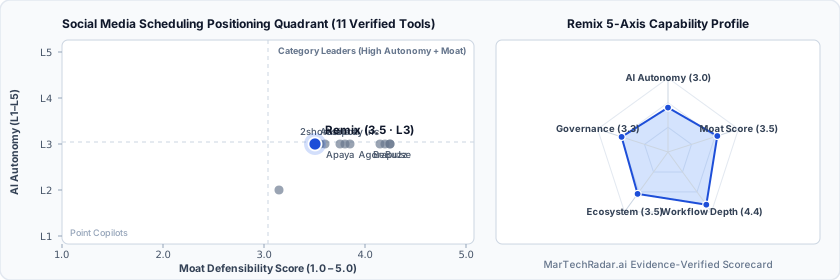
Remix is a Web SaaS tool for Social Media Scheduling (Social Media Scheduling & Auto-Publishing) in Social & Influencer. Pricing: Pricing not disclosed. Best suited to B2B SaaS and Marketing & Growth Teams. Editor ratings: AI autonomy L3 (conditional automation); moat score 3.5/5.0 (Proprietary moat). Fact-checked by Tim Fenolz on Oct 16, 2026.
Parallel multi-agent social content and AI UGC studio that turns existing brand photos, voice notes, and viral trends into ready-to-run videos and posts.
Remix buyer fit verdict: when to choose vs. when to walk away
Choose Remix if (Best Fit)
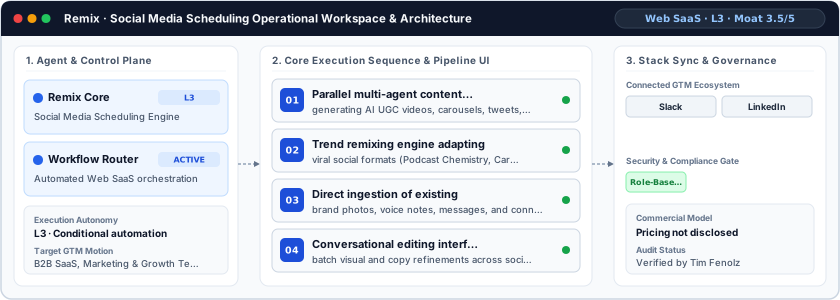
- Target ICP & Stack Fit: You operate as B2B SaaS and Marketing & Growth Teams requiring a Web SaaS deployment for Social Media Scheduling, with verified ecosystem connectivity for Slack, LinkedIn.
- L3 Architecture & Defensibility: Orchestrating hundreds of parallel AI agents to transform first-party photos, voice notes, and trending social formats into on-brand UGC videos and carousels compresses daily social production.
- Commercial Model Fit: Your procurement budget aligns with Pricing not disclosed.
Walk away from Remix if (Deal-Breakers)
- Walk away if you require transparent self-serve monthly billing or your budget ceiling is under $1,000/mo (Remix requires sales-gated custom quoting).
- Walk away if your workflow cannot tolerate synthetic ugc uncanny valley boundary: While AI-remixed UGC formats accelerate top-of-funnel creative testing, synthetic human expressions and lip-sync rendering can still exhibit subtle visual artifacts or hallucination friction under close viewer scrutiny.
- Walk away if trend format saturation risk is a deal-breaker for your team: Relying heavily on pre-packaged viral video templates introduces creative fatigue and algorithmic sameness if multiple brands in the same vertical remix identical trending hooks simultaneously.
Remix key facts & scorecard
| Pricing | Pricing not disclosed |
|---|---|
| Free plan | No / not disclosed |
| Delivery | Web SaaS |
| Audience | B2B SaaS, Marketing & Growth Teams |
| AI autonomy level | L3 · Conditional automationEditor-verified |
| Moat tier & score | 3.5 / 5.0 · Proprietary moatEditor-verified |
| Funding | Seed |
| Ecosystem integrations | Slack, LinkedIn |
| Governance & docs | Terms ↗ · Privacy ↗ |
| Headquarters | San Francisco, CA |
| Founded | 2025 |
| Last verified |
Remix pros & cons: strengths vs. operational limitations
Pros: core strengths & capabilities
- Parallel multi-agent content studio: generating AI UGC videos, carousels, tweets, and articles simultaneously
- Trend remixing engine adapting: viral social formats (Podcast Chemistry, Car UGC, Marketer Interviews) to any brand
- Direct ingestion of existing: brand photos, voice notes, messages, and connected LinkedIn or X history
- Conversational editing interface applying: batch visual and copy refinements across social deliverables
Cons: operational limitations & risks
- Synthetic UGC Uncanny Valley Boundary: While AI-remixed UGC formats accelerate top-of-funnel creative testing, synthetic human expressions and lip-sync rendering can still exhibit subtle visual artifacts or hallucination friction under close viewer scrutiny.
- Trend Format Saturation Risk: Relying heavily on pre-packaged viral video templates introduces creative fatigue and algorithmic sameness if multiple brands in the same vertical remix identical trending hooks simultaneously.
- Enterprise Brand Governance Barrier: Regulated consumer brands with strict legal review gates struggle with autonomous parallel agent publishing, facing an approval workflow bottleneck and compliance learning curve.
Remix TCO & deal-breaker stress test
Simulate 12-month stepped TCO, hidden cost multipliers, contract lock-in exposure, and stack failure modes using only facts verified by Tim Fenolz on · Capture SHA f49d70dc.
Remix triggers high-severity friction under your 5-seat / $800/mo constraints. Benchmark the verified subtrack alternatives below before committing.
| Plan / Tier | Verified Rate | Scale Fit | Scope & Quota Notes |
|---|---|---|---|
| Enterprise / Custom | Custom quote | 15–50+ seats (Enterprise SLA) | Sales-negotiated annual contract for custom volume, SSO/RBAC governance, and dedicated SLA. |
- Moat Score
- 3.5 / 5.0
- AI Autonomy
- L3
- Free Tier / Trial
- None disclosed
Triggered audit signals & failure modes
- Opaque Enterprise Quoting vs. SMB/Mid-Market BudgetVerified Pricing Ledger
Remix does not disclose a public self-serve floor (Pricing not disclosed). Buyers with a $800/mo cap face high sales-qualification friction.
- Sales-Gated Contract TermsFact-checked by Tim Fenolz
Pricing is available on request through enterprise sales quotes, with customized tiers based on seat counts or usage volume.
- Primary Operational Bottleneck: Synthetic UGC Uncanny Valley BoundaryAudit by Tim Fenolz
While AI-remixed UGC formats accelerate top-of-funnel creative testing, synthetic human expressions and lip-sync rendering can still exhibit subtle visual artifacts or hallucination friction under close viewer scrutiny.
Hidden TCO Multipliers & Quota Gates
- Credit & Usage Burn Multiplier: Automated workflows consume metered credits/usage quotas; multi-step enrichment, voice minutes, or high-frequency agent runs can trigger mid-cycle top-up packs.
- Synthetic UGC Uncanny Valley Boundary: While AI-remixed UGC formats accelerate top-of-funnel creative testing, synthetic human expressions and lip-sync rendering can still exhibit subtle visual artifacts or hallucination friction under close viewer scrutiny.
- Trend Format Saturation Risk: Relying heavily on pre-packaged viral video templates introduces creative fatigue and algorithmic sameness if multiple brands in the same vertical remix identical trending hooks simultaneously.
When to Walk Away & Negotiation Levers
- Walk away if you require transparent self-serve monthly billing or your budget ceiling is under $1,000/mo (Remix requires sales-gated custom quoting).
- Walk away if your workflow cannot tolerate synthetic ugc uncanny valley boundary: While AI-remixed UGC formats accelerate top-of-funnel creative testing, synthetic human expressions and lip-sync rendering can still exhibit subtle visual artifacts or hallucination friction under close viewer scrutiny.
- Walk away if trend format saturation risk is a deal-breaker for your team: Relying heavily on pre-packaged viral video templates introduces creative fatigue and algorithmic sameness if multiple brands in the same vertical remix identical trending hooks simultaneously.
- Demand a 30- to 60-day paid pilot opt-out clause in the Remix order form before signing a 12-month enterprise commitment.
- Require a sandbox proof-of-concept testing synthetic ugc uncanny valley boundary against your live CRM/data schema before annual sign-off.
Ask a custom procurement or TCO stress-test question about Remix
Lower 5-seat floor (~$395/mo vs. Custom Quote) · Transparent self-serve entry without mandatory annual lock-in
Lower 5-seat floor (~$10/mo vs. Custom Quote) · Transparent self-serve entry without mandatory annual lock-in
Remix key entities, modules & ecosystem stack
Remix moat & subtrack positioning
Orchestrating hundreds of parallel AI agents to transform first-party photos, voice notes, and trending social formats into on-brand UGC videos and carousels compresses daily social production.
Editorial review
Fact-checked by Tim Fenolz (Lead AdTech, Programmatic & Attribution Analyst) on .
Background
Built by founder Sam Kaplan and headquartered in San Francisco, CA, Remix (remix.re, formerly Resonate) is an AI-native social content and UGC video creation studio designed for growth marketers, consumer app teams, and founder-led brands. Operating with a lean engineering team of 1 to 10 employees and backed by institutional accelerator investor Y Combinator (W26), the company eliminates the blank-canvas bottleneck of daily social media marketing by automatically generating ready-to-publish videos and posts from a brand's existing assets and live social trends.
How Remix works
Remix operates at Level 3 autonomy by deploying hundreds of parallel AI agents across a multimodal ingestion, style-cloning, and video synthesis pipeline. Users connect their existing LinkedIn or X/Twitter accounts or drop raw product photos, voice notes, and Slack messages into Remix Studio. The platform's agent swarm simultaneously selects the strongest visual assets, extracts the user's authentic writing cadence, and adapts trending short-form formats—such as Podcast Chemistry, UGC in Motion, Car UGC, and Marketer Interviews—into finished short-form videos, image carousels, and written threads that can be refined through a single chat interface.
Limitations
Operational limitations and technical trade-offs include:
- Synthetic UGC Uncanny Valley Boundary: While AI-remixed UGC formats accelerate top-of-funnel creative testing, synthetic human expressions and lip-sync rendering can still exhibit subtle visual artifacts or hallucination friction under close viewer scrutiny.
- Trend Format Saturation Risk: Relying heavily on pre-packaged viral video templates introduces creative fatigue and algorithmic sameness if multiple brands in the same vertical remix identical trending hooks simultaneously.
- Enterprise Brand Governance Barrier: Regulated consumer brands with strict legal review gates struggle with autonomous parallel agent publishing, facing an approval workflow bottleneck and compliance learning curve.
Remix pricing
Pricing is available on request through enterprise sales quotes, with customized tiers based on seat counts or usage volume. Creators and marketing teams can launch Remix Studio directly via the web or mobile app to test initial content generation and evaluate workspace credit plans.
How Remix compares
Within the Social Media Scheduling & Auto-Publishing category, Remix competes against AI social and UGC generation alternatives such as VibeFlow, Holo AI, and Arcads. Versus text-focused LinkedIn schedulers like Taplio or single-avatar ad generators like Arcads, Remix differentiates itself by combining first-party account data ingestion with a multi-agent studio that remixes viral video trends and multi-format social posts in parallel. High-cadence consumer and founder brands choose Remix for rapid trend execution.
Frequently asked questions about Remix
How much does Remix cost and does it require a custom enterprise quote?
Published pricing summary for Remix: Pricing not disclosed. A permanent free plan is not disclosed for Remix. Pricing is available on request through enterprise sales quotes, with customized tiers based on seat counts or usage volume. Creators and marketing teams can launch Remix Studio directly via the web or mobile app to test initial content generation and evaluate workspace credit plans.
How does Remix work and how autonomous is its AI architecture?
Parallel multi-agent social content and AI UGC studio that turns existing brand photos, voice notes, and viral trends into ready-to-run videos and posts. Within Social Media Scheduling (Social Media Scheduling & Auto-Publishing), MarTechRadar rates its execution architecture at L3 · Conditional automation with a verified Moat Score of 3.5 / 5.0 (Proprietary moat). Orchestrating hundreds of parallel AI agents to transform first-party photos, voice notes, and trending social formats into on-brand UGC videos and carousels compresses daily social production.
What are the main limitations of Remix and when should buyers walk away?
Based on our editorial technical audit, key operational considerations and boundaries for Remix include: (1) Synthetic UGC Uncanny Valley Boundary: While AI-remixed UGC formats accelerate top-of-funnel creative testing, synthetic human expressions and lip-sync rendering can still exhibit subtle visual artifacts or hallucination friction under close viewer scrutiny. (2) Trend Format Saturation Risk: Relying heavily on pre-packaged viral video templates introduces creative fatigue and algorithmic sameness if multiple brands in the same vertical remix identical trending hooks simultaneously. (3) Enterprise Brand Governance Barrier: Regulated consumer brands with strict legal review gates struggle with autonomous parallel agent publishing, facing an approval workflow bottleneck and compliance learning curve. Primary procurement walk-away rule: Walk away if you require transparent self-serve monthly billing or your budget ceiling is under $1,000/mo (Remix requires sales-gated custom quoting).
What integrations, compliance certifications, and contract terms apply to Remix?
Verified ecosystem and stack integrations include Slack, LinkedIn. Key TCO multiplier to watch: Credit & Usage Burn Multiplier (Automated workflows consume metered credits/usage quotas; multi-step enrichment, voice minutes, or high-frequency agent runs can trigger mid-cycle top-up packs.) Before signing a contract, procurement teams should demand a 30- to 60-day paid pilot opt-out clause in the Remix order form before signing a 12-month enterprise commitment.
What are the best Remix alternatives and head-to-head competitors in 2026?
Top fact-checked alternatives to Remix in Social Media Scheduling (Social Media Scheduling & Auto-Publishing) include VibeFlow (Pricing not disclosed), Taplio (Custom / enterprise pricing), QuickVid (Custom / enterprise pricing), Arcads (Custom / enterprise pricing). Within the Social Media Scheduling & Auto-Publishing category, Remix competes against AI social and UGC generation alternatives such as VibeFlow, Holo AI, and Arcads.
Verified sources & evidence trail
- Official product domain: https://remix.re
- Commercial pricing verification: Verified against official vendor pricing policy (Pricing not disclosed)
- First-party governance & documentation links: Terms · Privacy
- Editorial audit sign-off: Fact-checked by Tim Fenolz on under the MarTechRadar Evidence-Ledger Protocol.