RAD Intel Review (2026): Social Media Scheduling Pricing, Limits & Alternatives
Bottom line
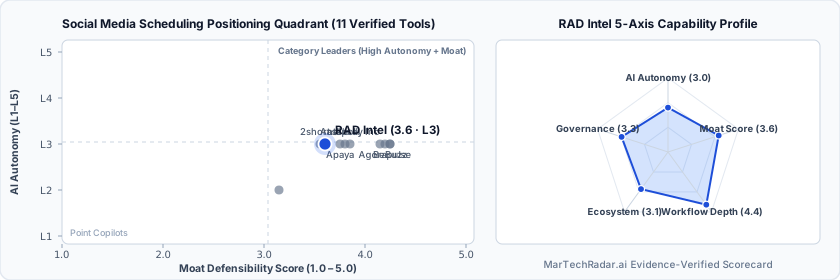
RAD Intel is a Web SaaS tool for Social Media Scheduling (Social Media Scheduling & Auto-Publishing) in Social & Influencer. Pricing: Custom / enterprise pricing. Best suited to Social Media Managers, Creator & Influencer Agencies and Brand Community Ops. Editor ratings: AI autonomy L3 (conditional automation); moat score 3.6/5.0 (Proprietary moat). Fact-checked by Sarah Per on Oct 14, 2026.
AI-powered social intelligence and automated publishing platform aligning predictive audience discovery with multi-channel distribution workflows.
RAD Intel buyer fit verdict: when to choose vs. when to walk away
Choose RAD Intel if (Best Fit)
- Target ICP & Stack Fit: You operate as Social Media Managers, Creator & Influencer Agencies and Brand Community Ops requiring a Web SaaS deployment for Social Media Scheduling.
- L3 Architecture & Defensibility: Proprietary predictive audience intelligence combined with keyword clustering models that optimize organic post distribution and influencer alignment across social channels.
- Commercial Model Fit: Your procurement budget aligns with Custom / enterprise pricing.
Walk away from RAD Intel if (Deal-Breakers)
- Walk away if you require transparent self-serve monthly billing or your budget ceiling is under $1,000/mo (RAD Intel requires sales-gated custom quoting).
- Walk away if your workflow cannot tolerate API rate limits and token depreciation: Automated cross-posting and analytics ingestion remain constrained by third-party developer rate limits and unexpected token invalidations imposed by platform partners.
- Walk away if algorithmic drift in topic discovery is a deal-breaker for your team: Keyword clustering models can misidentify niche contextual sarcasm or sudden shifts in vernacular, requiring periodic manual audit of audience groupings.
RAD Intel key facts & scorecard
| Pricing | Custom / enterprise pricing |
|---|---|
| Free plan | No / not disclosed |
| Delivery | Web SaaS |
| Audience | Social Media Managers, Creator & Influencer Agencies, Brand Community Ops |
| AI autonomy level | L3 · Conditional automationEditor-verified |
| Moat tier & score | 3.6 / 5.0 · Proprietary moatEditor-verified |
| Funding | Series A |
| Company size | 11-50 employees |
| Governance & docs | Terms ↗ · Privacy ↗ |
| Headquarters | Venice, California |
| Founded | 2018 |
| Last verified |
RAD Intel pros & cons: strengths vs. operational limitations
Pros: core strengths & capabilities
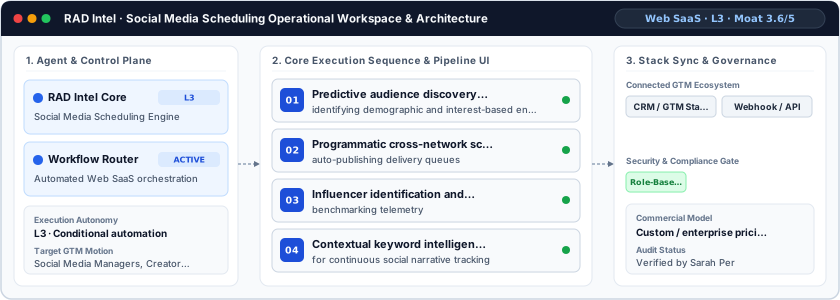
- Predictive audience discovery engine: identifying demographic and interest-based engagement clusters
- Programmatic cross-network scheduling and: auto-publishing delivery queues
- Influencer identification and performance: benchmarking telemetry
- Contextual keyword intelligence module: for continuous social narrative tracking
Cons: operational limitations & risks
- API Rate Limits and Token Depreciation: Automated cross-posting and analytics ingestion remain constrained by third-party developer rate limits and unexpected token invalidations imposed by platform partners.
- Algorithmic Drift in Topic Discovery: Keyword clustering models can misidentify niche contextual sarcasm or sudden shifts in vernacular, requiring periodic manual audit of audience groupings.
- Metadata Translation Failures: Cross-platform video and asset aspect ratios occasionally fail to map correctly when pushing singular creative assets to divergent network publishing schemas.
RAD Intel TCO & deal-breaker stress test
Simulate 12-month stepped TCO, hidden cost multipliers, contract lock-in exposure, and stack failure modes using only facts verified by Sarah Per on · Capture SHA 3e603b91.
RAD Intel triggers high-severity friction under your 5-seat / $800/mo constraints. Benchmark the verified subtrack alternatives below before committing.
| Plan / Tier | Verified Rate | Scale Fit | Scope & Quota Notes |
|---|---|---|---|
| Enterprise / Custom | Custom quote | 15–50+ seats (Enterprise SLA) | Sales-negotiated annual contract for custom volume, SSO/RBAC governance, and dedicated SLA. |
- Moat Score
- 3.6 / 5.0
- AI Autonomy
- L3
- Free Tier / Trial
- None disclosed
Triggered audit signals & failure modes
- Opaque Enterprise Quoting vs. SMB/Mid-Market BudgetVerified Pricing Ledger
RAD Intel does not disclose a public self-serve floor (Custom / enterprise pricing). Buyers with a $800/mo cap face high sales-qualification friction.
- Sales-Gated Contract TermsFact-checked by Sarah Per
RAD Intel provisions software access through tailored enterprise sales quotes based on organizational scale, social account volume, and seat requirements.
- Primary Operational Bottleneck: API Rate Limits and Token DepreciationAudit by Sarah Per
Automated cross-posting and analytics ingestion remain constrained by third-party developer rate limits and unexpected token invalidations imposed by platform partners.
Hidden TCO Multipliers & Quota Gates
- Credit & Usage Burn Multiplier: Automated workflows consume metered credits/usage quotas; multi-step enrichment, voice minutes, or high-frequency agent runs can trigger mid-cycle top-up packs.
- API Rate Limits and Token Depreciation: Automated cross-posting and analytics ingestion remain constrained by third-party developer rate limits and unexpected token invalidations imposed by platform partners.
- Algorithmic Drift in Topic Discovery: Keyword clustering models can misidentify niche contextual sarcasm or sudden shifts in vernacular, requiring periodic manual audit of audience groupings.
When to Walk Away & Negotiation Levers
- Walk away if you require transparent self-serve monthly billing or your budget ceiling is under $1,000/mo (RAD Intel requires sales-gated custom quoting).
- Walk away if your workflow cannot tolerate API rate limits and token depreciation: Automated cross-posting and analytics ingestion remain constrained by third-party developer rate limits and unexpected token invalidations imposed by platform partners.
- Walk away if algorithmic drift in topic discovery is a deal-breaker for your team: Keyword clustering models can misidentify niche contextual sarcasm or sudden shifts in vernacular, requiring periodic manual audit of audience groupings.
- Demand a 30- to 60-day paid pilot opt-out clause in the RAD Intel order form before signing a 12-month enterprise commitment.
- Require a sandbox proof-of-concept testing API rate limits and token depreciation against your live CRM/data schema before annual sign-off.
Ask a custom procurement or TCO stress-test question about RAD Intel
Lower 5-seat floor (~$395/mo vs. Custom Quote) · Transparent self-serve entry without mandatory annual lock-in
Lower 5-seat floor (~$10/mo vs. Custom Quote) · Transparent self-serve entry without mandatory annual lock-in
RAD Intel moat & subtrack positioning
Proprietary predictive audience intelligence combined with keyword clustering models that optimize organic post distribution and influencer alignment across social channels.
Editorial review
Fact-checked by Sarah Per (Principal Content Systems & Generative Media Editor) on .
Background
To capture organic reach across fragmented digital networks, corporate growth teams must bridge data intelligence with disciplined content distribution. Established in 2018 in Venice, California, RAD Intel develops software that unites audience intelligence with automated distribution mechanics. Engineered specifically for enterprise social strategists, communications teams, and performance marketers, the platform addresses the labor-intensive handoffs between market research and cross-platform publishing execution. Operating within the social media scheduling and auto-publishing domain, the system serves as a centralized hub for data-informed audience targeting and scheduled deployment.
How RAD Intel works
At its technical core, the platform operates an automated workflow pipeline that aligns audience discovery algorithms with programmatic delivery endpoints. The system ingests public engagement signals, social metrics, and conversational metadata via direct network APIs, applying keyword clustering algorithms to detect emerging topics. These signals populate targeted content calendars where marketing teams stage, configure, and automate multi-channel publishing sequences. Operating at Level 3 conditional autonomy, the engine automatically formats metadata and triggers asset distribution across target profiles based on operational parameters, while alerting operators when engagement anomalies or connection interruptions require human review.
Limitations
Operational considerations and platform boundaries include:
- API Rate Limits and Token Depreciation: Automated cross-posting and analytics ingestion remain constrained by third-party developer rate limits and unexpected token invalidations imposed by platform partners.
- Algorithmic Drift in Topic Discovery: Keyword clustering models can misidentify niche contextual sarcasm or sudden shifts in vernacular, requiring periodic manual audit of audience groupings.
- Metadata Translation Failures: Cross-platform video and asset aspect ratios occasionally fail to map correctly when pushing singular creative assets to divergent network publishing schemas.
RAD Intel pricing
RAD Intel provisions software access through tailored enterprise sales quotes based on organizational scale, social account volume, and seat requirements. Potential customers must contact the sales engineering team directly to map operational requirements into customized annual contracts. The licensing tier covers data ingestion thresholds, multi-brand account management, and enterprise support service-level agreements without publicly published entry-level subscriptions.
How RAD Intel compares
Within the social publishing landscape, RAD Intel differentiates through its emphasis on upfront audience discovery alongside distribution pipelines. Conventional platforms like Agorapulse emphasize direct community management, inbox triage, and team approval workflows, often lacking deep predictive audience modeling. Early-stage AI competitors such as Antela.ai, Inc. focus predominantly on text generation, whereas Apaya targets rapid content repurposing. RAD Intel presents trade-offs in specialized operational overhead compared to turnkey social schedulers, making it best suited for mid-market and enterprise marketing organizations that require predictive audience targeting integrated into multi-channel publishing routines.
Direct competitors & market radar
Top algorithmic competitors based on category positioning, capability overlap, and ICP alignment.
Frequently asked questions about RAD Intel
How much does RAD Intel cost and does it require a custom enterprise quote?
Published pricing summary for RAD Intel: Custom / enterprise pricing. A permanent free plan is not disclosed for RAD Intel. RAD Intel provisions software access through tailored enterprise sales quotes based on organizational scale, social account volume, and seat requirements. Potential customers must contact the sales engineering team directly to map operational requirements into customized annual contracts.
How does RAD Intel work and how autonomous is its AI architecture?
AI-powered social intelligence and automated publishing platform aligning predictive audience discovery with multi-channel distribution workflows. Within Social Media Scheduling (Social Media Scheduling & Auto-Publishing), MarTechRadar rates its execution architecture at L3 · Conditional automation with a verified Moat Score of 3.6 / 5.0 (Proprietary moat). Proprietary predictive audience intelligence combined with keyword clustering models that optimize organic post distribution and influencer alignment across social channels. Corporate profile: operating at 11-50 employees scale.
What are the main limitations of RAD Intel and when should buyers walk away?
Based on our editorial technical audit, key operational considerations and boundaries for RAD Intel include: (1) API Rate Limits and Token Depreciation: Automated cross-posting and analytics ingestion remain constrained by third-party developer rate limits and unexpected token invalidations imposed by platform partners. (2) Algorithmic Drift in Topic Discovery: Keyword clustering models can misidentify niche contextual sarcasm or sudden shifts in vernacular, requiring periodic manual audit of audience groupings. (3) Metadata Translation Failures: Cross-platform video and asset aspect ratios occasionally fail to map correctly when pushing singular creative assets to divergent network publishing schemas. Primary procurement walk-away rule: Walk away if you require transparent self-serve monthly billing or your budget ceiling is under $1,000/mo (RAD Intel requires sales-gated custom quoting).
What integrations, compliance certifications, and contract terms apply to RAD Intel?
Key TCO multiplier to watch: Credit & Usage Burn Multiplier (Automated workflows consume metered credits/usage quotas; multi-step enrichment, voice minutes, or high-frequency agent runs can trigger mid-cycle top-up packs.) Before signing a contract, procurement teams should demand a 30- to 60-day paid pilot opt-out clause in the RAD Intel order form before signing a 12-month enterprise commitment.
What are the best RAD Intel alternatives and head-to-head competitors in 2026?
Top fact-checked alternatives to RAD Intel in Social Media Scheduling (Social Media Scheduling & Auto-Publishing) include Post Planner (Custom / enterprise pricing), RecurPost (Custom / enterprise pricing), StoryKit (Custom / enterprise pricing), Taplio (Custom / enterprise pricing). Within the social publishing landscape, RAD Intel differentiates through its emphasis on upfront audience discovery alongside distribution pipelines. Conventional platforms like Agorapulse emphasize direct community management, inbox triage, and team approval workflows, often lacking deep predictive audience modeling.
Verified sources & evidence trail
- Official product domain: http://www.radintel.ai
- Commercial pricing verification: Verified against official vendor pricing policy (Custom / enterprise pricing)
- Verified corporate entity profiles (
sameAs): LinkedIn Company Profile - First-party governance & documentation links: Terms · Privacy
- Editorial audit sign-off: Fact-checked by Sarah Per on under the MarTechRadar Evidence-Ledger Protocol.