QueryLift Review (2026): GEO Pricing, Limits & Alternatives
Bottom line
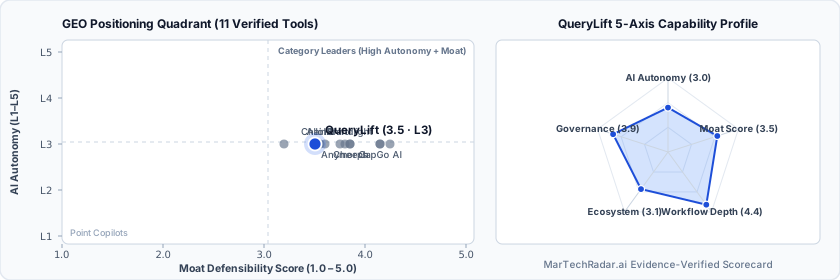
QueryLift is a Web SaaS tool for GEO (GEO Brand Tracking & LLM Rank Tracking) in GEO & AI SEO. Pricing: Custom / enterprise pricing. Best suited to SEO Directors, Brand Strategy Leaders and Growth Marketers. Editor ratings: AI autonomy L3 (conditional automation); moat score 3.5/5.0 (Proprietary moat). Fact-checked by Jiacky Lee on Oct 10, 2026.
Generative engine optimization and LLM rank tracking platform monitoring brand share-of-voice, citation health, and prompt-level positioning across AI search.
QueryLift buyer fit verdict: when to choose vs. when to walk away
Choose QueryLift if (Best Fit)
- Target ICP & Stack Fit: You operate as SEO Directors, Brand Strategy Leaders and Growth Marketers requiring a Web SaaS deployment for GEO.
- L3 Architecture & Defensibility: Defensibility rests on localized Japanese and multilingual semantic prompt datasets, proprietary citation contamination detection algorithms, and automated pipeline adapters across diverse LLM inference endpoints.
- Commercial Model Fit: Your procurement budget aligns with Custom / enterprise pricing.
Walk away from QueryLift if (Deal-Breakers)
- Walk away if you require transparent self-serve monthly billing or your budget ceiling is under $1,000/mo (QueryLift requires sales-gated custom quoting).
- Walk away if your workflow cannot tolerate dynamic model stochasticity: LLM response non-determinism produces fluctuating rank metrics across identical prompt seeds, requiring high-frequency statistical sampling that increases synthetic query overhead.
- Walk away if closed-ecosystem observability is a deal-breaker for your team: Conversational engines frequently update anti-scraping safeguards and alter search retrieval-augmented generation mechanisms, causing temporary data ingestion lag.
QueryLift key facts & scorecard
| Pricing | Custom / enterprise pricing |
|---|---|
| Free plan | No / not disclosed |
| Delivery | Web SaaS |
| Audience | SEO Directors, Brand Strategy Leaders, Growth Marketers |
| AI autonomy level | L3 · Conditional automationEditor-verified |
| Moat tier & score | 3.5 / 5.0 · Proprietary moatEditor-verified |
| Funding | Seed |
| Total funding | ¥100MBacked by Z Venture Capital, JAFCO |
| Company size | 2-10 employees |
| Governance & docs | Trust & Security ↗ · Terms ↗ · Privacy ↗ |
| Headquarters | Tokyo, Japan |
| Founded | 2025 |
| Last verified |
QueryLift pros & cons: strengths vs. operational limitations
Pros: core strengths & capabilities
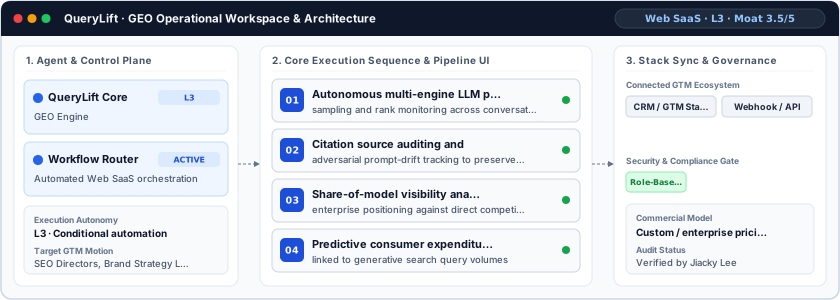
- Autonomous multi-engine LLM prompt: sampling and rank monitoring across conversational search tools
- Citation source auditing and: adversarial prompt-drift tracking to preserve brand trust
- Share-of-model visibility analytics benchmarking: enterprise positioning against direct competitors
- Predictive consumer expenditure modeling: linked to generative search query volumes
Cons: operational limitations & risks
- Dynamic Model Stochasticity: LLM response non-determinism produces fluctuating rank metrics across identical prompt seeds, requiring high-frequency statistical sampling that increases synthetic query overhead.
- Closed-Ecosystem Observability: Conversational engines frequently update anti-scraping safeguards and alter search retrieval-augmented generation mechanisms, causing temporary data ingestion lag.
- Attribution Traceability Latency: Linking synthetic visibility metrics directly to downstream customer conversion events requires manual correlation against organic web analytics and customer relationship databases.
QueryLift TCO & deal-breaker stress test
Simulate 12-month stepped TCO, hidden cost multipliers, contract lock-in exposure, and stack failure modes using only facts verified by Jiacky Lee on · Capture SHA dd791b0d.
QueryLift triggers high-severity friction under your 5-seat / $800/mo constraints. Benchmark the verified subtrack alternatives below before committing.
| Plan / Tier | Verified Rate | Scale Fit | Scope & Quota Notes |
|---|---|---|---|
| Enterprise / Custom | Custom quote | 15–50+ seats (Enterprise SLA) | Sales-negotiated annual contract for custom volume, SSO/RBAC governance, and dedicated SLA. |
- Moat Score
- 3.5 / 5.0
- AI Autonomy
- L3
- Free Tier / Trial
- None disclosed
Triggered audit signals & failure modes
- Opaque Enterprise Quoting vs. SMB/Mid-Market BudgetVerified Pricing Ledger
QueryLift does not disclose a public self-serve floor (Custom / enterprise pricing). Buyers with a $800/mo cap face high sales-qualification friction.
- Sales-Gated Contract TermsFact-checked by Jiacky Lee
QueryLift distributes its software via custom enterprise pricing packages negotiated directly with commercial sales teams. Procurement agreements depend on active enterprise brand footprints, tracked prompt clusters, and programmatic query frequencies across target models.
- Primary Operational Bottleneck: Dynamic Model StochasticityAudit by Jiacky Lee
LLM response non-determinism produces fluctuating rank metrics across identical prompt seeds, requiring high-frequency statistical sampling that increases synthetic query overhead.
Hidden TCO Multipliers & Quota Gates
- Dynamic Model Stochasticity: LLM response non-determinism produces fluctuating rank metrics across identical prompt seeds, requiring high-frequency statistical sampling that increases synthetic query overhead.
- Closed-Ecosystem Observability: Conversational engines frequently update anti-scraping safeguards and alter search retrieval-augmented generation mechanisms, causing temporary data ingestion lag.
When to Walk Away & Negotiation Levers
- Walk away if you require transparent self-serve monthly billing or your budget ceiling is under $1,000/mo (QueryLift requires sales-gated custom quoting).
- Walk away if your workflow cannot tolerate dynamic model stochasticity: LLM response non-determinism produces fluctuating rank metrics across identical prompt seeds, requiring high-frequency statistical sampling that increases synthetic query overhead.
- Walk away if closed-ecosystem observability is a deal-breaker for your team: Conversational engines frequently update anti-scraping safeguards and alter search retrieval-augmented generation mechanisms, causing temporary data ingestion lag.
- Demand a 30- to 60-day paid pilot opt-out clause in the QueryLift order form before signing a 12-month enterprise commitment.
- Require a sandbox proof-of-concept testing dynamic model stochasticity against your live CRM/data schema before annual sign-off.
Ask a custom procurement or TCO stress-test question about QueryLift
Lower 5-seat floor (~$29/mo vs. Custom Quote) · Transparent self-serve entry without mandatory annual lock-in
Lower 5-seat floor (~$29/mo vs. Custom Quote) · Transparent self-serve entry without mandatory annual lock-in
QueryLift moat & subtrack positioning
Defensibility rests on localized Japanese and multilingual semantic prompt datasets, proprietary citation contamination detection algorithms, and automated pipeline adapters across diverse LLM inference endpoints.
Editorial review
Fact-checked by Jiacky Lee (Managing Editor, AI Autonomy & Moat Methodology) on .
Background
Backed by ¥100M in venture funding and founded in 2025 in Tokyo, Japan, QueryLift engineers visibility analytics for search strategists and corporate marketing directors navigating algorithmic conversational interfaces. As consumer discovery transitions from indexing crawlers to synthesized conversational answers, enterprises encounter reduced visibility into how generative agents represent corporate offerings. Operating within generative engine optimization and LLM rank tracking, QueryLift tracks brand mentions, semantic sentiment, and citations across consumer-facing artificial intelligence services.
How QueryLift works
QueryLift functions as an L3 monitoring engine utilizing programmatic prompt orchestration. The pipeline generates structured prompt variations across defined target industries, querying multiple foundational language models through automated scheduling layers. Ingested raw responses pass through natural language parsers that isolate entity mentions, product recommendations, and outbound URL citations. Vector similarity scoring continuously evaluates whether brand narratives align with verified corporate source data or reflect citation drift.
Limitations
Operational considerations and platform boundaries include:
- Dynamic Model Stochasticity: LLM response non-determinism produces fluctuating rank metrics across identical prompt seeds, requiring high-frequency statistical sampling that increases synthetic query overhead.
- Closed-Ecosystem Observability: Conversational engines frequently update anti-scraping safeguards and alter search retrieval-augmented generation mechanisms, causing temporary data ingestion lag.
- Attribution Traceability Latency: Linking synthetic visibility metrics directly to downstream customer conversion events requires manual correlation against organic web analytics and customer relationship databases.
QueryLift pricing
QueryLift distributes its software via custom enterprise pricing packages negotiated directly with commercial sales teams. Procurement agreements depend on active enterprise brand footprints, tracked prompt clusters, and programmatic query frequencies across target models. Buyers obtain tailored agreements structured around dedicated workspace access, service-level guarantees, and strategic onboarding support without published standard recurring digital tiers.
How QueryLift compares
Within generative tracking software, QueryLift competes alongside AthenaHQ, Brandlight, and Anymorph. While Brandlight and AthenaHQ emphasize broad English-language search indices and North American e-commerce monitoring, QueryLift delivers localized lexical extraction tuned for complex multi-byte character prompts and regional marketplace dynamics. In contrast to Anymorph's developer-centric API evaluation framework, QueryLift presents brand strategists with turn-key intelligence dashboards tailored for corporate enterprise oversight.
Frequently asked questions about QueryLift
How much does QueryLift cost and does it require a custom enterprise quote?
Published pricing summary for QueryLift: Custom / enterprise pricing. A permanent free plan is not disclosed for QueryLift. QueryLift distributes its software via custom enterprise pricing packages negotiated directly with commercial sales teams. Procurement agreements depend on active enterprise brand footprints, tracked prompt clusters, and programmatic query frequencies across target models.
How does QueryLift work and how autonomous is its AI architecture?
Generative engine optimization and LLM rank tracking platform monitoring brand share-of-voice, citation health, and prompt-level positioning across AI search. Within GEO (GEO Brand Tracking & LLM Rank Tracking), MarTechRadar rates its execution architecture at L3 · Conditional automation with a verified Moat Score of 3.5 / 5.0 (Proprietary moat). Defensibility rests on localized Japanese and multilingual semantic prompt datasets, proprietary citation contamination detection algorithms, and automated pipeline adapters across diverse LLM inference endpoints. Corporate profile: operating at 2-10 employees scale.
What are the main limitations of QueryLift and when should buyers walk away?
Based on our editorial technical audit, key operational considerations and boundaries for QueryLift include: (1) Dynamic Model Stochasticity: LLM response non-determinism produces fluctuating rank metrics across identical prompt seeds, requiring high-frequency statistical sampling that increases synthetic query overhead. (2) Closed-Ecosystem Observability: Conversational engines frequently update anti-scraping safeguards and alter search retrieval-augmented generation mechanisms, causing temporary data ingestion lag. (3) Attribution Traceability Latency: Linking synthetic visibility metrics directly to downstream customer conversion events requires manual correlation against organic web analytics and customer relationship databases. Primary procurement walk-away rule: Walk away if you require transparent self-serve monthly billing or your budget ceiling is under $1,000/mo (QueryLift requires sales-gated custom quoting).
What integrations, compliance certifications, and contract terms apply to QueryLift?
First-party governance and developer endpoints verified on domain include: Trust/Security (https://app.querylift.co.jp/security). Key TCO multiplier to watch: Dynamic Model Stochasticity (LLM response non-determinism produces fluctuating rank metrics across identical prompt seeds, requiring high-frequency statistical sampling that increases synthetic query overhead.) Before signing a contract, procurement teams should demand a 30- to 60-day paid pilot opt-out clause in the QueryLift order form before signing a 12-month enterprise commitment.
What are the best QueryLift alternatives and head-to-head competitors in 2026?
Top fact-checked alternatives to QueryLift in GEO (GEO Brand Tracking & LLM Rank Tracking) include Otterly.ai (From $29/mo · Enterprise plan), Petra Labs (Custom / enterprise pricing), Parsnipp ($39.99–$99.99/mo), Second Wind (Custom / enterprise pricing). Within generative tracking software, QueryLift competes alongside AthenaHQ, Brandlight, and Anymorph.
Verified sources & evidence trail
- Official product domain: https://querylift.co.jp
- Commercial pricing verification: Verified against official vendor pricing policy (Custom / enterprise pricing)
- Verified corporate entity profiles (
sameAs): LinkedIn Company Profile · Crunchbase Entity Record - First-party governance & documentation links: Trust & Security · Terms · Privacy
- Editorial audit sign-off: Fact-checked by Jiacky Lee on under the MarTechRadar Evidence-Ledger Protocol.