BrandEcho Review (2026): GEO Pricing, Pros & Cons
Bottom line
BrandEcho is a Web SaaS tool for GEO (GEO Brand Tracking & LLM Rank Tracking) in GEO & AI SEO. Pricing: From $29/mo. Best suited to DTC / eCommerce and Enterprise Brands. Editor ratings: AI autonomy L2 (workflow copilot); moat score 1.7/5.0 (Thin wrapper). Fact-checked by MarTechRadar Research Desk on Oct 15, 2026.
Generative engine optimization and brand tracking platform that monitors multi-turn AI chatbot responses, citation sources, and competitor positioning.
Is BrandEcho worth it in 2026? Buyer fit & when to walk away
Choose BrandEcho if (Best Fit)
- Target ICP & Stack Fit: You operate as DTC / eCommerce and Enterprise Brands requiring a Web SaaS deployment for GEO.
- L2 Architecture & Defensibility: Maintains an automated multi-turn prompt simulation pipeline across major model endpoints, capturing longitudinal share-of-voice and hallucination risks before they alter consumer purchase decisions.
- Commercial Model Fit: Your procurement budget aligns with From $29/mo.
Walk away from BrandEcho if (Deal-Breakers)
- Walk away if your workflow cannot tolerate nondeterministic model drift: Model updates and temperature fluctuations across third-party LLM inference APIs introduce tracking volatility, occasionally yielding inconsistent citation attribution across identical prompt runs.
- Walk away if prompt archetype calibration is a deal-breaker for your team: Simulated buyer dialogues require ongoing manual query curation to ensure simulated conversational paths mirror genuine enterprise procurement terminology rather than synthetic approximations.
BrandEcho pricing, free plan & scorecard at a glance
| Pricing | From $29/moVendor pricing page |
|---|---|
| Free plan | No / not disclosed |
| Delivery | Web SaaS |
| Audience | DTC / eCommerce, Enterprise Brands |
| AI autonomy level | L2 · Workflow copilotEditor-verified |
| Moat tier & score | 1.7 / 5.0 · Thin wrapperEditor-verified |
| Funding | Pre-seed |
| Governance & docs | Terms ↗ · Privacy ↗ |
| Headquarters | United States |
| Last verified | Oct 15, 2026 |
BrandEcho pros & cons: strengths vs. operational limitations
Pros: core strengths & capabilities
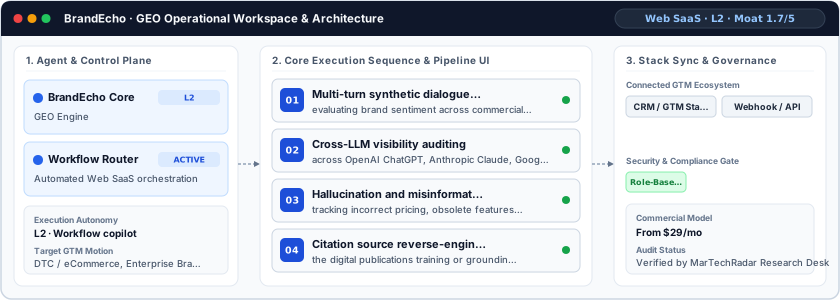
- Multi-turn synthetic dialogue simulation: evaluating brand sentiment across commercial buyer prompts
- Cross-LLM visibility auditing: across OpenAI ChatGPT, Anthropic Claude, Google Gemini, and Perplexity
- Hallucination and misinformation detection: tracking incorrect pricing, obsolete features, or erroneous claims
- Citation source reverse-engineering mapping: the digital publications training or grounding engine answers
Cons: operational limitations & risks
- Nondeterministic Model Drift: Model updates and temperature fluctuations across third-party LLM inference APIs introduce tracking volatility, occasionally yielding inconsistent citation attribution across identical prompt runs.
- Prompt Archetype Calibration: Simulated buyer dialogues require ongoing manual query curation to ensure simulated conversational paths mirror genuine enterprise procurement terminology rather than synthetic approximations.
- API Rate Limiting & Latency: Bulk multi-turn executions depend entirely on external vendor API availability, leaving high-frequency monitoring runs vulnerable to rate limits and upstream context window throttling.
BrandEcho TCO & deal-breaker stress test
Simulate 12-month stepped TCO, hidden cost multipliers, contract lock-in exposure, and stack failure modes using only facts verified by MarTechRadar Research Desk on 2026-10-15 · Capture SHA b2a307f4.
BrandEcho aligns with your 5-seat / $800/mo profile. Review the walk-away triggers and contract levers below before deployment.
- Moat Score
- 1.7 / 5.0
- AI Autonomy
- L2
- Free Tier / Trial
- None disclosed
Triggered audit signals & failure modes
- Published Self-Serve Entry FloorVerified Pricing Ledger
BrandEcho publishes a transparent entry point (From $29/mo) for initial validation before committing.
- Primary Operational Bottleneck: Nondeterministic Model DriftAudit by MarTechRadar Research Desk
Model updates and temperature fluctuations across third-party LLM inference APIs introduce tracking volatility, occasionally yielding inconsistent citation attribution across identical prompt runs.
Test a custom BrandEcho budget or stack constraint
Fits within $800/mo budget (Free plan · $49–$1,990/mo · Enterprise plan)
Fits within $800/mo budget (From $149/mo)
BrandEcho AI moat & GEO positioning
Maintains an automated multi-turn prompt simulation pipeline across major model endpoints, capturing longitudinal share-of-voice and hallucination risks before they alter consumer purchase decisions.
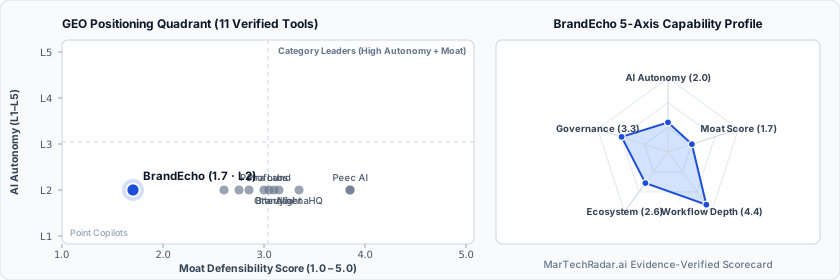
BrandEcho in-depth review, pricing & architecture analysis
Editor sign-off: Oct 15, 2026. How profiles are made.
What is BrandEcho? Overview & background
Headquartered in the United States, BrandEcho addresses the operational mandate of generative engine optimization (GEO) and algorithmic brand governance. As prospective B2B buyers query conversational assistants for software comparisons and vendor validation, commercial teams face significant blind spots regarding how frontier models represent their offerings. BrandEcho serves brand protection officers, digital marketing directors, and communications leads seeking automated oversight into generative answer engines, eliminating the manual friction of running repetitive prompt audits across disparate conversational interfaces.
How BrandEcho works: architecture & workflow
At an L2 workflow-copilot autonomy level, the platform utilizes an automated testing pipeline that executes multi-turn conversational sequences across endpoints including OpenAI ChatGPT, Google Gemini, Anthropic Claude, and Perplexity. Rather than dispatching isolated one-shot prompts, BrandEcho generates layered buyer queries that simulate qualification cycles, pricing inquiries, and feature evaluations. The pipeline ingests the generated unstructured text, applies entity extraction and sentiment classification, maps cited domain references, and benchmarks competitor mention frequency against the monitored organization over longitudinal tracking windows.
BrandEcho limitations, drawbacks & risks
Operational considerations and platform boundaries include:
- Nondeterministic Model Drift: Model updates and temperature fluctuations across third-party LLM inference APIs introduce tracking volatility, occasionally yielding inconsistent citation attribution across identical prompt runs.
- Prompt Archetype Calibration: Simulated buyer dialogues require ongoing manual query curation to ensure simulated conversational paths mirror genuine enterprise procurement terminology rather than synthetic approximations.
- API Rate Limiting & Latency: Bulk multi-turn executions depend entirely on external vendor API availability, leaving high-frequency monitoring runs vulnerable to rate limits and upstream context window throttling.
BrandEcho pricing, plans & cost breakdown
BrandEcho adopts a tiered self-service subscription structure billed on a monthly cadence. Access begins from $29 per month on an entry-level tier designed for focused domain scanning, scaling to higher volume allocations priced at $79 and $299 per month for organizations requiring denser prompt execution volumes, broader brand variant coverage, and accelerated refresh cadences.
How BrandEcho compares vs. competitors & alternatives
Within the emerging generative engine monitoring sector, BrandEcho competes directly with tools such as Anymorph, AthenaHQ, and Brandlight. While AthenaHQ targets enterprise-grade communications infrastructure with governance workflows and Brandlight emphasizes search attribution crossovers, BrandEcho delivers targeted multi-turn prompt auditing at an accessible entry tier. It is best suited for mid-market software and consumer brands requiring continuous synthetic oversight into generative search responses without complex enterprise deployment overhead.
Frequently asked questions about BrandEcho
How much does BrandEcho cost in 2026?
BrandEcho pricing: From $29/mo. No free plan is publicly disclosed. BrandEcho adopts a tiered self-service subscription structure billed on a monthly cadence.
What are the top BrandEcho alternatives in GEO?
Verified GEO alternatives include BrightEdge Generative Parser (Custom / enterprise pricing), Unusual (Pricing not disclosed), ShareOfAsk (Free plan · $49–$1,990/mo · Enterprise plan), Plynt (Custom / enterprise pricing). Within the emerging generative engine monitoring sector, BrandEcho competes directly with tools such as Anymorph, AthenaHQ, and Brandlight.
What are the main limitations and trade-offs of BrandEcho?
Operational considerations and platform boundaries include: Nondeterministic Model Drift: Model updates and temperature fluctuations across third-party LLM inference APIs introduce tracking volatility, occasionally yielding inconsistent citation attribution across identical prompt runs. Walk away if your workflow cannot tolerate nondeterministic model drift: Model updates and temperature fluctuations across third-party LLM inference APIs introduce tracking volatility, occasionally yielding inconsistent citation attribution across identical prompt runs.
Verified sources & evidence trail
- Official product domain: https://brandecho.ai
- Commercial pricing verification: https://brandecho.ai/en/pricing
- First-party governance & documentation links: Terms · Privacy
- Editor sign-off: Oct 15, 2026 (how profiles are made).
