Pupila Brand Studio Review (2026): Email Marketing Pricing, Limits & Alternatives
Bottom line
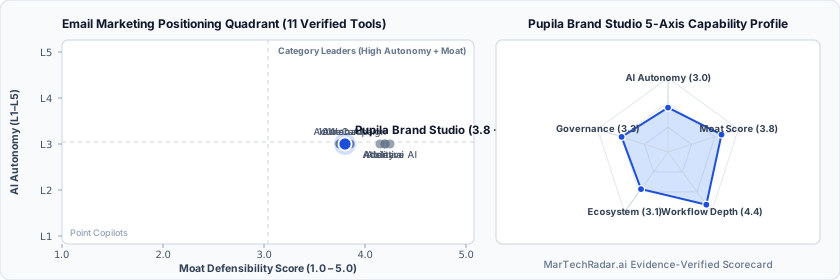
Pupila Brand Studio is a Web SaaS tool for Email Marketing (AI Email Marketing & Lifecycle Journeys) in Lifecycle & CDP. Pricing: Custom / enterprise pricing. Best suited to CRM & Lifecycle Marketers, eCommerce Growth Teams and Customer Experience Directors. Editor ratings: AI autonomy L3 (conditional automation); moat score 3.8/5.0 (Proprietary moat). Fact-checked by Anthony Hay on Oct 11, 2026.
Generative branding platform turning enterprise identity guidelines into on-brand visual collateral, images, and video assets.
Pupila Brand Studio buyer fit verdict: when to choose vs. when to walk away
Choose Pupila Brand Studio if (Best Fit)
- Target ICP & Stack Fit: You operate as CRM & Lifecycle Marketers, eCommerce Growth Teams and Customer Experience Directors requiring a Web SaaS deployment for Email Marketing.
- L3 Architecture & Defensibility: Fine-tuned visual conditioning pipeline that codifies brand identity rules, asset management structures, and style constraints into automated creative workflows.
- Commercial Model Fit: Your procurement budget aligns with Custom / enterprise pricing.
Walk away from Pupila Brand Studio if (Deal-Breakers)
- Walk away if you require transparent self-serve monthly billing or your budget ceiling is under $1,000/mo (Pupila Brand Studio requires sales-gated custom quoting).
- Walk away if your workflow cannot tolerate vector and typographic accuracy: Raster diffusion pipelines frequently encounter token-level edge artifacting when rendering complex vector logos or micro-typography, requiring manual vector replacement in downstream production tools.
- Walk away if cross-channel variant scale is a deal-breaker for your team: Generating large asset matrices across disparate aspect ratios introduces composition skewing, demanding manual aspect-ratio reframing rather than fully automated responsive re-layouts.
Pupila Brand Studio key facts & scorecard
| Pricing | Custom / enterprise pricing |
|---|---|
| Free plan | No / not disclosed |
| Delivery | Web SaaS |
| Audience | CRM & Lifecycle Marketers, eCommerce Growth Teams, Customer Experience Directors |
| AI autonomy level | L3 · Conditional automationEditor-verified |
| Moat tier & score | 3.8 / 5.0 · Proprietary moatEditor-verified |
| Funding | Undisclosed |
| Total funding | UndisclosedBacked by 14B Venture Capital, Amazon Web Services |
| Company size | 11-50 employees |
| Governance & docs | Privacy ↗ |
| Headquarters | São Paulo |
| Founded | 2024 |
| Last verified |
Pupila Brand Studio pros & cons: strengths vs. operational limitations
Pros: core strengths & capabilities
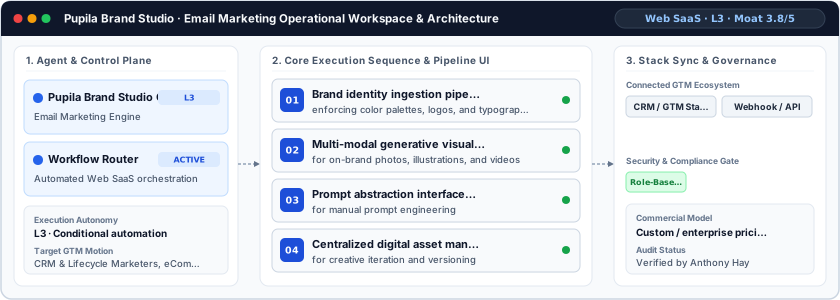
- Brand identity ingestion pipeline: enforcing color palettes, logos, and typography rules
- Multi-modal generative visual studio: for on-brand photos, illustrations, and videos
- Prompt abstraction interface removing the need: for manual prompt engineering
- Centralized digital asset management workspace: for creative iteration and versioning
Cons: operational limitations & risks
- Vector and Typographic Accuracy: Raster diffusion pipelines frequently encounter token-level edge artifacting when rendering complex vector logos or micro-typography, requiring manual vector replacement in downstream production tools.
- Cross-Channel Variant Scale: Generating large asset matrices across disparate aspect ratios introduces composition skewing, demanding manual aspect-ratio reframing rather than fully automated responsive re-layouts.
- Direct ESP Pipeline Integrations: The current platform functions primarily as an asset creation studio, requiring export steps rather than native dynamic image injection into external lifecycle automation engines.
Pupila Brand Studio TCO & deal-breaker stress test
Simulate 12-month stepped TCO, hidden cost multipliers, contract lock-in exposure, and stack failure modes using only facts verified by Anthony Hay on · Capture SHA 71962c44.
Pupila Brand Studio triggers high-severity friction under your 5-seat / $800/mo constraints. Benchmark the verified subtrack alternatives below before committing.
| Plan / Tier | Verified Rate | Scale Fit | Scope & Quota Notes |
|---|---|---|---|
| Enterprise / Custom | Custom quote | 15–50+ seats (Enterprise SLA) | Sales-negotiated annual contract for custom volume, SSO/RBAC governance, and dedicated SLA. |
- Moat Score
- 3.8 / 5.0
- AI Autonomy
- L3
- Free Tier / Trial
- None disclosed
Triggered audit signals & failure modes
- Opaque Enterprise Quoting vs. SMB/Mid-Market BudgetVerified Pricing Ledger
Pupila Brand Studio does not disclose a public self-serve floor (Custom / enterprise pricing). Buyers with a $800/mo cap face high sales-qualification friction.
- Sales-Gated Contract TermsFact-checked by Anthony Hay
Pupila Brand Studio operates an enterprise software commercial structure without public self-serve tiers. Commercial pricing is available on request through tailored enterprise sales quotes based on organizational scale and seats.
- Primary Operational Bottleneck: Vector and Typographic AccuracyAudit by Anthony Hay
Raster diffusion pipelines frequently encounter token-level edge artifacting when rendering complex vector logos or micro-typography, requiring manual vector replacement in downstream production tools.
Hidden TCO Multipliers & Quota Gates
- Credit & Usage Burn Multiplier: Automated workflows consume metered credits/usage quotas; multi-step enrichment, voice minutes, or high-frequency agent runs can trigger mid-cycle top-up packs.
- Vector and Typographic Accuracy: Raster diffusion pipelines frequently encounter token-level edge artifacting when rendering complex vector logos or micro-typography, requiring manual vector replacement in downstream production tools.
- Cross-Channel Variant Scale: Generating large asset matrices across disparate aspect ratios introduces composition skewing, demanding manual aspect-ratio reframing rather than fully automated responsive re-layouts.
When to Walk Away & Negotiation Levers
- Walk away if you require transparent self-serve monthly billing or your budget ceiling is under $1,000/mo (Pupila Brand Studio requires sales-gated custom quoting).
- Walk away if your workflow cannot tolerate vector and typographic accuracy: Raster diffusion pipelines frequently encounter token-level edge artifacting when rendering complex vector logos or micro-typography, requiring manual vector replacement in downstream production tools.
- Walk away if cross-channel variant scale is a deal-breaker for your team: Generating large asset matrices across disparate aspect ratios introduces composition skewing, demanding manual aspect-ratio reframing rather than fully automated responsive re-layouts.
- Demand a 30- to 60-day paid pilot opt-out clause in the Pupila Brand Studio order form before signing a 12-month enterprise commitment.
- Require a sandbox proof-of-concept testing vector and typographic accuracy against your live CRM/data schema before annual sign-off.
Ask a custom procurement or TCO stress-test question about Pupila Brand Studio
Lower 5-seat floor (~$10/mo vs. Custom Quote) · Transparent self-serve entry without mandatory annual lock-in
Lower 5-seat floor (~$15/mo vs. Custom Quote) · Transparent self-serve entry without mandatory annual lock-in
Pupila Brand Studio moat & subtrack positioning
Fine-tuned visual conditioning pipeline that codifies brand identity rules, asset management structures, and style constraints into automated creative workflows.
Editorial review
Fact-checked by Anthony Hay (Senior SEO, Search Intelligence & Content Operations Editor) on .
Background
Architected to solve visual entropy in high-velocity marketing operations, Pupila Brand Studio functions as a brand-conditioned generative production platform. Established in 2024 and headquartered in São Paulo, the company targets brand directors, creative leads, and lifecycle marketers struggling with asset production bottlenecks. Rather than treating visual synthesis as an unconstrained open-canvas prompt box, the system grounds generative workflows inside strict corporate design guidelines.
How Pupila Brand Studio works
Operating at an L3 autonomy profile, Pupila ingests core brand identity parameters—including vector logos, verified color spaces, typography rules, and photographic style guides—to train structured generation guardrails. The platform abstracts raw prompt engineering behind standardized marketing templates, routing creative requests through fine-tuned diffusion models that constrain composition, lighting, and palette compliance. The asset engine processes automated image rendering, video generation, and post-generation enhancement modules, writing output directly into a centralized asset catalog.
Limitations
Operational considerations and platform boundaries include:
- Vector and Typographic Accuracy: Raster diffusion pipelines frequently encounter token-level edge artifacting when rendering complex vector logos or micro-typography, requiring manual vector replacement in downstream production tools.
- Cross-Channel Variant Scale: Generating large asset matrices across disparate aspect ratios introduces composition skewing, demanding manual aspect-ratio reframing rather than fully automated responsive re-layouts.
- Direct ESP Pipeline Integrations: The current platform functions primarily as an asset creation studio, requiring export steps rather than native dynamic image injection into external lifecycle automation engines.
Pupila Brand Studio pricing
Pupila Brand Studio operates an enterprise software commercial structure without public self-serve tiers. Commercial pricing is available on request through tailored enterprise sales quotes based on organizational scale and seats. Contracts typically account for brand model customization, volume of generative rendering units, compute consumption for video synthesis, and dedicated support provisions.
How Pupila Brand Studio compares
Within multi-channel asset creation and lifecycle marketing tech stacks, Pupila differentiates itself from generalist page builders like 10Web AI by concentrating strictly on brand-locked visual synthesis rather than complete web infrastructure. Unlike optimization platforms such as AB Tasty that orchestrate client-side front-end experiments, or autonomous agents like Ability.ai that govern campaign allocation, Pupila focuses on the visual production bottleneck. It fits enterprise marketing departments prioritizing programmatic visual consistency across high-volume campaigns.
Direct competitors & market radar
Top algorithmic competitors based on category positioning, capability overlap, and ICP alignment.
Frequently asked questions about Pupila Brand Studio
How much does Pupila Brand Studio cost and does it require a custom enterprise quote?
Published pricing summary for Pupila Brand Studio: Custom / enterprise pricing. A permanent free plan is not disclosed for Pupila Brand Studio. Pupila Brand Studio operates an enterprise software commercial structure without public self-serve tiers. Commercial pricing is available on request through tailored enterprise sales quotes based on organizational scale and seats.
How does Pupila Brand Studio work and how autonomous is its AI architecture?
Generative branding platform turning enterprise identity guidelines into on-brand visual collateral, images, and video assets. Within Email Marketing (AI Email Marketing & Lifecycle Journeys), MarTechRadar rates its execution architecture at L3 · Conditional automation with a verified Moat Score of 3.8 / 5.0 (Proprietary moat). Fine-tuned visual conditioning pipeline that codifies brand identity rules, asset management structures, and style constraints into automated creative workflows. Corporate profile: operating at 11-50 employees scale.
What are the main limitations of Pupila Brand Studio and when should buyers walk away?
Based on our editorial technical audit, key operational considerations and boundaries for Pupila Brand Studio include: (1) Vector and Typographic Accuracy: Raster diffusion pipelines frequently encounter token-level edge artifacting when rendering complex vector logos or micro-typography, requiring manual vector replacement in downstream production tools. (2) Cross-Channel Variant Scale: Generating large asset matrices across disparate aspect ratios introduces composition skewing, demanding manual aspect-ratio reframing rather than fully automated responsive re-layouts. (3) Direct ESP Pipeline Integrations: The current platform functions primarily as an asset creation studio, requiring export steps rather than native dynamic image injection into external lifecycle automation engines. Primary procurement walk-away rule: Walk away if you require transparent self-serve monthly billing or your budget ceiling is under $1,000/mo (Pupila Brand Studio requires sales-gated custom quoting).
What integrations, compliance certifications, and contract terms apply to Pupila Brand Studio?
Key TCO multiplier to watch: Credit & Usage Burn Multiplier (Automated workflows consume metered credits/usage quotas; multi-step enrichment, voice minutes, or high-frequency agent runs can trigger mid-cycle top-up packs.) Before signing a contract, procurement teams should demand a 30- to 60-day paid pilot opt-out clause in the Pupila Brand Studio order form before signing a 12-month enterprise commitment.
What are the best Pupila Brand Studio alternatives and head-to-head competitors in 2026?
Top fact-checked alternatives to Pupila Brand Studio in Email Marketing (AI Email Marketing & Lifecycle Journeys) include Qualified (Custom / enterprise pricing), Persado (Custom / enterprise pricing), Sendlane (From $10/mo), Eikona (Custom / enterprise pricing). Within multi-channel asset creation and lifecycle marketing tech stacks, Pupila differentiates itself from generalist page builders like 10Web AI by concentrating strictly on brand-locked visual synthesis rather than complete web infrastructure.
Verified sources & evidence trail
- Official product domain: https://www.pupila.ai/
- Commercial pricing verification: Verified against official vendor pricing policy (Custom / enterprise pricing)
- Verified corporate entity profiles (
sameAs): LinkedIn Company Profile · Crunchbase Entity Record - First-party governance & documentation links: Privacy
- Editorial audit sign-off: Fact-checked by Anthony Hay on under the MarTechRadar Evidence-Ledger Protocol.