PPC.io Review (2026): DCO Pricing, Limits & Alternatives
Bottom line
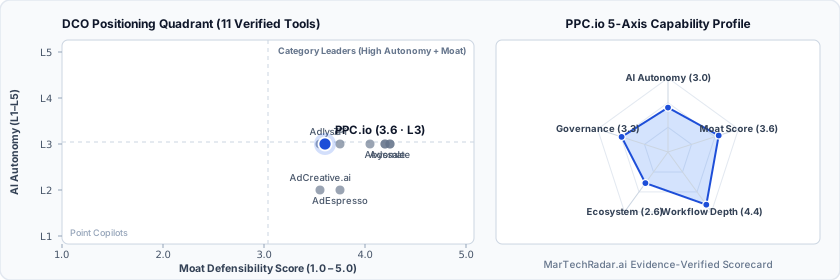
PPC.io is a Web SaaS tool for DCO (Dynamic Creative Optimization / DCO) in AdTech & Paid Media. Pricing: Custom / enterprise pricing. Best suited to Performance Marketing Directors, Ad Agencies and Retail Media Advertisers. Editor ratings: AI autonomy L3 (conditional automation); moat score 3.6/5.0 (Proprietary moat). Fact-checked by Sarah Per on Oct 15, 2026.
Dynamic creative optimization platform automating high-velocity ad asset synthesis, template versioning, and programmatic deployment for enterprise.
PPC.io buyer fit verdict: when to choose vs. when to walk away
Choose PPC.io if (Best Fit)
- Target ICP & Stack Fit: You operate as Performance Marketing Directors, Ad Agencies and Retail Media Advertisers requiring a Web SaaS deployment for DCO.
- L3 Architecture & Defensibility: Operational moat stems from automated visual assembly engines that link feed-driven catalog updates directly to multi-channel dynamic creative distribution pipelines.
- Commercial Model Fit: Your procurement budget aligns with Custom / enterprise pricing.
Walk away from PPC.io if (Deal-Breakers)
- Walk away if you require transparent self-serve monthly billing or your budget ceiling is under $1,000/mo (PPC.io requires sales-gated custom quoting).
- Walk away if your workflow cannot tolerate catalog schema fragility: Upstream alterations to structured product feeds or omitted image URLs cause automated rendering passes to drop incomplete variants, requiring dedicated schema mapping maintenance.
- Walk away if network API latency is a deal-breaker for your team: High-frequency creative refreshing frequently encounters rate limits and review-cycle delays on third-party ad networks, preventing instantaneous asset propagation during volatile bidding spikes.
PPC.io key facts & scorecard
| Pricing | Custom / enterprise pricing |
|---|---|
| Free plan | No / not disclosed |
| Delivery | Web SaaS |
| Audience | Performance Marketing Directors, Ad Agencies, Retail Media Advertisers |
| AI autonomy level | L3 · Conditional automationEditor-verified |
| Moat tier & score | 3.6 / 5.0 · Proprietary moatEditor-verified |
| Funding | Seed |
| Headquarters | United Kingdom |
| Founded | 2024 |
| Last verified |
PPC.io pros & cons: strengths vs. operational limitations
Pros: core strengths & capabilities
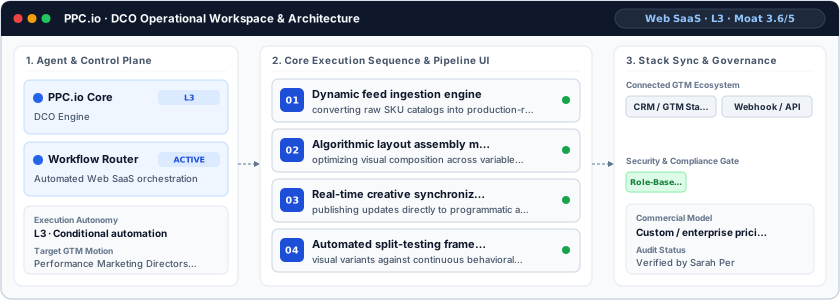
- Dynamic feed ingestion engine: converting raw SKU catalogs into production-ready ad creatives
- Algorithmic layout assembly module: optimizing visual composition across variable display ratios
- Real-time creative synchronization engine: publishing updates directly to programmatic ad networks
- Automated split-testing framework matching: visual variants against continuous behavioral response metrics
Cons: operational limitations & risks
- Catalog Schema Fragility: Upstream alterations to structured product feeds or omitted image URLs cause automated rendering passes to drop incomplete variants, requiring dedicated schema mapping maintenance.
- Network API Latency: High-frequency creative refreshing frequently encounters rate limits and review-cycle delays on third-party ad networks, preventing instantaneous asset propagation during volatile bidding spikes.
- Strict Visual Guardrails: Complex multi-layered brand typography and custom physics-based animations cannot be parsed algorithmically, restricting output to structured component templates and predefined modular blocks.
PPC.io TCO & deal-breaker stress test
Simulate 12-month stepped TCO, hidden cost multipliers, contract lock-in exposure, and stack failure modes using only facts verified by Sarah Per on .
PPC.io triggers high-severity friction under your 5-seat / $800/mo constraints. Benchmark the verified subtrack alternatives below before committing.
| Plan / Tier | Verified Rate | Scale Fit | Scope & Quota Notes |
|---|---|---|---|
| Enterprise / Custom | Custom quote | 15–50+ seats (Enterprise SLA) | Sales-negotiated annual contract for custom volume, SSO/RBAC governance, and dedicated SLA. |
- Moat Score
- 3.6 / 5.0
- AI Autonomy
- L3
- Free Tier / Trial
- None disclosed
Triggered audit signals & failure modes
- Opaque Enterprise Quoting vs. SMB/Mid-Market BudgetVerified Pricing Ledger
PPC.io does not disclose a public self-serve floor (Custom / enterprise pricing). Buyers with a $800/mo cap face high sales-qualification friction.
- Sales-Gated Contract TermsFact-checked by Sarah Per
Commercial procurement operates entirely through custom enterprise contracts negotiated via direct sales consultation.
- Primary Operational Bottleneck: Catalog Schema FragilityAudit by Sarah Per
Upstream alterations to structured product feeds or omitted image URLs cause automated rendering passes to drop incomplete variants, requiring dedicated schema mapping maintenance.
Hidden TCO Multipliers & Quota Gates
- Catalog Schema Fragility: Upstream alterations to structured product feeds or omitted image URLs cause automated rendering passes to drop incomplete variants, requiring dedicated schema mapping maintenance.
- Network API Latency: High-frequency creative refreshing frequently encounters rate limits and review-cycle delays on third-party ad networks, preventing instantaneous asset propagation during volatile bidding spikes.
When to Walk Away & Negotiation Levers
- Walk away if you require transparent self-serve monthly billing or your budget ceiling is under $1,000/mo (PPC.io requires sales-gated custom quoting).
- Walk away if your workflow cannot tolerate catalog schema fragility: Upstream alterations to structured product feeds or omitted image URLs cause automated rendering passes to drop incomplete variants, requiring dedicated schema mapping maintenance.
- Walk away if network API latency is a deal-breaker for your team: High-frequency creative refreshing frequently encounters rate limits and review-cycle delays on third-party ad networks, preventing instantaneous asset propagation during volatile bidding spikes.
- Demand a 30- to 60-day paid pilot opt-out clause in the PPC.io order form before signing a 12-month enterprise commitment.
- Require a sandbox proof-of-concept testing catalog schema fragility against your live CRM/data schema before annual sign-off.
Ask a custom procurement or TCO stress-test question about PPC.io
Lower 5-seat floor (~$10/mo vs. Custom Quote) · Transparent self-serve entry without mandatory annual lock-in
Lower 5-seat floor (~$36/mo vs. Custom Quote) · Transparent self-serve entry without mandatory annual lock-in
PPC.io moat & subtrack positioning
Operational moat stems from automated visual assembly engines that link feed-driven catalog updates directly to multi-channel dynamic creative distribution pipelines.
Editorial review
Fact-checked by Sarah Per (Principal Content Systems & Generative Media Editor) on .
Background
Headquartered in the United Kingdom, PPC.io addresses the friction of multi-variant ad production by automating dynamic creative optimization across programmatic channels. Built primarily for enterprise performance marketing teams, growth advertising leads, and programmatic traders, the platform treats ad production as a continuous data-driven pipeline rather than a static design cycle. Within performance marketing environments, PPC.io executes automated template generation, catalog synchronization, and creative assembly to eliminate manual asset production bottlenecks across disparate digital networks.
How PPC.io works
Under the hood, the platform operates as an L3 dynamic creative optimization pipeline that ingests product feeds, brand guidelines, and visual assets via direct API and catalog connectors. The orchestration core evaluates structured catalog attributes against preconfigured layout constraints, programmatically assembling multi-format display and paid social banners. A headless rendering pipeline outputs dynamic visual variations across multiple aspect ratios, while automated bidding and placement connectors push localized creative variations directly into programmatic exchanges based on audience signals and conversion feedback.
Limitations
Operational considerations and platform boundaries include:
- Catalog Schema Fragility: Upstream alterations to structured product feeds or omitted image URLs cause automated rendering passes to drop incomplete variants, requiring dedicated schema mapping maintenance.
- Network API Latency: High-frequency creative refreshing frequently encounters rate limits and review-cycle delays on third-party ad networks, preventing instantaneous asset propagation during volatile bidding spikes.
- Strict Visual Guardrails: Complex multi-layered brand typography and custom physics-based animations cannot be parsed algorithmically, restricting output to structured component templates and predefined modular blocks.
PPC.io pricing
Commercial procurement operates entirely through custom enterprise contracts negotiated via direct sales consultation. Rather than offering self-serve digital tiers, the licensing structure evaluates organizational deployment scale, monthly generated impression volume, active connected ad accounts, and operational seat allocations. Prospective buyers must contact the sales team to obtain customized commercial proposals, dedicated service-level agreements, and integrated enterprise onboarding packages. Pricing is available on request through tailored enterprise sales quotes, with custom enterprise tiers, subscription plans, and seat licenses structured around organizational scale and monthly workflow volume.
How PPC.io compares
Within dynamic creative optimization, PPC.io competes against systems like 7Pi, Abyssale, and AdCreative.ai. While Abyssale specializes in automated image generation via robust API endpoints for developer workflows, and AdCreative.ai emphasizes conversion-scoring algorithms for small-to-midsize growth accounts, PPC.io focuses on end-to-end programmatic distribution and automated catalog synchronization. 7Pi offers specialized feed handling, yet PPC.io differentiates through deep direct programmatic channel orchestration. The platform best serves high-SKU retailers and performance marketing teams managing extensive inventory variations across multiple programmatic display networks. It is best suited for enterprise marketing teams and growth practitioners seeking disciplined workflow orchestration.
Direct competitors & market radar
Top algorithmic competitors based on category positioning, capability overlap, and ICP alignment.
Frequently asked questions about PPC.io
How much does PPC.io cost and does it require a custom enterprise quote?
Published pricing summary for PPC.io: Custom / enterprise pricing. A permanent free plan is not disclosed for PPC.io. Commercial procurement operates entirely through custom enterprise contracts negotiated via direct sales consultation.
How does PPC.io work and how autonomous is its AI architecture?
Dynamic creative optimization platform automating high-velocity ad asset synthesis, template versioning, and programmatic deployment for enterprise. Within DCO (Dynamic Creative Optimization / DCO), MarTechRadar rates its execution architecture at L3 · Conditional automation with a verified Moat Score of 3.6 / 5.0 (Proprietary moat). Operational moat stems from automated visual assembly engines that link feed-driven catalog updates directly to multi-channel dynamic creative distribution pipelines.
What are the main limitations of PPC.io and when should buyers walk away?
Based on our editorial technical audit, key operational considerations and boundaries for PPC.io include: (1) Catalog Schema Fragility: Upstream alterations to structured product feeds or omitted image URLs cause automated rendering passes to drop incomplete variants, requiring dedicated schema mapping maintenance. (2) Network API Latency: High-frequency creative refreshing frequently encounters rate limits and review-cycle delays on third-party ad networks, preventing instantaneous asset propagation during volatile bidding spikes. (3) Strict Visual Guardrails: Complex multi-layered brand typography and custom physics-based animations cannot be parsed algorithmically, restricting output to structured component templates and predefined modular blocks. Primary procurement walk-away rule: Walk away if you require transparent self-serve monthly billing or your budget ceiling is under $1,000/mo (PPC.io requires sales-gated custom quoting).
What integrations, compliance certifications, and contract terms apply to PPC.io?
Key TCO multiplier to watch: Catalog Schema Fragility (Upstream alterations to structured product feeds or omitted image URLs cause automated rendering passes to drop incomplete variants, requiring dedicated schema mapping maintenance.) Before signing a contract, procurement teams should demand a 30- to 60-day paid pilot opt-out clause in the PPC.io order form before signing a 12-month enterprise commitment.
What are the best PPC.io alternatives and head-to-head competitors in 2026?
Top fact-checked alternatives to PPC.io in DCO (Dynamic Creative Optimization / DCO) include Optmyzr (Custom / enterprise pricing), WordStream (Custom / enterprise pricing), Revealbot (From $10/mo), Incremental (Custom / enterprise pricing). Within dynamic creative optimization, PPC.io competes against systems like 7Pi, Abyssale, and AdCreative.ai.
Verified sources & evidence trail
- Official product domain: https://ppc.io/
- Commercial pricing verification: Verified against official vendor pricing policy (Custom / enterprise pricing)
- Editorial audit sign-off: Fact-checked by Sarah Per on under the MarTechRadar Evidence-Ledger Protocol.