Plynt Review (2026): GEO Pricing, Limits & Alternatives
Bottom line
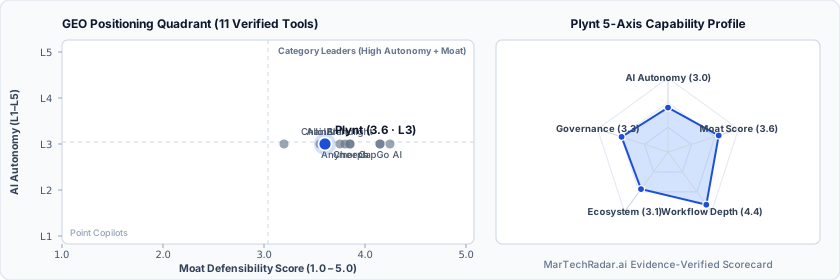
Plynt is a Web SaaS tool for GEO (GEO Brand Tracking & LLM Rank Tracking) in GEO & AI SEO. Pricing: Custom / enterprise pricing. Best suited to SEO Directors, Brand Strategy Leaders and Growth Marketers. Editor ratings: AI autonomy L3 (conditional automation); moat score 3.6/5.0 (Proprietary moat). Fact-checked by Vasilia Xia on Oct 15, 2026.
Multi-agent infrastructure and observability platform providing real-time telemetry, execution tracing, and governance for distributed LLM agent.
Plynt buyer fit verdict: when to choose vs. when to walk away
Choose Plynt if (Best Fit)
- Target ICP & Stack Fit: You operate as SEO Directors, Brand Strategy Leaders and Growth Marketers requiring a Web SaaS deployment for GEO.
- L3 Architecture & Defensibility: Deep execution graph introspection across multi-agent pipelines with native integration into frameworks like LangChain and AutoGPT, coupled with automated guardrail-level telemetry.
- Commercial Model Fit: Your procurement budget aligns with Custom / enterprise pricing.
Walk away from Plynt if (Deal-Breakers)
- Walk away if you require transparent self-serve monthly billing or your budget ceiling is under $1,000/mo (Plynt requires sales-gated custom quoting).
- Walk away if your workflow cannot tolerate instrumentation overhead: Injecting deep telemetry hooks across low-latency multi-agent calls can introduce processing overhead, requiring strict sampling thresholds to avoid throttling synchronous downstream inferences.
- Walk away if framework version coupling is a deal-breaker for your team: Dynamic updates to underlying open-source orchestration libraries can temporarily degrade pipeline trace schemas, necessitating continuous telemetry adapter maintenance.
Plynt key facts & scorecard
| Pricing | Custom / enterprise pricing |
|---|---|
| Free plan | No / not disclosed |
| Delivery | Web SaaS |
| Audience | SEO Directors, Brand Strategy Leaders, Growth Marketers |
| AI autonomy level | L3 · Conditional automationEditor-verified |
| Moat tier & score | 3.6 / 5.0 · Proprietary moatEditor-verified |
| Funding | Pre-seed |
| Company size | 2-10 employees |
| Headquarters | Sunnyvale, California |
| Founded | 2026 |
| Last verified |
Plynt pros & cons: strengths vs. operational limitations
Pros: core strengths & capabilities
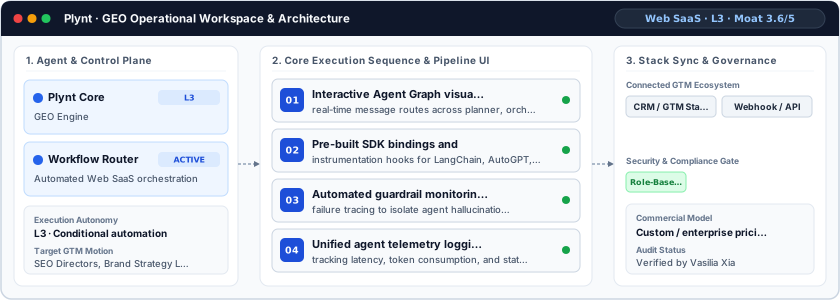
- Interactive Agent Graph visualizing: real-time message routes across planner, orchestrator, and retriever nodes
- Pre-built SDK bindings and: instrumentation hooks for LangChain, AutoGPT, and custom agent APIs
- Automated guardrail monitoring and: failure tracing to isolate agent hallucination and execution loop incidents
- Unified agent telemetry logging: tracking latency, token consumption, and state transitions per node
Cons: operational limitations & risks
- Instrumentation Overhead: Injecting deep telemetry hooks across low-latency multi-agent calls can introduce processing overhead, requiring strict sampling thresholds to avoid throttling synchronous downstream inferences.
- Framework Version Coupling: Dynamic updates to underlying open-source orchestration libraries can temporarily degrade pipeline trace schemas, necessitating continuous telemetry adapter maintenance.
- Context Payload Storage Bloat: Persisting full context window histories and iterative chain-of-thought scratchpads across complex agent swarms demands aggressive log retention policies to prevent runaway database scale.
Plynt TCO & deal-breaker stress test
Simulate 12-month stepped TCO, hidden cost multipliers, contract lock-in exposure, and stack failure modes using only facts verified by Vasilia Xia on · Capture SHA 5f791aaf.
Plynt triggers high-severity friction under your 5-seat / $800/mo constraints. Benchmark the verified subtrack alternatives below before committing.
| Plan / Tier | Verified Rate | Scale Fit | Scope & Quota Notes |
|---|---|---|---|
| Enterprise / Custom | Custom quote | 15–50+ seats (Enterprise SLA) | Sales-negotiated annual contract for custom volume, SSO/RBAC governance, and dedicated SLA. |
- Moat Score
- 3.6 / 5.0
- AI Autonomy
- L3
- Free Tier / Trial
- None disclosed
Triggered audit signals & failure modes
- Opaque Enterprise Quoting vs. SMB/Mid-Market BudgetVerified Pricing Ledger
Plynt does not disclose a public self-serve floor (Custom / enterprise pricing). Buyers with a $800/mo cap face high sales-qualification friction.
- Sales-Gated Contract TermsFact-checked by Vasilia Xia
Plynt provides an initial 14-day trial period for technical evaluation, while long-term deployment relies on commercial pricing available on request through tailored enterprise sales quotes based on organizational scale and seats.
- Primary Operational Bottleneck: Instrumentation OverheadAudit by Vasilia Xia
Injecting deep telemetry hooks across low-latency multi-agent calls can introduce processing overhead, requiring strict sampling thresholds to avoid throttling synchronous downstream inferences.
Hidden TCO Multipliers & Quota Gates
- Per-Seat Linear Scaling: Plynt prices licenses on a per-user/seat basis (Custom / enterprise pricing); expanding from 2 to 15+ operators multiplies base recurring spend linearly.
- Credit & Usage Burn Multiplier: Automated workflows consume metered credits/usage quotas; multi-step enrichment, voice minutes, or high-frequency agent runs can trigger mid-cycle top-up packs.
When to Walk Away & Negotiation Levers
- Walk away if you require transparent self-serve monthly billing or your budget ceiling is under $1,000/mo (Plynt requires sales-gated custom quoting).
- Walk away if your workflow cannot tolerate instrumentation overhead: Injecting deep telemetry hooks across low-latency multi-agent calls can introduce processing overhead, requiring strict sampling thresholds to avoid throttling synchronous downstream inferences.
- Walk away if framework version coupling is a deal-breaker for your team: Dynamic updates to underlying open-source orchestration libraries can temporarily degrade pipeline trace schemas, necessitating continuous telemetry adapter maintenance.
- Demand a 30- to 60-day paid pilot opt-out clause in the Plynt order form before signing a 12-month enterprise commitment.
- Require a sandbox proof-of-concept testing instrumentation overhead against your live CRM/data schema before annual sign-off.
Ask a custom procurement or TCO stress-test question about Plynt
Lower 5-seat floor (~$29/mo vs. Custom Quote) · Transparent self-serve entry without mandatory annual lock-in
Lower 5-seat floor (~$149/mo vs. Custom Quote) · Transparent self-serve entry without mandatory annual lock-in
Plynt moat & subtrack positioning
Deep execution graph introspection across multi-agent pipelines with native integration into frameworks like LangChain and AutoGPT, coupled with automated guardrail-level telemetry.
Editorial review
Fact-checked by Vasilia Xia (E-Commerce, Lifecycle & Retention Marketing Analyst) on .
Background
Decoupling runtime execution from distributed agent observability represents a foundational challenge in generative AI operations. Established in 2026 in Sunnyvale, California, Plynt develops multi-agent infrastructure designed to give engineering leaders, AI product managers, and enterprise technical teams rigorous visibility into autonomous agent pipelines. By intercepting agent interactions across discrete nodes—such as planners, retrievers, and execution environments—the platform establishes systematic observability across complex inference workflows. Rather than treating compound model networks as black boxes, the system introduces structured operational telemetry for autonomous deployments.
How Plynt works
At its technical core, Plynt operates at an L3 autonomy profile, capturing asynchronous trace spans from agent frameworks via dedicated SDKs supporting LangChain, AutoGPT, and raw API interfaces. As tasks traverse discrete agent microservices, Plynt’s distributed ingestion engine parses execution state changes, context retrievability, and inter-agent message payloads into an interactive directed acyclic graph. Algorithmic guardrails continuously evaluate node transitions, isolating deterministic software exceptions from semantic drift or infinite agent reflection loops. By benchmarking token consumption and contextual handoffs against historical trace baselines, the engine alerts engineering teams to anomalous latency spikes and agent logic deadlocks.
Limitations
Operational considerations and platform boundaries include:
- Instrumentation Overhead: Injecting deep telemetry hooks across low-latency multi-agent calls can introduce processing overhead, requiring strict sampling thresholds to avoid throttling synchronous downstream inferences.
- Framework Version Coupling: Dynamic updates to underlying open-source orchestration libraries can temporarily degrade pipeline trace schemas, necessitating continuous telemetry adapter maintenance.
- Context Payload Storage Bloat: Persisting full context window histories and iterative chain-of-thought scratchpads across complex agent swarms demands aggressive log retention policies to prevent runaway database scale.
Plynt pricing
Plynt provides an initial 14-day trial period for technical evaluation, while long-term deployment relies on commercial pricing available on request through tailored enterprise sales quotes based on organizational scale and seats. The commercial framework scales alongside active node density, telemetry volume, and administrative seats, avoiding fixed public pricing tiers in favor of structured enterprise service contracts.
How Plynt compares
Within the observability landscape, Plynt contrasts with platforms like Anymorph, AthenaHQ, and Brandlight. While AthenaHQ and Brandlight focus heavily on tracking end-user output rankings and external synthetic brand appearances across language models, Plynt specializes in internal runtime architecture, distributed orchestration traces, and node-level failure diagnosis. Anymorph emphasizes external model adaptation, whereas Plynt prioritizes intra-agent execution stability. The software is suited for enterprise platform engineering teams running self-hosted, multi-agent frameworks requiring granular telemetry, deterministic guardrails, and rapid incident triage.
Frequently asked questions about Plynt
How much does Plynt cost and does it require a custom enterprise quote?
Published pricing summary for Plynt: Custom / enterprise pricing. A permanent free plan is not disclosed for Plynt. Plynt provides an initial 14-day trial period for technical evaluation, while long-term deployment relies on commercial pricing available on request through tailored enterprise sales quotes based on organizational scale and seats.
How does Plynt work and how autonomous is its AI architecture?
Multi-agent infrastructure and observability platform providing real-time telemetry, execution tracing, and governance for distributed LLM agent. Within GEO (GEO Brand Tracking & LLM Rank Tracking), MarTechRadar rates its execution architecture at L3 · Conditional automation with a verified Moat Score of 3.6 / 5.0 (Proprietary moat). Deep execution graph introspection across multi-agent pipelines with native integration into frameworks like LangChain and AutoGPT, coupled with automated guardrail-level telemetry. Corporate profile: operating at 2-10 employees scale.
What are the main limitations of Plynt and when should buyers walk away?
Based on our editorial technical audit, key operational considerations and boundaries for Plynt include: (1) Instrumentation Overhead: Injecting deep telemetry hooks across low-latency multi-agent calls can introduce processing overhead, requiring strict sampling thresholds to avoid throttling synchronous downstream inferences. (2) Framework Version Coupling: Dynamic updates to underlying open-source orchestration libraries can temporarily degrade pipeline trace schemas, necessitating continuous telemetry adapter maintenance. (3) Context Payload Storage Bloat: Persisting full context window histories and iterative chain-of-thought scratchpads across complex agent swarms demands aggressive log retention policies to prevent runaway database scale. Primary procurement walk-away rule: Walk away if you require transparent self-serve monthly billing or your budget ceiling is under $1,000/mo (Plynt requires sales-gated custom quoting).
What integrations, compliance certifications, and contract terms apply to Plynt?
Key TCO multiplier to watch: Per-Seat Linear Scaling (Plynt prices licenses on a per-user/seat basis (Custom / enterprise pricing); expanding from 2 to 15+ operators multiplies base recurring spend linearly.) Before signing a contract, procurement teams should demand a 30- to 60-day paid pilot opt-out clause in the Plynt order form before signing a 12-month enterprise commitment.
What are the best Plynt alternatives and head-to-head competitors in 2026?
Top fact-checked alternatives to Plynt in GEO (GEO Brand Tracking & LLM Rank Tracking) include Petra Labs (Custom / enterprise pricing), QueryLift (Custom / enterprise pricing), Unveilr AI (Custom / enterprise pricing), BrandEcho (From $29/mo). Within the observability landscape, Plynt contrasts with platforms like Anymorph, AthenaHQ, and Brandlight.
Verified sources & evidence trail
- Official product domain: https://plynt.one
- Commercial pricing verification: Verified against official vendor pricing policy (Custom / enterprise pricing)
- Verified corporate entity profiles (
sameAs): LinkedIn Company Profile - Editorial audit sign-off: Fact-checked by Vasilia Xia on under the MarTechRadar Evidence-Ledger Protocol.