Nativo Review (2026): DCO Pricing, Pros & Cons
Bottom line
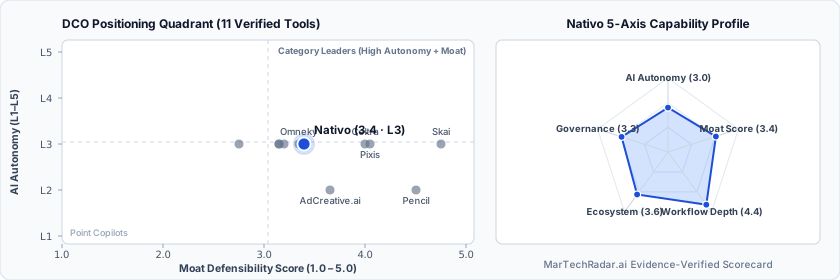
Nativo is a Web SaaS tool for DCO (Dynamic Creative Optimization / DCO) in AdTech & Paid Media. Pricing: Custom / enterprise pricing. Best suited to DTC / eCommerce and Enterprise Brands. Editor ratings: AI autonomy L3 (conditional automation); moat score 3.4/5.0 (Workflow-embedded (strong)). Fact-checked by MarTechRadar Research Desk on Oct 12, 2026.
Native advertising and dynamic creative optimization engine that programmatically renders branded content and editorial units inside publisher design systems.
Is Nativo worth it in 2026? Buyer fit & when to walk away
Choose Nativo if (Best Fit)
- Target ICP & Stack Fit: You operate as DTC / eCommerce and Enterprise Brands requiring a Web SaaS deployment for DCO, with verified ecosystem connectivity for Twilio Segment.
- L3 Architecture & Defensibility: Deep native rendering technology that dynamically matches publisher layout styling and runs sponsored editorial content on-site without external redirect friction, backed by custom engagement telemetry.
- Commercial Model Fit: Your procurement budget aligns with Custom / enterprise pricing.
Walk away from Nativo if (Deal-Breakers)
- Walk away if you need published self-serve pricing: Nativo is sold by custom quote.
- Walk away if your workflow cannot tolerate dom mutation fragility: Publisher-side structural changes, client-side single-page application framework updates, and dynamic CSS styling shifts can disrupt native layout rendering, necessitating ongoing site-by-site container mapping maintenance.
- Walk away if creative component rigidity is a deal-breaker for your team: Assets must adhere to strict modular text and image hierarchies to ensure uniform rendering across diverse layout rules, limiting unconventional, non-standard visual layouts.
Nativo pricing, free plan & scorecard at a glance
| Pricing | Custom / enterprise pricing |
|---|---|
| Free plan | No / not disclosed |
| Delivery | Web SaaS |
| Audience | DTC / eCommerce, Enterprise Brands |
| AI autonomy level | L3 · Conditional automationEditor-verified |
| Moat tier & score | 3.4 / 5.0 · Workflow-embedded (strong)Editor-verified |
| Funding | Series B |
| Company size | 51-200 employees |
| Ecosystem integrations | Twilio Segment |
| Governance & docs | API & Docs ↗ · Terms ↗ · Privacy ↗ |
| Headquarters | San Mateo, California |
| Founded | 2023 |
| Last verified | Oct 12, 2026 |
Nativo pros & cons: strengths vs. operational limitations
Pros: core strengths & capabilities
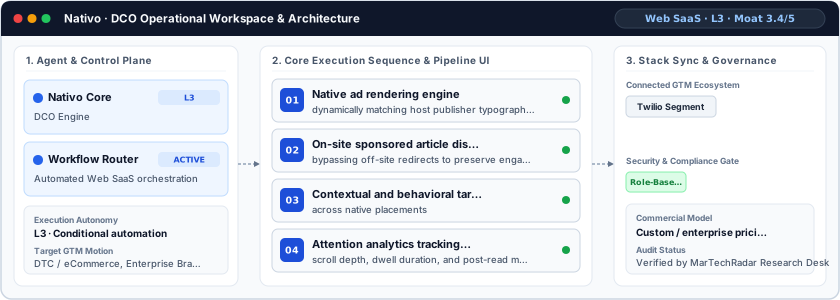
- Native ad rendering engine: dynamically matching host publisher typography and DOM layouts
- On-site sponsored article distribution: bypassing off-site redirects to preserve engagement
- Contextual and behavioral targeting: across native placements
- Attention analytics tracking reader: scroll depth, dwell duration, and post-read metrics
Cons: operational limitations & risks
- DOM Mutation Fragility: Publisher-side structural changes, client-side single-page application framework updates, and dynamic CSS styling shifts can disrupt native layout rendering, necessitating ongoing site-by-site container mapping maintenance.
- Creative Component Rigidity: Assets must adhere to strict modular text and image hierarchies to ensure uniform rendering across diverse layout rules, limiting unconventional, non-standard visual layouts.
- Attribution Latency: Because the architecture prioritizes on-site engagement and long-form consumption over instantaneous outbound redirects, multi-touch downstream attribution windows require asynchronous server-to-server data synchronization.
Nativo TCO & deal-breaker stress test
Simulate 12-month stepped TCO, hidden cost multipliers, contract lock-in exposure, and stack failure modes using only facts verified by MarTechRadar Research Desk on 2026-10-12.
Nativo triggers high-severity friction under your 5-seat / $800/mo constraints. Benchmark the verified subtrack alternatives below before committing.
- Moat Score
- 3.4 / 5.0
- AI Autonomy
- L3
- Free Tier / Trial
- None disclosed
Triggered audit signals & failure modes
- Opaque Enterprise Quoting vs. SMB/Mid-Market BudgetVerified Pricing Ledger
Nativo does not disclose a public self-serve floor (Custom / enterprise pricing). Buyers with a $800/mo cap face high sales-qualification friction.
- Sales-Gated Contract TermsFact-checked by MarTechRadar Research Desk
Commercial pricing is available on request through tailored enterprise sales quotes based on organizational scale and seats.
- Primary Operational Bottleneck: DOM Mutation FragilityAudit by MarTechRadar Research Desk
Publisher-side structural changes, client-side single-page application framework updates, and dynamic CSS styling shifts can disrupt native layout rendering, necessitating ongoing site-by-site container mapping maintenance.
Test a custom Nativo budget or stack constraint
Lower 5-seat floor (~$50/mo vs. Custom Quote) · Transparent self-serve entry without mandatory annual lock-in
Nativo integrations, API, security & compliance stack
Nativo AI moat & DCO positioning
Deep native rendering technology that dynamically matches publisher layout styling and runs sponsored editorial content on-site without external redirect friction, backed by custom engagement telemetry.
Nativo in-depth review, pricing & architecture analysis
Editor sign-off: Oct 12, 2026. How profiles are made.
What is Nativo? Overview & background
Architectured around programmatic native display and sponsored content delivery, Nativo, founded in 2023 in San Mateo, California, operates as a specialized dynamic creative optimization platform for enterprise media buyers, brand advertisers, and publishers. The platform addresses the structural tension between banner blindness and editorial integrity by decoupling branded message components from static creative containers. Rather than serving rigid iframes across publisher inventories, Nativo delivers headless creative assets into publisher DOM environments, targeting digital media planners and programmatic advertising teams demanding sustained content engagement.
How Nativo works: architecture & workflow
Nativo runs an ad-serving engine that ingests structured creative assets—headlines, body copy, hero imagery, and video feeds—and dynamically compiles them to match host site design systems, typography, and responsive grid layouts. The system operates at an L3 autonomy profile, programmatically assembling and testing creative variants across disparate publisher endpoints in real time. For long-form sponsored content, the ingestion engine renders articles directly within the publisher page frame, keeping users on-site while an analytics telemetry pipeline captures granular attention signals, including scroll velocity, active reading duration, and interaction depth.
Nativo limitations, drawbacks & risks
Operational considerations and platform boundaries include:
- DOM Mutation Fragility: Publisher-side structural changes, client-side single-page application framework updates, and dynamic CSS styling shifts can disrupt native layout rendering, necessitating ongoing site-by-site container mapping maintenance.
- Creative Component Rigidity: Assets must adhere to strict modular text and image hierarchies to ensure uniform rendering across diverse layout rules, limiting unconventional, non-standard visual layouts.
- Attribution Latency: Because the architecture prioritizes on-site engagement and long-form consumption over instantaneous outbound redirects, multi-touch downstream attribution windows require asynchronous server-to-server data synchronization.
Nativo pricing, plans & cost breakdown
Commercial pricing is available on request through tailored enterprise sales quotes based on organizational scale and seats. Contracts typically align with media spend volume, managed service requirements, publisher network integration commitments, and software-as-a-service ad serving platform tiers.
| Plan / Tier | Verified Price & Billing | Included Scope & Contract Terms |
|---|---|---|
| Enterprise / Custom | Custom quote | Custom-quoted plan; terms come from the vendor's sales team. |
How Nativo compares vs. competitors & alternatives
While creative automation engines such as AdCreative.ai and Abyssale focus on batch generation of standardized social banners and static image permutations, Nativo differentiates by dynamically injecting rendered native units directly into publisher layouts within the DCO segment. Unlike 7Pi, which centers on programmatic cross-channel feed generation, Nativo couples dynamic creative assembly with on-site editorial ad serving. The platform is best suited for enterprise media agencies and brand publishers prioritizing native reader retention, contextual alignment, and dwell time over standard display conversion metrics.
Direct competitors & market radar
Top algorithmic competitors based on category positioning, capability overlap, and ICP alignment.
Frequently asked questions about Nativo
Does Nativo publish pricing or require an enterprise quote?
Nativo pricing: Custom / enterprise pricing. No free plan is publicly disclosed. Commercial pricing is available on request through tailored enterprise sales quotes based on organizational scale and seats.
What are the top Nativo alternatives in DCO?
Verified DCO alternatives include Metadata.io (Custom / enterprise pricing), Nodals AI (Custom / enterprise pricing), Taboola (Custom / enterprise pricing), Ingosa (Free plan · $50–$149/mo). While creative automation engines such as AdCreative.ai and Abyssale focus on batch generation of standardized social banners and static image permutations, Nativo differentiates by dynamically injecting rendered native units directly into publisher layouts within the DCO segment.
What are the main limitations and trade-offs of Nativo?
Operational considerations and platform boundaries include: DOM Mutation Fragility: Publisher-side structural changes, client-side single-page application framework updates, and dynamic CSS styling shifts can disrupt native layout rendering, necessitating ongoing site-by-site container mapping maintenance. Walk away if you need published self-serve pricing: Nativo is sold by custom quote.
Verified sources & evidence trail
- Official product domain: https://nativo.com
- Commercial pricing verification: Verified against official vendor pricing policy (Custom / enterprise pricing)
- Verified corporate entity profiles (
sameAs): LinkedIn Company Profile - First-party governance & documentation links: API & Docs · Terms · Privacy
- Editor sign-off: Oct 12, 2026 (how profiles are made).
