Monocle Review (2026): Email Marketing Pricing, Limits & Alternatives
Bottom line
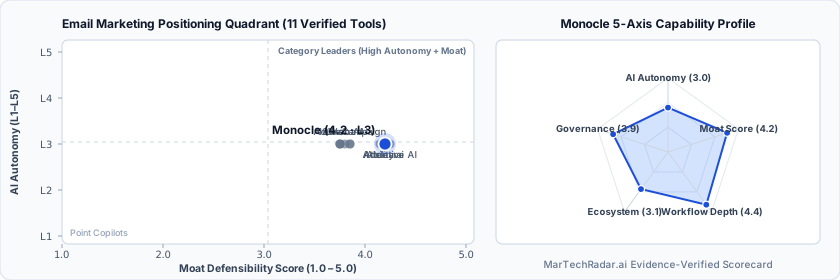
Monocle is a Web SaaS tool for Email Marketing (AI Email Marketing & Lifecycle Journeys) in Lifecycle & CDP. Pricing: Custom / enterprise pricing. Best suited to CRM & Lifecycle Marketers, eCommerce Growth Teams and Customer Experience Directors. Editor ratings: AI autonomy L3 (conditional automation); moat score 4.2/5.0 (Proprietary moat). Fact-checked by Jiacky Lee on Oct 11, 2026.
AI-native retention and promotional decisioning engine calculating individual price sensitivity to optimize discounts and email lifecycle journeys.
Monocle buyer fit verdict: when to choose vs. when to walk away
Choose Monocle if (Best Fit)
- Target ICP & Stack Fit: You operate as CRM & Lifecycle Marketers, eCommerce Growth Teams and Customer Experience Directors requiring a Web SaaS deployment for Email Marketing.
- L3 Architecture & Defensibility: Proprietary promotion elasticity scoring and personalized margin-optimizing models embedded into direct-to-consumer email flows, defending profitability against uniform discount discounting.
- Commercial Model Fit: Your procurement budget aligns with Custom / enterprise pricing.
Walk away from Monocle if (Deal-Breakers)
- Walk away if you require transparent self-serve monthly billing or your budget ceiling is under $1,000/mo (Monocle requires sales-gated custom quoting).
- Walk away if your workflow cannot tolerate cold-start data insufficiency: The predictive incentive models require continuous historical order volumes and session density to accurately model price elasticity, leading to sub-optimal default incentives on newly acquired or low-intent anonymous cohorts.
- Walk away if CDP and catalog schema latency is a deal-breaker for your team: Real-time offer decisioning relies on low-latency event synchronization; asynchronous data ingestion lags across external catalog pipelines risk distributing outdated pricing or out-of-stock product recommendations.
Monocle key facts & scorecard
| Pricing | Custom / enterprise pricing |
|---|---|
| Free plan | No / not disclosed |
| Delivery | Web SaaS |
| Audience | CRM & Lifecycle Marketers, eCommerce Growth Teams, Customer Experience Directors |
| AI autonomy level | L3 · Conditional automationEditor-verified |
| Moat tier & score | 4.2 / 5.0 · Proprietary moatEditor-verified |
| Funding | AcquiredAcquired by OuterSignal |
| Total funding | $7.5MBacked by F2 Venture Capital, Tiferes Ventures, irrvntVC |
| Founders | Mark Lotman, Noam Szpiro |
| Company size | 11-50 employees |
| Headquarters | New York, NY |
| Founded | 2023 |
| Last verified |
Monocle pros & cons: strengths vs. operational limitations
Pros: core strengths & capabilities
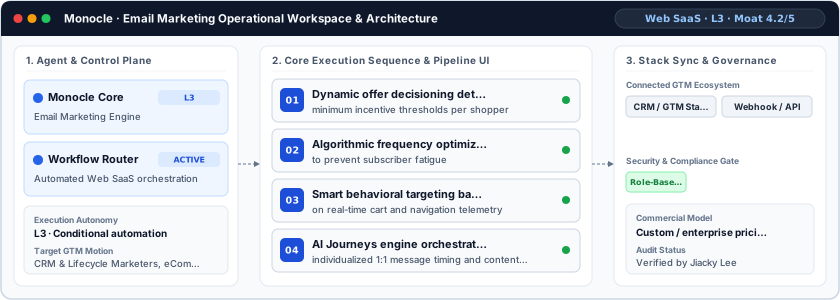
- Dynamic offer decisioning determining: minimum incentive thresholds per shopper
- Algorithmic frequency optimization: to prevent subscriber fatigue
- Smart behavioral targeting based: on real-time cart and navigation telemetry
- AI Journeys engine orchestrating: individualized 1:1 message timing and content selection
Cons: operational limitations & risks
- Cold-start data insufficiency: The predictive incentive models require continuous historical order volumes and session density to accurately model price elasticity, leading to sub-optimal default incentives on newly acquired or low-intent anonymous cohorts.
- CDP and catalog schema latency: Real-time offer decisioning relies on low-latency event synchronization; asynchronous data ingestion lags across external catalog pipelines risk distributing outdated pricing or out-of-stock product recommendations.
- ESP webhook delivery constraints: Because the platform delegates final message rendering to downstream email service providers, API rate limits and external webhook processing spikes during seasonal retail events can introduce critical delivery bottlenecks.
Monocle TCO & deal-breaker stress test
Simulate 12-month stepped TCO, hidden cost multipliers, contract lock-in exposure, and stack failure modes using only facts verified by Jiacky Lee on · Capture SHA 11c21e1e.
Monocle triggers high-severity friction under your 5-seat / $800/mo constraints. Benchmark the verified subtrack alternatives below before committing.
| Plan / Tier | Verified Rate | Scale Fit | Scope & Quota Notes |
|---|---|---|---|
| Enterprise / Custom | Custom quote | 15–50+ seats (Enterprise SLA) | Sales-negotiated annual contract for custom volume, SSO/RBAC governance, and dedicated SLA. |
- Moat Score
- 4.2 / 5.0
- AI Autonomy
- L3
- Free Tier / Trial
- None disclosed
Triggered audit signals & failure modes
- Opaque Enterprise Quoting vs. SMB/Mid-Market BudgetVerified Pricing Ledger
Monocle does not disclose a public self-serve floor (Custom / enterprise pricing). Buyers with a $800/mo cap face high sales-qualification friction.
- Sales-Gated Contract TermsFact-checked by Jiacky Lee
Monocle operates under a closed commercial model where software licensing is available on request through tailored enterprise sales quotes based on organizational scale and seats.
- Primary Operational Bottleneck: Cold-start data insufficiencyAudit by Jiacky Lee
The predictive incentive models require continuous historical order volumes and session density to accurately model price elasticity, leading to sub-optimal default incentives on newly acquired or low-intent anonymous cohorts.
Hidden TCO Multipliers & Quota Gates
- Cold-start data insufficiency: The predictive incentive models require continuous historical order volumes and session density to accurately model price elasticity, leading to sub-optimal default incentives on newly acquired or low-intent anonymous cohorts.
- CDP and catalog schema latency: Real-time offer decisioning relies on low-latency event synchronization; asynchronous data ingestion lags across external catalog pipelines risk distributing outdated pricing or out-of-stock product recommendations.
When to Walk Away & Negotiation Levers
- Walk away if you require transparent self-serve monthly billing or your budget ceiling is under $1,000/mo (Monocle requires sales-gated custom quoting).
- Walk away if your workflow cannot tolerate cold-start data insufficiency: The predictive incentive models require continuous historical order volumes and session density to accurately model price elasticity, leading to sub-optimal default incentives on newly acquired or low-intent anonymous cohorts.
- Walk away if CDP and catalog schema latency is a deal-breaker for your team: Real-time offer decisioning relies on low-latency event synchronization; asynchronous data ingestion lags across external catalog pipelines risk distributing outdated pricing or out-of-stock product recommendations.
- Demand a 30- to 60-day paid pilot opt-out clause in the Monocle order form before signing a 12-month enterprise commitment.
- Require a sandbox proof-of-concept testing cold-start data insufficiency against your live CRM/data schema before annual sign-off.
Ask a custom procurement or TCO stress-test question about Monocle
Lower 5-seat floor (~$21/mo vs. Custom Quote) · Transparent self-serve entry without mandatory annual lock-in
Lower 5-seat floor (~$6/mo vs. Custom Quote) · Transparent self-serve entry without mandatory annual lock-in
Monocle moat & subtrack positioning
Proprietary promotion elasticity scoring and personalized margin-optimizing models embedded into direct-to-consumer email flows, defending profitability against uniform discount discounting.
Editorial review
Fact-checked by Jiacky Lee (Managing Editor, AI Autonomy & Moat Methodology) on .
Background
E-commerce retention leaders face persistent margin compression when deploying blanket discount strategies across standard email workflows. Founded in 2023 and headquartered in New York, NY, Monocle was engineered to replace static coupon distribution with real-time dynamic incentive targeting. Having secured $7.5M in venture backing, the platform targets retention, CRM, and growth marketing teams across high-volume direct-to-consumer brands seeking to protect gross margins without sacrificing subscriber conversion rates.
How Monocle works
Monocle functions as an automated lifecycle decisioning layer connecting upstream commerce systems and customer data platforms with downstream outbound messaging channels. The platform ingests live shopper navigation, historical order frequency, and session telemetry into predictive inference pipelines. Its algorithmic engine evaluates price elasticity at the individual customer level, resolving optimal incentive values, message frequency, and dispatch timing before passing automated triggers into customer messaging journeys.
Limitations
Operational considerations and platform boundaries include:
- Cold-start data insufficiency: The predictive incentive models require continuous historical order volumes and session density to accurately model price elasticity, leading to sub-optimal default incentives on newly acquired or low-intent anonymous cohorts.
- CDP and catalog schema latency: Real-time offer decisioning relies on low-latency event synchronization; asynchronous data ingestion lags across external catalog pipelines risk distributing outdated pricing or out-of-stock product recommendations.
- ESP webhook delivery constraints: Because the platform delegates final message rendering to downstream email service providers, API rate limits and external webhook processing spikes during seasonal retail events can introduce critical delivery bottlenecks.
Monocle pricing
Monocle operates under a closed commercial model where software licensing is available on request through tailored enterprise sales quotes based on organizational scale and seats. Contracts typically incorporate platform access, unified data connector overhead, and recurring monthly active customer tiers, negotiated directly with technical account representatives.
How Monocle compares
Within the AI email marketing and lifecycle automation ecosystem, Monocle differentiates itself by focusing on autonomous promotional decisioning rather than broad experimentation or site design. While AB Tasty prioritizes client-side front-end experimentation and 10Web AI emphasizes automated web presence creation, Monocle operates strictly within retention pipelines to calculate margin-preserving incentives. Ability.ai targets broader multi-channel autonomous agents, leaving Monocle tailored for mid-market to enterprise direct-to-consumer retailers seeking to govern discount economics inside automated messaging flows.
Direct competitors & market radar
Top algorithmic competitors based on category positioning, capability overlap, and ICP alignment.
Frequently asked questions about Monocle
How much does Monocle cost and does it require a custom enterprise quote?
Published pricing summary for Monocle: Custom / enterprise pricing. A permanent free plan is not disclosed for Monocle. Monocle operates under a closed commercial model where software licensing is available on request through tailored enterprise sales quotes based on organizational scale and seats.
How does Monocle work and how autonomous is its AI architecture?
AI-native retention and promotional decisioning engine calculating individual price sensitivity to optimize discounts and email lifecycle journeys. Within Email Marketing (AI Email Marketing & Lifecycle Journeys), MarTechRadar rates its execution architecture at L3 · Conditional automation with a verified Moat Score of 4.2 / 5.0 (Proprietary moat). Proprietary promotion elasticity scoring and personalized margin-optimizing models embedded into direct-to-consumer email flows, defending profitability against uniform discount discounting. Corporate profile: Founded by Mark Lotman, Noam Szpiro, operating at 11-50 employees scale, acquired by OuterSignal.
What are the main limitations of Monocle and when should buyers walk away?
Based on our editorial technical audit, key operational considerations and boundaries for Monocle include: (1) Cold-start data insufficiency: The predictive incentive models require continuous historical order volumes and session density to accurately model price elasticity, leading to sub-optimal default incentives on newly acquired or low-intent anonymous cohorts. (2) CDP and catalog schema latency: Real-time offer decisioning relies on low-latency event synchronization; asynchronous data ingestion lags across external catalog pipelines risk distributing outdated pricing or out-of-stock product recommendations. (3) ESP webhook delivery constraints: Because the platform delegates final message rendering to downstream email service providers, API rate limits and external webhook processing spikes during seasonal retail events can introduce critical delivery bottlenecks. Primary procurement walk-away rule: Walk away if you require transparent self-serve monthly billing or your budget ceiling is under $1,000/mo (Monocle requires sales-gated custom quoting).
What integrations, compliance certifications, and contract terms apply to Monocle?
Key TCO multiplier to watch: Cold-start data insufficiency (The predictive incentive models require continuous historical order volumes and session density to accurately model price elasticity, leading to sub-optimal default incentives on newly acquired or low-intent anonymous cohorts.) Before signing a contract, procurement teams should demand a 30- to 60-day paid pilot opt-out clause in the Monocle order form before signing a 12-month enterprise commitment.
What are the best Monocle alternatives and head-to-head competitors in 2026?
Top fact-checked alternatives to Monocle in Email Marketing (AI Email Marketing & Lifecycle Journeys) include Haast (Custom / enterprise pricing), Kustomer (Custom / enterprise pricing), Nas.com (From $20.75/mo), Wunderkind (Custom / enterprise pricing). Within the AI email marketing and lifecycle automation ecosystem, Monocle differentiates itself by focusing on autonomous promotional decisioning rather than broad experimentation or site design.
Verified sources & evidence trail
- Official product domain: https://www.usemonocle.com/
- Commercial pricing verification: Verified against official vendor pricing policy (Custom / enterprise pricing)
- Verified corporate entity profiles (
sameAs): LinkedIn Company Profile · Crunchbase Entity Record - Editorial audit sign-off: Fact-checked by Jiacky Lee on under the MarTechRadar Evidence-Ledger Protocol.