Monetate Review (2026): AI Landing Page Pricing, Pros & Cons
Bottom line
Monetate is a Web SaaS tool for AI Landing Page (Landing Page Builders & Autonomous CRO) in Lifecycle & CDP. Pricing: Custom / enterprise pricing. Best suited to DTC / eCommerce and Enterprise Brands. Editor ratings: AI autonomy L3 (conditional automation); moat score 4.2/5.0 (Proprietary moat). Fact-checked by MarTechRadar Research Desk on Oct 12, 2026.
Enterprise customer experience optimization and dynamic personalization engine driving automated audience targeting, A/B testing, and product merchandising.
Is Monetate worth it in 2026? Buyer fit & when to walk away
Choose Monetate if (Best Fit)
- Target ICP & Stack Fit: You operate as DTC / eCommerce and Enterprise Brands requiring a Web SaaS deployment for AI Landing Page.
- L3 Architecture & Defensibility: Deeply embedded client-side and server-side decision engines supported by enterprise catalog metadata ingestion and predictive machine learning models tailored for multi-channel commerce experiences.
- Commercial Model Fit: Your procurement budget aligns with Custom / enterprise pricing.
Walk away from Monetate if (Deal-Breakers)
- Walk away if you need published self-serve pricing: Monetate is sold by custom quote.
- Walk away if your workflow cannot tolerate client-side dom latency: Asynchronous script execution on heavy retail storefronts can cause cumulative layout shifts or visual flicker if DOM mutation elements are not cached properly at the CDN edge.
- Walk away if catalog schema synchronization is a deal-breaker for your team: Dynamic product merchandising relies on batch catalog ingestion; desynchronizations between enterprise PIM systems and Monetate indices lead to ghost-inventory recommendations during high-velocity promotional events.
Monetate pricing, free plan & scorecard at a glance
| Pricing | Custom / enterprise pricing |
|---|---|
| Free plan | No / not disclosed |
| Delivery | Web SaaS |
| Audience | DTC / eCommerce, Enterprise Brands |
| AI autonomy level | L3 · Conditional automationEditor-verified |
| Moat tier & score | 4.2 / 5.0 · Proprietary moatEditor-verified |
| Funding | AcquiredAcquired by Kibo Commerce |
| Total funding | $46MBacked by First Round Capital, OpenView |
| Founders | David Bookspan, David Brussin |
| Company size | 51-200 employees |
| Governance & docs | API & Docs ↗ · Terms ↗ |
| Headquarters | Dallas, Texas |
| Founded | 2008 |
| Last verified | Oct 12, 2026 |
Monetate pros & cons: strengths vs. operational limitations
Pros: core strengths & capabilities
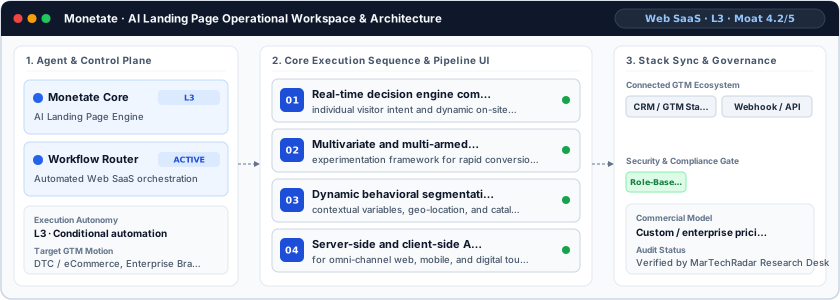
- Real-time decision engine computing: individual visitor intent and dynamic on-site product presentation
- Multivariate and multi-armed bandit: experimentation framework for rapid conversion rate optimization
- Dynamic behavioral segmentation leveraging: contextual variables, geo-location, and catalog affinity
- Server-side and client-side API integrations: for omni-channel web, mobile, and digital touchpoints
Cons: operational limitations & risks
- Client-Side DOM Latency: Asynchronous script execution on heavy retail storefronts can cause cumulative layout shifts or visual flicker if DOM mutation elements are not cached properly at the CDN edge.
- Catalog Schema Synchronization: Dynamic product merchandising relies on batch catalog ingestion; desynchronizations between enterprise PIM systems and Monetate indices lead to ghost-inventory recommendations during high-velocity promotional events.
- Attribution Window Degradation: Client-side identification degrades under strict browser cookie expiration policies, compromising multi-session attribution models for anonymous shoppers who fail to authenticate across consecutive days.
Monetate TCO & deal-breaker stress test
Simulate 12-month stepped TCO, hidden cost multipliers, contract lock-in exposure, and stack failure modes using only facts verified by MarTechRadar Research Desk on 2026-10-12.
Monetate triggers high-severity friction under your 5-seat / $800/mo constraints. Benchmark the verified subtrack alternatives below before committing.
- Moat Score
- 4.2 / 5.0
- AI Autonomy
- L3
- Free Tier / Trial
- None disclosed
Triggered audit signals & failure modes
- Opaque Enterprise Quoting vs. SMB/Mid-Market BudgetVerified Pricing Ledger
Monetate does not disclose a public self-serve floor (Custom / enterprise pricing). Buyers with a $800/mo cap face high sales-qualification friction.
- Sales-Gated Contract TermsFact-checked by MarTechRadar Research Desk
Monetate operates an enterprise software-as-a-service licensing structure with no public pricing tiers published. Commercial pricing is available on request through tailored enterprise sales quotes based on organizational scale and seats.
- Primary Operational Bottleneck: Client-Side DOM LatencyAudit by MarTechRadar Research Desk
Asynchronous script execution on heavy retail storefronts can cause cumulative layout shifts or visual flicker if DOM mutation elements are not cached properly at the CDN edge.
Test a custom Monetate budget or stack constraint
Lower 5-seat floor (~$49/mo vs. Custom Quote) · Transparent self-serve entry without mandatory annual lock-in
Lower 5-seat floor (~$25/mo vs. Custom Quote) · Transparent self-serve entry without mandatory annual lock-in
Monetate AI moat & AI Landing Page positioning
Deeply embedded client-side and server-side decision engines supported by enterprise catalog metadata ingestion and predictive machine learning models tailored for multi-channel commerce experiences.
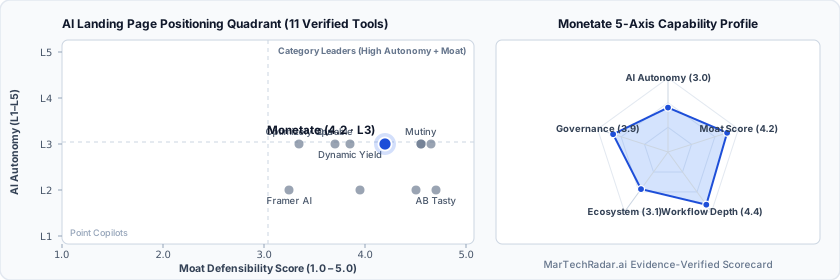
Monetate in-depth review, pricing & architecture analysis
Editor sign-off: Oct 12, 2026. How profiles are made.
What is Monetate? Overview & background
Architectured around real-time behavioral decisioning for omnichannel retail environments, Monetate was established in 2008 in Dallas, Texas. Supported by $46M in historical equity financing, the platform serves enterprise e-commerce merchants, digital merchandising leaders, and growth marketing teams seeking to replace static web layouts with deterministic, context-aware digital customer journeys. Rather than serving purely as an email broadcast tool, Monetate acts as an experience optimization layer orchestrating product recommendations and tailored content across user touchpoints.
How Monetate works: architecture & workflow
At its technical core, Monetate executes via an edge tag injection layer coupled with server-side decisioning APIs. The Monetate Decision Engine evaluates concurrent session telemetry—including cart state, historical clickstream, referral metadata, and geographic coordinates—against real-time catalog feeds. Running at an L3 operational autonomy level, the algorithmic routing automates variant testing via dynamic multi-armed bandit algorithms, routing traffic toward top-performing promotions without manual parameter retraining while maintaining deterministic rule sets for strict inventory governance.
Monetate limitations, drawbacks & risks
Operational considerations and platform boundaries include:
- Client-Side DOM Latency: Asynchronous script execution on heavy retail storefronts can cause cumulative layout shifts or visual flicker if DOM mutation elements are not cached properly at the CDN edge.
- Catalog Schema Synchronization: Dynamic product merchandising relies on batch catalog ingestion; desynchronizations between enterprise PIM systems and Monetate indices lead to ghost-inventory recommendations during high-velocity promotional events.
- Attribution Window Degradation: Client-side identification degrades under strict browser cookie expiration policies, compromising multi-session attribution models for anonymous shoppers who fail to authenticate across consecutive days.
Monetate pricing, plans & cost breakdown
Monetate operates an enterprise software-as-a-service licensing structure with no public pricing tiers published. Commercial pricing is available on request through tailored enterprise sales quotes based on organizational scale and seats. Contracts are scaled according to aggregate monthly web traffic, digital interaction volumes, dynamic catalog size, and required server-side API capacity.
| Plan / Tier | Verified Price & Billing | Included Scope & Contract Terms |
|---|---|---|
| Enterprise / Custom | Custom quote | Custom-quoted plan; terms come from the vendor's sales team. |
How Monetate compares vs. competitors & alternatives
Within experience optimization, Monetate confronts platforms like AB Tasty, which targets rapid front-end experimentation, and autonomous marketing frameworks such as Ability.ai or automated website builders like 10Web AI. While competitors emphasize low-code visual builders or pure generative pipelines, Monetate focuses on high-throughput catalog indexing and real-time behavioral merchandising. It remains tailored for enterprise retail organizations requiring high-volume transactional decisioning and complex merchandiser control.
Direct competitors & market radar
Top algorithmic competitors based on category positioning, capability overlap, and ICP alignment.
Frequently asked questions about Monetate
Does Monetate publish pricing or require an enterprise quote?
Monetate pricing: Custom / enterprise pricing. No free plan is publicly disclosed. Monetate operates an enterprise software-as-a-service licensing structure with no public pricing tiers published. Commercial pricing is available on request through tailored enterprise sales quotes based on organizational scale and seats.
What are the top Monetate alternatives in AI Landing Page?
Verified AI Landing Page alternatives include Dynamic Yield (Custom / enterprise pricing), Sleeknote (From $49/mo), Typeform ($25–$266/mo · Enterprise plan), Omnisend (Custom / enterprise pricing). Within experience optimization, Monetate confronts platforms like AB Tasty, which targets rapid front-end experimentation, and autonomous marketing frameworks such as Ability.ai or automated website builders like 10Web AI.
What are the main limitations and trade-offs of Monetate?
Operational considerations and platform boundaries include: Client-Side DOM Latency: Asynchronous script execution on heavy retail storefronts can cause cumulative layout shifts or visual flicker if DOM mutation elements are not cached properly at the CDN edge. Walk away if you need published self-serve pricing: Monetate is sold by custom quote.
Verified sources & evidence trail
- Official product domain: https://monetate.com
- Commercial pricing verification: Verified against official vendor pricing policy (Custom / enterprise pricing)
- Verified corporate entity profiles (
sameAs): LinkedIn Company Profile · Crunchbase Entity Record - First-party governance & documentation links: API & Docs · Terms
- Editor sign-off: Oct 12, 2026 (how profiles are made).
