Micro Review (2026): AI Marketing Agent Pricing, Limits & Alternatives
Bottom line
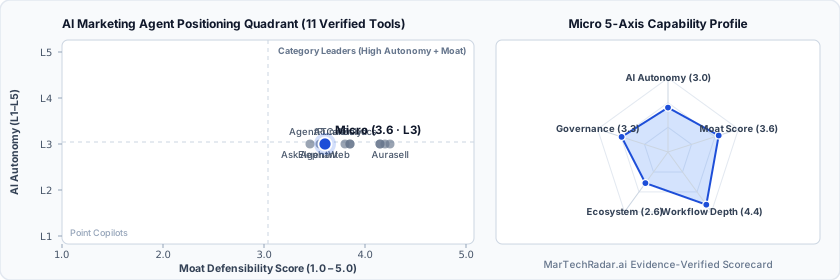
Micro is a Web SaaS tool for AI Marketing Agent (Autonomous Marketing Agents & Digital Coworkers) in Agent & Marketing Ops. Pricing: Custom / enterprise pricing. Best suited to GTM Operations Teams, Enterprise Marketing Executives and Automated Ops Teams. Editor ratings: AI autonomy L3 (conditional automation); moat score 3.6/5.0 (Proprietary moat). Fact-checked by Vasilia Xia on Oct 15, 2026.
Autonomous digital marketing coworker coordinating multi-step campaign planning, execution, and CRM pipeline automation.
Micro buyer fit verdict: when to choose vs. when to walk away
Choose Micro if (Best Fit)
- Target ICP & Stack Fit: You operate as GTM Operations Teams, Enterprise Marketing Executives and Automated Ops Teams requiring a Web SaaS deployment for AI Marketing Agent.
- L3 Architecture & Defensibility: Proprietary deterministic task-planning graphs coupled with deep bidirectional CRM and ad-network integrations that execute multi-step marketing operations without continuous human supervision.
- Commercial Model Fit: Your procurement budget aligns with Custom / enterprise pricing.
Walk away from Micro if (Deal-Breakers)
- Walk away if you require transparent self-serve monthly billing or your budget ceiling is under $1,000/mo (Micro requires sales-gated custom quoting).
- Walk away if your workflow cannot tolerate API rate limits and throughput throttle: High-frequency campaign adjustments across third-party ad networks and email service providers frequently hit upstream vendor rate limits, causing execution delays during synchronized multi-channel pushes.
- Walk away if schema drift vulnerability is a deal-breaker for your team: Custom fields or undocumented alterations within connected CRM schemas disrupt the agent's entity-resolution models, requiring manual field remapping to prevent erroneous task execution.
Micro key facts & scorecard
| Pricing | Custom / enterprise pricing |
|---|---|
| Free plan | No / not disclosed |
| Delivery | Web SaaS |
| Audience | GTM Operations Teams, Enterprise Marketing Executives, Automated Ops Teams |
| AI autonomy level | L3 · Conditional automationEditor-verified |
| Moat tier & score | 3.6 / 5.0 · Proprietary moatEditor-verified |
| Funding | Seed |
| Headquarters | Global |
| Last verified |
Micro pros & cons: strengths vs. operational limitations
Pros: core strengths & capabilities
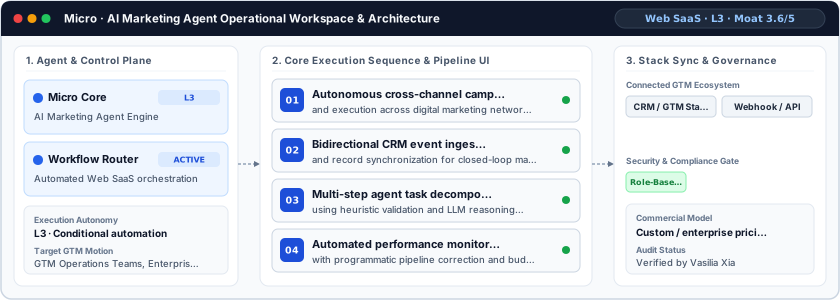
- Autonomous cross-channel campaign orchestration: and execution across digital marketing networks
- Bidirectional CRM event ingestion: and record synchronization for closed-loop marketing actions
- Multi-step agent task decomposition: using heuristic validation and LLM reasoning chains
- Automated performance monitoring: with programmatic pipeline correction and budget reallocation
Cons: operational limitations & risks
- API Rate Limits and Throughput Throttle: High-frequency campaign adjustments across third-party ad networks and email service providers frequently hit upstream vendor rate limits, causing execution delays during synchronized multi-channel pushes.
- Schema Drift Vulnerability: Custom fields or undocumented alterations within connected CRM schemas disrupt the agent's entity-resolution models, requiring manual field remapping to prevent erroneous task execution.
- Attribution Latency and Feedback Gaps: Because conversion events in complex B2B pipelines feature multi-week attribution windows, the agent's real-time programmatic adjustments can over-index on immediate vanity indicators rather than downstream pipeline revenue.
Micro TCO & deal-breaker stress test
Simulate 12-month stepped TCO, hidden cost multipliers, contract lock-in exposure, and stack failure modes using only facts verified by Vasilia Xia on .
Micro triggers high-severity friction under your 5-seat / $800/mo constraints. Benchmark the verified subtrack alternatives below before committing.
| Plan / Tier | Verified Rate | Scale Fit | Scope & Quota Notes |
|---|---|---|---|
| Enterprise / Custom | Custom quote | 15–50+ seats (Enterprise SLA) | Sales-negotiated annual contract for custom volume, SSO/RBAC governance, and dedicated SLA. |
- Moat Score
- 3.6 / 5.0
- AI Autonomy
- L3
- Free Tier / Trial
- None disclosed
Triggered audit signals & failure modes
- Opaque Enterprise Quoting vs. SMB/Mid-Market BudgetVerified Pricing Ledger
Micro does not disclose a public self-serve floor (Custom / enterprise pricing). Buyers with a $800/mo cap face high sales-qualification friction.
- Sales-Gated Contract TermsFact-checked by Vasilia Xia
Pricing is available on request through tailored enterprise sales quotes, with custom enterprise tiers structured around organizational scale, user seats, and workflow volume.
- Primary Operational Bottleneck: API Rate Limits and Throughput ThrottleAudit by Vasilia Xia
High-frequency campaign adjustments across third-party ad networks and email service providers frequently hit upstream vendor rate limits, causing execution delays during synchronized multi-channel pushes.
Hidden TCO Multipliers & Quota Gates
- API Rate Limits and Throughput Throttle: High-frequency campaign adjustments across third-party ad networks and email service providers frequently hit upstream vendor rate limits, causing execution delays during synchronized multi-channel pushes.
- Schema Drift Vulnerability: Custom fields or undocumented alterations within connected CRM schemas disrupt the agent's entity-resolution models, requiring manual field remapping to prevent erroneous task execution.
When to Walk Away & Negotiation Levers
- Walk away if you require transparent self-serve monthly billing or your budget ceiling is under $1,000/mo (Micro requires sales-gated custom quoting).
- Walk away if your workflow cannot tolerate API rate limits and throughput throttle: High-frequency campaign adjustments across third-party ad networks and email service providers frequently hit upstream vendor rate limits, causing execution delays during synchronized multi-channel pushes.
- Walk away if schema drift vulnerability is a deal-breaker for your team: Custom fields or undocumented alterations within connected CRM schemas disrupt the agent's entity-resolution models, requiring manual field remapping to prevent erroneous task execution.
- Demand a 30- to 60-day paid pilot opt-out clause in the Micro order form before signing a 12-month enterprise commitment.
- Require a sandbox proof-of-concept testing API rate limits and throughput throttle against your live CRM/data schema before annual sign-off.
Ask a custom procurement or TCO stress-test question about Micro
Lower 5-seat floor (~$100/mo vs. Custom Quote) · Transparent self-serve entry without mandatory annual lock-in
Lower 5-seat floor (~$495/mo vs. Custom Quote) · Transparent self-serve entry without mandatory annual lock-in
Micro moat & subtrack positioning
Proprietary deterministic task-planning graphs coupled with deep bidirectional CRM and ad-network integrations that execute multi-step marketing operations without continuous human supervision.
Editorial review
Fact-checked by Vasilia Xia (E-Commerce, Lifecycle & Retention Marketing Analyst) on .
Background
Micro is an autonomous marketing agent platform headquartered globally, engineered to address cross-channel operational bottlenecks across commercial growth pipelines. Designed for digital marketing directors, demand generation managers, and marketing operations architects, the solution operates as a virtual coworker capable of delegating, executing, and optimizing promotional initiatives. Rather than relying on static rules or siloed execution scripts, Micro provides an orchestration layer that interfaces directly with underlying growth stacks to manage multi-channel campaign lifecycles.
How Micro works
Under the hood, Micro functions through an asynchronous task-planning engine operating with Level 3 conditional autonomy. The architecture ingests first-party data, customer interaction logs, and campaign telemetry via bidirectional application programming interface connections to common customer relationship management platforms and advertising networks. Incoming data feeds an agentic reasoning loop that evaluates conversion trends against historical benchmarks, generates tactical intervention plans, and executes write actions across ad platforms, messaging tools, and database records without manual intervention.
Limitations
Operational considerations and platform boundaries include:
- API Rate Limits and Throughput Throttle: High-frequency campaign adjustments across third-party ad networks and email service providers frequently hit upstream vendor rate limits, causing execution delays during synchronized multi-channel pushes.
- Schema Drift Vulnerability: Custom fields or undocumented alterations within connected CRM schemas disrupt the agent's entity-resolution models, requiring manual field remapping to prevent erroneous task execution.
- Attribution Latency and Feedback Gaps: Because conversion events in complex B2B pipelines feature multi-week attribution windows, the agent's real-time programmatic adjustments can over-index on immediate vanity indicators rather than downstream pipeline revenue.
Micro pricing
Pricing is available on request through tailored enterprise sales quotes, with custom enterprise tiers structured around organizational scale, user seats, and workflow volume.
How Micro compares
Within the autonomous marketing coworker category, Micro contends with alternative agent architectures such as ai-marketing-claude, allGood, and AskElephant. While ai-marketing-claude centers on conversational prompt-driven content formulation and AskElephant targets customer intelligence retrieval, Micro focuses strictly on closed-loop operational workflows and bidirectional CRM adjustments. Conversely, allGood emphasizes collaborative creative approvals, whereas Micro targets autonomous execution. This makes Micro suitable for growth-stage and mid-market marketing organizations with mature tech stacks seeking programmatic campaign execution without expanding headcount. It is best suited for enterprise marketing teams and growth practitioners seeking disciplined workflow orchestration.
Frequently asked questions about Micro
How much does Micro cost and does it require a custom enterprise quote?
Published pricing summary for Micro: Custom / enterprise pricing. A permanent free plan is not disclosed for Micro. Pricing is available on request through tailored enterprise sales quotes, with custom enterprise tiers structured around organizational scale, user seats, and workflow volume.
How does Micro work and how autonomous is its AI architecture?
Autonomous digital marketing coworker coordinating multi-step campaign planning, execution, and CRM pipeline automation. Within AI Marketing Agent (Autonomous Marketing Agents & Digital Coworkers), MarTechRadar rates its execution architecture at L3 · Conditional automation with a verified Moat Score of 3.6 / 5.0 (Proprietary moat). Proprietary deterministic task-planning graphs coupled with deep bidirectional CRM and ad-network integrations that execute multi-step marketing operations without continuous human supervision.
What are the main limitations of Micro and when should buyers walk away?
Based on our editorial technical audit, key operational considerations and boundaries for Micro include: (1) API Rate Limits and Throughput Throttle: High-frequency campaign adjustments across third-party ad networks and email service providers frequently hit upstream vendor rate limits, causing execution delays during synchronized multi-channel pushes. (2) Schema Drift Vulnerability: Custom fields or undocumented alterations within connected CRM schemas disrupt the agent's entity-resolution models, requiring manual field remapping to prevent erroneous task execution. (3) Attribution Latency and Feedback Gaps: Because conversion events in complex B2B pipelines feature multi-week attribution windows, the agent's real-time programmatic adjustments can over-index on immediate vanity indicators rather than downstream pipeline revenue. Primary procurement walk-away rule: Walk away if you require transparent self-serve monthly billing or your budget ceiling is under $1,000/mo (Micro requires sales-gated custom quoting).
What integrations, compliance certifications, and contract terms apply to Micro?
Key TCO multiplier to watch: API Rate Limits and Throughput Throttle (High-frequency campaign adjustments across third-party ad networks and email service providers frequently hit upstream vendor rate limits, causing execution delays during synchronized multi-channel pushes.) Before signing a contract, procurement teams should demand a 30- to 60-day paid pilot opt-out clause in the Micro order form before signing a 12-month enterprise commitment.
What are the best Micro alternatives and head-to-head competitors in 2026?
Top fact-checked alternatives to Micro in AI Marketing Agent (Autonomous Marketing Agents & Digital Coworkers) include IPG Interactive Engine (Custom / enterprise pricing), Microsoft AutoGen (Custom / enterprise pricing), Microsoft Copilot Studio (Custom / enterprise pricing), PROQX INNOVATIONS PRIVATE LIMITED (Custom / enterprise pricing). Within the autonomous marketing coworker category, Micro contends with alternative agent architectures such as ai-marketing-claude, allGood, and AskElephant.
Verified sources & evidence trail
- Official product domain: https://www.micro.so/
- Commercial pricing verification: Verified against official vendor pricing policy (Custom / enterprise pricing)
- Editorial audit sign-off: Fact-checked by Vasilia Xia on under the MarTechRadar Evidence-Ledger Protocol.