Luthor Review (2026): AI Content Marketing Pricing, Limits & Alternatives
Bottom line
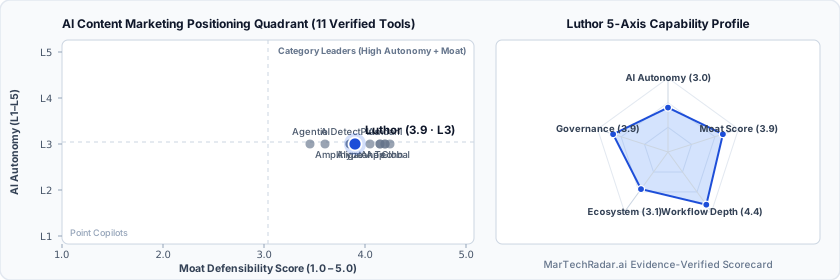
Luthor is a Web SaaS tool for AI Content Marketing (Enterprise & Long-Form Brand Content) in Copy & Content. Pricing: Pricing not disclosed. Best suited to B2B SaaS and Marketing & Growth Teams. Editor ratings: AI autonomy L3 (conditional automation); moat score 3.9/5.0 (Proprietary moat). Fact-checked by Jagmeet Sine on Oct 16, 2026.
Real-time enterprise marketing compliance platform that audits, enforces, and logs regulatory and brand rules across content for financial services.
Luthor buyer fit verdict: when to choose vs. when to walk away
Choose Luthor if (Best Fit)
- Target ICP & Stack Fit: You operate as B2B SaaS and Marketing & Growth Teams requiring a Web SaaS deployment for AI Content Marketing.
- L3 Architecture & Defensibility: Embedding automated SEC, FINRA, and banking regulatory rule engines with immutable audit logging into enterprise marketing review workflows creates high switching costs in regulated verticals.
- Commercial Model Fit: Your procurement budget aligns with Pricing not disclosed.
Walk away from Luthor if (Deal-Breakers)
- Walk away if you require transparent self-serve monthly billing or your budget ceiling is under $1,000/mo (Luthor requires sales-gated custom quoting).
- Walk away if your workflow cannot tolerate regulated vertical focus boundary: Because Luthor's deepest pre-built rule libraries target financial services, banking, and investment advisory compliance, unregulated consumer lifestyle brands will find its legal workflow controls overly heavy for casual social publishing.
- Walk away if custom legal policy calibration latency is a deal-breaker for your team: Translating bespoke institution-specific legal interpretations and historical enforcement precedents into automated checking rules requires initial compliance counsel collaboration, creating an onboarding learning curve and setup bottleneck.
Luthor key facts & scorecard
| Pricing | Pricing not disclosed |
|---|---|
| Free plan | No / not disclosed |
| Delivery | Web SaaS |
| Audience | B2B SaaS, Marketing & Growth Teams |
| AI autonomy level | L3 · Conditional automationEditor-verified |
| Moat tier & score | 3.9 / 5.0 · Proprietary moatEditor-verified |
| Funding | Seed |
| Total funding | $500K |
| Founders | Glenn Espinosa, John Espinosa |
| Company size | 11-50 employees |
| Governance & docs | Trust & Security ↗ · Terms ↗ · Privacy ↗ |
| Headquarters | San Francisco, California |
| Founded | 2024 |
| Last verified |
Luthor pros & cons: strengths vs. operational limitations
Pros: core strengths & capabilities
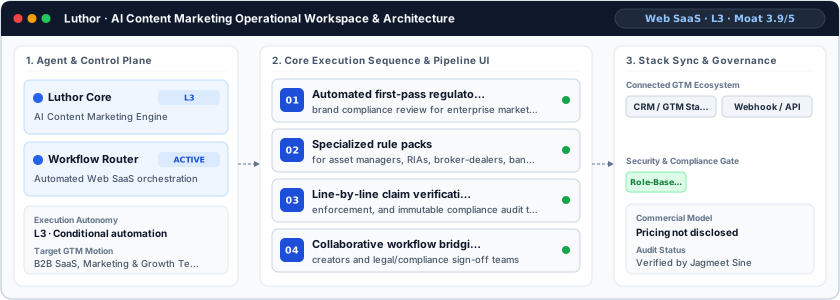
- Automated first-pass regulatory and: brand compliance review for enterprise marketing assets
- Specialized rule packs: for asset managers, RIAs, broker-dealers, banks, and credit unions
- Line-by-line claim verification, disclosure: enforcement, and immutable compliance audit trails
- Collaborative workflow bridging marketing: creators and legal/compliance sign-off teams
Cons: operational limitations & risks
- Regulated Vertical Focus Boundary: Because Luthor's deepest pre-built rule libraries target financial services, banking, and investment advisory compliance, unregulated consumer lifestyle brands will find its legal workflow controls overly heavy for casual social publishing.
- Custom Legal Policy Calibration Latency: Translating bespoke institution-specific legal interpretations and historical enforcement precedents into automated checking rules requires initial compliance counsel collaboration, creating an onboarding learning curve and setup bottleneck.
- Zero-False-Negative Governance Barrier: In strict FINRA or SEC examination environments, automated first-pass AI review still requires final human compliance officer sign-off on high-risk fund performance disclosures, maintaining a human-in-the-loop governance barrier.
Luthor TCO & deal-breaker stress test
Simulate 12-month stepped TCO, hidden cost multipliers, contract lock-in exposure, and stack failure modes using only facts verified by Jagmeet Sine on · Capture SHA 1076a8f4.
Luthor triggers high-severity friction under your 5-seat / $800/mo constraints. Benchmark the verified subtrack alternatives below before committing.
| Plan / Tier | Verified Rate | Scale Fit | Scope & Quota Notes |
|---|---|---|---|
| Enterprise / Custom | Custom quote | 15–50+ seats (Enterprise SLA) | Sales-negotiated annual contract for custom volume, SSO/RBAC governance, and dedicated SLA. |
- Moat Score
- 3.9 / 5.0
- AI Autonomy
- L3
- Free Tier / Trial
- None disclosed
Triggered audit signals & failure modes
- Opaque Enterprise Quoting vs. SMB/Mid-Market BudgetVerified Pricing Ledger
Luthor does not disclose a public self-serve floor (Pricing not disclosed). Buyers with a $800/mo cap face high sales-qualification friction.
- Sales-Gated Contract TermsFact-checked by Jagmeet Sine
Pricing is available on request through enterprise sales quotes, with customized tiers based on seat counts or usage volume.
- Primary Operational Bottleneck: Regulated Vertical Focus BoundaryAudit by Jagmeet Sine
Because Luthor's deepest pre-built rule libraries target financial services, banking, and investment advisory compliance, unregulated consumer lifestyle brands will find its legal workflow controls overly heavy for casual social publishing.
Hidden TCO Multipliers & Quota Gates
- Credit & Usage Burn Multiplier: Automated workflows consume metered credits/usage quotas; multi-step enrichment, voice minutes, or high-frequency agent runs can trigger mid-cycle top-up packs.
- Regulated Vertical Focus Boundary: Because Luthor's deepest pre-built rule libraries target financial services, banking, and investment advisory compliance, unregulated consumer lifestyle brands will find its legal workflow controls overly heavy for casual social publishing.
- Custom Legal Policy Calibration Latency: Translating bespoke institution-specific legal interpretations and historical enforcement precedents into automated checking rules requires initial compliance counsel collaboration, creating an onboarding learning curve and setup bottleneck.
When to Walk Away & Negotiation Levers
- Walk away if you require transparent self-serve monthly billing or your budget ceiling is under $1,000/mo (Luthor requires sales-gated custom quoting).
- Walk away if your workflow cannot tolerate regulated vertical focus boundary: Because Luthor's deepest pre-built rule libraries target financial services, banking, and investment advisory compliance, unregulated consumer lifestyle brands will find its legal workflow controls overly heavy for casual social publishing.
- Walk away if custom legal policy calibration latency is a deal-breaker for your team: Translating bespoke institution-specific legal interpretations and historical enforcement precedents into automated checking rules requires initial compliance counsel collaboration, creating an onboarding learning curve and setup bottleneck.
- Demand a 30- to 60-day paid pilot opt-out clause in the Luthor order form before signing a 12-month enterprise commitment.
- Require a sandbox proof-of-concept testing regulated vertical focus boundary against your live CRM/data schema before annual sign-off.
Ask a custom procurement or TCO stress-test question about Luthor
Verified AI Content Marketing peer (Pricing not disclosed · Moat 3.8/5.0)
Verified AI Content Marketing peer (Custom / enterprise pricing · Moat 3.6/5.0)
Luthor moat & subtrack positioning
Embedding automated SEC, FINRA, and banking regulatory rule engines with immutable audit logging into enterprise marketing review workflows creates high switching costs in regulated verticals.
Editorial review
Fact-checked by Jagmeet Sine (Senior MarTech Infrastructure & Agentic Workflow Architect) on .
Background
Founded in 2024 by Glenn Espinosa and John Espinosa and headquartered in San Francisco, California, Luthor (luthor.ai) is a real-time enterprise marketing compliance and governance platform built for marketing, legal, and compliance teams in regulated industries. Operating with a team of 11 to 50 employees and backed by $500K in Seed funding from Transpose Platform Management, Y Combinator (F24), and Sunset Ventures, the company resolves the compliance bottleneck created by generative AI: while AI tools have made producing marketing copy and campaigns rapid, manual legal review has become the single largest bottleneck and risk surface in regulated enterprises.
How Luthor works
Luthor operates at Level 3 autonomy through a deterministic-plus-LLM regulatory rule engine, document parsing pipeline, and immutable audit logging system. As marketing teams draft web pages, email campaigns, pitch decks, or social advertisements, Luthor automatically scans every claim, performance figure, and footnote against internal brand policies and external regulatory frameworks—specifically tailored for financial services organizations including asset managers, registered investment advisors (RIAs), broker-dealers, banks, and credit unions. The platform flags prohibited promissory language or missing disclosures in real time, suggests compliant rewrites, and records a complete audit trail for regulatory examinations.
Limitations
Operational limitations and technical trade-offs include:
- Regulated Vertical Focus Boundary: Because Luthor's deepest pre-built rule libraries target financial services, banking, and investment advisory compliance, unregulated consumer lifestyle brands will find its legal workflow controls overly heavy for casual social publishing.
- Custom Legal Policy Calibration Latency: Translating bespoke institution-specific legal interpretations and historical enforcement precedents into automated checking rules requires initial compliance counsel collaboration, creating an onboarding learning curve and setup bottleneck.
- Zero-False-Negative Governance Barrier: In strict FINRA or SEC examination environments, automated first-pass AI review still requires final human compliance officer sign-off on high-risk fund performance disclosures, maintaining a human-in-the-loop governance barrier.
Luthor pricing
Pricing is available on request through enterprise sales quotes, with customized tiers based on seat counts or usage volume. Regulated financial institutions and enterprise marketing teams can request a live compliance demo via the Luthor website to scope custom rule-engine deployment.
How Luthor compares
Within the Enterprise & Long-Form Brand Content and Brand Compliance category, Luthor competes against marketing compliance alternatives such as Red Oak Compliance, PerformLine, and Writer. Versus general enterprise writing assistants like Writer that focus on style guides or legacy manual ticketing systems, Luthor differentiates itself through real-time, automated first-pass regulatory claim enforcement and audit logging purpose-built for financial services and banking marketing teams.
Frequently asked questions about Luthor
How much does Luthor cost and does it require a custom enterprise quote?
Published pricing summary for Luthor: Pricing not disclosed. A permanent free plan is not disclosed for Luthor. Pricing is available on request through enterprise sales quotes, with customized tiers based on seat counts or usage volume. Regulated financial institutions and enterprise marketing teams can request a live compliance demo via the Luthor website to scope custom rule-engine deployment.
How does Luthor work and how autonomous is its AI architecture?
Real-time enterprise marketing compliance platform that audits, enforces, and logs regulatory and brand rules across content for financial services. Within AI Content Marketing (Enterprise & Long-Form Brand Content), MarTechRadar rates its execution architecture at L3 · Conditional automation with a verified Moat Score of 3.9 / 5.0 (Proprietary moat). Embedding automated SEC, FINRA, and banking regulatory rule engines with immutable audit logging into enterprise marketing review workflows creates high switching costs in regulated verticals. Corporate profile: Founded by Glenn Espinosa, John Espinosa, operating at 11-50 employees scale.
What are the main limitations of Luthor and when should buyers walk away?
Based on our editorial technical audit, key operational considerations and boundaries for Luthor include: (1) Regulated Vertical Focus Boundary: Because Luthor's deepest pre-built rule libraries target financial services, banking, and investment advisory compliance, unregulated consumer lifestyle brands will find its legal workflow controls overly heavy for casual social publishing. (2) Custom Legal Policy Calibration Latency: Translating bespoke institution-specific legal interpretations and historical enforcement precedents into automated checking rules requires initial compliance counsel collaboration, creating an onboarding learning curve and setup bottleneck. (3) Zero-False-Negative Governance Barrier: In strict FINRA or SEC examination environments, automated first-pass AI review still requires final human compliance officer sign-off on high-risk fund performance disclosures, maintaining a human-in-the-loop governance barrier. Primary procurement walk-away rule: Walk away if you require transparent self-serve monthly billing or your budget ceiling is under $1,000/mo (Luthor requires sales-gated custom quoting).
What integrations, compliance certifications, and contract terms apply to Luthor?
First-party governance and developer endpoints verified on domain include: Trust/Security (https://www.luthor.ai/security). Key TCO multiplier to watch: Credit & Usage Burn Multiplier (Automated workflows consume metered credits/usage quotas; multi-step enrichment, voice minutes, or high-frequency agent runs can trigger mid-cycle top-up packs.) Before signing a contract, procurement teams should demand a 30- to 60-day paid pilot opt-out clause in the Luthor order form before signing a 12-month enterprise commitment.
What are the best Luthor alternatives and head-to-head competitors in 2026?
Top fact-checked alternatives to Luthor in AI Content Marketing (Enterprise & Long-Form Brand Content) include PerformLine (Pricing not disclosed), Moda (Custom / enterprise pricing), INK for All (Custom / enterprise pricing), Axcels (Custom / enterprise pricing). Within the Enterprise & Long-Form Brand Content and Brand Compliance category, Luthor competes against marketing compliance alternatives such as Red Oak Compliance, PerformLine, and Writer.
Verified sources & evidence trail
- Official product domain: https://luthor.ai
- Commercial pricing verification: Verified against official vendor pricing policy (Pricing not disclosed)
- Verified corporate entity profiles (
sameAs): LinkedIn Company Profile · Crunchbase Entity Record - First-party governance & documentation links: Trust & Security · Terms · Privacy
- Editorial audit sign-off: Fact-checked by Jagmeet Sine on under the MarTechRadar Evidence-Ledger Protocol.