Kameleoon Review (2026): AI Landing Page Pricing, Pros & Cons
Bottom line
Kameleoon is a Web SaaS tool for AI Landing Page (Landing Page Builders & Autonomous CRO) in Lifecycle & CDP. Pricing: From $495/mo. Best suited to DTC / eCommerce and Enterprise Brands. Editor ratings: AI autonomy L2 (workflow copilot); moat score 3.9/5.0 (Proprietary moat). Fact-checked by MarTechRadar Research Desk on Oct 14, 2026.
AI-driven experimentation and personalization platform delivering prompt-based web optimization, sequential testing, and dynamic journey targeting.
Is Kameleoon worth it in 2026? Buyer fit & when to walk away
Choose Kameleoon if (Best Fit)
- Target ICP & Stack Fit: You operate as DTC / eCommerce and Enterprise Brands requiring a Web SaaS deployment for AI Landing Page, with verified ecosystem connectivity for Twilio Segment.
- L2 Architecture & Defensibility: Proprietary Prompt-Based Experimentation engine coupled with sub-millisecond edge evaluation, robust sequential testing statistics, and GDPR-compliant server-side experimentation SDKs.
- Commercial Model Fit: Your procurement budget aligns with From $495/mo.
Walk away from Kameleoon if (Deal-Breakers)
- Walk away if your workflow cannot tolerate dom mutation fragility: Client-side variants generated via prompt-based instructions risk visual flicker (FOUT) or broken layouts if underlying frontend single-page application frameworks mutate baseline DOM classes.
- Walk away if data pipeline latency is a deal-breaker for your team: Cross-channel behavioral segment synchronization experiences propagation lag when resolving visitor identities across siloed downstream customer data systems.
Kameleoon pricing, free plan & scorecard at a glance
| Pricing | From $495/moVendor pricing page |
|---|---|
| Free plan | No / not disclosed |
| Delivery | Web SaaS |
| Audience | DTC / eCommerce, Enterprise Brands |
| AI autonomy level | L2 · Workflow copilotEditor-verified |
| Moat tier & score | 3.9 / 5.0 · Proprietary moatEditor-verified |
| Funding | Series A |
| Total funding | €7.3M |
| Company size | 51-200 employees |
| Ecosystem integrations | Twilio Segment |
| Compliance & governance | GDPR |
| Governance & docs | API & Docs ↗ · Privacy ↗ |
| Headquarters | Paris, Ile-de-France, France |
| Founded | 2012 |
| Last verified | Oct 14, 2026 |
Kameleoon pros & cons: strengths vs. operational limitations
Pros: core strengths & capabilities
- Prompt-Based Experimentation (PBX): generating code and interface variations directly from natural language requests
- Sequential testing engine minimizing: sample sizes while avoiding false-positive statistical distortion
- Dynamic segmentation matrix evaluating: over 40 behavioral, contextual, and profile attributes in real time
- Mutually exclusive experiment groups: to prevent multi-variant collision and interaction bias
Cons: operational limitations & risks
- DOM Mutation Fragility: Client-side variants generated via prompt-based instructions risk visual flicker (FOUT) or broken layouts if underlying frontend single-page application frameworks mutate baseline DOM classes.
- Data Pipeline Latency: Cross-channel behavioral segment synchronization experiences propagation lag when resolving visitor identities across siloed downstream customer data systems.
- Edge SDK Maintenance Overhead: Server-side deployments necessitate continuous engineering governance to sync SDK feature flags and maintain schema consistency across microservices.
Kameleoon TCO & deal-breaker stress test
Simulate 12-month stepped TCO, hidden cost multipliers, contract lock-in exposure, and stack failure modes using only facts verified by MarTechRadar Research Desk on 2026-10-14 · Capture SHA f64aec07.
Kameleoon aligns with your 5-seat / $800/mo profile. Review the walk-away triggers and contract levers below before deployment.
- Moat Score
- 3.9 / 5.0
- AI Autonomy
- L2
- Free Tier / Trial
- None disclosed
Triggered audit signals & failure modes
- Published Self-Serve Entry FloorVerified Pricing Ledger
Kameleoon publishes a transparent entry point (From $495/mo) for initial validation before committing.
- Primary Operational Bottleneck: DOM Mutation FragilityAudit by MarTechRadar Research Desk
Client-side variants generated via prompt-based instructions risk visual flicker (FOUT) or broken layouts if underlying frontend single-page application frameworks mutate baseline DOM classes.
Test a custom Kameleoon budget or stack constraint
Lower 5-seat floor (~$11/mo vs. From $495 / mo)
Lower 5-seat floor (~$79/mo vs. From $495 / mo)
Kameleoon integrations, API, security & compliance stack
Prompt-Based Experimentation generating code and interface variations directly from natural language requests
Kameleoon AI moat & AI Landing Page positioning
Proprietary Prompt-Based Experimentation engine coupled with sub-millisecond edge evaluation, robust sequential testing statistics, and GDPR-compliant server-side experimentation SDKs.
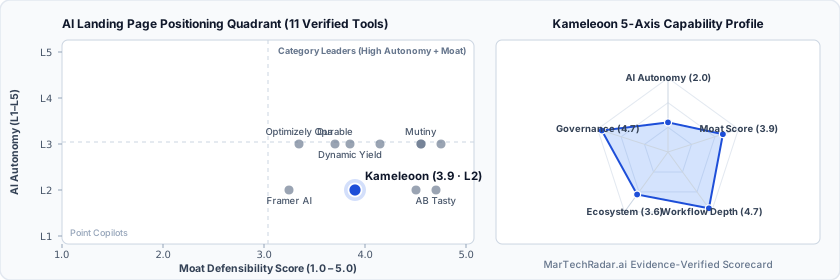
Kameleoon in-depth review, pricing & architecture analysis
Editor sign-off: Oct 14, 2026. How profiles are made.
What is Kameleoon? Overview & background
Architected to solve digital experimentation bottlenecks through automated interface variation, Kameleoon operates as an experimentation and journey optimization engine. Headquartered in Paris, Ile-de-France, France, and established in 2012, the vendor has raised €7.3M in venture funding. The platform targets conversion rate optimization leads, growth engineers, and digital marketing directors who require governed code generation to bypass developer backlogs and accelerate hypothesis testing.
How Kameleoon works: architecture & workflow
At the architectural layer, the system autonomy, Kameleoon pairs client-side script delivery with edge and server-side execution frameworks. The core mechanism is anchored by Prompt-Based Experimentation (PBX), which translates natural language prompts into structural DOM mutations and client-side scripts. The data pipeline ingests visitor telemetry, evaluating over 40 real-time segmentation attributes against predefined targeting rules. Variant allocation utilizes sequential testing mathematical models to determine statistical confidence without common peeking penalties, alongside mutually exclusive grouping structures to prevent cross-variant contamination, alongside native workflow integrations for Slack and Shopify under verified HIPAA and PCI DSS governance controls.
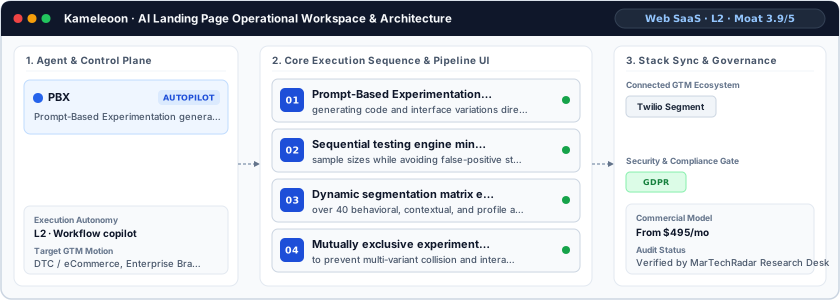
Kameleoon limitations, drawbacks & risks
Operational considerations and platform boundaries include:
- DOM Mutation Fragility: Client-side variants generated via prompt-based instructions risk visual flicker (FOUT) or broken layouts if underlying frontend single-page application frameworks mutate baseline DOM classes.
- Data Pipeline Latency: Cross-channel behavioral segment synchronization experiences propagation lag when resolving visitor identities across siloed downstream customer data systems.
- Edge SDK Maintenance Overhead: Server-side deployments necessitate continuous engineering governance to sync SDK feature flags and maintain schema consistency across microservices.
Kameleoon pricing, plans & cost breakdown
Commercial licensing scales based on active testing volume and visitor traffic. Entry-level deployment begins with the PBX Starter tier, starting from $495/month, which covers up to 10 active experiments and 50,000 monthly unique visitors. Higher-tier packages scale into custom enterprise contracts incorporating server-side SDK execution, advanced algorithmic targeting, and custom data warehouse integrations.
| Plan / Tier | Verified Price & Billing | Target Seat / Scale Fit | Included Scope & Contract Terms |
|---|---|---|---|
| Starter | $495/mo | Unlimited seats | Build experiments in minutes using PBX (Prompt-Based Experimentation) |
How Kameleoon compares vs. competitors & alternatives
Within conversion optimization and programmatic messaging, Kameleoon competes against AB Tasty, 10Web AI, and Ability.ai within the Email Marketing segment. While AB Tasty provides broad enterprise governance across web experiments, Kameleoon distinguishes itself technically through its native Prompt-Based Experimentation code synthesis engine. In contrast to 10Web AI's end-to-end CMS site rebuilding, Kameleoon focuses on modular hypothesis testing on established stacks. The system is best suited for mid-market and enterprise digital teams managing high-volume web properties that demand rigorous statistical testing without engineering bottlenecks.
Direct competitors & market radar
Top algorithmic competitors based on category positioning, capability overlap, and ICP alignment.
Frequently asked questions about Kameleoon
How much does Kameleoon cost in 2026?
Kameleoon pricing: From $495/mo. No free plan is publicly disclosed. Commercial licensing scales based on active testing volume and visitor traffic. Entry-level deployment begins with the PBX Starter tier, starting from $495/month, which covers up to 10 active experiments and 50,000 monthly unique visitors.
What are the top Kameleoon alternatives in AI Landing Page?
Verified AI Landing Page alternatives include Conversion Maker (Custom / enterprise pricing), Mutiny (Custom / enterprise pricing), Optimizely Opal (Custom / enterprise pricing), VWO (Pricing not disclosed). Within conversion optimization and programmatic messaging, Kameleoon competes against AB Tasty, 10Web AI, and Ability.ai within the Email Marketing segment.
What are the main limitations and trade-offs of Kameleoon?
Operational considerations and platform boundaries include: DOM Mutation Fragility: Client-side variants generated via prompt-based instructions risk visual flicker (FOUT) or broken layouts if underlying frontend single-page application frameworks mutate baseline DOM classes. Walk away if your workflow cannot tolerate dom mutation fragility: Client-side variants generated via prompt-based instructions risk visual flicker (FOUT) or broken layouts if underlying frontend single-page application frameworks mutate baseline DOM classes.
Verified sources & evidence trail
- Official product domain: https://kameleoon.com
- Commercial pricing verification: https://www.kameleoon.com/plans
- Verified corporate entity profiles (
sameAs): LinkedIn Company Profile · Crunchbase Entity Record - First-party governance & documentation links: API & Docs · Privacy
- Editor sign-off: Oct 14, 2026 (how profiles are made).
