Insense Review (2026): Influencer Marketing Pricing, Pros & Cons
Bottom line
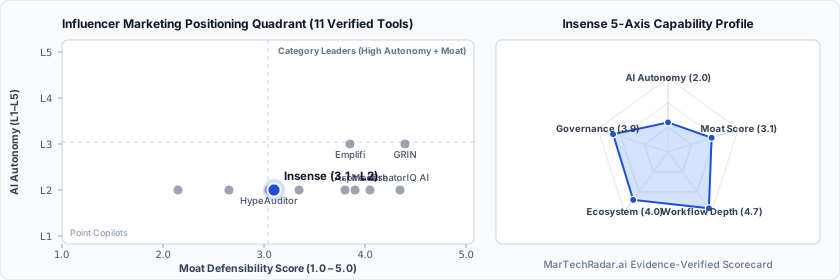
Insense is a Web SaaS tool for Influencer Marketing (Influencer Discovery & Campaign Management) in Social & Influencer. Pricing: $500–$2,400/mo. Editor ratings: AI autonomy L2 (workflow copilot); moat score 3.1/5.0 (Workflow-embedded (strong)). Fact-checked by MarTechRadar Research Desk on Oct 26, 2026.
All-in-one UGC creator marketplace, influencer campaign management, and whitelisted Meta Partnership and TikTok Spark Ads platform with native MCP support.
Is Insense worth it in 2026? Buyer fit & when to walk away
Choose Insense if (Best Fit)
- Target ICP & Stack Fit: You operate as Influencer Marketing teams requiring a Web SaaS deployment for Influencer Marketing, with verified ecosystem connectivity for Shopify, Model Context Protocol (MCP).
- L2 Architecture & Defensibility: Insense commands a strong DTC creator commerce moat through its 115,000+ vetted creator marketplace, native Meta Partnership and TikTok Spark Ads whitelisting, Creator Ops MCP server, and $5.9M Seed backing from Republic and Geek Ventures.
- Commercial Model Fit: Your procurement budget aligns with $500–$2,400/mo and want trial evaluation before contract sign-off.
Walk away from Insense if (Deal-Breakers)
- Walk away if your team is at early validation stage with a <$250/mo tool budget (Insense starts at $500–$2,400/mo before seat or usage expansion).
- Walk away if your workflow cannot tolerate primary operational trade-off: In practical deployments, the primary trade-off is that platform subscriptions do not include direct creator compensation and carry an additional 7% to 20% marketplace transaction fee on creator payouts, which increases total campaign unit costs for low-budget merchants.
- Walk away if functional scope boundary is a deal-breaker for your team: Insense is not built for B2B enterprise account-based marketing, technical website SEO auditing, or autonomous 3D synthetic avatar rendering.
Insense pricing, free plan & scorecard at a glance
| Pricing | $500–$2,400/moVendor pricing page |
|---|---|
| Free plan | No / not disclosed |
| Delivery | Web SaaS |
| Audience | — |
| AI autonomy level | L2 · Workflow copilotEditor-verified |
| Moat tier & score | 3.1 / 5.0 · Workflow-embedded (strong)Editor-verified |
| Funding | Seed |
| Total funding | $5.9MBacked by Republic, Geek Ventures, Flyer One Ventures, Starta VC, Trestle Partners |
| Founders | Anton Saliukov, Danil Saliukov |
| Company size | 51-200 employees |
| Ecosystem integrations | Shopify, Model Context Protocol (MCP) |
| Headquarters | New York, New York, United States |
| Founded | 2016 |
| Last verified | Oct 26, 2026 |
Insense pros & cons: strengths vs. operational limitations
Pros: core strengths & capabilities
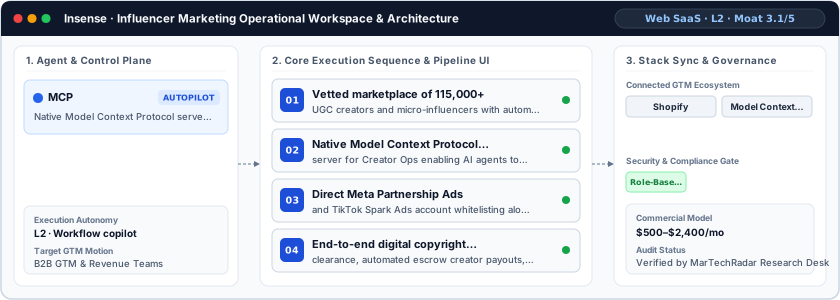
- Vetted marketplace of 115,000+: UGC creators and micro-influencers with automated creative brief matching and direct chat
- Native Model Context Protocol (MCP): server for Creator Ops enabling AI agents to orchestrate briefs, creator filtering, and campaign tracking
- Direct Meta Partnership Ads: and TikTok Spark Ads account whitelisting alongside automated Shopify product seeding fulfillment
- End-to-end digital copyright licensing: clearance, automated escrow creator payouts, and post-campaign ROAS analytics
Cons: operational limitations & risks
- Primary Operational Trade-Off: In practical deployments, the primary trade-off is that platform subscriptions do not include direct creator compensation and carry an additional 7% to 20% marketplace transaction fee on creator payouts, which increases total campaign unit costs for low-budget merchants.
- Functional Scope Boundary: Insense is not built for B2B enterprise account-based marketing, technical website SEO auditing, or autonomous 3D synthetic avatar rendering.
- Deployment & Governance Considerations: Additionally, because ongoing Brand and Agency self-serve plans renew on a quarterly billing cycle ($1,500 to $2,400 per quarter) and require coordinating physical product shipping via Shopify for seeding campaigns, merchants running sporadic one-off tests face logistical overhead and contract commitment friction.
Insense TCO & deal-breaker stress test
Simulate 12-month stepped TCO, hidden cost multipliers, contract lock-in exposure, and stack failure modes using only facts verified by MarTechRadar Research Desk on 2026-10-26 · Capture SHA c03d8154.
Insense aligns with your 5-seat / $800/mo profile. Review the walk-away triggers and contract levers below before deployment.
- Moat Score
- 3.1 / 5.0
- AI Autonomy
- L2
- Free Tier / Trial
- Free trial
Triggered audit signals & failure modes
- Published Self-Serve Entry FloorVerified Pricing Ledger
Insense publishes a transparent entry point ($500–$2,400/mo) with a free trial for initial validation before committing.
- Primary Operational Bottleneck: Primary Operational Trade-OffAudit by MarTechRadar Research Desk
In practical deployments, the primary trade-off is that platform subscriptions do not include direct creator compensation and carry an additional 7% to 20% marketplace transaction fee on creator payouts, which increases total campaign unit costs for low-budget merchants.
Test a custom Insense budget or stack constraint
Lower 5-seat floor (~$199/mo vs. From $500 / mo)
Insense integrations, API, security & compliance stack
Native Model Context Protocol server for Creator Ops enabling AI agents to orchestrate briefs, creator filtering, and campaign tracking
Insense AI moat & Influencer Marketing positioning
Insense commands a strong DTC creator commerce moat through its 115,000+ vetted creator marketplace, native Meta Partnership and TikTok Spark Ads whitelisting, Creator Ops MCP server, and $5.9M Seed backing from Republic and Geek Ventures.
Insense in-depth review, pricing & architecture analysis
Audited by MarTechRadar Research Desk (Evidence-Ledger Verified) on Oct 26, 2026.
What is Insense? Overview & background
Insense is an all-in-one user-generated content (UGC), creator licensing, and influencer campaign management platform built for DTC performance marketers, paid social media buyers, and creative agencies. Founded in 2016 by Anton Saliukov and Danil Saliukov and headquartered in New York, NY, the company operates with 51 to 200 employees, serves more than 3,500 consumer brands, and has raised $5.9M in Seed venture funding backed by Republic, Geek Ventures, Flyer One Ventures, Starta VC, and Trestle Partners. Built as an official Meta, TikTok, and Shopify partner, Insense connects brands with a vetted marketplace of over 115,000 creators to source custom video assets, automate product seeding, and launch whitelisted creator ads, capturing commercial demand for Insense pricing, influencer campaign management software, and creator marketplace platforms.
How Insense works: architecture & workflow
At the technical core of Insense is a creator procurement and ad-whitelisting architecture augmented by a native Model Context Protocol (MCP) server for Creator Ops and Influencer Marketing (insense.pro/integrations/mcp). Through the Insense MCP integration and API pipeline, growth teams can connect autonomous LLM agents directly to creator discovery filters, interactive creative brief templates, direct chat threads, copyright licensing ledgers, and escrow payment workflows. When a creator uploads raw or edited video deliverables, the platform's workflow model manages revision approvals, digital usage rights clearance, and direct OAuth ad-account connections so media buyers can launch creator-handle Meta Partnership Ads and TikTok Spark Ads without manual file transfers.
Insense limitations, drawbacks & risks
Operational considerations and platform boundaries include:
- Primary Operational Trade-Off: In practical deployments, the primary trade-off is that platform subscriptions do not include direct creator compensation and carry an additional 7% to 20% marketplace transaction fee on creator payouts, which increases total campaign unit costs for low-budget merchants.
- Functional Scope Boundary: Insense is not built for B2B enterprise account-based marketing, technical website SEO auditing, or autonomous 3D synthetic avatar rendering.
- Deployment & Governance Considerations: Additionally, because ongoing Brand and Agency self-serve plans renew on a quarterly billing cycle ($1,500 to $2,400 per quarter) and require coordinating physical product shipping via Shopify for seeding campaigns, merchants running sporadic one-off tests face logistical overhead and contract commitment friction.
Insense pricing, plans & cost breakdown
Insense publishes detailed subscription tiers on its official pricing page (insense.pro/pricing). A 1-month Trial plan starts at $650/mo for 1 user seat, 1 brand, 1 Meta Partnership Ads connection, 1 campaign, and up to 10 creators with a 20% marketplace fee. The Brand plan starts at $500/mo billed quarterly at $1,500, unlocking 2 seats, 10 Meta Partnership Ads connections, unlimited campaigns, unlimited creator hires, and a 10% marketplace fee. The Agency plan starts at $800/mo billed quarterly at $2,400 for 4 seats, 5 brands, unlimited Meta Partnership Ads connections, and a 7% marketplace fee, with modular add-ons at $30/month per extra seat, $100/month per extra brand, and $125/month for 5 additional Meta Partnership Ads connections.
| Plan / Tier | Verified Price & Billing | Target Seat / Scale Fit | Included Scope & Contract Terms |
|---|---|---|---|
| Agency | $800/mo | 1–2 seats | Verified $800/mo Agency tier from vendor pricing schedule. |
| Contract Watchout: Enterprise Governance & Add-On Gating | Advanced capabilities such as Single Sign-On (SSO), custom role permissions, or specialized analytics modules are gated behind upper tiers or paid add-ons. | ||
How Insense compares vs. competitors & alternatives
In the UGC creator marketplace and influencer campaign management market, Insense competes with Billo, Grin, Upfluence, and CreatorIQ within the Influencer & Creator Management segment, alongside verified subtrack peers such as Cruva, Featuring, and Boksi. Compared to passive influencer directories vs. low-end UGC video sites that lack direct Meta Partnership Ads and TikTok Spark Ads whitelisting or MCP agent orchestration, Insense differentiates itself by unifying creator sourcing, usage rights, and paid social ad amplification. DTC e-commerce brands and performance agencies should evaluate Insense to scale creator-led paid social ROAS.
Frequently asked questions about Insense
How much does Insense cost in 2026?
Insense pricing: $500–$2,400/mo. No permanent free tier is listed; trial evaluation is offered. Insense publishes detailed subscription tiers on its official pricing page (`insense.pro/pricing`).
What are the top Insense alternatives in Influencer Marketing?
Verified Influencer Marketing alternatives include Upfluence (Custom / enterprise pricing), Boksi (Pricing not disclosed), Featuring (Pricing not disclosed), Cruva ($199–$599/mo · Enterprise plan). In the UGC creator marketplace and influencer campaign management market, Insense competes with Billo, Grin, Upfluence, and CreatorIQ within the Influencer & Creator Management segment, alongside verified subtrack peers such as Cruva, Featuring, and Boksi.
Verified sources & evidence trail
- Official product domain: https://insense.pro
- Commercial pricing verification: https://insense.pro/pricing
- Verified corporate entity profiles (
sameAs): LinkedIn Company Profile · Crunchbase Entity Record - Editorial audit sign-off: Audited by MarTechRadar Research Desk (Evidence-Ledger Verified) on Oct 26, 2026.
