HypeAuditor Review (2026): Influencer Marketing Pricing, Pros & Cons
Bottom line
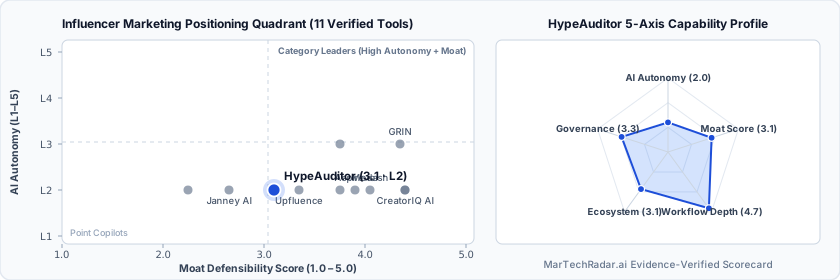
HypeAuditor is a Web SaaS tool for Influencer Marketing (Influencer Discovery & Campaign Management) in Social & Influencer. Pricing: Custom / enterprise pricing. Best suited to DTC / eCommerce and Enterprise Brands. Editor ratings: AI autonomy L2 (workflow copilot); moat score 3.1/5.0 (Workflow-embedded (strong)). Fact-checked by MarTechRadar Research Desk on Oct 10, 2026.
AI-powered influencer marketing and audience analytics platform providing fraud detection, creator discovery, and campaign measurement across social networks.
Is HypeAuditor worth it in 2026? Buyer fit & when to walk away
Choose HypeAuditor if (Best Fit)
- Target ICP & Stack Fit: You operate as DTC / eCommerce and Enterprise Brands requiring a Web SaaS deployment for Influencer Marketing.
- L2 Architecture & Defensibility: Proprietary Audience Quality Score (AQS) algorithm trained on multi-platform social graph patterns, combined with historical anomaly detection datasets for identifying engagement pods and bot inflation.
- Commercial Model Fit: Your procurement budget aligns with Custom / enterprise pricing.
Walk away from HypeAuditor if (Deal-Breakers)
- Walk away if you need published self-serve pricing: HypeAuditor is sold by custom quote.
- Walk away if your workflow cannot tolerate social network API scrapes: Third-party platform API policy revisions and automated anti-scraping countermeasures can intermittently delay demographic profile refreshes and engagement syncs.
- Walk away if niche creator visibility is a deal-breaker for your team: Anomaly detection precision degrades on hyper-niche or emerging creators who fall below baseline indexing thresholds, requiring manual profile addition and processing lag.
HypeAuditor pricing, free plan & scorecard at a glance
| Pricing | Custom / enterprise pricingVendor pricing page |
|---|---|
| Free plan | No / not disclosed |
| Delivery | Web SaaS |
| Audience | DTC / eCommerce, Enterprise Brands |
| AI autonomy level | L2 · Workflow copilotEditor-verified |
| Moat tier & score | 3.1 / 5.0 · Workflow-embedded (strong)Editor-verified |
| Funding | Bootstrapped |
| Founders | Alexander Frolov, Leonid Zhavoronkov |
| Company size | 51-200 employees |
| Governance & docs | Terms ↗ · Privacy ↗ |
| Headquarters | Indianapolis, United States |
| Founded | 2017 |
| Last verified | Oct 10, 2026 |
HypeAuditor pros & cons: strengths vs. operational limitations
Pros: core strengths & capabilities
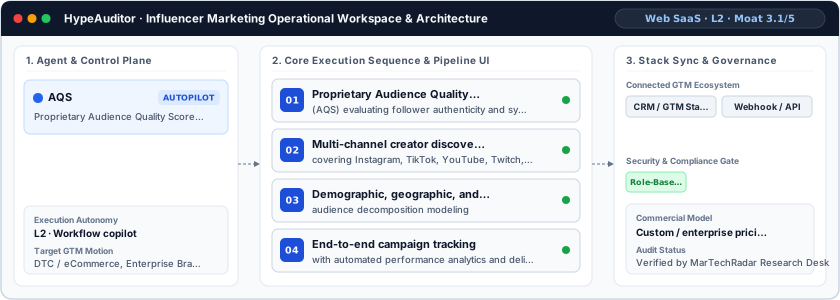
- Proprietary Audience Quality Score: (AQS) evaluating follower authenticity and synthetic engagement
- Multi-channel creator discovery database: covering Instagram, TikTok, YouTube, Twitch, and X
- Demographic, geographic, and behavioral: audience decomposition modeling
- End-to-end campaign tracking: with automated performance analytics and deliverable monitoring
Cons: operational limitations & risks
- Social Network API Scrapes: Third-party platform API policy revisions and automated anti-scraping countermeasures can intermittently delay demographic profile refreshes and engagement syncs.
- Niche Creator Visibility: Anomaly detection precision degrades on hyper-niche or emerging creators who fall below baseline indexing thresholds, requiring manual profile addition and processing lag.
- E-Commerce Attribution Gaps: Attribution focuses primarily on public engagement velocity rather than deep zero-party enterprise CRM conversion tracking, requiring external tracking pixels to measure closed-loop sales.
HypeAuditor TCO & deal-breaker stress test
Simulate 12-month stepped TCO, hidden cost multipliers, contract lock-in exposure, and stack failure modes using only facts verified by MarTechRadar Research Desk on 2026-10-10.
HypeAuditor triggers high-severity friction under your 5-seat / $800/mo constraints. Benchmark the verified subtrack alternatives below before committing.
- Moat Score
- 3.1 / 5.0
- AI Autonomy
- L2
- Free Tier / Trial
- None disclosed
Triggered audit signals & failure modes
- Opaque Enterprise Quoting vs. SMB/Mid-Market BudgetVerified Pricing Ledger
HypeAuditor does not disclose a public self-serve floor (Custom / enterprise pricing). Buyers with a $800/mo cap face high sales-qualification friction.
- Sales-Gated Contract TermsFact-checked by MarTechRadar Research Desk
Commercial procurement operates on an enterprise quote basis through tailored direct sales consultations. Licensing is structured around organizational tiering, required creator search volume, reporting seat allocations, and API pipeline throughput.
- Primary Operational Bottleneck: Social Network API ScrapesAudit by MarTechRadar Research Desk
Third-party platform API policy revisions and automated anti-scraping countermeasures can intermittently delay demographic profile refreshes and engagement syncs.
Test a custom HypeAuditor budget or stack constraint
Lower 5-seat floor (~$200/mo vs. Custom Quote) · Transparent self-serve entry without mandatory annual lock-in
Lower 5-seat floor (~$199/mo vs. Custom Quote) · Transparent self-serve entry without mandatory annual lock-in
HypeAuditor integrations, API, security & compliance stack
Proprietary Audience Quality Score evaluating follower authenticity and synthetic engagement
HypeAuditor AI moat & Influencer Marketing positioning
Proprietary Audience Quality Score (AQS) algorithm trained on multi-platform social graph patterns, combined with historical anomaly detection datasets for identifying engagement pods and bot inflation.
HypeAuditor in-depth review, pricing & architecture analysis
Editor sign-off: Oct 10, 2026. How profiles are made.
What is HypeAuditor? Overview & background
Eliminating ad spend waste caused by synthetic engagement, bot networks, and deceptive influencer metrics represents the core operational objective solved by HypeAuditor. Headquartered in Indianapolis, United States, and established in 2017, the organization develops an analytical intelligence suite targeted at performance marketing managers, consumer brand teams, and digital media agencies. Operating within the influencer discovery and campaign management domain, HypeAuditor functions as an empirical auditing mechanism that vets prospective creator partnerships prior to capital allocation.
How HypeAuditor works: architecture & workflow
The platform functions through an automated data collection and anomaly detection pipeline ingesting social graph endpoints across Instagram, TikTok, YouTube, Twitch, and X. Ingested metadata—including account follower trajectories, comment-to-like ratios, linguistic repetitiveness, and interaction intervals—feeds into supervised learning classifiers. The system benchmarks these signals against known patterns of click farms, automated engagement pods, and commercial bot deployments. This pipeline aggregates into a composite Audience Quality Score (AQS), delivering structured distributions of verifiable human audiences versus suspicious accounts alongside modeled age, gender, and regional affinities, alongside native workflow integrations for Zapier.
HypeAuditor limitations, drawbacks & risks
Operational considerations and platform boundaries include:
- Social Network API Scrapes: Third-party platform API policy revisions and automated anti-scraping countermeasures can intermittently delay demographic profile refreshes and engagement syncs.
- Niche Creator Visibility: Anomaly detection precision degrades on hyper-niche or emerging creators who fall below baseline indexing thresholds, requiring manual profile addition and processing lag.
- E-Commerce Attribution Gaps: Attribution focuses primarily on public engagement velocity rather than deep zero-party enterprise CRM conversion tracking, requiring external tracking pixels to measure closed-loop sales.
HypeAuditor pricing, plans & cost breakdown
Commercial procurement operates on an enterprise quote basis through tailored direct sales consultations. Licensing is structured around organizational tiering, required creator search volume, reporting seat allocations, and API pipeline throughput. Prospective enterprise customers schedule product walkthroughs to scope analytical coverage requirements, with contracts finalized without public self-serve list pricing.
| Plan / Tier | Verified Price & Billing | Included Scope & Contract Terms |
|---|---|---|
| Enterprise / Custom | Custom quote | Custom-quoted plan; terms come from the vendor's sales team. |
How HypeAuditor compares vs. competitors & alternatives
Within influencer operations, HypeAuditor competes against CreatorIQ AI, Emplifi, and GRIN. While GRIN concentrates heavily on direct-to-consumer physical product seeding and CreatorIQ AI targets broad enterprise agency workflow orchestration, HypeAuditor distinguishes its core architecture through analytical fraud modeling and algorithmic audience integrity verification. It serves mid-market to enterprise consumer brands requiring empirical validation against fraudulent audience inflation before executing creator contracts.
Direct competitors & market radar
Top algorithmic competitors based on category positioning, capability overlap, and ICP alignment.
Frequently asked questions about HypeAuditor
Does HypeAuditor publish pricing or require an enterprise quote?
HypeAuditor pricing: Custom / enterprise pricing. No free plan is publicly disclosed. Commercial procurement operates on an enterprise quote basis through tailored direct sales consultations.
What are the top HypeAuditor alternatives in Influencer Marketing?
Verified Influencer Marketing alternatives include CreatorIQ AI (Custom / enterprise pricing), GRIN (From $200/mo), Emplifi ($1,249–$2,499/mo), nowfluence (From $99/mo). Within influencer operations, HypeAuditor competes against CreatorIQ AI, Emplifi, and GRIN.
What are the main limitations and trade-offs of HypeAuditor?
Operational considerations and platform boundaries include: Social Network API Scrapes: Third-party platform API policy revisions and automated anti-scraping countermeasures can intermittently delay demographic profile refreshes and engagement syncs. Walk away if you need published self-serve pricing: HypeAuditor is sold by custom quote.
Verified sources & evidence trail
- Official product domain: https://hypeauditor.com
- Commercial pricing verification: https://hypeauditor.com/pricing/
- Verified corporate entity profiles (
sameAs): LinkedIn Company Profile · Crunchbase Entity Record - First-party governance & documentation links: Terms · Privacy
- Editor sign-off: Oct 10, 2026 (how profiles are made).
