GREENHOUSE OS Review (2026): AI Marketing Agent Pricing, Limits & Alternatives
Bottom line
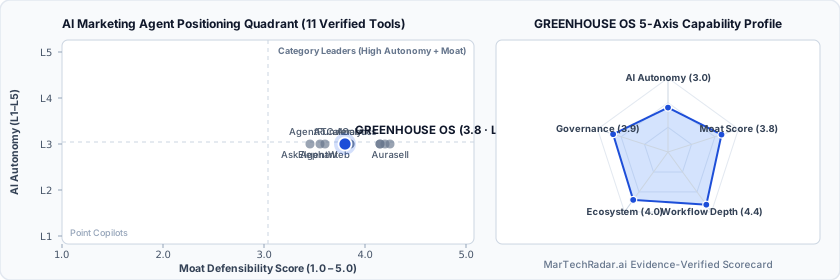
GREENHOUSE OS is a Web SaaS tool for AI Marketing Agent (Autonomous Marketing Agents & Digital Coworkers) in Agent & Marketing Ops. Pricing: Custom / enterprise pricing. Best suited to GTM Operations Teams, Enterprise Marketing Executives and Automated Ops Teams. Editor ratings: AI autonomy L3 (conditional automation); moat score 3.8/5.0 (Proprietary moat). Fact-checked by Jagmeet Sine on Oct 12, 2026.
Native Salesforce-powered CRM and autonomous marketing workflow platform designed for estate agencies to unlock dormant transaction revenue.
GREENHOUSE OS buyer fit verdict: when to choose vs. when to walk away
Choose GREENHOUSE OS if (Best Fit)
- Target ICP & Stack Fit: You operate as GTM Operations Teams, Enterprise Marketing Executives and Automated Ops Teams requiring a Web SaaS deployment for AI Marketing Agent, with verified ecosystem connectivity for Salesforce, Outreach.
- L3 Architecture & Defensibility: Built natively atop Salesforce infrastructure, combining sector-specific relational property data models with automated lifecycle workflows to replace fragmented legacy property software.
- Commercial Model Fit: Your procurement budget aligns with Custom / enterprise pricing.
Walk away from GREENHOUSE OS if (Deal-Breakers)
- Walk away if you require transparent self-serve monthly billing or your budget ceiling is under $1,000/mo (GREENHOUSE OS requires sales-gated custom quoting).
- Walk away if your workflow cannot tolerate salesforce infrastructure dependency: The system requires native alignment with Salesforce cloud schemas, introducing technical administration overhead for independent agencies lacking dedicated Salesforce administrators.
- Walk away if historical data ingestion friction is a deal-breaker for your team: Extracting unstructured contact records and legacy transaction histories from older on-premise estate agency management software creates significant schema mapping and data hygiene hurdles.
GREENHOUSE OS key facts & scorecard
| Pricing | Custom / enterprise pricing |
|---|---|
| Free plan | No / not disclosed |
| Delivery | Web SaaS |
| Audience | GTM Operations Teams, Enterprise Marketing Executives, Automated Ops Teams |
| AI autonomy level | L3 · Conditional automationEditor-verified |
| Moat tier & score | 3.8 / 5.0 · Proprietary moatEditor-verified |
| Funding | Seed |
| Total funding | £900KBacked by Finance Yorkshire |
| Company size | 11-50 employees |
| Ecosystem integrations | Salesforce, Outreach |
| Governance & docs | Privacy ↗ |
| Headquarters | Heslington, York, United Kingdom |
| Founded | 2023 |
| Last verified |
GREENHOUSE OS pros & cons: strengths vs. operational limitations
Pros: core strengths & capabilities
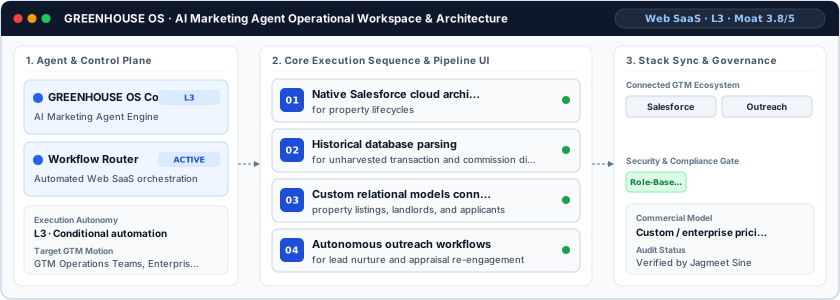
- Native Salesforce cloud architecture tailored: for property lifecycles
- Historical database parsing: for unharvested transaction and commission discovery
- Custom relational models connecting: property listings, landlords, and applicants
- Autonomous outreach workflows: for lead nurture and appraisal re-engagement
Cons: operational limitations & risks
- Salesforce Infrastructure Dependency: The system requires native alignment with Salesforce cloud schemas, introducing technical administration overhead for independent agencies lacking dedicated Salesforce administrators.
- Historical Data Ingestion Friction: Extracting unstructured contact records and legacy transaction histories from older on-premise estate agency management software creates significant schema mapping and data hygiene hurdles.
- Operational Pipeline Rigidity: Autonomous nurture actions adhere to deterministic property lifecycle triggers, restricting real-time multi-channel engagement adjustments when handling atypical commercial property structures.
GREENHOUSE OS TCO & deal-breaker stress test
Simulate 12-month stepped TCO, hidden cost multipliers, contract lock-in exposure, and stack failure modes using only facts verified by Jagmeet Sine on · Capture SHA a06a78a8.
GREENHOUSE OS triggers high-severity friction under your 5-seat / $800/mo constraints. Benchmark the verified subtrack alternatives below before committing.
| Plan / Tier | Verified Rate | Scale Fit | Scope & Quota Notes |
|---|---|---|---|
| Enterprise / Custom | Custom quote | 15–50+ seats (Enterprise SLA) | Sales-negotiated annual contract for custom volume, SSO/RBAC governance, and dedicated SLA. |
- Moat Score
- 3.8 / 5.0
- AI Autonomy
- L3
- Free Tier / Trial
- None disclosed
Triggered audit signals & failure modes
- Opaque Enterprise Quoting vs. SMB/Mid-Market BudgetVerified Pricing Ledger
GREENHOUSE OS does not disclose a public self-serve floor (Custom / enterprise pricing). Buyers with a $800/mo cap face high sales-qualification friction.
- Sales-Gated Contract TermsFact-checked by Jagmeet Sine
GREENHOUSE OS delivers software access under a tailored commercial model. Commercial pricing is available on request through tailored enterprise sales quotes based on organizational scale and seats.
- Primary Operational Bottleneck: Salesforce Infrastructure DependencyAudit by Jagmeet Sine
The system requires native alignment with Salesforce cloud schemas, introducing technical administration overhead for independent agencies lacking dedicated Salesforce administrators.
Hidden TCO Multipliers & Quota Gates
- Salesforce Infrastructure Dependency: The system requires native alignment with Salesforce cloud schemas, introducing technical administration overhead for independent agencies lacking dedicated Salesforce administrators.
- Historical Data Ingestion Friction: Extracting unstructured contact records and legacy transaction histories from older on-premise estate agency management software creates significant schema mapping and data hygiene hurdles.
When to Walk Away & Negotiation Levers
- Walk away if you require transparent self-serve monthly billing or your budget ceiling is under $1,000/mo (GREENHOUSE OS requires sales-gated custom quoting).
- Walk away if your workflow cannot tolerate salesforce infrastructure dependency: The system requires native alignment with Salesforce cloud schemas, introducing technical administration overhead for independent agencies lacking dedicated Salesforce administrators.
- Walk away if historical data ingestion friction is a deal-breaker for your team: Extracting unstructured contact records and legacy transaction histories from older on-premise estate agency management software creates significant schema mapping and data hygiene hurdles.
- Demand a 30- to 60-day paid pilot opt-out clause in the GREENHOUSE OS order form before signing a 12-month enterprise commitment.
- Require a sandbox proof-of-concept testing salesforce infrastructure dependency against your live CRM/data schema before annual sign-off.
Ask a custom procurement or TCO stress-test question about GREENHOUSE OS
Lower 5-seat floor (~$100/mo vs. Custom Quote) · Transparent self-serve entry without mandatory annual lock-in
Lower 5-seat floor (~$495/mo vs. Custom Quote) · Transparent self-serve entry without mandatory annual lock-in
GREENHOUSE OS key entities, modules & ecosystem stack
GREENHOUSE OS moat & subtrack positioning
Built natively atop Salesforce infrastructure, combining sector-specific relational property data models with automated lifecycle workflows to replace fragmented legacy property software.
Editorial review
Fact-checked by Jagmeet Sine (Senior MarTech Infrastructure & Agentic Workflow Architect) on .
Background
Architectured natively atop the Salesforce cloud ecosystem, GREENHOUSE OS was established in 2023 in Heslington, York, United Kingdom, backed by £900K in seed venture capital. The software is engineered specifically for residential real estate brokerages, multi-branch estate agencies, and property letting firms seeking to modernize dated operational stacks. Operating as an autonomous marketing agent and digital coworker within estate agency workflows, the system targets agency directors and revenue operations leaders burdened by fragmented legacy property management tools.
How GREENHOUSE OS works
Operating at an L3 autonomy profile, GREENHOUSE OS ingests historical property transaction data, applicant registries, and landlord correspondence directly into customized Salesforce relational models. Its pipeline links applicant intent records with property metadata to surface reactivation candidates automatically. Algorithmic trigger engines evaluate property tenure timelines, local market price fluctuations, and dormant contact histories, executing conditional marketing nurture sequences and alerting estate agents when high-probability listing opportunities emerge without requiring manual record audits.
Limitations
Operational considerations and platform boundaries include:
- Salesforce Infrastructure Dependency: The system requires native alignment with Salesforce cloud schemas, introducing technical administration overhead for independent agencies lacking dedicated Salesforce administrators.
- Historical Data Ingestion Friction: Extracting unstructured contact records and legacy transaction histories from older on-premise estate agency management software creates significant schema mapping and data hygiene hurdles.
- Operational Pipeline Rigidity: Autonomous nurture actions adhere to deterministic property lifecycle triggers, restricting real-time multi-channel engagement adjustments when handling atypical commercial property structures.
GREENHOUSE OS pricing
GREENHOUSE OS delivers software access under a tailored commercial model. Commercial pricing is available on request through tailored enterprise sales quotes based on organizational scale and seats. Contracts reflect multi-branch deployments, database volume, and requisite onboarding support.
How GREENHOUSE OS compares
While generalized agent frameworks like ai-marketing-claude offer open-ended copy generation and allGood or AskElephant target cross-industry conversation intelligence, GREENHOUSE OS focuses squarely on verticalized real estate workflows. Its trade-off centers on vertical specificity versus universal adaptability: while conversational coworkers operate flexibly across any B2B funnel, GREENHOUSE OS enforces strict real estate data governance and property milestones. The solution best fits mid-market and enterprise residential agency networks seeking automated database monetization on proven CRM infrastructure.
Frequently asked questions about GREENHOUSE OS
How much does GREENHOUSE OS cost and does it require a custom enterprise quote?
Published pricing summary for GREENHOUSE OS: Custom / enterprise pricing. A permanent free plan is not disclosed for GREENHOUSE OS. GREENHOUSE OS delivers software access under a tailored commercial model. Commercial pricing is available on request through tailored enterprise sales quotes based on organizational scale and seats. Contracts reflect multi-branch deployments, database volume, and requisite onboarding support.
How does GREENHOUSE OS work and how autonomous is its AI architecture?
Native Salesforce-powered CRM and autonomous marketing workflow platform designed for estate agencies to unlock dormant transaction revenue. Within AI Marketing Agent (Autonomous Marketing Agents & Digital Coworkers), MarTechRadar rates its execution architecture at L3 · Conditional automation with a verified Moat Score of 3.8 / 5.0 (Proprietary moat). Built natively atop Salesforce infrastructure, combining sector-specific relational property data models with automated lifecycle workflows to replace fragmented legacy property software. Corporate profile: operating at 11-50 employees scale.
What are the main limitations of GREENHOUSE OS and when should buyers walk away?
Based on our editorial technical audit, key operational considerations and boundaries for GREENHOUSE OS include: (1) Salesforce Infrastructure Dependency: The system requires native alignment with Salesforce cloud schemas, introducing technical administration overhead for independent agencies lacking dedicated Salesforce administrators. (2) Historical Data Ingestion Friction: Extracting unstructured contact records and legacy transaction histories from older on-premise estate agency management software creates significant schema mapping and data hygiene hurdles. (3) Operational Pipeline Rigidity: Autonomous nurture actions adhere to deterministic property lifecycle triggers, restricting real-time multi-channel engagement adjustments when handling atypical commercial property structures. Primary procurement walk-away rule: Walk away if you require transparent self-serve monthly billing or your budget ceiling is under $1,000/mo (GREENHOUSE OS requires sales-gated custom quoting).
What integrations, compliance certifications, and contract terms apply to GREENHOUSE OS?
Verified ecosystem and stack integrations include Salesforce, Outreach. Key TCO multiplier to watch: Salesforce Infrastructure Dependency (The system requires native alignment with Salesforce cloud schemas, introducing technical administration overhead for independent agencies lacking dedicated Salesforce administrators.) Before signing a contract, procurement teams should demand a 30- to 60-day paid pilot opt-out clause in the GREENHOUSE OS order form before signing a 12-month enterprise commitment.
What are the best GREENHOUSE OS alternatives and head-to-head competitors in 2026?
Top fact-checked alternatives to GREENHOUSE OS in AI Marketing Agent (Autonomous Marketing Agents & Digital Coworkers) include Kantiv (Custom / enterprise pricing), Noolie AI (From $0.08/mo), Honestly (Custom / enterprise pricing), Kris@Work (Custom / enterprise pricing). While generalized agent frameworks like ai-marketing-claude offer open-ended copy generation and allGood or AskElephant target cross-industry conversation intelligence, GREENHOUSE OS focuses squarely on verticalized real estate workflows.
Verified sources & evidence trail
- Official product domain: https://www.greenhouseos.com
- Commercial pricing verification: Verified against official vendor pricing policy (Custom / enterprise pricing)
- Verified corporate entity profiles (
sameAs): LinkedIn Company Profile · Crunchbase Entity Record - First-party governance & documentation links: Privacy
- Editorial audit sign-off: Fact-checked by Jagmeet Sine on under the MarTechRadar Evidence-Ledger Protocol.