Forge Review (2026): Social Media Scheduling Pricing, Pros & Cons
Bottom line
Forge is a Web SaaS tool for Social Media Scheduling (Social Media Scheduling & Auto-Publishing) in Social & Influencer. Pricing: Free plan · $9–$99/mo. Editor ratings: AI autonomy L2 (workflow copilot); moat score 2.9/5.0 (Workflow-embedded). Fact-checked by MarTechRadar Research Desk on Nov 14, 2026.
Grok-powered multi-network social drafting app turning one idea into tailored posts for X, LinkedIn, Instagram, Facebook, and Threads with confirmed posting.
Is Forge worth it in 2026? Buyer fit & when to walk away
Choose Forge if (Best Fit)
- Target ICP & Stack Fit: You operate as Social Media Scheduling teams requiring a Web SaaS deployment for Social Media Scheduling, with verified ecosystem connectivity for LinkedIn.
- Single-idea-to-five-drafts generation tailored simultaneously: for X, LinkedIn, Instagram, Facebook, and Threads
- Commercial Model Fit: Your procurement budget aligns with Free plan · $9–$99/mo and want a self-serve free tier for zero-cost initial validation.
Walk away from Forge if (Deal-Breakers)
- Walk away if primary constraint is a deal-breaker: Buyers evaluating Forge for broader social media operations should account for several functional limitations and workflow boundaries.
- Walk away if operational trade-off is a deal-breaker: First, Forge focuses narrowly on single-idea cross-network drafting and immediate confirmation-gated posting; it lacks enterprise social listening, multi-seat approval hierarchies, unified comment inboxes, and deep post-publish engagement analytics.
- Walk away if deployment boundary is a deal-breaker: Second, generation capacity is strictly metered by monthly prompt runs (30 on Starter, 80 on Pro, and 200 on Power), creating per-generation overage friction for high-frequency agencies managing dozens of client brands.
Forge pricing, free plan & scorecard at a glance
| Pricing | Free plan · $9–$99/moVendor pricing page |
|---|---|
| Free plan | Yes |
| Delivery | Web SaaS |
| Audience | — |
| AI autonomy level | L2 · Workflow copilotEditor-verified |
| Moat tier & score | 2.9 / 5.0 · Workflow-embeddedEditor-verified |
| Funding | Bootstrapped |
| Company size | 1-10 employees |
| Ecosystem integrations | |
| Headquarters | — |
| Founded | 2026 |
| Last verified | Nov 14, 2026 |
Forge pros & cons: strengths vs. operational limitations
Pros: core strengths & capabilities
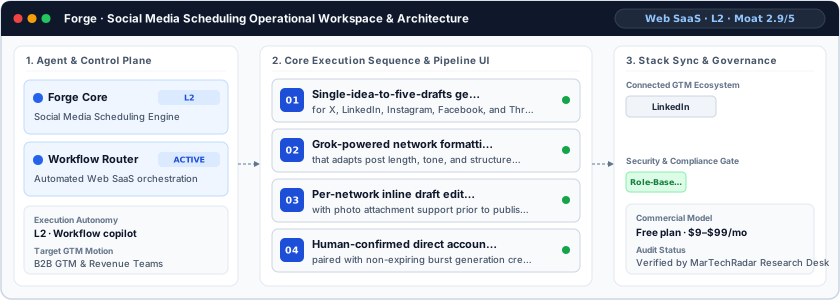
- Single-idea-to-five-drafts generation tailored simultaneously: for X, LinkedIn, Instagram, Facebook, and Threads
- Grok-powered network formatting: that adapts post length, tone, and structure to each social platform
- Per-network inline draft editor: with photo attachment support prior to publishing
- Human-confirmed direct account publishing: paired with non-expiring burst generation credit packs
Cons: operational limitations & risks
- Primary constraint: Buyers evaluating Forge for broader social media operations should account for several functional limitations and workflow boundaries.
- Operational trade-off: First, Forge focuses narrowly on single-idea cross-network drafting and immediate confirmation-gated posting; it lacks enterprise social listening, multi-seat approval hierarchies, unified comment inboxes, and deep post-publish engagement analytics.
- Deployment boundary: Second, generation capacity is strictly metered by monthly prompt runs (30 on Starter, 80 on Pro, and 200 on Power), creating per-generation overage friction for high-frequency agencies managing dozens of client brands.
Forge TCO & deal-breaker stress test
Simulate 12-month stepped TCO, hidden cost multipliers, contract lock-in exposure, and stack failure modes using only facts verified by MarTechRadar Research Desk on 2026-11-14 · Capture SHA ef64ece7.
Forge aligns with your 5-seat / $800/mo profile. Review the walk-away triggers and contract levers below before deployment.
- Moat Score
- 2.9 / 5.0
- AI Autonomy
- L2
- Free Tier / Trial
- Free plan
Triggered audit signals & failure modes
- Published Self-Serve Entry FloorVerified Pricing Ledger
Forge publishes a transparent entry point (Free plan · $9–$99/mo) with a free tier for initial validation before committing.
- Primary Operational Bottleneck: Operational trade-offAudit by MarTechRadar Research Desk
First, Forge focuses narrowly on single-idea cross-network drafting and immediate confirmation-gated posting; it lacks enterprise social listening, multi-seat approval hierarchies, unified comment inboxes, and deep post-publish engagement analytics.
Test a custom Forge budget or stack constraint
Fits within $800/mo budget ($15–$99/mo)
Lower 5-seat floor (~$5/mo vs. From $9 / mo)
Forge integrations, API, security & compliance stack
Forge in-depth review, pricing & architecture analysis
Editor sign-off: Nov 14, 2026. How profiles are made.
What is Forge? Overview & background
Forge (forgeprod.com), submitted by founder Carol Rehor and explicitly distinct from Honeywell Forge, Forge Productions, or forgecontent.ai, is a lightweight, Grok-powered multi-network social drafting and publishing web application. Designed for solo founders, local businesses, and small marketing teams who want to announce product launches, events, or daily updates across five major social feeds without rewriting copy five times, Forge converts a single plain-language idea and optional photo into five distinct, network-fitted drafts for X, LinkedIn, Instagram, Facebook, and Threads.
How Forge works: architecture & workflow
Architecturally, Forge operates as an L2 workflow copilot rather than an autonomous background scheduler. When a user enters a single seed idea—such as a weekend pop-up announcement or feature release—the Grok-backed generation pipeline produces five separate cards simultaneously, calibrating character length, paragraph pacing, and conversational tone for each destination network. Users can edit any draft inline, attach imagery, copy text manually, or click Post now on connected social accounts. Crucially, publishing is confirmation-gated: Forge never auto-posts unreviewed output, and if a destination network is not yet authenticated, the card preserves the draft in place while prompting account connection.
Forge limitations, drawbacks & risks
Buyers evaluating Forge for broader social media operations should account for several functional limitations and workflow boundaries. First, Forge focuses narrowly on single-idea cross-network drafting and immediate confirmation-gated posting; it lacks enterprise social listening, multi-seat approval hierarchies, unified comment inboxes, and deep post-publish engagement analytics. Second, generation capacity is strictly metered by monthly prompt runs (30 on Starter, 80 on Pro, and 200 on Power), creating per-generation overage friction for high-frequency agencies managing dozens of client brands. Third, because its language generation relies on Grok as the underlying LLM dependency, teams requiring model-agnostic routing (such as switching between Claude, OpenAI, and custom fine-tuned brand models) or video/carousel scheduling for TikTok and YouTube Shorts will find the platform too narrow.
Forge pricing, plans & cost breakdown
On commercial pricing (forgeprod.com/pricing), Forge combines a no-card Free tier ($0/month for 2 generations/month, $0.00/gen) with three monthly subscription plans and optional non-expiring top-up packs processed via Stripe: Starter ($19/month) includes 30 generations ($0.63/gen), Pro ($49/month) includes 80 generations ($0.61/gen), and Power ($99/month) includes 200 generations ($0.50/gen). For burst campaigns without recurring subscription lock-in, users can purchase stackable one-time Boost packs: Boost 10 ($9 for 10 generations, $0.90/gen), Boost 25 ($19 for 25 generations, $0.76/gen), and Boost 50 ($35 for 50 generations, $0.70/gen).
How Forge compares vs. competitors & alternatives
Within CAT-06-01 (*Social Media Scheduling & Auto-Publishing*), Forge competes with Buffer, Hootsuite, Typefully, and Taplio. Whereas Buffer and Hootsuite offer multi-channel content calendars, team permissions, and reporting suites, and Typefully/Taplio specialize deeply in X or LinkedIn audience analytics, Forge strips away calendar bloat in favor of rapid one-prompt-to-five-networks Grok drafting and transparent credit-pack flexibility. It is best suited for solo founders, creators, and small business operators who want fast, human-confirmed cross-posting across X, LinkedIn, Instagram, Facebook, and Threads.
Frequently asked questions about Forge
How much does Forge cost in 2026?
Forge pricing: Free plan · $9–$99/mo. A permanent free plan is available. On commercial pricing (`forgeprod.com/pricing`), Forge combines a no-card Free tier (`$0/month` for 2 generations/month, `$0.00/gen`) with three monthly subscription plans and optional non-expiring top-up packs processed via Stripe: Starter (`$19/month`) includes 30 generations (`$0.63/gen`), Pro (`$49/month`) includes 80 generations (`$0.61/gen`), and Power (`$99/month`) includes 200 generations (`$0.50/gen`).
What are the top Forge alternatives in Social Media Scheduling?
Verified Social Media Scheduling alternatives include Taplio (Custom / enterprise pricing), SlideFarm (Free plan · €29–€419/mo), Passionfroot (Custom / enterprise pricing), Warble ($15–$99/mo). Within `CAT-06-01` (*Social Media Scheduling & Auto-Publishing*), Forge competes with Buffer, Hootsuite, Typefully, and Taplio.
What are the main limitations and trade-offs of Forge?
Buyers evaluating Forge for broader social media operations should account for several functional limitations and workflow boundaries.
Verified sources & evidence trail
- Official product domain: https://forgeprod.com
- Commercial pricing verification: https://forgeprod.com/pricing
- Editor sign-off: Nov 14, 2026 (how profiles are made).
