Flint Review (2026): AI Landing Page Pricing, Limits & Alternatives
Bottom line
Flint is a SaaS Platform tool for AI Landing Page (Landing Page Builders & Autonomous CRO) in Lifecycle & CDP. Pricing: Pricing not disclosed. Best suited to B2B Marketing & GTM Teams. Editor ratings: AI autonomy L3 (conditional automation); moat score 3.8/5.0 (Proprietary moat). Fact-checked by Sarah Per on Oct 26, 2026.
Self-improving performance marketing platform that pairs autonomous landing page generation with a Google Ads optimization agent.
Flint buyer fit verdict: when to choose vs. when to walk away
Choose Flint if (Best Fit)
- Target ICP & Stack Fit: You operate as B2B Marketing & GTM Teams requiring a SaaS Platform deployment for AI Landing Page, with verified ecosystem connectivity for Salesforce, HubSpot, LinkedIn, WordPress.
- L3 Architecture & Defensibility: Closed-loop AI performance marketing system combining an autonomous on-brand landing page builder with a Google Ads optimization agent that continuously learns from conversion outcomes.
- Commercial Model Fit: Your procurement budget aligns with Pricing not disclosed.
Walk away from Flint if (Deal-Breakers)
- Walk away if you require transparent self-serve monthly billing or your budget ceiling is under $1,000/mo (Flint requires sales-gated custom quoting).
- Walk away if your workflow cannot tolerate primary operational constraint: In practical deployment, the main limitation is that Flint's paid media agent currently supports Google Ads live, while native Meta Ads and LinkedIn Ads agents remain on the product roadmap.
- Walk away if integration & scaling friction is a deal-breaker for your team: The platform is not built for e-commerce merchants managing multi-thousand-SKU retail catalogs or teams seeking an autonomous black-box ad buyer that executes changes without human sign-off.
Flint key facts & scorecard
| Pricing | Pricing not disclosed |
|---|---|
| Free plan | No / not disclosed |
| Delivery | SaaS Platform |
| Audience | B2B Marketing & GTM Teams |
| AI autonomy level | L3 · Conditional automationEditor-verified |
| Moat tier & score | 3.8 / 5.0 · Proprietary moatEditor-verified |
| Funding | Bootstrapped |
| Company size | 2-10 employees |
| Ecosystem integrations | Salesforce, HubSpot, LinkedIn, WordPress, Webflow, Twilio Segment |
| Headquarters | San Francisco, California, United States |
| Founded | 2020 |
| Last verified |
Flint pros & cons: strengths vs. operational limitations
Pros: core strengths & capabilities
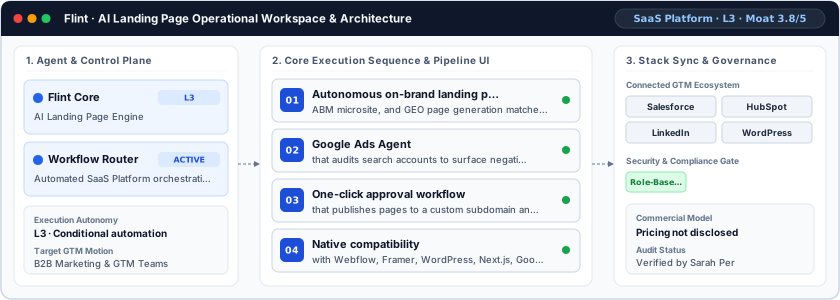
- Autonomous on-brand landing page,: ABM microsite, and GEO page generation matched to paid search campaigns and keywords
- Google Ads Agent: that audits search accounts to surface negative keywords, ad-group remapping, and landing page swaps
- One-click approval workflow: that publishes pages to a custom subdomain and writes updated final URLs directly to Google Ads
- Native compatibility: with Webflow, Framer, WordPress, Next.js, Google Analytics, HubSpot, Salesforce, and PostHog
Cons: operational limitations & risks
- Primary Operational Constraint: In practical deployment, the main limitation is that Flint's paid media agent currently supports Google Ads live, while native Meta Ads and LinkedIn Ads agents remain on the product roadmap.
- Integration & Scaling Friction: The platform is not built for e-commerce merchants managing multi-thousand-SKU retail catalogs or teams seeking an autonomous black-box ad buyer that executes changes without human sign-off.
- Governance & Cost Boundary: Additionally, onboarding requires initial brand design-system ingestion and subdomain DNS configuration, and lean teams must still invest human review bandwidth to approve campaign and page recommendations.
Are you a founder, co-founder, or product/growth lead at Flint? Verify your official @tryflint.com email to publish a factual architectural response or 2026 roadmap update below these limitations.
Flint TCO & deal-breaker stress test
Simulate 12-month stepped TCO, hidden cost multipliers, contract lock-in exposure, and stack failure modes using only facts verified by Sarah Per on · Capture SHA 277426ad.
Flint triggers high-severity friction under your 5-seat / $800/mo constraints. Benchmark the verified subtrack alternatives below before committing.
| Plan / Tier | Verified Rate | Scale Fit | Scope & Quota Notes |
|---|---|---|---|
| Enterprise / Custom | Custom quote | 15–50+ seats (Enterprise SLA) | Sales-negotiated annual contract for custom volume, SSO/RBAC governance, and dedicated SLA. |
- Moat Score
- 3.8 / 5.0
- AI Autonomy
- L3
- Free Tier / Trial
- None disclosed
Triggered audit signals & failure modes
- Opaque Enterprise Quoting vs. SMB/Mid-Market BudgetVerified Pricing Ledger
Flint does not disclose a public self-serve floor (Pricing not disclosed). Buyers with a $800/mo cap face high sales-qualification friction.
- Sales-Gated Contract TermsFact-checked by Sarah Per
Pricing available on request.
- Primary Operational Bottleneck: Governance & Cost BoundaryAudit by Sarah Per
Additionally, onboarding requires initial brand design-system ingestion and subdomain DNS configuration, and lean teams must still invest human review bandwidth to approve campaign and page recommendations.
Hidden TCO Multipliers & Quota Gates
- Primary Operational Constraint: In practical deployment, the main limitation is that Flint's paid media agent currently supports Google Ads live, while native Meta Ads and LinkedIn Ads agents remain on the product roadmap.
- Integration & Scaling Friction: The platform is not built for e-commerce merchants managing multi-thousand-SKU retail catalogs or teams seeking an autonomous black-box ad buyer that executes changes without human sign-off.
When to Walk Away & Negotiation Levers
- Walk away if you require transparent self-serve monthly billing or your budget ceiling is under $1,000/mo (Flint requires sales-gated custom quoting).
- Walk away if your workflow cannot tolerate primary operational constraint: In practical deployment, the main limitation is that Flint's paid media agent currently supports Google Ads live, while native Meta Ads and LinkedIn Ads agents remain on the product roadmap.
- Walk away if integration & scaling friction is a deal-breaker for your team: The platform is not built for e-commerce merchants managing multi-thousand-SKU retail catalogs or teams seeking an autonomous black-box ad buyer that executes changes without human sign-off.
- Demand a 30- to 60-day paid pilot opt-out clause in the Flint order form before signing a 12-month enterprise commitment.
- Require a sandbox proof-of-concept testing primary operational constraint against your live CRM/data schema before annual sign-off.
4 hard questions to ask on a Flint sales or technical demo
“Regarding Flint's commercial model (Pricing not disclosed) and primary operational constraint, what is the exact unit overage rate once baseline allowances are exhausted, and do unused monthly credits roll over across billing cycles?”
Contract / Technical Proof to Require: Demand a 30- to 60-day paid pilot opt-out clause in the Flint order form before signing a 12-month enterprise commitment.
“Our technical audit of Flint flagged "Primary Operational Constraint" (In practical deployment, the main limitation is that Flint's paid media agent currently supports Google Ads live, while native Meta Ads and LinkedIn Ads agents remain on the product roadmap.). Can you demonstrate how Flint handles this scenario live against Salesforce without manual CSV workarounds or webhook latency?”
Contract / Technical Proof to Require: Walk away if you require transparent self-serve monthly billing or your budget ceiling is under $1,000/mo (Flint requires sales-gated custom quoting).
“Because Flint operates at L3 · Conditional automation (AI Landing Page), how do operators prevent "Integration & Scaling Friction" (The platform is not built for e-commerce merchants managing multi-thousand-SKU retail catalogs or teams seeking an autonomous black-box ad buyer that executes changes without human sign-off.) during high-volume campaigns, and what human-in-the-loop approval gates are configurable?”
Contract / Technical Proof to Require: Require a sandbox proof-of-concept testing primary operational constraint against your live CRM/data schema before annual sign-off.
“Our review of Flint did not find public SOC 2 Type II or ISO 27001 certificates on the pricing page. Can you share your security packet, DPA, and zero-data-retention policy for LLM sub-processors?”
Contract / Technical Proof to Require: Attach a signed DPA with zero model-training rights and 30-day data deletion SLA upon contract termination.
Ask a custom procurement or TCO stress-test question about Flint
Generate your 4-role approval packet or request a custom Flint sandbox & AI Landing Page quote
Active spec: 5 Seats · ≤ $800/mo ceiling · Any Stack · No Annual Lock-in
Lower 5-seat floor (~$22/mo vs. Custom Quote) · Transparent self-serve entry without mandatory annual lock-in
Lower 5-seat floor (~$10/mo vs. Custom Quote) · Transparent self-serve entry without mandatory annual lock-in
No public buyer quote requests logged in the current window for Flint. Be the first to lock a verified procurement specification above.
Flint key entities, modules & ecosystem stack
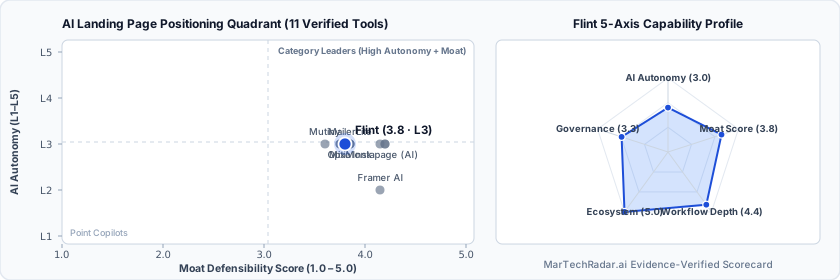
Flint moat & subtrack positioning
Closed-loop AI performance marketing system combining an autonomous on-brand landing page builder with a Google Ads optimization agent that continuously learns from conversion outcomes.
Editorial review
Fact-checked by Sarah Per (Principal Content Systems & Generative Media Editor) on .
Background
Flint (accessible via tryflint.com and flint.com, operated by Flint Technologies, Inc. and headquartered in San Francisco, California) is an AI-native performance marketing and conversion optimization platform engineered for lean B2B and high-growth consumer marketing teams. Operating with a specialized team of 2 to 10 employees and trusted by fast-growing technology companies such as 11x, Graphite, Pickle, Amigo, and Forus, Flint addresses the structural disconnect between paid media traffic management and post-click landing page production.
How Flint works
Architecturally, Flint unites two tightly coupled products—Pages and Agents—into a single closed-loop learning system. First, Flint ingests a company's existing design system, brand guidelines, component library, and business context, deploying on a custom subdomain alongside existing Webflow, Framer, WordPress, or Next.js sites while preserving Google Analytics, Google Tag Manager, PostHog, HubSpot, and Salesforce lead forms. Its Pages engine generates net-new, on-brand landing pages, ABM microsites, and GEO/SEO pages tailored to specific ad groups, keywords, or Clay outbound lists. Simultaneously, its Google Ads Agent connects via OAuth to audit live search campaigns, recommending negative keywords, ad-group-to-page remapping, and page swaps; once a marketer approves a recommendation in chat, Flint automatically publishes the new page and writes the updated final URL back to Google Ads.
Limitations
Operational limitations and deployment trade-offs include:
- Primary Operational Constraint: In practical deployment, the main limitation is that Flint's paid media agent currently supports Google Ads live, while native Meta Ads and LinkedIn Ads agents remain on the product roadmap.
- Integration & Scaling Friction: The platform is not built for e-commerce merchants managing multi-thousand-SKU retail catalogs or teams seeking an autonomous black-box ad buyer that executes changes without human sign-off.
- Governance & Cost Boundary: Additionally, onboarding requires initial brand design-system ingestion and subdomain DNS configuration, and lean teams must still invest human review bandwidth to approve campaign and page recommendations.
Flint pricing
Pricing available on request. While Flint offers a free-to-start entry experience and risk-free scoped pilots where prospective customers can test live campaign pages on their own domain with a dedicated account expert, commercial production deployments use custom managed-first pricing tailored to campaign volume, page velocity, and ad spend scale.
How Flint works
Compared to enterprise personalization suites like Mutiny or Unbounce, Flint goes beyond static on-site text swaps by autonomously shipping complete, design-system-compliant landing pages and directly updating Google Ads final URLs. Against general AI coding tools like Lovable or Claude Code, Flint eliminates ongoing engineering maintenance by handling analytics tags, CRM forms, SEO metadata, and bi-directional Google Ads API synchronization natively. B2B growth teams scaling paid search and ABM campaigns should evaluate Flint to lower customer acquisition costs without bottlenecking on web engineering resources within the AI Landing Page segment.
Frequently asked questions about Flint
How much does Flint cost and does it require a custom enterprise quote?
Published pricing summary for Flint: Pricing not disclosed. A permanent free plan is not disclosed for Flint. Pricing available on request.
How does Flint work and how autonomous is its AI architecture?
Self-improving performance marketing platform that pairs autonomous landing page generation with a Google Ads optimization agent. Within AI Landing Page (Landing Page Builders & Autonomous CRO), MarTechRadar rates its execution architecture at L3 · Conditional automation with a verified Moat Score of 3.8 / 5.0 (Proprietary moat). Closed-loop AI performance marketing system combining an autonomous on-brand landing page builder with a Google Ads optimization agent that continuously learns from conversion outcomes. Corporate profile: operating at 2-10 employees scale.
What are the main limitations of Flint and when should buyers walk away?
Based on our editorial technical audit, key operational considerations and boundaries for Flint include: (1) Primary Operational Constraint: In practical deployment, the main limitation is that Flint's paid media agent currently supports Google Ads live, while native Meta Ads and LinkedIn Ads agents remain on the product roadmap. (2) Integration & Scaling Friction: The platform is not built for e-commerce merchants managing multi-thousand-SKU retail catalogs or teams seeking an autonomous black-box ad buyer that executes changes without human sign-off. (3) Governance & Cost Boundary: Additionally, onboarding requires initial brand design-system ingestion and subdomain DNS configuration, and lean teams must still invest human review bandwidth to approve campaign and page recommendations. Primary procurement walk-away rule: Walk away if you require transparent self-serve monthly billing or your budget ceiling is under $1,000/mo (Flint requires sales-gated custom quoting).
What integrations, compliance certifications, and contract terms apply to Flint?
Verified ecosystem and stack integrations include Salesforce, HubSpot, LinkedIn, WordPress, Webflow, Twilio Segment, Google Analytics 4 (GA4), Google Ads, Meta Ads, LinkedIn Ads. Key TCO multiplier to watch: Primary Operational Constraint (In practical deployment, the main limitation is that Flint's paid media agent currently supports Google Ads live, while native Meta Ads and LinkedIn Ads agents remain on the product roadmap.) Before signing a contract, procurement teams should demand a 30- to 60-day paid pilot opt-out clause in the Flint order form before signing a 12-month enterprise commitment.
What are the best Flint alternatives and head-to-head competitors in 2026?
Top fact-checked alternatives to Flint in AI Landing Page (Landing Page Builders & Autonomous CRO) include Unbounce (From $22/mo), VWO (Pricing not disclosed), Fibr AI (Pricing not disclosed), Clay (Free plan · $54–$180/mo).
Flint profile completeness & verified buyer trust checklist
Our analysts verified the first 5 baseline facts below from public captures. Founders and growth leads at Flint can reach 100% Gold Verified Transparency (and unlock priority buyer sandbox inquiries) by supplying workflow screenshots, customer ROI case studies, and direct support SLA contacts:
- 1. Corporate Identity & HQ: Founded 2020 · San Francisco, California, United States
- 2. Team Scale & Backing: 2-10 employees · Bootstrapped / Undisclosed
- 3. Published Pricing Floor: Pricing not disclosed (Sentinel S7 verified)
- 4. Free Trial & Onboarding: Demo / Sales onboarding
- 5. Stack & Compliance Signals: Salesforce, HubSpot, LinkedIn, WordPress
- 6. Product Workflow Screenshots & Customer Case Studies: Upload 3 UI screenshots & verified ROI case study (+15% completeness) →
- 7. Direct Support SLA, Hotline & Reader Perk Code: Add official support email/phone, SLA & exclusive buyer trial perk (+10% completeness) →
Verified sources & evidence trail
- Official product domain: https://tryflint.com
- Commercial pricing verification: Verified against official vendor pricing policy (Pricing not disclosed)
- Verified corporate entity profiles (
sameAs): LinkedIn Company Profile - Editorial audit sign-off: Fact-checked by Sarah Per on under the MarTechRadar Evidence-Ledger Protocol.