Fibr AI Review (2026): AI Landing Page Pricing, Limits & Alternatives
Bottom line
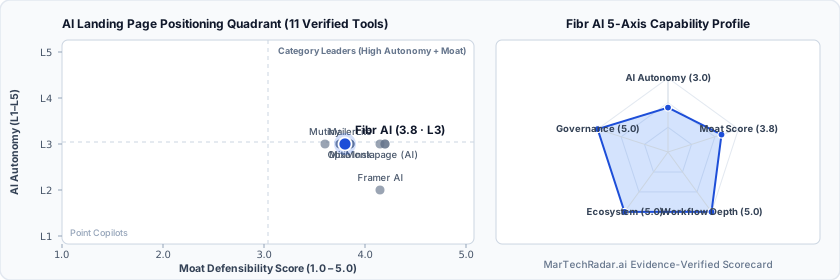
Fibr AI is a SaaS Platform tool for AI Landing Page (Landing Page Builders & Autonomous CRO) in Lifecycle & CDP. Pricing: Pricing not disclosed. Best suited to B2B Marketing & GTM Teams. Editor ratings: AI autonomy L3 (conditional automation); moat score 3.8/5.0 (Proprietary moat). Fact-checked by Sarah Per on Oct 23, 2026.
Agentic web experience and AI CRO platform deploying autonomous agents for 1:1 landing page personalization, A/B testing, and uptime monitoring.
Fibr AI buyer fit verdict: when to choose vs. when to walk away
Choose Fibr AI if (Best Fit)
- Target ICP & Stack Fit: You operate as B2B Marketing & GTM Teams requiring a SaaS Platform deployment for AI Landing Page, with verified ecosystem connectivity for LinkedIn, Google Analytics 4 (GA4), Google Ads, Meta Ads.
- L3 Architecture & Defensibility: Fibr AI builds an agentic conversion-optimization moat through its specialized Liv, Max, and Aya web agents that synchronize paid ad intent with dynamic landing page personalization, backed by $9.5M from Accel.
- Commercial Model Fit: Your procurement budget aligns with Pricing not disclosed.
Walk away from Fibr AI if (Deal-Breakers)
- Walk away if you require transparent self-serve monthly billing or your budget ceiling is under $1,000/mo (Fibr AI requires sales-gated custom quoting).
- Walk away if your workflow cannot tolerate client-side dom manipulation latency risk: Dynamically swapping hero headlines and visual elements via client-side scripts requires proper anti-flicker configuration and edge caching to prevent Cumulative Layout Shift (CLS) or brief content flashing on slow mobile connections.
- Walk away if statistical significance traffic bottleneck is a deal-breaker for your team: Running autonomous multi-variant experiments via Max requires sufficient monthly visitor sessions per landing page; low-traffic B2B niche pages face slow convergence timelines.
Fibr AI key facts & scorecard
| Pricing | Pricing not disclosed |
|---|---|
| Free plan | No / not disclosed |
| Delivery | SaaS Platform |
| Audience | B2B Marketing & GTM Teams |
| AI autonomy level | L3 · Conditional automationEditor-verified |
| Moat tier & score | 3.8 / 5.0 · Proprietary moatEditor-verified |
| Funding | Seed |
| Total funding | $9.5MBacked by Accel, MVP Ventures, Sprint Vc, 2am VC, Kunal Shah |
| Founders | Ankur Goyal, Pritam Roy |
| Company size | 11-50 employees |
| Ecosystem integrations | LinkedIn, Google Analytics 4 (GA4), Google Ads, Meta Ads, LinkedIn Ads |
| Compliance & governance | SOC 2, GDPR, ISO 27001, CCPA |
| Headquarters | San Francisco, California, United States |
| Founded | 2023 |
| Last verified |
Fibr AI pros & cons: strengths vs. operational limitations
Pros: core strengths & capabilities
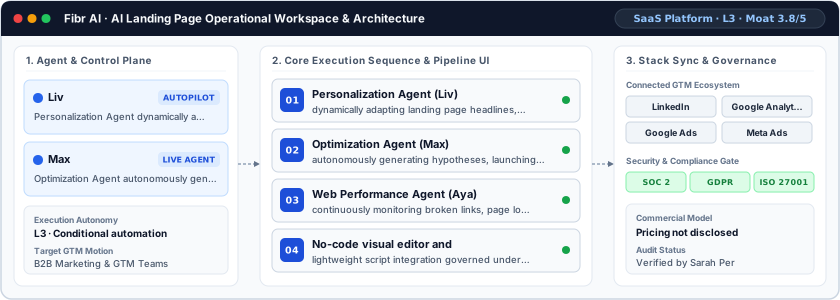
- Personalization Agent (Liv): dynamically adapting landing page headlines, imagery, and CTAs to match Google, Meta, and LinkedIn ad campaigns and LLM referral intent
- Optimization Agent (Max): autonomously generating hypotheses, launching A/B and multivariate experiments, and reallocating traffic to winning variants
- Web Performance Agent (Aya): continuously monitoring broken links, page load speed, Core Web Vitals, and conversion-blocking scripts
- No-code visual editor and: lightweight script integration governed under SOC 2, ISO 27001, GDPR, and CCPA compliance
Cons: operational limitations & risks
- Client-Side DOM Manipulation Latency Risk: Dynamically swapping hero headlines and visual elements via client-side scripts requires proper anti-flicker configuration and edge caching to prevent Cumulative Layout Shift (CLS) or brief content flashing on slow mobile connections.
- Statistical Significance Traffic Bottleneck: Running autonomous multi-variant experiments via Max requires sufficient monthly visitor sessions per landing page; low-traffic B2B niche pages face slow convergence timelines.
- Brand & Legal Approval Governance: In regulated industries such as banking, healthcare, and insurance, allowing AI agents to autonomously alter landing page claims or pricing callouts requires human-in-the-loop compliance approval gates.
Are you a founder, co-founder, or product/growth lead at Fibr AI? Verify your official @fibr.ai email to publish a factual architectural response or 2026 roadmap update below these limitations.
Fibr AI TCO & deal-breaker stress test
Simulate 12-month stepped TCO, hidden cost multipliers, contract lock-in exposure, and stack failure modes using only facts verified by Sarah Per on · Capture SHA 0da98080.
Fibr AI triggers high-severity friction under your 5-seat / $800/mo constraints. Benchmark the verified subtrack alternatives below before committing.
| Plan / Tier | Verified Rate | Scale Fit | Scope & Quota Notes |
|---|---|---|---|
| Enterprise / Custom | Custom quote | 15–50+ seats (Enterprise SLA) | Sales-negotiated annual contract for custom volume, SSO/RBAC governance, and dedicated SLA. |
- Moat Score
- 3.8 / 5.0
- AI Autonomy
- L3
- Free Tier / Trial
- None disclosed
Triggered audit signals & failure modes
- Opaque Enterprise Quoting vs. SMB/Mid-Market BudgetVerified Pricing Ledger
Fibr AI does not disclose a public self-serve floor (Pricing not disclosed). Buyers with a $800/mo cap face high sales-qualification friction.
- Sales-Gated Contract TermsFact-checked by Sarah Per
Fibr AI offers tiered SaaS and enterprise plans (spanning Starter, Agency, and Enterprise editions, with a 30-day pilot option) with custom pricing available on request.
- Primary Operational Bottleneck: Client-Side DOM Manipulation Latency RiskAudit by Sarah Per
Dynamically swapping hero headlines and visual elements via client-side scripts requires proper anti-flicker configuration and edge caching to prevent Cumulative Layout Shift (CLS) or brief content flashing on slow mobile connections.
Hidden TCO Multipliers & Quota Gates
- Client-Side DOM Manipulation Latency Risk: Dynamically swapping hero headlines and visual elements via client-side scripts requires proper anti-flicker configuration and edge caching to prevent Cumulative Layout Shift (CLS) or brief content flashing on slow mobile connections.
- Statistical Significance Traffic Bottleneck: Running autonomous multi-variant experiments via Max requires sufficient monthly visitor sessions per landing page; low-traffic B2B niche pages face slow convergence timelines.
When to Walk Away & Negotiation Levers
- Walk away if you require transparent self-serve monthly billing or your budget ceiling is under $1,000/mo (Fibr AI requires sales-gated custom quoting).
- Walk away if your workflow cannot tolerate client-side dom manipulation latency risk: Dynamically swapping hero headlines and visual elements via client-side scripts requires proper anti-flicker configuration and edge caching to prevent Cumulative Layout Shift (CLS) or brief content flashing on slow mobile connections.
- Walk away if statistical significance traffic bottleneck is a deal-breaker for your team: Running autonomous multi-variant experiments via Max requires sufficient monthly visitor sessions per landing page; low-traffic B2B niche pages face slow convergence timelines.
- Demand a 30- to 60-day paid pilot opt-out clause in the Fibr AI order form before signing a 12-month enterprise commitment.
- Require a sandbox proof-of-concept testing client-side dom manipulation latency risk against your live CRM/data schema before annual sign-off.
Ask a custom procurement or TCO stress-test question about Fibr AI
Lower 5-seat floor (~$22/mo vs. Custom Quote) · Transparent self-serve entry without mandatory annual lock-in
Lower 5-seat floor (~$10/mo vs. Custom Quote) · Transparent self-serve entry without mandatory annual lock-in
Fibr AI key entities, modules & ecosystem stack
Personalization Agent dynamically adapting landing page headlines, imagery, and CTAs to match Google, Meta, and LinkedIn ad campaigns and LLM referral intent
Optimization Agent autonomously generating hypotheses, launching A/B and multivariate experiments, and reallocating traffic to winning variants
Web Performance Agent continuously monitoring broken links, page load speed, Core Web Vitals, and conversion-blocking scripts
Fibr AI moat & subtrack positioning
Fibr AI builds an agentic conversion-optimization moat through its specialized Liv, Max, and Aya web agents that synchronize paid ad intent with dynamic landing page personalization, backed by $9.5M from Accel.
Editorial review
Fact-checked by Sarah Per (Principal Content Systems & Generative Media Editor) on .
Background
Founded in 2023 by Ankur Goyal and Pritam Roy and headquartered in San Francisco, California, United States, Fibr AI (fibr.ai) is an agentic web experience and conversion rate optimization (CRO) platform built for performance marketers, growth teams, and digital agencies across B2B SaaS, e-commerce, financial services, healthcare, and telecom. Operating with a team of 11-50 employees and backed by $9.5M in Seed funding across three rounds from lead investors Accel, MVP Ventures, Sprint Vc, 2am VC, and Kunal Shah, the company solves the post-click conversion drop-off caused by sending diverse paid ad audiences and AI search referrals to static, one-size-fits-all landing pages.
How Fibr AI works
Fibr AI operates at Level 3 autonomy by deploying three specialized AI agents—Liv (Personalization Agent), Max (Optimization Agent), and Aya (Web Performance Agent)—on top of existing websites via a lightweight script tag without requiring engineering rebuilds. Liv connects directly to Google Ads, Meta Ads, LinkedIn Ads, and Google Analytics to read campaign keywords, ad creative messaging, audience segments, and inbound LLM referral context, dynamically rewriting landing page headlines, hero visuals, social proof, and calls-to-action in real time for 1:1 message match. Concurrently, Max analyzes visitor behavior to formulate CRO hypotheses, launches automated A/B and split tests, and shifts traffic toward higher-converting variants, while Aya monitors 24/7 for page latency spikes, broken checkout links, or script errors under SOC 2, ISO 27001, GDPR, and CCPA compliance.
Limitations
Operational limitations and technical trade-offs include:
- Client-Side DOM Manipulation Latency Risk: Dynamically swapping hero headlines and visual elements via client-side scripts requires proper anti-flicker configuration and edge caching to prevent Cumulative Layout Shift (CLS) or brief content flashing on slow mobile connections.
- Statistical Significance Traffic Bottleneck: Running autonomous multi-variant experiments via Max requires sufficient monthly visitor sessions per landing page; low-traffic B2B niche pages face slow convergence timelines.
- Brand & Legal Approval Governance: In regulated industries such as banking, healthcare, and insurance, allowing AI agents to autonomously alter landing page claims or pricing callouts requires human-in-the-loop compliance approval gates.
Fibr AI pricing
Fibr AI offers tiered SaaS and enterprise plans (spanning Starter, Agency, and Enterprise editions, with a 30-day pilot option) with custom pricing available on request. Tiers are metered by monthly personalized visitor sessions, number of active domains, and the number of live personalized web experiences and autonomous A/B tests deployed. Prospective marketing teams and agencies contact Fibr AI's commercial team for a conversion audit and custom annual quote.
How Fibr AI compares
Within the Web Personalization, CRO & Landing Page Intelligence category, Fibr AI competes against website personalization and experimentation platforms such as Mutiny, Unbounce, Instapage, VWO, and Optimizely. Versus legacy enterprise testing suites like Optimizely or VWO that require manual developer-assisted hypothesis coding, or B2B account-only banner tools like Mutiny, Fibr AI differentiates itself by combining ad-to-page personalization (Liv), autonomous A/B experimentation (Max), and technical page health monitoring (Aya) in a single agentic CRO platform.
Frequently asked questions about Fibr AI
How much does Fibr AI cost and does it require a custom enterprise quote?
Published pricing summary for Fibr AI: Pricing not disclosed. A permanent free plan is not disclosed for Fibr AI. Fibr AI offers tiered SaaS and enterprise plans (spanning Starter, Agency, and Enterprise editions, with a 30-day pilot option) with custom pricing available on request.
How does Fibr AI work and how autonomous is its AI architecture?
Agentic web experience and AI CRO platform deploying autonomous agents for 1:1 landing page personalization, A/B testing, and uptime monitoring. Within AI Landing Page (Landing Page Builders & Autonomous CRO), MarTechRadar rates its execution architecture at L3 · Conditional automation with a verified Moat Score of 3.8 / 5.0 (Proprietary moat). Fibr AI builds an agentic conversion-optimization moat through its specialized Liv, Max, and Aya web agents that synchronize paid ad intent with dynamic landing page personalization, backed by $9.5M from Accel. Corporate profile: Founded by Ankur Goyal, Pritam Roy, operating at 11-50 employees scale.
What are the main limitations of Fibr AI and when should buyers walk away?
Based on our editorial technical audit, key operational considerations and boundaries for Fibr AI include: (1) Client-Side DOM Manipulation Latency Risk: Dynamically swapping hero headlines and visual elements via client-side scripts requires proper anti-flicker configuration and edge caching to prevent Cumulative Layout Shift (CLS) or brief content flashing on slow mobile connections. (2) Statistical Significance Traffic Bottleneck: Running autonomous multi-variant experiments via Max requires sufficient monthly visitor sessions per landing page; low-traffic B2B niche pages face slow convergence timelines. (3) Brand & Legal Approval Governance: In regulated industries such as banking, healthcare, and insurance, allowing AI agents to autonomously alter landing page claims or pricing callouts requires human-in-the-loop compliance approval gates. Primary procurement walk-away rule: Walk away if you require transparent self-serve monthly billing or your budget ceiling is under $1,000/mo (Fibr AI requires sales-gated custom quoting).
What integrations, compliance certifications, and contract terms apply to Fibr AI?
Verified ecosystem and stack integrations include LinkedIn, Google Analytics 4 (GA4), Google Ads, Meta Ads, LinkedIn Ads. Documented security and governance attestations include SOC 2, GDPR, ISO 27001, CCPA. Key TCO multiplier to watch: Client-Side DOM Manipulation Latency Risk (Dynamically swapping hero headlines and visual elements via client-side scripts requires proper anti-flicker configuration and edge caching to prevent Cumulative Layout Shift (CLS) or brief content flashing on slow mobile connections.) Before signing a contract, procurement teams should demand a 30- to 60-day paid pilot opt-out clause in the Fibr AI order form before signing a 12-month enterprise commitment.
What are the best Fibr AI alternatives and head-to-head competitors in 2026?
Top fact-checked alternatives to Fibr AI in AI Landing Page (Landing Page Builders & Autonomous CRO) include Mutiny (Custom / enterprise pricing), Unbounce (From $22/mo), RowFlow (Pricing not disclosed), Klaviyo (AI) (Custom / enterprise pricing). Within the Web Personalization, CRO & Landing Page Intelligence category, Fibr AI competes against website personalization and experimentation platforms such as Mutiny, Unbounce, Instapage, VWO, and Optimizely.
Verified sources & evidence trail
- Official product domain: https://fibr.ai
- Commercial pricing verification: Verified against official vendor pricing policy (Pricing not disclosed)
- Verified corporate entity profiles (
sameAs): LinkedIn Company Profile · Crunchbase Entity Record - Editorial audit sign-off: Fact-checked by Sarah Per on under the MarTechRadar Evidence-Ledger Protocol.