EatFuti Review (2026): Social Media Scheduling Pricing, Limits & Alternatives
Bottom line
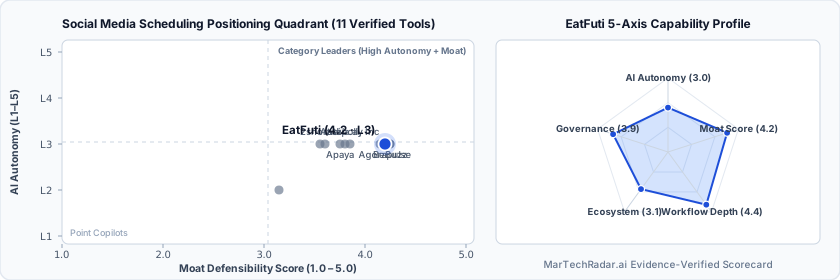
EatFuti is a Web SaaS tool for Social Media Scheduling (Social Media Scheduling & Auto-Publishing) in Social & Influencer. Pricing: Free plan · $0/mo · Enterprise plan. Best suited to Social Media Managers, Creator & Influencer Agencies and Brand Community Ops. Editor ratings: AI autonomy L3 (conditional automation); moat score 4.2/5.0 (Proprietary moat). Fact-checked by Tim Fenolz on Oct 14, 2026.
EatFuti is an AI-driven restaurant automation platform combining social scheduling, review remediation, and direct online ordering to reduce external.
EatFuti buyer fit verdict: when to choose vs. when to walk away
Choose EatFuti if (Best Fit)
- Target ICP & Stack Fit: You operate as Social Media Managers, Creator & Influencer Agencies and Brand Community Ops requiring a Web SaaS deployment for Social Media Scheduling.
- L3 Architecture & Defensibility: EatFuti couples verticalized hospitality data pipelines—spanning Google review sentiment, direct guest ordering, and automated social distribution—into an integrated workflow engine tailored specifically for food service operators.
- Commercial Model Fit: Your procurement budget aligns with Free plan · $0/mo · Enterprise plan and want a self-serve free tier for zero-cost initial validation.
Walk away from EatFuti if (Deal-Breakers)
- Walk away if your workflow requires uncapped enterprise volume on the Free plan · $0/mo · Enterprise plan entry plan without upgrading tiers.
- Walk away if your workflow cannot tolerate API rate limits and review scraping constraints: Review syndication depends heavily on Google Business Profile API quotas, where downstream sync latency can delay urgent review remediation cycles.
- Walk away if menu sync and pos schema drift is a deal-breaker for your team: Connecting direct ordering workflows with legacy point-of-sale systems requires manual schema alignment whenever menu items, taxes, or modifiers change.
EatFuti key facts & scorecard
| Pricing | Free plan · $0/mo · Enterprise planVendor pricing page |
|---|---|
| Free plan | Yes |
| Delivery | Web SaaS |
| Audience | Social Media Managers, Creator & Influencer Agencies, Brand Community Ops |
| AI autonomy level | L3 · Conditional automationEditor-verified |
| Moat tier & score | 4.2 / 5.0 · Proprietary moatEditor-verified |
| Funding | Seed |
| Total funding | $1M |
| Founders | Khang Nguyen, Khoa Ma, Noor Ahmed, Tin Lam |
| Company size | 11-50 employees |
| Governance & docs | Terms ↗ · Privacy ↗ |
| Headquarters | Des Moines, Iowa, United States |
| Founded | 2020 |
| Last verified |
EatFuti pros & cons: strengths vs. operational limitations
Pros: core strengths & capabilities
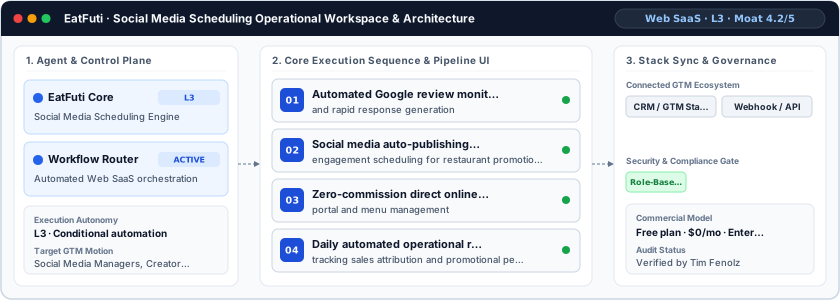
- Automated Google review monitoring: and rapid response generation
- Social media auto-publishing and: engagement scheduling for restaurant promotions
- Zero-commission direct online ordering: portal and menu management
- Daily automated operational reporting: tracking sales attribution and promotional performance
Cons: operational limitations & risks
- API Rate Limits and Review Scraping Constraints: Review syndication depends heavily on Google Business Profile API quotas, where downstream sync latency can delay urgent review remediation cycles.
- Menu Sync and POS Schema Drift: Connecting direct ordering workflows with legacy point-of-sale systems requires manual schema alignment whenever menu items, taxes, or modifiers change.
- Contextual Brand Voice Hallucinations: Autonomous draft generation occasionally generates misaligned hospitality responses during complex customer disputes, requiring manual guardrails.
EatFuti TCO & deal-breaker stress test
Simulate 12-month stepped TCO, hidden cost multipliers, contract lock-in exposure, and stack failure modes using only facts verified by Tim Fenolz on · Capture SHA bd294411.
EatFuti is viable for 5 seats, but requires commercial or technical verification on the flagged items below.
| Plan / Tier | Verified Rate | Scale Fit | Scope & Quota Notes |
|---|---|---|---|
| Free / Sandbox | $0 | 1–2 seats (Evaluation) | Entry free tier with capped usage or feature quotas for initial workflow testing. |
| Entry / Starter | $79/mo | 1–2 seats | Points, rewards, friend gifting, VIP levels, and win back messages that bring quiet customers h |
| Growth / Professional | $99/mo | 5 seats | Everything a restaurant needs to sell direct. |
| Scale / Advanced | $149/mo | 15 seats | Posts written and published for you, photos fixed by typing, reels from your own dishes, trend |
- Moat Score
- 4.2 / 5.0
- AI Autonomy
- L3
- Free Tier / Trial
- Free plan
Triggered audit signals & failure modes
- Opaque Enterprise Quoting vs. SMB/Mid-Market BudgetVerified Pricing Ledger
EatFuti does not disclose a public self-serve floor (Free plan · $0/mo · Enterprise plan). Buyers with a $800/mo cap face high sales-qualification friction.
- Published Self-Serve Entry FloorVerified Pricing Ledger
EatFuti publishes a transparent entry point (Free plan · $0/mo · Enterprise plan) with a free tier for initial validation before committing.
- Tier Fit for 5-Seat Scale: Entry / Starter ($79/mo)Verified Tier Schedule
Points, rewards, friend gifting, VIP levels, and win back messages that bring quiet customers h
- Primary Operational Bottleneck: API Rate Limits and Review Scraping ConstraintsAudit by Tim Fenolz
Review syndication depends heavily on Google Business Profile API quotas, where downstream sync latency can delay urgent review remediation cycles.
Hidden TCO Multipliers & Quota Gates
- Annual Billing Headline vs. Monthly Premium: Headline entry rates reflect annual billing commitments (SAVE 24%); month-to-month flexibility carries a higher effective monthly rate or requires annual prepayment.
- Enterprise Governance & Add-On Gating: Advanced capabilities such as Single Sign-On (SSO), custom role permissions, or specialized analytics modules are gated behind upper tiers or paid add-ons.
When to Walk Away & Negotiation Levers
- Walk away if your workflow requires uncapped enterprise volume on the Free plan · $0/mo · Enterprise plan entry plan without upgrading tiers.
- Walk away if your workflow cannot tolerate API rate limits and review scraping constraints: Review syndication depends heavily on Google Business Profile API quotas, where downstream sync latency can delay urgent review remediation cycles.
- Walk away if menu sync and pos schema drift is a deal-breaker for your team: Connecting direct ordering workflows with legacy point-of-sale systems requires manual schema alignment whenever menu items, taxes, or modifiers change.
- Validate exact quota thresholds (seats, credits, or API calls) included in EatFuti's Free plan · $0/mo · Enterprise plan tier before converting from monthly to annual billing.
- Require a sandbox proof-of-concept testing API rate limits and review scraping constraints against your live CRM/data schema before annual sign-off.
Ask a custom procurement or TCO stress-test question about EatFuti
Lower 5-seat floor (~$395/mo vs. Custom Quote)
Lower 5-seat floor (~$10/mo vs. Custom Quote)
EatFuti moat & subtrack positioning
EatFuti couples verticalized hospitality data pipelines—spanning Google review sentiment, direct guest ordering, and automated social distribution—into an integrated workflow engine tailored specifically for food service operators.
Editorial review
Fact-checked by Tim Fenolz (Lead AdTech, Programmatic & Attribution Analyst) on .
Background
To capture local foot traffic and retain margin, hospitality operators require automated marketing channels that bypass high third-party aggregator commissions. EatFuti addresses this operational task. Established in 2020 and headquartered in Des Moines, Iowa, United States, the company has raised $1M in venture capital funding. Designed primarily for restaurant owners, general managers, and multi-location hospitality marketers, the platform automates localized promotional distribution and reputation monitoring to protect unit-level margins.
How EatFuti works
EatFuti operates as an L3 autonomous local marketing engine. The architecture continuously ingests transactional data, Google review webhooks, and local audience engagement metrics. Upon event ingestion, internal parsing models categorize sentiment and trigger pre-configured workflows. For social media distribution, the system synchronizes promotional assets with operational inventory, scheduling updates across digital channels. Automated remediation workflows draft contextual responses to negative reviews and route critical operational issues directly to store operators without human intervention.
Limitations
Operational considerations and platform boundaries include:
- API Rate Limits and Review Scraping Constraints: Review syndication depends heavily on Google Business Profile API quotas, where downstream sync latency can delay urgent review remediation cycles.
- Menu Sync and POS Schema Drift: Connecting direct ordering workflows with legacy point-of-sale systems requires manual schema alignment whenever menu items, taxes, or modifiers change.
- Contextual Brand Voice Hallucinations: Autonomous draft generation occasionally generates misaligned hospitality responses during complex customer disputes, requiring manual guardrails.
EatFuti pricing
Commercial procurement for EatFuti follows a tiered subscription structure. The vendor provides a free entry tier at $0 per month for basic listing visibility and initial setup. Paid operations scale starting at $99 per month for the base package, which covers digital ordering infrastructure, review remediation, and scheduled promotional distribution. Enterprise multi-unit operators scale into custom pricing tiers based on operational location count and custom integration requirements.
How EatFuti compares
Within multi-channel social publishing, EatFuti competes against broad scheduling solutions like Agorapulse alongside vertical tools such as Antela.ai, Inc. and Apaya. Unlike Agorapulse, which provides comprehensive enterprise analytics across generalized brand profiles, EatFuti couples publishing pipelines directly to restaurant ordering and review endpoints. Antela.ai, Inc. and Apaya focus heavily on generic conversational AI, whereas EatFuti optimizes for food service unit economics, making it ideal for independent restaurants and regional hospitality groups.
Frequently asked questions about EatFuti
How much does EatFuti cost and what pricing tiers are available?
Published pricing summary for EatFuti: Free plan · $0/mo · Enterprise plan. EatFuti includes a free tier or sandbox entry point. Verified tier schedule: Free / Sandbox ($0 for 1–2 seats (Evaluation)); Entry / Starter ($79/mo for 1–2 seats); Growth / Professional ($99/mo for 5 seats); Scale / Advanced ($149/mo for 15 seats). Commercial procurement for EatFuti follows a tiered subscription structure. The vendor provides a free entry tier at $0 per month for basic listing visibility and initial setup.
How does EatFuti work and how autonomous is its AI architecture?
EatFuti is an AI-driven restaurant automation platform combining social scheduling, review remediation, and direct online ordering to reduce external. Within Social Media Scheduling (Social Media Scheduling & Auto-Publishing), MarTechRadar rates its execution architecture at L3 · Conditional automation with a verified Moat Score of 4.2 / 5.0 (Proprietary moat). EatFuti couples verticalized hospitality data pipelines—spanning Google review sentiment, direct guest ordering, and automated social distribution—into an integrated workflow engine tailored specifically for food service operators. Corporate profile: Founded by Khang Nguyen, Khoa Ma, Noor Ahmed, Tin Lam, operating at 11-50 employees scale.
What are the main limitations of EatFuti and when should buyers walk away?
Based on our editorial technical audit, key operational considerations and boundaries for EatFuti include: (1) API Rate Limits and Review Scraping Constraints: Review syndication depends heavily on Google Business Profile API quotas, where downstream sync latency can delay urgent review remediation cycles. (2) Menu Sync and POS Schema Drift: Connecting direct ordering workflows with legacy point-of-sale systems requires manual schema alignment whenever menu items, taxes, or modifiers change. (3) Contextual Brand Voice Hallucinations: Autonomous draft generation occasionally generates misaligned hospitality responses during complex customer disputes, requiring manual guardrails. Primary procurement walk-away rule: Walk away if your workflow requires uncapped enterprise volume on the Free plan · $0/mo · Enterprise plan entry plan without upgrading tiers.
What integrations, compliance certifications, and contract terms apply to EatFuti?
Key TCO multiplier to watch: Annual Billing Headline vs. Monthly Premium (Headline entry rates reflect annual billing commitments (SAVE 24%); month-to-month flexibility carries a higher effective monthly rate or requires annual prepayment.) Before signing a contract, procurement teams should validate exact quota thresholds (seats, credits, or API calls) included in EatFuti's Free plan · $0/mo · Enterprise plan tier before converting from monthly to annual billing.
What are the best EatFuti alternatives and head-to-head competitors in 2026?
Top fact-checked alternatives to EatFuti in Social Media Scheduling (Social Media Scheduling & Auto-Publishing) include Blink AI (Custom / enterprise pricing), BeBuzz (Custom / enterprise pricing), Commune (Custom / enterprise pricing), Dash Hudson (Custom / enterprise pricing). Within multi-channel social publishing, EatFuti competes against broad scheduling solutions like Agorapulse alongside vertical tools such as Antela.ai, Inc. and Apaya.
Verified sources & evidence trail
- Official product domain: https://www.eatfuti.ai
- Commercial pricing verification: https://www.eatfuti.ai/pricing
- Verified corporate entity profiles (
sameAs): Crunchbase Entity Record - First-party governance & documentation links: Terms · Privacy
- Editorial audit sign-off: Fact-checked by Tim Fenolz on under the MarTechRadar Evidence-Ledger Protocol.