Dig Review (2026): AI Content Marketing Pricing, Limits & Alternatives
Bottom line
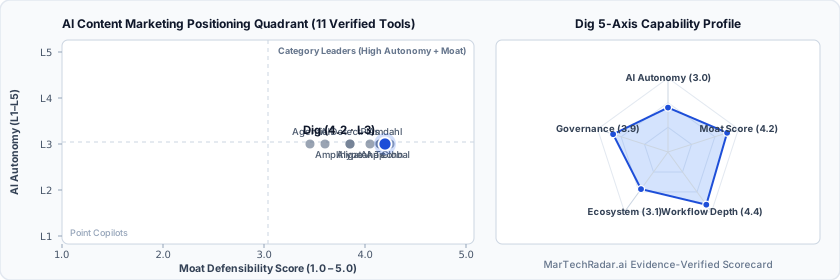
Dig is a Web SaaS tool for AI Content Marketing (Enterprise & Long-Form Brand Content) in Copy & Content. Pricing: Free plan · $0/mo · Enterprise plan. Best suited to Enterprise Content Teams, Brand Marketers and Global Copywriters. Editor ratings: AI autonomy L3 (conditional automation); moat score 4.2/5.0 (Proprietary moat). Fact-checked by Jagmeet Sine on Oct 11, 2026.
Multimodal social listening and brand intelligence engine analyzing video, audio, and text across short-form media networks.
Dig buyer fit verdict: when to choose vs. when to walk away
Choose Dig if (Best Fit)
- Target ICP & Stack Fit: You operate as Enterprise Content Teams, Brand Marketers and Global Copywriters requiring a Web SaaS deployment for AI Content Marketing.
- L3 Architecture & Defensibility: Dig maintains a defensive data moat via proprietary multimodal parsing of short-form video streams, translating raw visual, audio, and textual narrative signals into structured brand health metrics.
- Commercial Model Fit: Your procurement budget aligns with Free plan · $0/mo · Enterprise plan and want a self-serve free tier for zero-cost initial validation.
Walk away from Dig if (Deal-Breakers)
- Walk away if your workflow requires uncapped enterprise volume on the Free plan · $0/mo · Enterprise plan entry plan without upgrading tiers.
- Walk away if your workflow cannot tolerate social API ingestion quotas: Rate limits and volatile endpoint schemas across walled-garden video platforms can throttle real-time extraction queues during unexpected viral spikes.
- Walk away if multimodal inference latency is a deal-breaker for your team: Concurrent processing of dense audio tracks and high-resolution video frames introduces narrative clustering delays compared to lightweight text-only keyword listeners.
Dig key facts & scorecard
| Pricing | Free plan · $0/mo · Enterprise planVendor pricing page |
|---|---|
| Free plan | Yes |
| Delivery | Web SaaS |
| Audience | Enterprise Content Teams, Brand Marketers, Global Copywriters |
| AI autonomy level | L3 · Conditional automationEditor-verified |
| Moat tier & score | 4.2 / 5.0 · Proprietary moatEditor-verified |
| Funding | Series A |
| Total funding | $22MBacked by New Era Capital Partners |
| Founders | Adi Paz, Eyal Koren, Ofer Familier |
| Company size | 51-200 employees |
| Governance & docs | Terms ↗ · Privacy ↗ |
| Headquarters | New York |
| Founded | 2021 |
| Last verified |
Dig pros & cons: strengths vs. operational limitations
Pros: core strengths & capabilities
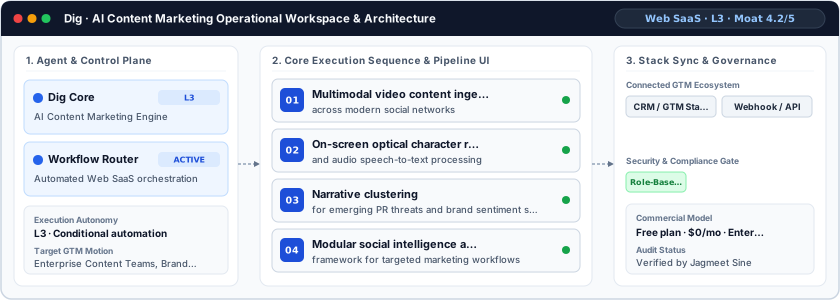
- Multimodal video content ingestion: across modern social networks
- On-screen optical character recognition: and audio speech-to-text processing
- Narrative clustering: for emerging PR threats and brand sentiment shifts
- Modular social intelligence application: framework for targeted marketing workflows
Cons: operational limitations & risks
- Social API Ingestion Quotas: Rate limits and volatile endpoint schemas across walled-garden video platforms can throttle real-time extraction queues during unexpected viral spikes.
- Multimodal Inference Latency: Concurrent processing of dense audio tracks and high-resolution video frames introduces narrative clustering delays compared to lightweight text-only keyword listeners.
- Sarcasm and Cultural Ambiguity: Algorithmic sentiment scoring occasionally misinterprets visual irony, trending audio memes, and colloquial creator humor, generating false-positive crisis alerts.
Dig TCO & deal-breaker stress test
Simulate 12-month stepped TCO, hidden cost multipliers, contract lock-in exposure, and stack failure modes using only facts verified by Jagmeet Sine on · Capture SHA 099ee493.
Dig is viable for 5 seats, but requires commercial or technical verification on the flagged items below.
| Plan / Tier | Verified Rate | Scale Fit | Scope & Quota Notes |
|---|---|---|---|
| Free / Sandbox | $0 | 1–2 seats (Evaluation) | Entry free tier with capped usage or feature quotas for initial workflow testing. |
| Pro | $25/mo | 1–2 seats | For power users who need deeper, |
| Enterprise / Custom | Custom quote | 15–50+ seats (Enterprise SLA) | Sales-negotiated annual contract for custom volume, SSO/RBAC governance, and dedicated SLA. |
- Moat Score
- 4.2 / 5.0
- AI Autonomy
- L3
- Free Tier / Trial
- Free plan
Triggered audit signals & failure modes
- Opaque Enterprise Quoting vs. SMB/Mid-Market BudgetVerified Pricing Ledger
Dig does not disclose a public self-serve floor (Free plan · $0/mo · Enterprise plan). Buyers with a $800/mo cap face high sales-qualification friction.
- Published Self-Serve Entry FloorVerified Pricing Ledger
Dig publishes a transparent entry point (Free plan · $0/mo · Enterprise plan) with a free tier for initial validation before committing.
- Primary Operational Bottleneck: Social API Ingestion QuotasAudit by Jagmeet Sine
Rate limits and volatile endpoint schemas across walled-garden video platforms can throttle real-time extraction queues during unexpected viral spikes.
Hidden TCO Multipliers & Quota Gates
- Credit & Usage Burn Multiplier: Automated workflows consume metered credits/usage quotas; multi-step enrichment, voice minutes, or high-frequency agent runs can trigger mid-cycle top-up packs.
- Enterprise Governance & Add-On Gating: Advanced capabilities such as Single Sign-On (SSO), custom role permissions, or specialized analytics modules are gated behind upper tiers or paid add-ons.
When to Walk Away & Negotiation Levers
- Walk away if your workflow requires uncapped enterprise volume on the Free plan · $0/mo · Enterprise plan entry plan without upgrading tiers.
- Walk away if your workflow cannot tolerate social API ingestion quotas: Rate limits and volatile endpoint schemas across walled-garden video platforms can throttle real-time extraction queues during unexpected viral spikes.
- Walk away if multimodal inference latency is a deal-breaker for your team: Concurrent processing of dense audio tracks and high-resolution video frames introduces narrative clustering delays compared to lightweight text-only keyword listeners.
- Validate exact quota thresholds (seats, credits, or API calls) included in Dig's Free plan · $0/mo · Enterprise plan tier before converting from monthly to annual billing.
- Require a sandbox proof-of-concept testing social API ingestion quotas against your live CRM/data schema before annual sign-off.
Ask a custom procurement or TCO stress-test question about Dig
Lower 5-seat floor (~$24/mo vs. Custom Quote)
Offers a free tier (Free plan · $0/mo · Enterprise plan)
Dig moat & subtrack positioning
Dig maintains a defensive data moat via proprietary multimodal parsing of short-form video streams, translating raw visual, audio, and textual narrative signals into structured brand health metrics.
Editorial review
Fact-checked by Jagmeet Sine (Senior MarTech Infrastructure & Agentic Workflow Architect) on .
Background
Architectured to resolve the blind spots of legacy text-based listening, Dig was founded in 2021 in New York and has raised $22M in venture funding. The platform provides social listening and brand intelligence specifically calibrated for modern, video-first channels. Designed for brand communications leaders, public relations teams, and enterprise consumer marketers, Dig ingests high-volume multimedia assets to monitor audience sentiment and track brand perception where traditional scrapers fail.
How Dig works
Dig operates as an L3 autonomous brand monitoring system powered by a multimodal processing pipeline. The architecture ingests visual media streams, extracting metadata across three simultaneous vectors: acoustic signals via automated speech recognition, contextual imagery via frame-level computer vision, and on-screen text through optical character recognition. These extracted feeds pass into natural language processing transformers that synthesize sentiment nuances, detect brand mentions, and cluster emerging narrative arcs without requiring manual query re-engineering.
Limitations
Operational considerations and platform boundaries include:
- Social API Ingestion Quotas: Rate limits and volatile endpoint schemas across walled-garden video platforms can throttle real-time extraction queues during unexpected viral spikes.
- Multimodal Inference Latency: Concurrent processing of dense audio tracks and high-resolution video frames introduces narrative clustering delays compared to lightweight text-only keyword listeners.
- Sarcasm and Cultural Ambiguity: Algorithmic sentiment scoring occasionally misinterprets visual irony, trending audio memes, and colloquial creator humor, generating false-positive crisis alerts.
Dig pricing
Commercial procurement for Dig combines self-serve accessibility with tailored enterprise contracts. Platform access initiates on a Free tier ($0/month) for evaluation and baseline brand monitoring tasks. Scaled organizational rollouts, higher data consumption volumes, expanded app store access, and customized analytical dashboards are delivered via custom enterprise pricing negotiated on an annual license basis.
How Dig compares
Within Enterprise & Long-Form Brand Content and narrative tracking, Dig differentiates through native multimodal video transcription, whereas Agentio focuses on creator ad marketplace automation, Aha Global addresses global audience research synthesis, and AIDetectPlus inspects text authenticity. Dig suits mid-market to enterprise consumer enterprises requiring automated visual sentiment tracking across TikTok, Reels, and YouTube Shorts.
Frequently asked questions about Dig
How much does Dig cost and what pricing tiers are available?
Published pricing summary for Dig: Free plan · $0/mo · Enterprise plan. Dig includes a free tier or sandbox entry point. Verified tier schedule: Free / Sandbox ($0 for 1–2 seats (Evaluation)); Pro ($25/mo for 1–2 seats); Enterprise / Custom (Custom quote for 15–50+ seats (Enterprise SLA)). Commercial procurement for Dig combines self-serve accessibility with tailored enterprise contracts. Platform access initiates on a Free tier ($0/month) for evaluation and baseline brand monitoring tasks.
How does Dig work and how autonomous is its AI architecture?
Multimodal social listening and brand intelligence engine analyzing video, audio, and text across short-form media networks. Within AI Content Marketing (Enterprise & Long-Form Brand Content), MarTechRadar rates its execution architecture at L3 · Conditional automation with a verified Moat Score of 4.2 / 5.0 (Proprietary moat). Dig maintains a defensive data moat via proprietary multimodal parsing of short-form video streams, translating raw visual, audio, and textual narrative signals into structured brand health metrics. Corporate profile: Founded by Adi Paz, Eyal Koren, Ofer Familier, operating at 51-200 employees scale.
What are the main limitations of Dig and when should buyers walk away?
Based on our editorial technical audit, key operational considerations and boundaries for Dig include: (1) Social API Ingestion Quotas: Rate limits and volatile endpoint schemas across walled-garden video platforms can throttle real-time extraction queues during unexpected viral spikes. (2) Multimodal Inference Latency: Concurrent processing of dense audio tracks and high-resolution video frames introduces narrative clustering delays compared to lightweight text-only keyword listeners. (3) Sarcasm and Cultural Ambiguity: Algorithmic sentiment scoring occasionally misinterprets visual irony, trending audio memes, and colloquial creator humor, generating false-positive crisis alerts. Primary procurement walk-away rule: Walk away if your workflow requires uncapped enterprise volume on the Free plan · $0/mo · Enterprise plan entry plan without upgrading tiers.
What integrations, compliance certifications, and contract terms apply to Dig?
Key TCO multiplier to watch: Credit & Usage Burn Multiplier (Automated workflows consume metered credits/usage quotas; multi-step enrichment, voice minutes, or high-frequency agent runs can trigger mid-cycle top-up packs.) Before signing a contract, procurement teams should validate exact quota thresholds (seats, credits, or API calls) included in Dig's Free plan · $0/mo · Enterprise plan tier before converting from monthly to annual billing.
What are the best Dig alternatives and head-to-head competitors in 2026?
Top fact-checked alternatives to Dig in AI Content Marketing (Enterprise & Long-Form Brand Content) include YAi Digital (Custom / enterprise pricing), Amdahl (From $0.34/mo), Intangible (Free plan · $0/mo · Enterprise plan), Rembrand (From $24/mo). Within Enterprise & Long-Form Brand Content and narrative tracking, Dig differentiates through native multimodal video transcription, whereas Agentio focuses on creator ad marketplace automation, Aha Global addresses global audience research synthesis, and AIDetectPlus inspects text authenticity.
Verified sources & evidence trail
- Official product domain: https://dig.ai/
- Commercial pricing verification: https://dig.ai/pricing
- Verified corporate entity profiles (
sameAs): LinkedIn Company Profile · Crunchbase Entity Record - First-party governance & documentation links: Terms · Privacy
- Editorial audit sign-off: Fact-checked by Jagmeet Sine on under the MarTechRadar Evidence-Ledger Protocol.