CRSTBL Review (2026): GEO Pricing, Limits & Alternatives
Bottom line
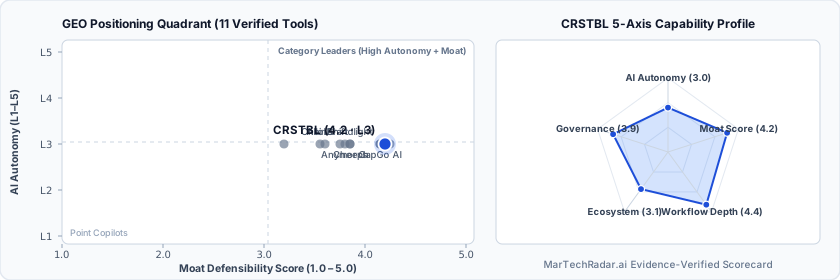
CRSTBL is a Web SaaS tool for GEO (GEO Brand Tracking & LLM Rank Tracking) in GEO & AI SEO. Pricing: From $35/mo. Best suited to SEO Directors, Brand Strategy Leaders and Growth Marketers. Editor ratings: AI autonomy L3 (conditional automation); moat score 4.2/5.0 (Proprietary moat). Fact-checked by Jagmeet Sine on Oct 14, 2026.
CRSTBL provides governed conversational agent deployment and generative engine optimization telemetry to manage how external LLMs represent enterprise.
CRSTBL buyer fit verdict: when to choose vs. when to walk away
Choose CRSTBL if (Best Fit)
- Target ICP & Stack Fit: You operate as SEO Directors, Brand Strategy Leaders and Growth Marketers requiring a Web SaaS deployment for GEO.
- L3 Architecture & Defensibility: CRSTBL integrates outward-facing conversational agents with synthetic prompt monitoring to detect, structure, and remediate brand factual drift across commercial AI search platforms.
- Commercial Model Fit: Your procurement budget aligns with From $35/mo.
Walk away from CRSTBL if (Deal-Breakers)
- Walk away if your workflow requires uncapped enterprise volume on the From $35/mo entry plan without upgrading tiers.
- Walk away if your workflow cannot tolerate synthetic query sampling volatility: LLM response generation relies on probabilistic inference, causing non-deterministic outputs across prompt runs that can introduce statistical noise into longitudinal brand ranking metrics.
- Walk away if external engine indexing latency is a deal-breaker for your team: Remediating factual inaccuracies depends on crawler refresh cycles and context window training cadences within third-party foundation models, preventing instantaneous real-time corrections.
CRSTBL key facts & scorecard
| Pricing | From $35/moVendor pricing page |
|---|---|
| Free plan | No / not disclosed |
| Delivery | Web SaaS |
| Audience | SEO Directors, Brand Strategy Leaders, Growth Marketers |
| AI autonomy level | L3 · Conditional automationEditor-verified |
| Moat tier & score | 4.2 / 5.0 · Proprietary moatEditor-verified |
| Funding | Seed |
| Total funding | $1.5M |
| Founders | James McMillian, John Chang |
| Company size | 11-50 employees |
| Governance & docs | Terms ↗ · Privacy ↗ |
| Headquarters | Los Angeles, California |
| Founded | 2025 |
| Last verified |
CRSTBL pros & cons: strengths vs. operational limitations
Pros: core strengths & capabilities
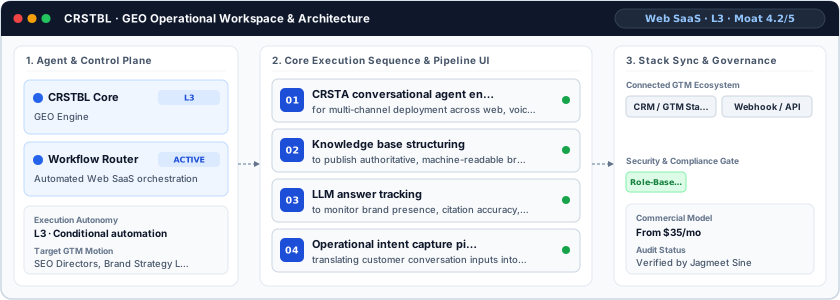
- CRSTA conversational agent engine: for multi-channel deployment across web, voice, and interactive endpoints
- Knowledge base structuring: to publish authoritative, machine-readable brand data for external AI models
- LLM answer tracking: to monitor brand presence, citation accuracy, and prompt visibility across generative search engines
- Operational intent capture pipelines: translating customer conversation inputs into governed product answers
Cons: operational limitations & risks
- Synthetic Query Sampling Volatility: LLM response generation relies on probabilistic inference, causing non-deterministic outputs across prompt runs that can introduce statistical noise into longitudinal brand ranking metrics.
- External Engine Indexing Latency: Remediating factual inaccuracies depends on crawler refresh cycles and context window training cadences within third-party foundation models, preventing instantaneous real-time corrections.
- Multi-Endpoint Schema Maintenance: Unifying catalog datasets across kiosks, voice endpoints, and website conversational agents requires regular schema normalization, creating administrative overhead when product taxonomies change.
CRSTBL TCO & deal-breaker stress test
Simulate 12-month stepped TCO, hidden cost multipliers, contract lock-in exposure, and stack failure modes using only facts verified by Jagmeet Sine on · Capture SHA 0aa3b471.
CRSTBL aligns with your 5-seat / $800/mo profile. Review the walk-away triggers and contract levers below before deployment.
| Plan / Tier | Verified Rate | Scale Fit | Scope & Quota Notes |
|---|---|---|---|
| Entry / Starter | $35/mo | 1–2 seats | Cumae Publish is free — a self-asserted public identity record, no card required. |
| Growth / Professional | $99/mo | 5 seats | Multi-address record $149/mo · additional locations from $35/mo · hotels from $499/mo per prope |
| Scale / Advanced | $120/mo | 15 seats | SMB from $1,000/month + agents · Enterprise from $2,500/month + agents |
- Moat Score
- 4.2 / 5.0
- AI Autonomy
- L3
- Free Tier / Trial
- None disclosed
Triggered audit signals & failure modes
- Published Self-Serve Entry FloorVerified Pricing Ledger
CRSTBL publishes a transparent entry point (From $35/mo) for initial validation before committing.
- Tier Fit for 5-Seat Scale: Growth / Professional ($99/mo)Verified Tier Schedule
Multi-address record $149/mo · additional locations from $35/mo · hotels from $499/mo per prope
- Primary Operational Bottleneck: Synthetic Query Sampling VolatilityAudit by Jagmeet Sine
LLM response generation relies on probabilistic inference, causing non-deterministic outputs across prompt runs that can introduce statistical noise into longitudinal brand ranking metrics.
Hidden TCO Multipliers & Quota Gates
- Annual Billing Headline vs. Monthly Premium: Headline entry rates reflect annual billing commitments; month-to-month flexibility carries a higher effective monthly rate or requires annual prepayment.
- Synthetic Query Sampling Volatility: LLM response generation relies on probabilistic inference, causing non-deterministic outputs across prompt runs that can introduce statistical noise into longitudinal brand ranking metrics.
- External Engine Indexing Latency: Remediating factual inaccuracies depends on crawler refresh cycles and context window training cadences within third-party foundation models, preventing instantaneous real-time corrections.
When to Walk Away & Negotiation Levers
- Walk away if your workflow requires uncapped enterprise volume on the From $35/mo entry plan without upgrading tiers.
- Walk away if your workflow cannot tolerate synthetic query sampling volatility: LLM response generation relies on probabilistic inference, causing non-deterministic outputs across prompt runs that can introduce statistical noise into longitudinal brand ranking metrics.
- Walk away if external engine indexing latency is a deal-breaker for your team: Remediating factual inaccuracies depends on crawler refresh cycles and context window training cadences within third-party foundation models, preventing instantaneous real-time corrections.
- Validate exact quota thresholds (seats, credits, or API calls) included in CRSTBL's From $35/mo tier before converting from monthly to annual billing.
- Require a sandbox proof-of-concept testing synthetic query sampling volatility against your live CRM/data schema before annual sign-off.
Ask a custom procurement or TCO stress-test question about CRSTBL
Lower 5-seat floor (~$29/mo vs. $99 / mo)
Lower 5-seat floor (~$97/mo vs. $99 / mo)
CRSTBL moat & subtrack positioning
CRSTBL integrates outward-facing conversational agents with synthetic prompt monitoring to detect, structure, and remediate brand factual drift across commercial AI search platforms.
Editorial review
Fact-checked by Jagmeet Sine (Senior MarTech Infrastructure & Agentic Workflow Architect) on .
Background
Backed by $1.5M in venture funding, CRSTBL was founded in 2025 in Los Angeles, California, to address corporate data fragmentation across external generative engines. Operating within the generative engine optimization and conversational AI landscape, the vendor equips digital marketing directors and search operations teams with a dual framework: internal conversational agents and external AI brand presence governance.
How CRSTBL works
CRSTBL functions via two primary operational components: the CRSTA conversational deployment layer and an external AI monitoring pipeline. The ingestion engine processes structured entity data—including product catalogs, pricing documentation, and service specifications—into a governed knowledge repository. CRSTA serves this data programmatically across web interfaces, kiosks, and voice agents. Concurrently, CRSTBL executes automated synthetic prompt routines across commercial LLMs to extract brand citations, monitor response sentiment, and detect factual hallucinations. Operating at an L3 autonomy profile, the platform generates automated corrective structured markup to align external generative search summaries with the verified source catalog.
Limitations
Operational considerations and platform boundaries include:
- Synthetic Query Sampling Volatility: LLM response generation relies on probabilistic inference, causing non-deterministic outputs across prompt runs that can introduce statistical noise into longitudinal brand ranking metrics.
- External Engine Indexing Latency: Remediating factual inaccuracies depends on crawler refresh cycles and context window training cadences within third-party foundation models, preventing instantaneous real-time corrections.
- Multi-Endpoint Schema Maintenance: Unifying catalog datasets across kiosks, voice endpoints, and website conversational agents requires regular schema normalization, creating administrative overhead when product taxonomies change.
CRSTBL pricing
CRSTBL offers an entry tier starting at $35 per month, structured around monitored entity volume and conversational traffic allowances. As organizations expand to multi-channel deployments and higher LLM tracking frequencies, pricing tiers scale into enterprise licensing structures based on custom model connections, synthetic audit volume, and dedicated integration support.
How CRSTBL compares
Within the generative search optimization subtrack, CRSTBL differentiates itself by pairing outward agent deployment with generative brand tracking, whereas Anymorph focuses primarily on synthetic visibility analytics across consumer chatbots. AthenaHQ delivers competitive enterprise brand sentiment tracking across public foundation models, and Brandlight specializes in crawler access logs and knowledge graph validation. CRSTBL is best suited for mid-market multi-channel retailers and service franchises requiring governed conversational agents alongside external generative search auditing.
Direct competitors & market radar
Top algorithmic competitors based on category positioning, capability overlap, and ICP alignment.
Frequently asked questions about CRSTBL
How much does CRSTBL cost and what pricing tiers are available?
Published pricing summary for CRSTBL: From $35/mo. A permanent free plan is not disclosed for CRSTBL. Verified tier schedule: Entry / Starter ($35/mo for 1–2 seats); Growth / Professional ($99/mo for 5 seats); Scale / Advanced ($120/mo for 15 seats). CRSTBL offers an entry tier starting at $35 per month, structured around monitored entity volume and conversational traffic allowances.
How does CRSTBL work and how autonomous is its AI architecture?
CRSTBL provides governed conversational agent deployment and generative engine optimization telemetry to manage how external LLMs represent enterprise. Within GEO (GEO Brand Tracking & LLM Rank Tracking), MarTechRadar rates its execution architecture at L3 · Conditional automation with a verified Moat Score of 4.2 / 5.0 (Proprietary moat). CRSTBL integrates outward-facing conversational agents with synthetic prompt monitoring to detect, structure, and remediate brand factual drift across commercial AI search platforms. Corporate profile: Founded by James McMillian, John Chang, operating at 11-50 employees scale.
What are the main limitations of CRSTBL and when should buyers walk away?
Based on our editorial technical audit, key operational considerations and boundaries for CRSTBL include: (1) Synthetic Query Sampling Volatility: LLM response generation relies on probabilistic inference, causing non-deterministic outputs across prompt runs that can introduce statistical noise into longitudinal brand ranking metrics. (2) External Engine Indexing Latency: Remediating factual inaccuracies depends on crawler refresh cycles and context window training cadences within third-party foundation models, preventing instantaneous real-time corrections. (3) Multi-Endpoint Schema Maintenance: Unifying catalog datasets across kiosks, voice endpoints, and website conversational agents requires regular schema normalization, creating administrative overhead when product taxonomies change. Primary procurement walk-away rule: Walk away if your workflow requires uncapped enterprise volume on the From $35/mo entry plan without upgrading tiers.
What integrations, compliance certifications, and contract terms apply to CRSTBL?
Key TCO multiplier to watch: Annual Billing Headline vs. Monthly Premium (Headline entry rates reflect annual billing commitments; month-to-month flexibility carries a higher effective monthly rate or requires annual prepayment.) Before signing a contract, procurement teams should validate exact quota thresholds (seats, credits, or API calls) included in CRSTBL's From $35/mo tier before converting from monthly to annual billing.
What are the best CRSTBL alternatives and head-to-head competitors in 2026?
Top fact-checked alternatives to CRSTBL in GEO (GEO Brand Tracking & LLM Rank Tracking) include Evertune (From $800/mo), Petra Labs (Custom / enterprise pricing), Rankability (From $97/mo), Sight AI (From $29/mo). Within the generative search optimization subtrack, CRSTBL differentiates itself by pairing outward agent deployment with generative brand tracking, whereas Anymorph focuses primarily on synthetic visibility analytics across consumer chatbots.
Verified sources & evidence trail
- Official product domain: https://crstbl.com
- Commercial pricing verification: https://crstbl.com/pricing/
- Verified corporate entity profiles (
sameAs): LinkedIn Company Profile · Crunchbase Entity Record - First-party governance & documentation links: Terms · Privacy
- Editorial audit sign-off: Fact-checked by Jagmeet Sine on under the MarTechRadar Evidence-Ledger Protocol.