brand.ai Review (2026): Email Marketing Pricing, Limits & Alternatives
Bottom line
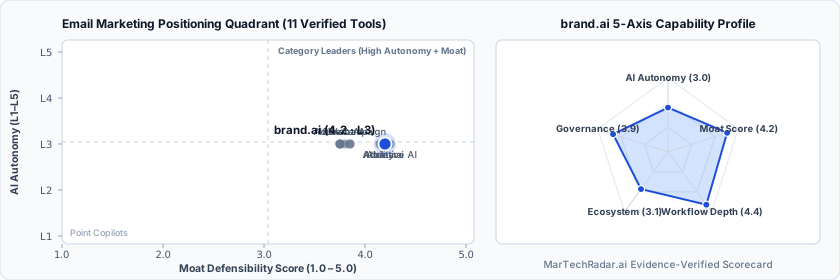
brand.ai is a Web SaaS tool for Email Marketing (AI Email Marketing & Lifecycle Journeys) in Lifecycle & CDP. Pricing: Custom / enterprise pricing. Best suited to CRM & Lifecycle Marketers, eCommerce Growth Teams and Customer Experience Directors. Editor ratings: AI autonomy L3 (conditional automation); moat score 4.2/5.0 (Proprietary moat). Fact-checked by Tim Fenolz on Oct 11, 2026.
Machine-readable brand infrastructure converting static brand manuals into structured ontologies for generative pipelines, marketing tools, and autonomous.
brand.ai buyer fit verdict: when to choose vs. when to walk away
Choose brand.ai if (Best Fit)
- Target ICP & Stack Fit: You operate as CRM & Lifecycle Marketers, eCommerce Growth Teams and Customer Experience Directors requiring a Web SaaS deployment for Email Marketing.
- L3 Architecture & Defensibility: Proprietary 150+ dimensional brand ontology schema that translates unstructured narrative guidelines into machine-executable evaluation parameters, creating strong governance lock-in for enterprise AI agent architectures.
- Commercial Model Fit: Your procurement budget aligns with Custom / enterprise pricing.
Walk away from brand.ai if (Deal-Breakers)
- Walk away if you require transparent self-serve monthly billing or your budget ceiling is under $1,000/mo (brand.ai requires sales-gated custom quoting).
- Walk away if your workflow cannot tolerate high latency overhead: Programmatic real-time verification against a 150-dimensional ontology introduces computational overhead that can slow batch email campaign generation workflows.
- Walk away if context window extraction loss is a deal-breaker for your team: Parsing dense, highly conceptual PDF design manuals frequently misses nuanced visual hierarchy instructions during automatic knowledge graph translation.
brand.ai key facts & scorecard
| Pricing | Custom / enterprise pricing |
|---|---|
| Free plan | No / not disclosed |
| Delivery | Web SaaS |
| Audience | CRM & Lifecycle Marketers, eCommerce Growth Teams, Customer Experience Directors |
| AI autonomy level | L3 · Conditional automationEditor-verified |
| Moat tier & score | 4.2 / 5.0 · Proprietary moatEditor-verified |
| Funding | Seed |
| Total funding | $6.2MBacked by Uncork Capital, K5 Global |
| Founders | Chelsey Susin Kantor, Michael Carter, Nate Bosshard |
| Company size | 2-10 employees |
| Governance & docs | Trust & Security ↗ · System Status ↗ · Privacy ↗ |
| Headquarters | San Francisco, California |
| Founded | 2023 |
| Last verified |
brand.ai pros & cons: strengths vs. operational limitations
Pros: core strengths & capabilities
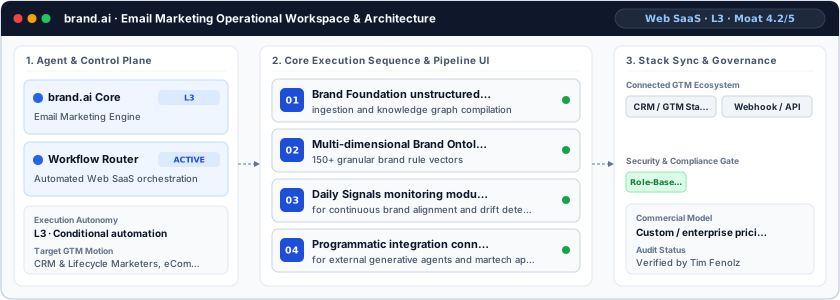
- Brand Foundation unstructured document: ingestion and knowledge graph compilation
- Multi-dimensional Brand Ontology supporting: 150+ granular brand rule vectors
- Daily Signals monitoring module: for continuous brand alignment and drift detection
- Programmatic integration connectors: for external generative agents and martech applications
Cons: operational limitations & risks
- High Latency Overhead: Programmatic real-time verification against a 150-dimensional ontology introduces computational overhead that can slow batch email campaign generation workflows.
- Context Window Extraction Loss: Parsing dense, highly conceptual PDF design manuals frequently misses nuanced visual hierarchy instructions during automatic knowledge graph translation.
- Continuous Schema Maintenance: Quarterly brand repositioning requires manual re-indexing and schema tuning to avoid false rejections across automated external generative endpoints.
brand.ai TCO & deal-breaker stress test
Simulate 12-month stepped TCO, hidden cost multipliers, contract lock-in exposure, and stack failure modes using only facts verified by Tim Fenolz on · Capture SHA 0c1b2309.
brand.ai triggers high-severity friction under your 5-seat / $800/mo constraints. Benchmark the verified subtrack alternatives below before committing.
| Plan / Tier | Verified Rate | Scale Fit | Scope & Quota Notes |
|---|---|---|---|
| Enterprise / Custom | Custom quote | 15–50+ seats (Enterprise SLA) | Sales-negotiated annual contract for custom volume, SSO/RBAC governance, and dedicated SLA. |
- Moat Score
- 4.2 / 5.0
- AI Autonomy
- L3
- Free Tier / Trial
- None disclosed
Triggered audit signals & failure modes
- Opaque Enterprise Quoting vs. SMB/Mid-Market BudgetVerified Pricing Ledger
brand.ai does not disclose a public self-serve floor (Custom / enterprise pricing). Buyers with a $800/mo cap face high sales-qualification friction.
- Sales-Gated Contract TermsFact-checked by Tim Fenolz
Commercial pricing for brand.ai operates under an enterprise licensing structure available on request through tailored enterprise sales quotes based on organizational scale and seats.
- Primary Operational Bottleneck: High Latency OverheadAudit by Tim Fenolz
Programmatic real-time verification against a 150-dimensional ontology introduces computational overhead that can slow batch email campaign generation workflows.
Hidden TCO Multipliers & Quota Gates
- Profile / Workspace Quota Ceilings: Base tiers cap the number of connected profiles, workspaces, or contact records, forcing tier upgrades before seat limits are reached.
- High Latency Overhead: Programmatic real-time verification against a 150-dimensional ontology introduces computational overhead that can slow batch email campaign generation workflows.
- Context Window Extraction Loss: Parsing dense, highly conceptual PDF design manuals frequently misses nuanced visual hierarchy instructions during automatic knowledge graph translation.
When to Walk Away & Negotiation Levers
- Walk away if you require transparent self-serve monthly billing or your budget ceiling is under $1,000/mo (brand.ai requires sales-gated custom quoting).
- Walk away if your workflow cannot tolerate high latency overhead: Programmatic real-time verification against a 150-dimensional ontology introduces computational overhead that can slow batch email campaign generation workflows.
- Walk away if context window extraction loss is a deal-breaker for your team: Parsing dense, highly conceptual PDF design manuals frequently misses nuanced visual hierarchy instructions during automatic knowledge graph translation.
- Demand a 30- to 60-day paid pilot opt-out clause in the brand.ai order form before signing a 12-month enterprise commitment.
- Require a sandbox proof-of-concept testing high latency overhead against your live CRM/data schema before annual sign-off.
Ask a custom procurement or TCO stress-test question about brand.ai
Lower 5-seat floor (~$14/mo vs. Custom Quote) · Transparent self-serve entry without mandatory annual lock-in
Lower 5-seat floor (~$15/mo vs. Custom Quote) · Transparent self-serve entry without mandatory annual lock-in
brand.ai moat & subtrack positioning
Proprietary 150+ dimensional brand ontology schema that translates unstructured narrative guidelines into machine-executable evaluation parameters, creating strong governance lock-in for enterprise AI agent architectures.
Editorial review
Fact-checked by Tim Fenolz (Lead AdTech, Programmatic & Attribution Analyst) on .
Background
Modern generative pipelines frequently fail due to the disconnect between static style documentation and autonomous execution. Established in 2023 in San Francisco, California, brand.ai delivers brand infrastructure designed to translate unstructured guidelines into machine-readable code. Backed by $6.2M in venture funding, the company targets chief marketing officers, enterprise creative directors, and marketing technology architects seeking programmatic brand governance across automated generative touchpoints.
How brand.ai works
Operating at an L3 autonomy profile, brand.ai utilizes its Brand Foundation ingestion engine to parse brand books, slide decks, and creative manuals into a centralized knowledge graph. This data feeds into a proprietary Brand Ontology spanning more than 150 operational dimensions covering tone, semantic guardrails, visual values, and voice rules. By publishing this graph through programmatic APIs and connected applications, downstream text generators, email campaign tools, and synthetic agents validate marketing copy against deterministic brand parameters prior to publication.
Limitations
Operational considerations and platform boundaries include:
- High Latency Overhead: Programmatic real-time verification against a 150-dimensional ontology introduces computational overhead that can slow batch email campaign generation workflows.
- Context Window Extraction Loss: Parsing dense, highly conceptual PDF design manuals frequently misses nuanced visual hierarchy instructions during automatic knowledge graph translation.
- Continuous Schema Maintenance: Quarterly brand repositioning requires manual re-indexing and schema tuning to avoid false rejections across automated external generative endpoints.
brand.ai pricing
Commercial pricing for brand.ai operates under an enterprise licensing structure available on request through tailored enterprise sales quotes based on organizational scale and seats. Contracts typically reflect platform capacity tiers, the volume of managed brand ontologies, and API connector throughput across internal business units and autonomous marketing pipelines.
How brand.ai compares
Within generative workflow governance, brand.ai occupies a specialized niche compared to adjacent tooling. While 10Web AI targets synthetic web production and AB Tasty emphasizes conversion experimentation loops, brand.ai focuses strictly on codifying compliance schemas for autonomous generation. Unlike Ability.ai's agent execution layer, brand.ai acts as the foundational governance plane, suiting enterprises deploying multi-agent content pipelines requiring deterministic brand fidelity.
Direct competitors & market radar
Top algorithmic competitors based on category positioning, capability overlap, and ICP alignment.
Frequently asked questions about brand.ai
How much does brand.ai cost and does it require a custom enterprise quote?
Published pricing summary for brand.ai: Custom / enterprise pricing. A permanent free plan is not disclosed for brand.ai. Commercial pricing for brand.ai operates under an enterprise licensing structure available on request through tailored enterprise sales quotes based on organizational scale and seats.
How does brand.ai work and how autonomous is its AI architecture?
Machine-readable brand infrastructure converting static brand manuals into structured ontologies for generative pipelines, marketing tools, and autonomous. Within Email Marketing (AI Email Marketing & Lifecycle Journeys), MarTechRadar rates its execution architecture at L3 · Conditional automation with a verified Moat Score of 4.2 / 5.0 (Proprietary moat). Proprietary 150+ dimensional brand ontology schema that translates unstructured narrative guidelines into machine-executable evaluation parameters, creating strong governance lock-in for enterprise AI agent architectures. Corporate profile: Founded by Chelsey Susin Kantor, Michael Carter, Nate Bosshard, operating at 2-10 employees scale.
What are the main limitations of brand.ai and when should buyers walk away?
Based on our editorial technical audit, key operational considerations and boundaries for brand.ai include: (1) High Latency Overhead: Programmatic real-time verification against a 150-dimensional ontology introduces computational overhead that can slow batch email campaign generation workflows. (2) Context Window Extraction Loss: Parsing dense, highly conceptual PDF design manuals frequently misses nuanced visual hierarchy instructions during automatic knowledge graph translation. (3) Continuous Schema Maintenance: Quarterly brand repositioning requires manual re-indexing and schema tuning to avoid false rejections across automated external generative endpoints. Primary procurement walk-away rule: Walk away if you require transparent self-serve monthly billing or your budget ceiling is under $1,000/mo (brand.ai requires sales-gated custom quoting).
What integrations, compliance certifications, and contract terms apply to brand.ai?
First-party governance and developer endpoints verified on domain include: Trust/Security (https://brand.ai/security), Status (https://status.brand.ai). Key TCO multiplier to watch: Profile / Workspace Quota Ceilings (Base tiers cap the number of connected profiles, workspaces, or contact records, forcing tier upgrades before seat limits are reached.) Before signing a contract, procurement teams should demand a 30- to 60-day paid pilot opt-out clause in the brand.ai order form before signing a 12-month enterprise commitment.
What are the best brand.ai alternatives and head-to-head competitors in 2026?
Top fact-checked alternatives to brand.ai in Email Marketing (AI Email Marketing & Lifecycle Journeys) include Benchmark Email (From $15/mo), Adclear (Custom / enterprise pricing), Blee (Custom / enterprise pricing), Campaigner (From $14/mo). Within generative workflow governance, brand.ai occupies a specialized niche compared to adjacent tooling. While 10Web AI targets synthetic web production and AB Tasty emphasizes conversion experimentation loops, brand.ai focuses strictly on codifying compliance schemas for autonomous generation.
Verified sources & evidence trail
- Official product domain: https://brand.ai
- Commercial pricing verification: Verified against official vendor pricing policy (Custom / enterprise pricing)
- Verified corporate entity profiles (
sameAs): LinkedIn Company Profile · Crunchbase Entity Record - First-party governance & documentation links: Trust & Security · System Status · Privacy
- Editorial audit sign-off: Fact-checked by Tim Fenolz on under the MarTechRadar Evidence-Ledger Protocol.