Brahma AI Review (2026): AI Content Marketing Pricing, Limits & Alternatives
Bottom line
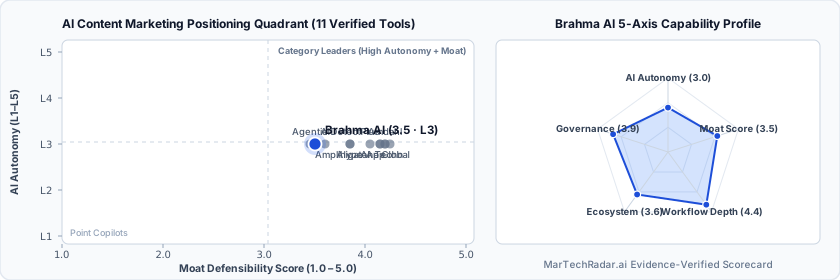
Brahma AI is a Web SaaS tool for AI Content Marketing (Enterprise & Long-Form Brand Content) in Copy & Content. Pricing: Custom / enterprise pricing. Best suited to Enterprise Content Teams, Brand Marketers and Global Copywriters. Editor ratings: AI autonomy L3 (conditional automation); moat score 3.5/5.0 (Proprietary moat). Fact-checked by Jiacky Lee on Oct 10, 2026.
Enterprise AI-native content operating system combining asset management, multi-model generation, and governed editorial workflows for global brand teams.
Brahma AI buyer fit verdict: when to choose vs. when to walk away
Choose Brahma AI if (Best Fit)
- Target ICP & Stack Fit: You operate as Enterprise Content Teams, Brand Marketers and Global Copywriters requiring a Web SaaS deployment for AI Content Marketing, with verified ecosystem connectivity for Twilio Segment.
- L3 Architecture & Defensibility: Proprietary Mind² architecture uniting enterprise asset graph indexing with domain-adapted LLM orchestration, backed by substantial private equity capital.
- Commercial Model Fit: Your procurement budget aligns with Custom / enterprise pricing.
Walk away from Brahma AI if (Deal-Breakers)
- Walk away if you require transparent self-serve monthly billing or your budget ceiling is under $1,000/mo (Brahma AI requires sales-gated custom quoting).
- Walk away if your workflow cannot tolerate corpus ingestion overhead: Ingesting heterogeneous enterprise document stores requires extensive initial schema mapping and data sanitization to prevent legacy factual inaccuracies from polluting the generation context.
- Walk away if vector drift vulnerability is a deal-breaker for your team: Rapid shifts in product positioning demand ongoing manual vector index retraining, risking hallucinatory brand terminology if retrieval stores desynchronize from active corporate messaging.
Brahma AI key facts & scorecard
| Pricing | Custom / enterprise pricing |
|---|---|
| Free plan | No / not disclosed |
| Delivery | Web SaaS |
| Audience | Enterprise Content Teams, Brand Marketers, Global Copywriters |
| AI autonomy level | L3 · Conditional automationEditor-verified |
| Moat tier & score | 3.5 / 5.0 · Proprietary moatEditor-verified |
| Funding | Undisclosed |
| Total funding | $150.0MBacked by Multiples |
| Company size | 1,001-5,000 employees |
| Ecosystem integrations | Twilio Segment |
| Governance & docs | Terms ↗ · Privacy ↗ |
| Headquarters | United Kingdom |
| Founded | 2023 |
| Last verified |
Brahma AI pros & cons: strengths vs. operational limitations
Pros: core strengths & capabilities
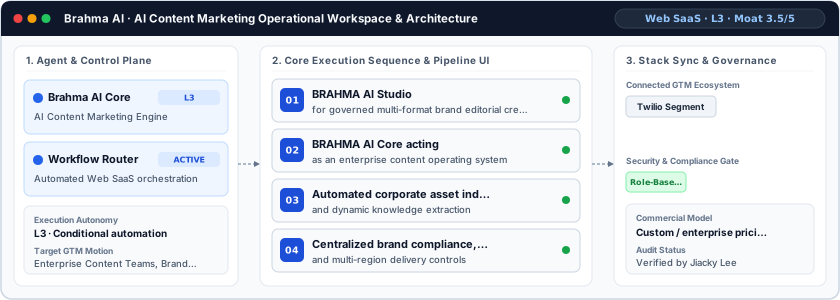
- BRAHMA AI Studio: for governed multi-format brand editorial creation
- BRAHMA AI Core acting: as an enterprise content operating system
- Automated corporate asset indexing: and dynamic knowledge extraction
- Centralized brand compliance, taxonomy,: and multi-region delivery controls
Cons: operational limitations & risks
- Corpus Ingestion Overhead: Ingesting heterogeneous enterprise document stores requires extensive initial schema mapping and data sanitization to prevent legacy factual inaccuracies from polluting the generation context.
- Vector Drift Vulnerability: Rapid shifts in product positioning demand ongoing manual vector index retraining, risking hallucinatory brand terminology if retrieval stores desynchronize from active corporate messaging.
- Regional Taxonomy Brittleness: Localized content adaptation depends heavily on explicit prompt rules, creating editorial friction when enforcing multi-jurisdiction regulatory compliance across non-English collateral.
Brahma AI TCO & deal-breaker stress test
Simulate 12-month stepped TCO, hidden cost multipliers, contract lock-in exposure, and stack failure modes using only facts verified by Jiacky Lee on · Capture SHA 2565a392.
Brahma AI triggers high-severity friction under your 5-seat / $800/mo constraints. Benchmark the verified subtrack alternatives below before committing.
| Plan / Tier | Verified Rate | Scale Fit | Scope & Quota Notes |
|---|---|---|---|
| Enterprise / Custom | Custom quote | 15–50+ seats (Enterprise SLA) | Sales-negotiated annual contract for custom volume, SSO/RBAC governance, and dedicated SLA. |
- Moat Score
- 3.5 / 5.0
- AI Autonomy
- L3
- Free Tier / Trial
- None disclosed
Triggered audit signals & failure modes
- Opaque Enterprise Quoting vs. SMB/Mid-Market BudgetVerified Pricing Ledger
Brahma AI does not disclose a public self-serve floor (Custom / enterprise pricing). Buyers with a $800/mo cap face high sales-qualification friction.
- Sales-Gated Contract TermsFact-checked by Jiacky Lee
Commercial procurement for Brahma AI is available on request through tailored enterprise sales quotes based on organizational scale and seats.
- Primary Operational Bottleneck: Corpus Ingestion OverheadAudit by Jiacky Lee
Ingesting heterogeneous enterprise document stores requires extensive initial schema mapping and data sanitization to prevent legacy factual inaccuracies from polluting the generation context.
Hidden TCO Multipliers & Quota Gates
- Corpus Ingestion Overhead: Ingesting heterogeneous enterprise document stores requires extensive initial schema mapping and data sanitization to prevent legacy factual inaccuracies from polluting the generation context.
- Vector Drift Vulnerability: Rapid shifts in product positioning demand ongoing manual vector index retraining, risking hallucinatory brand terminology if retrieval stores desynchronize from active corporate messaging.
When to Walk Away & Negotiation Levers
- Walk away if you require transparent self-serve monthly billing or your budget ceiling is under $1,000/mo (Brahma AI requires sales-gated custom quoting).
- Walk away if your workflow cannot tolerate corpus ingestion overhead: Ingesting heterogeneous enterprise document stores requires extensive initial schema mapping and data sanitization to prevent legacy factual inaccuracies from polluting the generation context.
- Walk away if vector drift vulnerability is a deal-breaker for your team: Rapid shifts in product positioning demand ongoing manual vector index retraining, risking hallucinatory brand terminology if retrieval stores desynchronize from active corporate messaging.
- Demand a 30- to 60-day paid pilot opt-out clause in the Brahma AI order form before signing a 12-month enterprise commitment.
- Require a sandbox proof-of-concept testing corpus ingestion overhead against your live CRM/data schema before annual sign-off.
Ask a custom procurement or TCO stress-test question about Brahma AI
Lower 5-seat floor (~$15/mo vs. Custom Quote) · Transparent self-serve entry without mandatory annual lock-in
Lower 5-seat floor (~$16/mo vs. Custom Quote) · Transparent self-serve entry without mandatory annual lock-in
Brahma AI key entities, modules & ecosystem stack
Brahma AI moat & subtrack positioning
Proprietary Mind² architecture uniting enterprise asset graph indexing with domain-adapted LLM orchestration, backed by substantial private equity capital.
Editorial review
Fact-checked by Jiacky Lee (Managing Editor, AI Autonomy & Moat Methodology) on .
Background
Backed by $150.0M in private equity funding led by Multiples, Brahma AI was established in 2023 in the United Kingdom to transform corporate knowledge into scalable marketing assets. Built specifically for enterprise editorial directors, content marketing leads, and global brand strategists, the platform addresses structural overhead in large-scale content lifecycles. Operating within the enterprise and long-form brand content category, Brahma AI functions as a centralized content operating system that bridges legacy digital asset repositories with automated production pipelines.
How Brahma AI works
Architecturally, Brahma AI deploys its Mind² framework through two primary layers: BRAHMA AI Core and BRAHMA AI Studio. The platform executes at an L3 autonomy level, ingesting unstructured enterprise archives, collateral repositories, and style guides to construct a structured semantic knowledge graph. When generating long-form copy, the engine runs context-retrieval pipelines into fine-tuned language models, enforcing brand voice parameters, corporate taxonomy, and legal guardrails before human operators approve final deployment across omni-channel distribution nodes.
Limitations
Operational considerations and platform boundaries include:
- Corpus Ingestion Overhead: Ingesting heterogeneous enterprise document stores requires extensive initial schema mapping and data sanitization to prevent legacy factual inaccuracies from polluting the generation context.
- Vector Drift Vulnerability: Rapid shifts in product positioning demand ongoing manual vector index retraining, risking hallucinatory brand terminology if retrieval stores desynchronize from active corporate messaging.
- Regional Taxonomy Brittleness: Localized content adaptation depends heavily on explicit prompt rules, creating editorial friction when enforcing multi-jurisdiction regulatory compliance across non-English collateral.
Brahma AI pricing
Commercial procurement for Brahma AI is available on request through tailored enterprise sales quotes based on organizational scale and seats. The licensing framework follows an enterprise subscription structure governed by platform compute capacity, volume of ingested corporate assets, and user seat allocations across editorial tiers. Deployments typically bundle onboarding, dedicated tenant provisioning, ongoing solution engineering, and customized governance compliance packages into annualized vendor agreements.
How Brahma AI compares
Within the enterprise editorial space, Brahma AI occupies an asset-centric niche distinct from adjacent point solutions within the AI Content Marketing segment. While Typeface concentrates narrowly on creator ad automation and Amdahl acts as a targeted AI verification utility, Brahma AI provides full-cycle generative infrastructure across deep corporate archives. Conversely, Amdahl delivers horizontal marketing campaign orchestration, whereas Brahma AI specializes in deterministic enterprise content governance. The platform fits global multi-brand corporations requiring unified, secure asset transformation.
Frequently asked questions about Brahma AI
How much does Brahma AI cost and does it require a custom enterprise quote?
Published pricing summary for Brahma AI: Custom / enterprise pricing. A permanent free plan is not disclosed for Brahma AI. Commercial procurement for Brahma AI is available on request through tailored enterprise sales quotes based on organizational scale and seats.
How does Brahma AI work and how autonomous is its AI architecture?
Enterprise AI-native content operating system combining asset management, multi-model generation, and governed editorial workflows for global brand teams. Within AI Content Marketing (Enterprise & Long-Form Brand Content), MarTechRadar rates its execution architecture at L3 · Conditional automation with a verified Moat Score of 3.5 / 5.0 (Proprietary moat). Proprietary Mind² architecture uniting enterprise asset graph indexing with domain-adapted LLM orchestration, backed by substantial private equity capital. Corporate profile: operating at 1,001-5,000 employees scale.
What are the main limitations of Brahma AI and when should buyers walk away?
Based on our editorial technical audit, key operational considerations and boundaries for Brahma AI include: (1) Corpus Ingestion Overhead: Ingesting heterogeneous enterprise document stores requires extensive initial schema mapping and data sanitization to prevent legacy factual inaccuracies from polluting the generation context. (2) Vector Drift Vulnerability: Rapid shifts in product positioning demand ongoing manual vector index retraining, risking hallucinatory brand terminology if retrieval stores desynchronize from active corporate messaging. (3) Regional Taxonomy Brittleness: Localized content adaptation depends heavily on explicit prompt rules, creating editorial friction when enforcing multi-jurisdiction regulatory compliance across non-English collateral. Primary procurement walk-away rule: Walk away if you require transparent self-serve monthly billing or your budget ceiling is under $1,000/mo (Brahma AI requires sales-gated custom quoting).
What integrations, compliance certifications, and contract terms apply to Brahma AI?
Verified ecosystem and stack integrations include Twilio Segment. Key TCO multiplier to watch: Corpus Ingestion Overhead (Ingesting heterogeneous enterprise document stores requires extensive initial schema mapping and data sanitization to prevent legacy factual inaccuracies from polluting the generation context.) Before signing a contract, procurement teams should demand a 30- to 60-day paid pilot opt-out clause in the Brahma AI order form before signing a 12-month enterprise commitment.
What are the best Brahma AI alternatives and head-to-head competitors in 2026?
Top fact-checked alternatives to Brahma AI in AI Content Marketing (Enterprise & Long-Form Brand Content) include Amdahl (From $0.34/mo), Clearscope (From $15/mo), Brask AI (Custom / enterprise pricing), Agentio (Custom / enterprise pricing). Within the enterprise editorial space, Brahma AI occupies an asset-centric niche distinct from adjacent point solutions within the AI Content Marketing segment.
Verified sources & evidence trail
- Official product domain: https://www.brahma.io
- Commercial pricing verification: Verified against official vendor pricing policy (Custom / enterprise pricing)
- Verified corporate entity profiles (
sameAs): LinkedIn Company Profile · Crunchbase Entity Record - First-party governance & documentation links: Terms · Privacy
- Editorial audit sign-off: Fact-checked by Jiacky Lee on under the MarTechRadar Evidence-Ledger Protocol.