Bluecore Review (2026): CDP Pricing, Pros & Cons
Bottom line
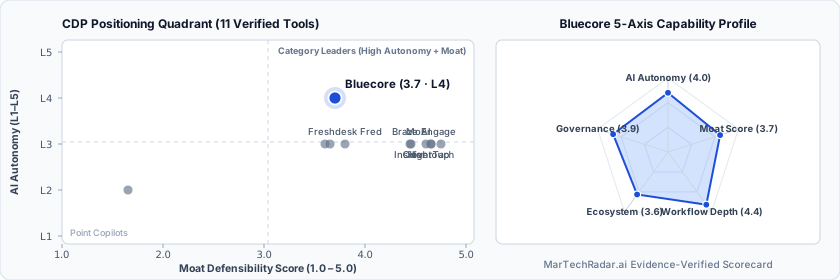
Bluecore is a Cloud SaaS Platform tool for CDP (Customer Data Platform & Journey Orchestration) in Lifecycle & CDP. Pricing: Custom / enterprise pricing. Best suited to B2B Marketing and Growth & Revenue Teams. Editor ratings: AI autonomy L4 (autonomous agent); moat score 3.7/5.0 (Proprietary moat). Fact-checked by MarTechRadar Research Desk on Oct 26, 2026.
Enterprise retail AI marketing and customer movement platform combining first-party identity resolution, predictive SKU merchandising, and lifecycle email.
Is Bluecore worth it in 2026? Buyer fit & when to walk away
Choose Bluecore if (Best Fit)
- Target ICP & Stack Fit: You operate as B2B Marketing and Growth & Revenue Teams requiring a Cloud SaaS Platform deployment for CDP, with verified ecosystem connectivity for Shopify.
- L4 Architecture & Defensibility: Bluecore commands a deep enterprise retail marketing moat through its patented unifying customer-and-product catalog graph, Transparent AI predictive modeling, 95 verified G2 reviews (4.3 stars), $263.2M in venture backing, and strategic combination with Insider One.
- Commercial Model Fit: Your procurement budget aligns with Custom / enterprise pricing.
Walk away from Bluecore if (Deal-Breakers)
- Walk away if you require transparent self-serve monthly billing or your budget ceiling is under $1,000/mo (Bluecore requires sales-gated custom quoting).
- Walk away if your workflow cannot tolerate primary operational trade-off: In practical enterprise deployments, the primary trade-off is that Bluecore is purpose-built and priced for large enterprise retailers with high-volume web traffic and complex multi-SKU catalogs rather than small Shopify boutiques or B2B software companies.
- Walk away if functional scope boundary is a deal-breaker for your team: Bluecore is not built for B2B cold sales prospecting, long-form SEO blog generation, or AI video avatar lip-syncing.
Bluecore pricing, free plan & scorecard at a glance
| Pricing | Custom / enterprise pricing |
|---|---|
| Free plan | No / not disclosed |
| Delivery | Cloud SaaS Platform |
| Audience | B2B Marketing, Growth & Revenue Teams |
| AI autonomy level | L4 · Autonomous agentEditor-verified |
| Moat tier & score | 3.7 / 5.0 · Proprietary moatEditor-verified |
| Funding | AcquiredAcquired by Insider One |
| Total funding | $263.2MBacked by Norwest, Gaingels, FirstMark, Techstars, Felicis |
| Founders | Fayez Mohamood, Mahmoud Arram, Max Bennett |
| Company size | 201-500 employees |
| Ecosystem integrations | Shopify |
| Headquarters | New York, New York, United States |
| Founded | 2013 |
| Last verified | Oct 26, 2026 |
Bluecore pros & cons: strengths vs. operational limitations
Pros: core strengths & capabilities
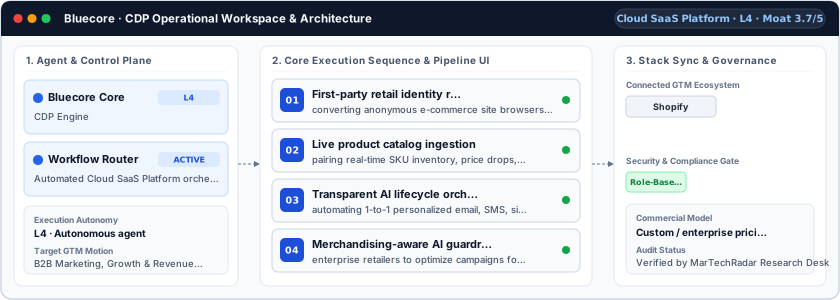
- First-party retail identity resolution: converting anonymous e-commerce site browsers into known, addressable shopper profiles
- Live product catalog ingestion: pairing real-time SKU inventory, price drops, and margin data with individual shopper propensity models
- Transparent AI lifecycle orchestration: automating 1-to-1 personalized email, SMS, site personalization, and paid media audiences
- Merchandising-aware AI guardrails allowing: enterprise retailers to optimize campaigns for full-price sell-through and gross margin
Cons: operational limitations & risks
- Primary Operational Trade-Off: In practical enterprise deployments, the primary trade-off is that Bluecore is purpose-built and priced for large enterprise retailers with high-volume web traffic and complex multi-SKU catalogs rather than small Shopify boutiques or B2B software companies.
- Functional Scope Boundary: Bluecore is not built for B2B cold sales prospecting, long-form SEO blog generation, or AI video avatar lip-syncing.
- Deployment & Governance Considerations: Additionally, integrating live product feed telemetry, JavaScript site identity tags, and multi-channel ESP/SMS routing requires dedicated implementation coordination with Bluecore's enterprise onboarding team.
Bluecore TCO & deal-breaker stress test
Simulate 12-month stepped TCO, hidden cost multipliers, contract lock-in exposure, and stack failure modes using only facts verified by MarTechRadar Research Desk on 2026-10-26.
Bluecore triggers high-severity friction under your 5-seat / $800/mo constraints. Benchmark the verified subtrack alternatives below before committing.
- Moat Score
- 3.7 / 5.0
- AI Autonomy
- L4
- Free Tier / Trial
- None disclosed
Triggered audit signals & failure modes
- Opaque Enterprise Quoting vs. SMB/Mid-Market BudgetVerified Pricing Ledger
Bluecore does not disclose a public self-serve floor (Custom / enterprise pricing). Buyers with a $800/mo cap face high sales-qualification friction.
- Sales-Gated Contract TermsFact-checked by MarTechRadar Research Desk
Pricing available on request.
- Primary Operational Bottleneck: Primary Operational Trade-OffAudit by MarTechRadar Research Desk
In practical enterprise deployments, the primary trade-off is that Bluecore is purpose-built and priced for large enterprise retailers with high-volume web traffic and complex multi-SKU catalogs rather than small Shopify boutiques or B2B software companies.
Test a custom Bluecore budget or stack constraint
Lower 5-seat floor (~$10/mo vs. Custom Quote) · Transparent self-serve entry without mandatory annual lock-in
Lower 5-seat floor (~$265/mo vs. Custom Quote) · Transparent self-serve entry without mandatory annual lock-in
Bluecore integrations, API, security & compliance stack
Bluecore AI moat & CDP positioning
Bluecore commands a deep enterprise retail marketing moat through its patented unifying customer-and-product catalog graph, Transparent AI predictive modeling, 95 verified G2 reviews (4.3 stars), $263.2M in venture backing, and strategic combination with Insider One.
Bluecore in-depth review, pricing & architecture analysis
Audited by MarTechRadar Research Desk (Evidence-Ledger Verified) on Oct 26, 2026.
What is Bluecore? Overview & background
Bluecore is an enterprise retail AI marketing, shopper identification, and lifecycle journey platform built for large multi-brand retailers, apparel and footwear leaders, and enterprise e-commerce CMOs. Founded in 2013 by Fayez Mohamood, Mahmoud Arram, and Max Bennett and headquartered in New York, NY, the company operates with 201 to 500 employees, raised $263.2M in venture funding backed by Norwest, FirstMark, Felicis, Gaingels, and Techstars, and combined forces with Insider One (as recorded on Crunchbase). Validated on G2 with 95 verified enterprise reviews (4.3 stars), Bluecore replaces batch-and-blast retail promotions with automated 1-to-1 customer movement across email, SMS, and web, capturing buyer searches for retail ai marketing platform, bluecore pricing, and a bloomreach vs klaviyo enterprise alternative.
How Bluecore works: architecture & workflow
At the technical core of Bluecore is a dual-graph architecture that links a retailer's real-time first-party shopper identity graph directly with its live e-commerce product catalog (SKU inventory levels, size availability, price drops, and replenishment cycles). Unlike standard email service providers that only trigger basic cart-abandonment flows without understanding catalog stockouts, Bluecore's Transparent AI models continuously score every shopper's next-best purchase propensity, discount sensitivity, and churn risk. When a product goes back in stock or drops in price, Bluecore automatically suppresses out-of-stock SKUs and dispatches individualized product recommendations to the highest-propensity buyers across email, SMS, on-site experiences, and paid social/search retargeting audiences.
Bluecore limitations, drawbacks & risks
Operational considerations and platform boundaries include:
- Primary Operational Trade-Off: In practical enterprise deployments, the primary trade-off is that Bluecore is purpose-built and priced for large enterprise retailers with high-volume web traffic and complex multi-SKU catalogs rather than small Shopify boutiques or B2B software companies.
- Functional Scope Boundary: Bluecore is not built for B2B cold sales prospecting, long-form SEO blog generation, or AI video avatar lip-syncing.
- Deployment & Governance Considerations: Additionally, integrating live product feed telemetry, JavaScript site identity tags, and multi-channel ESP/SMS routing requires dedicated implementation coordination with Bluecore's enterprise onboarding team.
Bluecore pricing, plans & cost breakdown
Pricing available on request. On its official website (bluecore.com), Bluecore scopes custom multi-year enterprise contracts through its executive demo and consultation process, aligning commercial terms with annual online gross merchandise value (GMV), identified shopper volume, and active lifecycle channels.
| Plan / Tier | Verified Price & Billing | Target Seat / Scale Fit | Included Scope & Contract Terms |
|---|---|---|---|
| Enterprise / Custom | Custom quote | 15–50+ seats (Enterprise SLA) | Sales-negotiated annual contract for custom volume, SSO/RBAC governance, and dedicated SLA. |
| Contract Watchout: Primary Operational Trade-Off | In practical enterprise deployments, the primary trade-off is that Bluecore is purpose-built and priced for large enterprise retailers with high-volume web traffic and complex multi-SKU catalogs rather than small Shopify boutiques or B2B software companies. | ||
How Bluecore compares vs. competitors & alternatives
In the AI email marketing, retail lifecycle orchestration, and CDP market, Bluecore competes with Klaviyo (AI), Omnisend, Sendlane, Bloomreach Loomi, Insider, and Cordial. Compared to generic ESPs that treat product recommendations as an afterthought and continue promoting out-of-stock sizes, Bluecore differentiates itself through its deep retail catalog intelligence, first-party shopper identification network, and $263.2M enterprise scale. Enterprise apparel, beauty, home goods, and specialty retailers should evaluate Bluecore to accelerate repeat buyer movement.
Frequently asked questions about Bluecore
Does Bluecore publish pricing or require an enterprise quote?
Bluecore pricing: Custom / enterprise pricing. No free plan is publicly disclosed. Pricing available on request.
What are the top Bluecore alternatives in CDP?
Verified CDP alternatives include Insider (Custom / enterprise pricing), Sendlane (From $10/mo), Omnisend (Custom / enterprise pricing), Cordial (Pricing not disclosed). In the AI email marketing, retail lifecycle orchestration, and CDP market, Bluecore competes with Klaviyo (AI), Omnisend, Sendlane, Bloomreach Loomi, Insider, and Cordial.
Verified sources & evidence trail
- Official product domain: https://www.bluecore.com
- Commercial pricing verification: Verified against official vendor pricing policy (Custom / enterprise pricing)
- Verified corporate entity profiles (
sameAs): LinkedIn Company Profile · Crunchbase Entity Record - Editorial audit sign-off: Audited by MarTechRadar Research Desk (Evidence-Ledger Verified) on Oct 26, 2026.
