Blee Review (2026): Email Marketing Pricing, Limits & Alternatives
Bottom line
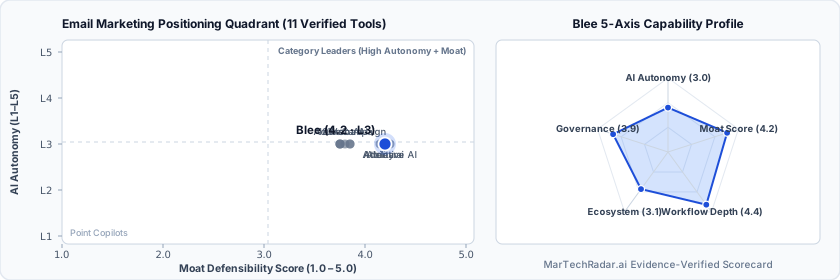
Blee is a Web SaaS tool for Email Marketing (AI Email Marketing & Lifecycle Journeys) in Lifecycle & CDP. Pricing: Custom / enterprise pricing. Best suited to CRM & Lifecycle Marketers, eCommerce Growth Teams and Customer Experience Directors. Editor ratings: AI autonomy L3 (conditional automation); moat score 4.2/5.0 (Proprietary moat). Fact-checked by Tim Fenolz on Oct 12, 2026.
Blee is an AI-first marketing compliance platform that automates regulatory risk detection and approval workflows across campaign content.
Blee buyer fit verdict: when to choose vs. when to walk away
Choose Blee if (Best Fit)
- Target ICP & Stack Fit: You operate as CRM & Lifecycle Marketers, eCommerce Growth Teams and Customer Experience Directors requiring a Web SaaS deployment for Email Marketing.
- L3 Architecture & Defensibility: Domain-tuned regulatory fine-tuning and proprietary rule frameworks for high-scrutiny sectors, reinforced by deep enterprise workflow integrations.
- Commercial Model Fit: Your procurement budget aligns with Custom / enterprise pricing.
Walk away from Blee if (Deal-Breakers)
- Walk away if you require transparent self-serve monthly billing or your budget ceiling is under $1,000/mo (Blee requires sales-gated custom quoting).
- Walk away if your workflow cannot tolerate contextual ambiguity and false positives: The heuristic and semantic parsers struggle with nuanced brand satire or non-standard promotional idioms, occasionally triggering false-positive flags that require manual compliance dismissal.
- Walk away if multi-jurisdictional schema maintenance is a deal-breaker for your team: Organizations operating across divergent regional regulatory boundaries face continuous policy synchronization overhead to keep localized rule libraries aligned with shifting jurisdictional enforcement standards.
Blee key facts & scorecard
| Pricing | Custom / enterprise pricing |
|---|---|
| Free plan | No / not disclosed |
| Delivery | Web SaaS |
| Audience | CRM & Lifecycle Marketers, eCommerce Growth Teams, Customer Experience Directors |
| AI autonomy level | L3 · Conditional automationEditor-verified |
| Moat tier & score | 4.2 / 5.0 · Proprietary moatEditor-verified |
| Funding | Series A |
| Total funding | $27.5MBacked by Y Combinator, Fin Capital |
| Founders | Guy Shahar |
| Company size | 11-50 employees |
| Governance & docs | Trust & Security ↗ · Terms ↗ · Privacy ↗ |
| Headquarters | New York, NY |
| Founded | 2022 |
| Last verified |
Blee pros & cons: strengths vs. operational limitations
Pros: core strengths & capabilities
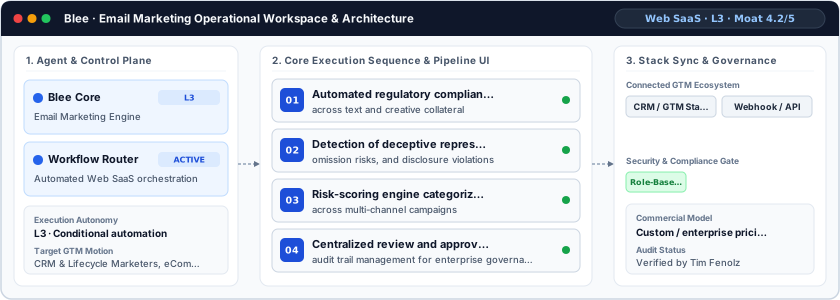
- Automated regulatory compliance scanning: across text and creative collateral
- Detection of deceptive representations,: omission risks, and disclosure violations
- Risk-scoring engine categorizing flag severity: across multi-channel campaigns
- Centralized review and approval: audit trail management for enterprise governance
Cons: operational limitations & risks
- Contextual Ambiguity and False Positives: The heuristic and semantic parsers struggle with nuanced brand satire or non-standard promotional idioms, occasionally triggering false-positive flags that require manual compliance dismissal.
- Multi-Jurisdictional Schema Maintenance: Organizations operating across divergent regional regulatory boundaries face continuous policy synchronization overhead to keep localized rule libraries aligned with shifting jurisdictional enforcement standards.
- Dynamic Content Rendering Gaps: Real-time personalization engines and conditionally loaded email elements present pipeline inspection latency, limiting the platform's ability to evaluate fully assembled, individualized end-user states.
Blee TCO & deal-breaker stress test
Simulate 12-month stepped TCO, hidden cost multipliers, contract lock-in exposure, and stack failure modes using only facts verified by Tim Fenolz on · Capture SHA 07151677.
Blee triggers high-severity friction under your 5-seat / $800/mo constraints. Benchmark the verified subtrack alternatives below before committing.
| Plan / Tier | Verified Rate | Scale Fit | Scope & Quota Notes |
|---|---|---|---|
| Enterprise / Custom | Custom quote | 15–50+ seats (Enterprise SLA) | Sales-negotiated annual contract for custom volume, SSO/RBAC governance, and dedicated SLA. |
- Moat Score
- 4.2 / 5.0
- AI Autonomy
- L3
- Free Tier / Trial
- None disclosed
Triggered audit signals & failure modes
- Opaque Enterprise Quoting vs. SMB/Mid-Market BudgetVerified Pricing Ledger
Blee does not disclose a public self-serve floor (Custom / enterprise pricing). Buyers with a $800/mo cap face high sales-qualification friction.
- Sales-Gated Contract TermsFact-checked by Tim Fenolz
Commercial procurement for Blee is conducted through direct enterprise channels. Pricing is available on request through tailored enterprise sales quotes based on organizational scale, active reviewer seats, and annual scan volume across monitored repositories.
- Primary Operational Bottleneck: Contextual Ambiguity and False PositivesAudit by Tim Fenolz
The heuristic and semantic parsers struggle with nuanced brand satire or non-standard promotional idioms, occasionally triggering false-positive flags that require manual compliance dismissal.
Hidden TCO Multipliers & Quota Gates
- Enterprise Governance & Add-On Gating: Advanced capabilities such as Single Sign-On (SSO), custom role permissions, or specialized analytics modules are gated behind upper tiers or paid add-ons.
- Contextual Ambiguity and False Positives: The heuristic and semantic parsers struggle with nuanced brand satire or non-standard promotional idioms, occasionally triggering false-positive flags that require manual compliance dismissal.
- Multi-Jurisdictional Schema Maintenance: Organizations operating across divergent regional regulatory boundaries face continuous policy synchronization overhead to keep localized rule libraries aligned with shifting jurisdictional enforcement standards.
When to Walk Away & Negotiation Levers
- Walk away if you require transparent self-serve monthly billing or your budget ceiling is under $1,000/mo (Blee requires sales-gated custom quoting).
- Walk away if your workflow cannot tolerate contextual ambiguity and false positives: The heuristic and semantic parsers struggle with nuanced brand satire or non-standard promotional idioms, occasionally triggering false-positive flags that require manual compliance dismissal.
- Walk away if multi-jurisdictional schema maintenance is a deal-breaker for your team: Organizations operating across divergent regional regulatory boundaries face continuous policy synchronization overhead to keep localized rule libraries aligned with shifting jurisdictional enforcement standards.
- Demand a 30- to 60-day paid pilot opt-out clause in the Blee order form before signing a 12-month enterprise commitment.
- Require a sandbox proof-of-concept testing contextual ambiguity and false positives against your live CRM/data schema before annual sign-off.
Ask a custom procurement or TCO stress-test question about Blee
Lower 5-seat floor (~$14/mo vs. Custom Quote) · Transparent self-serve entry without mandatory annual lock-in
Lower 5-seat floor (~$15/mo vs. Custom Quote) · Transparent self-serve entry without mandatory annual lock-in
Blee moat & subtrack positioning
Domain-tuned regulatory fine-tuning and proprietary rule frameworks for high-scrutiny sectors, reinforced by deep enterprise workflow integrations.
Editorial review
Fact-checked by Tim Fenolz (Lead AdTech, Programmatic & Attribution Analyst) on .
Background
Backed by $27.5M in venture funding, Blee was established in 2022 in New York, NY, to resolve the friction between aggressive growth marketing and strict regulatory oversight. The platform targets compliance officers, legal counsels, and growth leaders operating within highly scrutinized sectors like financial services, fintech, and healthcare. Rather than treating compliance as a manual post-production blocker, Blee introduces automated governance directly into omnichannel asset development.
How Blee works
At Level 3 autonomy, Blee functions as a conditional-execution oversight engine that monitors marketing assets across creation tools, email drafts, and ad repositories. Its ingestion pipeline parses visual and textual copy against pre-trained regulatory taxonomies, identifying deceptive representations, required disclosure omissions, and unsubstantiated performance claims. The system calculates contextual risk scores, flags specific violations, and generates remediated phrasing alternatives before human reviewers provide final promotional sign-off.
Limitations
Operational considerations and platform boundaries include:
- Contextual Ambiguity and False Positives: The heuristic and semantic parsers struggle with nuanced brand satire or non-standard promotional idioms, occasionally triggering false-positive flags that require manual compliance dismissal.
- Multi-Jurisdictional Schema Maintenance: Organizations operating across divergent regional regulatory boundaries face continuous policy synchronization overhead to keep localized rule libraries aligned with shifting jurisdictional enforcement standards.
- Dynamic Content Rendering Gaps: Real-time personalization engines and conditionally loaded email elements present pipeline inspection latency, limiting the platform's ability to evaluate fully assembled, individualized end-user states.
Blee pricing
Commercial procurement for Blee is conducted through direct enterprise channels. Pricing is available on request through tailored enterprise sales quotes based on organizational scale, active reviewer seats, and annual scan volume across monitored repositories. Enterprise packages encompass custom policy mapping, dedicated audit log storage, role-based access control, and specialized integration assistance for custom marketing infrastructure.
How Blee compares
While lifecycle engines like Ability.ai, AB Tasty, and 10Web AI optimize front-end campaign delivery, multivariate experiments, and site generation, Blee functions as an upstream regulatory guardrail. Platforms focusing purely on conversion optimization lack deterministic compliance evaluation layers, leaving regulated organizations exposed to punitive scrutiny. Blee is suited for mid-market and enterprise organizations operating under strict legal compliance frameworks where automated pre-publication risk scoring outweighs generic speed metrics.
Direct competitors & market radar
Top algorithmic competitors based on category positioning, capability overlap, and ICP alignment.
Frequently asked questions about Blee
How much does Blee cost and does it require a custom enterprise quote?
Published pricing summary for Blee: Custom / enterprise pricing. A permanent free plan is not disclosed for Blee. Commercial procurement for Blee is conducted through direct enterprise channels. Pricing is available on request through tailored enterprise sales quotes based on organizational scale, active reviewer seats, and annual scan volume across monitored repositories.
How does Blee work and how autonomous is its AI architecture?
Blee is an AI-first marketing compliance platform that automates regulatory risk detection and approval workflows across campaign content. Within Email Marketing (AI Email Marketing & Lifecycle Journeys), MarTechRadar rates its execution architecture at L3 · Conditional automation with a verified Moat Score of 4.2 / 5.0 (Proprietary moat). Domain-tuned regulatory fine-tuning and proprietary rule frameworks for high-scrutiny sectors, reinforced by deep enterprise workflow integrations. Corporate profile: Founded by Guy Shahar, operating at 11-50 employees scale.
What are the main limitations of Blee and when should buyers walk away?
Based on our editorial technical audit, key operational considerations and boundaries for Blee include: (1) Contextual Ambiguity and False Positives: The heuristic and semantic parsers struggle with nuanced brand satire or non-standard promotional idioms, occasionally triggering false-positive flags that require manual compliance dismissal. (2) Multi-Jurisdictional Schema Maintenance: Organizations operating across divergent regional regulatory boundaries face continuous policy synchronization overhead to keep localized rule libraries aligned with shifting jurisdictional enforcement standards. (3) Dynamic Content Rendering Gaps: Real-time personalization engines and conditionally loaded email elements present pipeline inspection latency, limiting the platform's ability to evaluate fully assembled, individualized end-user states. Primary procurement walk-away rule: Walk away if you require transparent self-serve monthly billing or your budget ceiling is under $1,000/mo (Blee requires sales-gated custom quoting).
What integrations, compliance certifications, and contract terms apply to Blee?
First-party governance and developer endpoints verified on domain include: Trust/Security (https://www.blee.com/security). Key TCO multiplier to watch: Enterprise Governance & Add-On Gating (Advanced capabilities such as Single Sign-On (SSO), custom role permissions, or specialized analytics modules are gated behind upper tiers or paid add-ons.) Before signing a contract, procurement teams should demand a 30- to 60-day paid pilot opt-out clause in the Blee order form before signing a 12-month enterprise commitment.
What are the best Blee alternatives and head-to-head competitors in 2026?
Top fact-checked alternatives to Blee in Email Marketing (AI Email Marketing & Lifecycle Journeys) include Benchmark Email (From $15/mo), Constant Contact (From $0/mo), Adclear (Custom / enterprise pricing), brand.ai (Custom / enterprise pricing). While lifecycle engines like Ability.ai, AB Tasty, and 10Web AI optimize front-end campaign delivery, multivariate experiments, and site generation, Blee functions as an upstream regulatory guardrail.
Verified sources & evidence trail
- Official product domain: https://www.blee.com/
- Commercial pricing verification: Verified against official vendor pricing policy (Custom / enterprise pricing)
- Verified corporate entity profiles (
sameAs): LinkedIn Company Profile · Crunchbase Entity Record - First-party governance & documentation links: Trust & Security · Terms · Privacy
- Editorial audit sign-off: Fact-checked by Tim Fenolz on under the MarTechRadar Evidence-Ledger Protocol.