Cardinal vs Unify
Reviewed by MarTechRadar Research Desk. Pricing & entity snapshots verified Oct 16, 2026.
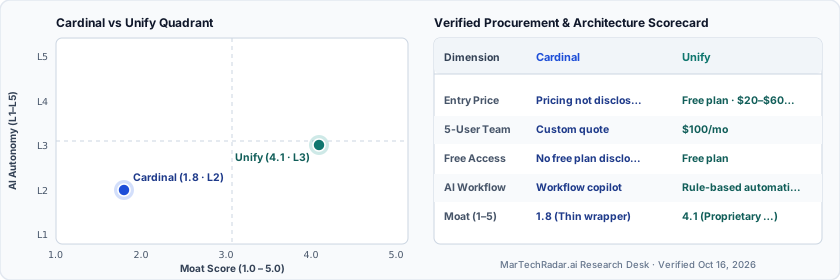
Cardinal (Web SaaS, Buyer Intent Data & Account-Based Marketing) and Unify (Web SaaS, Autonomous B2B Sales Agents & AI BDRs) address adjacent GTM workflows. On pricing, Cardinal lists Pricing not disclosed (no free plan disclosed), whereas Unify lists Free plan · $20–$60/seat/mo · Enterprise plan (free plan). Technically, Cardinal is rated L2 · Workflow copilot with a 1.8/5.0 (Thin wrapper) moat, while Unify is rated L3 · Conditional automation with a 4.1/5.0 (Proprietary moat) moat. Corporate profile: Cardinal (HQ San Francisco, CA) vs. Unify (founded 2023, HQ San Francisco, California, $58.3M funding). Verified by the MarTechRadar Research Desk (Oct 16, 2026 for Cardinal; Oct 12, 2026 for Unify). At a 5-seat team baseline, Cardinal starts at Custom quote vs Unify at $100/mo.
Cardinal
AI revenue agent and precision outbound playbook platform enabling high-growth GTM teams to detect account commonalities and automate custom selling.
5-User Team Cost: Custom quote (Pricing not disclosed) · Autonomy: L2 · Workflow copilot · Moat: 1.8/5.0 (Thin wrapper)
Target fit: B2B SaaS, Marketing & Growth Teams (Web SaaS)
Unify
Autonomous outbound sales platform that identifies warm buyer intent signals and orchestrates AI-driven multichannel pipeline generation.
5-Seat Floor: $100/mo (Free plan · $20–$60/seat/mo · Enterprise plan) · Autonomy: L3 · Conditional automation · Moat: 4.1/5.0 (Proprietary moat)
Target fit: B2B Sales Leaders, SDR/BDR Teams, Revenue Operations (RevOps) (Web SaaS)
How Cardinal and Unify differ
- Cardinal is listed under Buyer Intent Data & Account-Based Marketing; Unify under Autonomous B2B Sales Agents & AI BDRs.
- Unify publishes an entry price (Free plan · $20–$60/seat/mo · Enterprise plan); Cardinal does not (Pricing not disclosed).
- Unify has a free plan; none is recorded for Cardinal.
- AI autonomy: Unify is rated L3 · Conditional automation, Cardinal L2 · Workflow copilot on the MarTechRadar scale.
- Moat tier: Unify is rated Proprietary moat, Cardinal Thin wrapper.
- Headquarters: Cardinal in San Francisco, CA, Unify in San Francisco, California.
- Funding stage: Cardinal is Seed; Unify is Series B.
- Company headcount: Cardinal is 2-10 employees; Unify is 51-200 employees.
- Audience: Cardinal targets B2B SaaS, Marketing & Growth Teams; Unify targets B2B Sales Leaders, SDR/BDR Teams, Revenue Operations (RevOps).
- Ecosystem stack: Cardinal connects with Outreach; Unify connects with Salesforce, HubSpot, Outreach, Salesloft.
Computed from the fields below. Only editor-verified ratings and vendor-sourced prices are compared.
When to choose Cardinal vs Unify (and when to walk away)
Choose Cardinal if
- Target ICP & Stack Fit: You operate as B2B SaaS and Marketing & Growth Teams requiring a Web SaaS deployment for ABM, with verified ecosystem connectivity for Outreach.
- L2 Architecture & Defensibility: Codifying custom GTM selling playbooks into autonomous revenue agents adopted by fast-growing AI companies like Mintlify, Deepgram, and Giga creates deep workflow lock-in.
- Commercial Model Fit: Your procurement budget aligns with Pricing not disclosed.
Walk away from Cardinal if
- Walk away if you require transparent self-serve monthly billing or your budget ceiling is under $1,000/mo (Cardinal requires sales-gated custom quoting).
- Walk away if your workflow cannot tolerate playbook setup curve: Because Cardinal is built around custom research playbooks rather than generic one-click templates, sales leads spend upfront time defining their signal rules.
- Walk away if thin offline footprints is a deal-breaker for your team: Deep web and technical signal checks work great for software and digital buyers, but find less data on old-line offline businesses.
Choose Unify if
- Target ICP & Stack Fit: You operate as B2B Sales Leaders, SDR/BDR Teams and Revenue Operations (RevOps) requiring a Web SaaS deployment for AI SDR, with verified ecosystem connectivity for Salesforce, HubSpot, Outreach, Salesloft.
- L3 Architecture & Defensibility: Proprietary identity resolution spanning 40+ dynamic intent data feeds merged into an embedded multichannel sequencing and agentic execution layer.
- Commercial Model Fit: Your procurement budget aligns with Free plan · $20–$60/seat/mo · Enterprise plan and want a self-serve free tier for zero-cost initial validation.
Walk away from Unify if
- Walk away if your workflow requires uncapped enterprise volume on the Free plan · $20–$60/seat/mo · Enterprise plan entry plan without upgrading tiers.
- Walk away if your workflow cannot tolerate deliverability overhead: Automated email distribution across multi-agent campaigns requires external domain isolation, continuous DNS authentication management, and manual inbox warming to prevent domain reputation degradation.
- Walk away if signal attribution lag is a deal-breaker for your team: Third-party intent feeds exhibit variable ingestion latency, which occasionally triggers outbound cadences after competitor engagement has already begun or internal hiring priorities have pivoted.
Side-by-side facts
| Field | Cardinal | Unify |
|---|---|---|
| Subtrack | Buyer Intent Data & Account-Based Marketing | Autonomous B2B Sales Agents & AI BDRs |
| Pricing | Pricing not disclosed | Free plan · $20–$60/seat/mo · Enterprise plan |
| Pricing model | Not disclosed | Freemium |
| Published pricing tiers | Enterprise / Custom (Custom quote) | Free ($0/mo) · Base ($20/seat/mo) · Pro ($60/seat/mo) · Business (Custom annual) |
| Free access | No free plan disclosed | Free plan |
| Enterprise plan | Not recorded | Yes |
| AI autonomy level | L2 · Workflow copilot | L3 · Conditional automation |
| Moat tier & score | 1.8 / 5.0 · Thin wrapper | 4.1 / 5.0 · Proprietary moat |
| Delivery | Web SaaS | Web SaaS |
| Audience | B2B SaaS, Marketing & Growth Teams | B2B Sales Leaders, SDR/BDR Teams, Revenue Operations (RevOps) |
| Ecosystem integrations | Outreach | Salesforce, HubSpot, Outreach, Salesloft, Slack, Twilio Segment |
| Funding & backing | Seed | $58.3M · Backed by Emergence Capital |
| Founders | — | Austin Hughes, Connor Heggie |
| Company size | 2-10 employees | 51-200 employees |
| Founded | 2025 | 2023 |
| Headquarters | San Francisco, CA | San Francisco, California |
| Fact-checked | MarTechRadar Research Desk, Oct 16, 2026 | MarTechRadar Research Desk, Oct 12, 2026 |
| Governance & docs | — | Trust & Security ↗ · API & Docs ↗ · Changelog ↗ · Privacy ↗ |
Cardinal vs Unify: TCO & constraint stress test
Test how both tools behave under your team size, monthly budget ceiling, CRM ecosystem, and governance guardrails.
Cardinal
High Deal-Risk · Constraint Mismatch- Opaque Enterprise Quoting vs. SMB/Mid-Market Budget: Cardinal does not disclose a public self-serve floor (Pricing not disclosed). Buyers with a $800/mo cap face high sales-qualification friction.
- Sales-Gated Contract Terms: Cardinal sells its platform through custom enterprise quotes without public self-serve pricing tiers. Pricing scales by seat count, playbook runs, and monthly account research volume.
- Primary Operational Bottleneck: Playbook Setup Curve: Because Cardinal is built around custom research playbooks rather than generic one-click templates, sales leads spend upfront time defining their signal rules.
Walk-Away Rule: Walk away if you require transparent self-serve monthly billing or your budget ceiling is under $1,000/mo (Cardinal requires sales-gated custom quoting).
Negotiation Lever: Demand a 30- to 60-day paid pilot opt-out clause in the Cardinal order form before signing a 12-month enterprise commitment.
Unify
Low Procurement Risk · Strong Fit- Published Self-Serve Entry Floor: Unify publishes a transparent entry point (Free plan · $20–$60/seat/mo · Enterprise plan) with a free tier for initial validation before committing.
- Linear Per-Seat Scaling (5 Seats × $20/seat/mo): Base license scales linearly with operator headcount ($100/mo for 5 seats on Base).
- Primary Operational Bottleneck: Deliverability Overhead: Automated email distribution across multi-agent campaigns requires external domain isolation, continuous DNS authentication management, and manual inbox warming to prevent domain reputation degradation.
Walk-Away Rule: Walk away if your workflow requires uncapped enterprise volume on the Free plan · $20–$60/seat/mo · Enterprise plan entry plan without upgrading tiers.
Negotiation Lever: Validate exact quota thresholds (seats, credits, or API calls) included in Unify's Free plan · $20–$60/seat/mo · Enterprise plan tier before converting from monthly to annual billing.
Limitations
Cardinal
Key platform limits and trade-offs include: Playbook Setup Curve: Because Cardinal is built around custom research playbooks rather than generic one-click templates, sales leads spend upfront time defining their signal rules.Full limitations in the Cardinal review
Unify
Operational considerations and platform boundaries include: Deliverability Overhead: Automated email distribution across multi-agent campaigns requires external domain isolation, continuous DNS authentication management, and manual inbox warming to prevent domain reputation degradation.Full limitations in the Unify review
Official vendor architectural differentiators & migration proof
To help buyers evaluate real-world switching costs, verified founders, solutions architects, and PMMs at both Cardinal and Unify can submit up to 3 evidence-backed architectural differentiators or verified customer migration case studies.
Why teams choose Cardinal over Unify
Work at Cardinal? Verify your official domain email to publish 3 technical differentiators, migration benchmarks, or a head-to-head buyer sandbox offer on this comparison page:
+ Submit Cardinal Official Differentiators & Case Study →Why teams choose Unify over Cardinal
Work at Unify? Verify your official domain email to publish 3 technical differentiators, migration benchmarks, or a head-to-head buyer sandbox offer on this comparison page:
+ Submit Unify Official Differentiators & Case Study →Pricing notes & tier schedules
Cardinal: Pricing not disclosed
Cardinal sells its platform through custom enterprise quotes without public self-serve pricing tiers. Pricing scales by seat count, playbook runs, and monthly account research volume. Sales and growth teams can book a live demo on `trycardinal.ai` to scope custom playbooks and agent tiers.
- Enterprise / Custom (Custom quote, 15–50+ seats (Enterprise SLA)): Sales-negotiated annual contract for custom volume, SSO/RBAC governance, and dedicated SLA.
- Playbook Setup Curve: Because Cardinal is built around custom research playbooks rather than generic one-click templates, sales leads spend upfront time defining their signal rules.
- Thin Offline Footprints: Deep web and technical signal checks work great for software and digital buyers, but find less data on old-line offline businesses.
Unify: Free plan · $20–$60/seat/mo · Enterprise plan
Commercial pricing operates on a monthly per-seat subscription coupled with consumption-based credit allocations. Unify provides a permanent Free plan ($0/month for up to three seats with limited credits across 40+ data sources and multi-channel sequencing).
- Free ($0/mo, Up to 3 seats (starter credits)): Up to 3 seats, 1.1B+ people & 65M+ companies, 40+ data sources, and multi-channel sequencing.
- Base ($20/seat/mo, Per-seat (800 credits/seat/mo)): 800 credits/seat/mo, job-change & hiring signals, phone & email enrichment, and unlimited seat scaling.
- Pro ($60/seat/mo, Per-seat (2,400 credits/seat/mo)): 2,400 credits/seat/mo, read-only HubSpot & Salesforce sync, Slack alerts, and 14-day free trial.
- Business (Custom annual, Custom workspace & intent signals): Website intent & product signals, signal-triggered automations, managed mailboxes, and read-write CRM sync.
- Per-Seat Linear Scaling: Unify prices licenses on a per-user/seat basis (Free plan · $20–$60/seat/mo · Enterprise plan); expanding from 2 to 15+ operators multiplies base recurring spend linearly.
- Annual Billing Headline vs. Monthly Premium: Headline entry rates reflect annual billing commitments; month-to-month flexibility carries a higher effective monthly rate or requires annual prepayment.
Frequently asked questions: Cardinal vs Unify
How does Cardinal pricing compare to Unify in 2026?
Cardinal is listed at Pricing not disclosed (not disclosed, no free plan disclosed), whereas Unify is listed at Free plan · $20–$60/seat/mo · Enterprise plan (freemium, free plan).
How do Cardinal and Unify compare on AI autonomy and moat depth?
On the MarTechRadar L1–L5 scale, Cardinal is rated L2 · Workflow copilot with a Thin wrapper moat (1.8/5.0), while Unify is rated L3 · Conditional automation with a Proprietary moat moat (4.1/5.0).
Which teams are Cardinal and Unify built for?
Cardinal is a Web SaaS product in Buyer Intent Data & Account-Based Marketing designed for B2B SaaS, Marketing & Growth Teams. Unify is a Web SaaS product in Autonomous B2B Sales Agents & AI BDRs designed for B2B Sales Leaders, SDR/BDR Teams, Revenue Operations (RevOps).
What are the main limitations of Cardinal vs Unify?
For Cardinal: Key platform limits and trade-offs include: Playbook Setup Curve: Because Cardinal is built around custom research playbooks rather than generic one-click templates, sales leads spend upfront time defining their signal rules. For Unify: Operational considerations and platform boundaries include: Deliverability Overhead: Automated email distribution across multi-agent campaigns requires external domain isolation, continuous DNS authentication management, and manual inbox warming to prevent domain reputation degradation.
What are the hidden TCO drivers and contract negotiation levers for Cardinal vs Unify?
For Cardinal: Playbook Setup Curve (Because Cardinal is built around custom research playbooks rather than generic one-click templates, sales leads spend upfront time defining their signal rules.) Negotiation lever: Demand a 30- to 60-day paid pilot opt-out clause in the Cardinal order form before signing a 12-month enterprise commitment. For Unify: Per-Seat Linear Scaling (Unify prices licenses on a per-user/seat basis (Free plan · $20–$60/seat/mo · Enterprise plan); expanding from 2 to 15+ operators multiplies base recurring spend linearly.) Negotiation lever: Validate exact quota thresholds (seats, credits, or API calls) included in Unify's Free plan · $20–$60/seat/mo · Enterprise plan tier before converting from monthly to annual billing.
Excerpts are quoted verbatim from each fact-checked review. Last updated Oct 16, 2026.