ProcureSpark vs RelayThat
Reviewed by MarTechRadar Research Desk. Pricing & entity snapshots verified Oct 14, 2026.
ProcureSpark (Web SaaS) and RelayThat (Web SaaS) both compete in Dynamic Creative Optimization / DCO. On pricing, ProcureSpark lists Custom / enterprise pricing (no free plan disclosed), whereas RelayThat lists From $15/mo (no free plan disclosed). Technically, ProcureSpark is rated L3 · Conditional automation with a 2.6/5.0 (Workflow-embedded) moat, while RelayThat is rated L3 · Conditional automation with a 2.5/5.0 (Workflow-embedded) moat. Corporate profile: ProcureSpark (founded 2023, HQ San Francisco, California, United States, $145K funding) vs. RelayThat (founded 2015, HQ Boston, MA). Verified by the MarTechRadar Research Desk (Oct 11, 2026 for ProcureSpark; Oct 14, 2026 for RelayThat). At a 5-seat team baseline, ProcureSpark starts at Custom quote vs RelayThat at ~$75/mo.
ProcureSpark
ProcureSpark provides an AI-driven proposal and RFP response automation platform that ingests past bids, technical collateral, and compliance.
5-User Team Cost: Custom quote (Custom / enterprise pricing) · Autonomy: L3 · Conditional automation · Moat: 2.6/5.0 (Workflow-embedded)
Target fit: Performance Marketing Directors, Ad Agencies, Retail Media Advertisers (Web SaaS)
RelayThat
Algorithmic design automation platform that enforces strict brand governance while generating multi-channel digital ad variants at scale.
5-Seat Floor: ~$75/mo (From $15/mo) · Autonomy: L3 · Conditional automation · Moat: 2.5/5.0 (Workflow-embedded)
Target fit: B2B SaaS, Creators / Solo (Web SaaS)
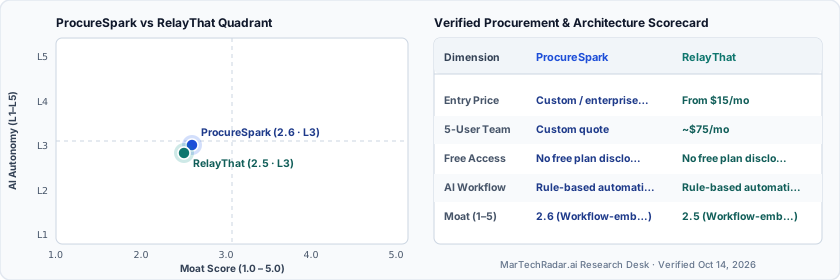
How ProcureSpark and RelayThat differ
- Pricing model: ProcureSpark is enterprise / quote, RelayThat is subscription.
- RelayThat publishes an entry price (From $15/mo); ProcureSpark does not (Custom / enterprise pricing).
- RelayThat was founded earlier (2015) than ProcureSpark (2023).
- Headquarters: ProcureSpark in San Francisco, California, United States, RelayThat in Boston, MA.
- Funding stage: ProcureSpark is Pre-seed; RelayThat is Bootstrapped.
- Audience: ProcureSpark targets Performance Marketing Directors, Ad Agencies, Retail Media Advertisers; RelayThat targets B2B SaaS, Creators / Solo.
- Ecosystem stack: ProcureSpark connects with Twilio Segment; RelayThat connects with Webflow, Twilio Segment.
Computed from the fields below. Only editor-verified ratings and vendor-sourced prices are compared.
When to choose ProcureSpark vs RelayThat (and when to walk away)
Choose ProcureSpark if
- Target ICP & Stack Fit: You operate as Performance Marketing Directors, Ad Agencies and Retail Media Advertisers requiring a Web SaaS deployment for DCO, with verified ecosystem connectivity for Twilio Segment.
- L3 Architecture & Defensibility: Proprietary domain-specific retrieval embeddings tailored to enterprise procurement schemas and security questionnaires, backed by continuous domain-level feedback loops.
- Commercial Model Fit: Your procurement budget aligns with Custom / enterprise pricing.
Walk away from ProcureSpark if
- Walk away if you require transparent self-serve monthly billing or your budget ceiling is under $1,000/mo (ProcureSpark requires sales-gated custom quoting).
- Walk away if your workflow cannot tolerate corpus freshness latency: The system relies on updated underlying technical collateral; stale security attestations or obsolete feature specifications directly generate hallucinated or deprecated answers requiring manual correction.
- Walk away if spreadsheet schema parsing failures is a deal-breaker for your team: Complex multi-tab matrix spreadsheets with nested merged cells or non-standard conditional logic can cause parsing dropouts during question ingestion.
Choose RelayThat if
- Target ICP & Stack Fit: You operate as B2B SaaS and Creators / Solo requiring a Web SaaS deployment for DCO, with verified ecosystem connectivity for Webflow, Twilio Segment.
- L3 Architecture & Defensibility: Rule-based layout adaptation engine that isolates brand tokens (colors, typography, logos) from layout execution, eliminating manual formatting while maintaining programmatic compliance.
- Commercial Model Fit: Your procurement budget aligns with From $15/mo.
Walk away from RelayThat if
- Walk away if your workflow requires uncapped enterprise volume on the From $15/mo entry plan without upgrading tiers.
- Walk away if your workflow cannot tolerate layout flexibility boundaries: The strict reliance on algorithmic layout templates prevents granular pixel-level overrides, creating operational friction when bespoke spatial configurations or irregular typography treatments are required.
- Walk away if ad exchange feed integration is a deal-breaker for your team: The platform focuses on static rendering rather than real-time programmatic ad server assembly, requiring manual export or secondary orchestration to connect generated variants directly into active bidding pipes.
Side-by-side facts
| Field | ProcureSpark | RelayThat |
|---|---|---|
| Subtrack | Dynamic Creative Optimization / DCO | Dynamic Creative Optimization / DCO |
| Pricing | Custom / enterprise pricing | From $15/mo |
| Pricing model | Enterprise / quote | Subscription |
| Published pricing tiers | Enterprise / Custom (Custom quote) | Pro ($15/mo) |
| Free access | No free plan disclosed | No free plan disclosed |
| Enterprise plan | Yes | Not recorded |
| AI autonomy level | L3 · Conditional automation | L3 · Conditional automation |
| Moat tier & score | 2.6 / 5.0 · Workflow-embedded | 2.5 / 5.0 · Workflow-embedded |
| Delivery | Web SaaS | Web SaaS |
| Audience | Performance Marketing Directors, Ad Agencies, Retail Media Advertisers | B2B SaaS, Creators / Solo |
| Ecosystem integrations | Twilio Segment | Webflow, Twilio Segment |
| Funding & backing | $145K · Backed by Right Side Capital Management | Bootstrapped |
| Founders | — | Craig Carpenter |
| Company size | 2-10 employees | 2-10 employees |
| Founded | 2023 | 2015 |
| Headquarters | San Francisco, California, United States | Boston, MA |
| Fact-checked | MarTechRadar Research Desk, Oct 11, 2026 | MarTechRadar Research Desk, Oct 14, 2026 |
| Governance & docs | Trust & Security ↗ · Terms ↗ · Privacy ↗ | Terms ↗ · Privacy ↗ |
ProcureSpark vs RelayThat: TCO & constraint stress test
Test how both tools behave under your team size, monthly budget ceiling, CRM ecosystem, and governance guardrails.
ProcureSpark
High Deal-Risk · Constraint Mismatch- Opaque Enterprise Quoting vs. SMB/Mid-Market Budget: ProcureSpark does not disclose a public self-serve floor (Custom / enterprise pricing). Buyers with a $800/mo cap face high sales-qualification friction.
- Sales-Gated Contract Terms: Commercial procurement is managed through bespoke agreements, with commercial pricing available on request through tailored enterprise sales quotes based on organizational scale and seats.
- Primary Operational Bottleneck: Corpus freshness latency: The system relies on updated underlying technical collateral; stale security attestations or obsolete feature specifications directly generate hallucinated or deprecated answers requiring manual correction.
Walk-Away Rule: Walk away if you require transparent self-serve monthly billing or your budget ceiling is under $1,000/mo (ProcureSpark requires sales-gated custom quoting).
Negotiation Lever: Demand a 30- to 60-day paid pilot opt-out clause in the ProcureSpark order form before signing a 12-month enterprise commitment.
RelayThat
Low Procurement Risk · Strong Fit- Published Self-Serve Entry Floor: RelayThat publishes a transparent entry point (From $15/mo) for initial validation before committing.
- Linear Per-Seat Scaling (5 Seats × $15/seat/mo): Base license scales linearly with operator headcount ($75/mo for 5 seats on Pro).
- Primary Operational Bottleneck: Layout Flexibility Boundaries: The strict reliance on algorithmic layout templates prevents granular pixel-level overrides, creating operational friction when bespoke spatial configurations or irregular typography treatments are required.
Walk-Away Rule: Walk away if your workflow requires uncapped enterprise volume on the From $15/mo entry plan without upgrading tiers.
Negotiation Lever: Validate exact quota thresholds (seats, credits, or API calls) included in RelayThat's From $15/mo tier before converting from monthly to annual billing.
Limitations
ProcureSpark
Operational considerations and platform boundaries include: Corpus freshness latency: The system relies on updated underlying technical collateral; stale security attestations or obsolete feature specifications directly generate hallucinated or deprecated answers requiring manual correction.Full limitations in the ProcureSpark review
RelayThat
Operational considerations and platform boundaries include: Layout Flexibility Boundaries: The strict reliance on algorithmic layout templates prevents granular pixel-level overrides, creating operational friction when bespoke spatial configurations or irregular typography treatments are required.Full limitations in the RelayThat review
Official vendor architectural differentiators & migration proof
To help buyers evaluate real-world switching costs, verified founders, solutions architects, and PMMs at both ProcureSpark and RelayThat can submit up to 3 evidence-backed architectural differentiators or verified customer migration case studies.
Why teams choose ProcureSpark over RelayThat
Work at ProcureSpark? Verify your official domain email to publish 3 technical differentiators, migration benchmarks, or a head-to-head buyer sandbox offer on this comparison page:
+ Submit ProcureSpark Official Differentiators & Case Study →Why teams choose RelayThat over ProcureSpark
Work at RelayThat? Verify your official domain email to publish 3 technical differentiators, migration benchmarks, or a head-to-head buyer sandbox offer on this comparison page:
+ Submit RelayThat Official Differentiators & Case Study →Pricing notes & tier schedules
ProcureSpark: Custom / enterprise pricing
Commercial procurement is managed through bespoke agreements, with commercial pricing available on request through tailored enterprise sales quotes based on organizational scale and seats.
- Enterprise / Custom (Custom quote, 15–50+ seats (Enterprise SLA)): Sales-negotiated annual contract for custom volume, SSO/RBAC governance, and dedicated SLA.
- Corpus freshness latency: The system relies on updated underlying technical collateral; stale security attestations or obsolete feature specifications directly generate hallucinated or deprecated answers requiring manual correction.
- Spreadsheet schema parsing failures: Complex multi-tab matrix spreadsheets with nested merged cells or non-standard conditional logic can cause parsing dropouts during question ingestion.
RelayThat: From $15/mo
RelayThat distributes its software through a transparent per-seat software-as-a-service model. Commercial licensing begins at $15 per month for the Pro tier, which provides core design automation capabilities for individual users.
- Pro ($15/mo, 1–2 seats): Verified $15/mo Pro tier from vendor pricing schedule.
- Per-Seat Linear Scaling: RelayThat prices licenses on a per-user/seat basis (From $15/mo); expanding from 2 to 15+ operators multiplies base recurring spend linearly.
- Profile / Workspace Quota Ceilings: Base tiers cap the number of connected profiles, workspaces, or contact records, forcing tier upgrades before seat limits are reached.
Frequently asked questions: ProcureSpark vs RelayThat
How does ProcureSpark pricing compare to RelayThat in 2026?
ProcureSpark is listed at Custom / enterprise pricing (enterprise / quote, no free plan disclosed), whereas RelayThat is listed at From $15/mo (subscription, no free plan disclosed).
How do ProcureSpark and RelayThat compare on AI autonomy and moat depth?
On the MarTechRadar L1–L5 scale, ProcureSpark is rated L3 · Conditional automation with a Workflow-embedded moat (2.6/5.0), while RelayThat is rated L3 · Conditional automation with a Workflow-embedded moat (2.5/5.0).
Which teams are ProcureSpark and RelayThat built for?
ProcureSpark is a Web SaaS product in Dynamic Creative Optimization / DCO designed for Performance Marketing Directors, Ad Agencies, Retail Media Advertisers. RelayThat is a Web SaaS product in Dynamic Creative Optimization / DCO designed for B2B SaaS, Creators / Solo.
What are the main limitations of ProcureSpark vs RelayThat?
For ProcureSpark: Operational considerations and platform boundaries include: Corpus freshness latency: The system relies on updated underlying technical collateral; stale security attestations or obsolete feature specifications directly generate hallucinated or deprecated answers requiring manual correction. For RelayThat: Operational considerations and platform boundaries include: Layout Flexibility Boundaries: The strict reliance on algorithmic layout templates prevents granular pixel-level overrides, creating operational friction when bespoke spatial configurations or irregular typography treatments are required.
What are the hidden TCO drivers and contract negotiation levers for ProcureSpark vs RelayThat?
For ProcureSpark: Corpus freshness latency (The system relies on updated underlying technical collateral; stale security attestations or obsolete feature specifications directly generate hallucinated or deprecated answers requiring manual correction.) Negotiation lever: Demand a 30- to 60-day paid pilot opt-out clause in the ProcureSpark order form before signing a 12-month enterprise commitment. For RelayThat: Per-Seat Linear Scaling (RelayThat prices licenses on a per-user/seat basis (From $15/mo); expanding from 2 to 15+ operators multiplies base recurring spend linearly.) Negotiation lever: Validate exact quota thresholds (seats, credits, or API calls) included in RelayThat's From $15/mo tier before converting from monthly to annual billing.
Excerpts are quoted verbatim from each fact-checked review. Last updated Oct 14, 2026.