Adlyse vs ProcureSpark
Reviewed by MarTechRadar Research Desk. Pricing & entity snapshots verified Oct 14, 2026.
Adlyse (Web SaaS) and ProcureSpark (Web SaaS) both compete in Dynamic Creative Optimization / DCO. On pricing, Adlyse lists Custom / enterprise pricing (no free plan disclosed), whereas ProcureSpark lists Custom / enterprise pricing (no free plan disclosed). Technically, Adlyse is rated L3 · Conditional automation with a 3.1/5.0 (Workflow-embedded (strong)) moat, while ProcureSpark is rated L3 · Conditional automation with a 2.6/5.0 (Workflow-embedded) moat. Corporate profile: Adlyse (founded 2025, HQ San Francisco) vs. ProcureSpark (founded 2023, HQ San Francisco, California, United States, $145K funding). Verified by the MarTechRadar Research Desk (Oct 14, 2026 for Adlyse; Oct 11, 2026 for ProcureSpark). At a 5-seat team baseline, Adlyse starts at Custom quote vs ProcureSpark at Custom quote.
Adlyse
Agentic ad management software delivering dynamic creative optimization, automated budget governance, and multi-network campaign pacing for paid media teams.
5-User Team Cost: Custom quote (Custom / enterprise pricing) · Autonomy: L3 · Conditional automation · Moat: 3.1/5.0 (Workflow-embedded (strong))
Target fit: Performance Marketing Directors, Ad Agencies, Retail Media Advertisers (Web SaaS)
ProcureSpark
ProcureSpark provides an AI-driven proposal and RFP response automation platform that ingests past bids, technical collateral, and compliance.
5-User Team Cost: Custom quote (Custom / enterprise pricing) · Autonomy: L3 · Conditional automation · Moat: 2.6/5.0 (Workflow-embedded)
Target fit: Performance Marketing Directors, Ad Agencies, Retail Media Advertisers (Web SaaS)
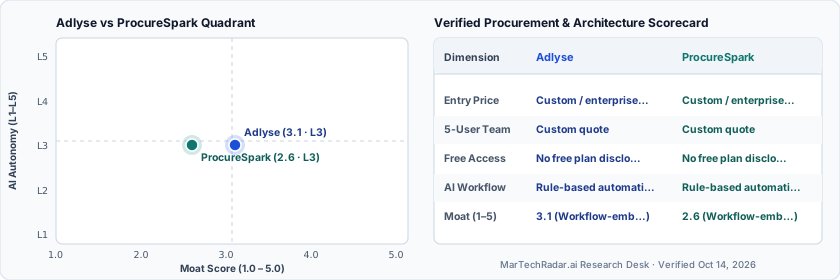
How Adlyse and ProcureSpark differ
- Moat tier: Adlyse is rated Workflow-embedded (strong), ProcureSpark Workflow-embedded.
- ProcureSpark was founded earlier (2023) than Adlyse (2025).
- Headquarters: Adlyse in San Francisco, ProcureSpark in San Francisco, California, United States.
- Company headcount: Adlyse is 11-50 employees; ProcureSpark is 2-10 employees.
Computed from the fields below. Only editor-verified ratings and vendor-sourced prices are compared.
When to choose Adlyse vs ProcureSpark (and when to walk away)
Choose Adlyse if
- Target ICP & Stack Fit: You operate as Performance Marketing Directors, Ad Agencies and Retail Media Advertisers requiring a Web SaaS deployment for DCO.
- L3 Architecture & Defensibility: Adlyse establishes defensibility through real-time bidirectional ad network connectors and automated execution guardrails that translate granular performance signals into autonomous bid and creative adjustments.
- Commercial Model Fit: Your procurement budget aligns with Custom / enterprise pricing.
Walk away from Adlyse if
- Walk away if you require transparent self-serve monthly billing or your budget ceiling is under $1,000/mo (Adlyse requires sales-gated custom quoting).
- Walk away if your workflow cannot tolerate API rate limits and polling latency: Bidirectional synchronization frequency is bound by platform API rate limits, which can delay automated bid and creative adjustments during volatile auction spikes.
- Walk away if attribution window lag is a deal-breaker for your team: Delayed conversion reporting from privacy frameworks like SKAdNetwork complicates real-time optimization, occasionally forcing the engine to act on incomplete attribution cohorts.
Choose ProcureSpark if
- Target ICP & Stack Fit: You operate as Performance Marketing Directors, Ad Agencies and Retail Media Advertisers requiring a Web SaaS deployment for DCO, with verified ecosystem connectivity for Twilio Segment.
- L3 Architecture & Defensibility: Proprietary domain-specific retrieval embeddings tailored to enterprise procurement schemas and security questionnaires, backed by continuous domain-level feedback loops.
- Commercial Model Fit: Your procurement budget aligns with Custom / enterprise pricing.
Walk away from ProcureSpark if
- Walk away if you require transparent self-serve monthly billing or your budget ceiling is under $1,000/mo (ProcureSpark requires sales-gated custom quoting).
- Walk away if your workflow cannot tolerate corpus freshness latency: The system relies on updated underlying technical collateral; stale security attestations or obsolete feature specifications directly generate hallucinated or deprecated answers requiring manual correction.
- Walk away if spreadsheet schema parsing failures is a deal-breaker for your team: Complex multi-tab matrix spreadsheets with nested merged cells or non-standard conditional logic can cause parsing dropouts during question ingestion.
Side-by-side facts
| Field | Adlyse | ProcureSpark |
|---|---|---|
| Subtrack | Dynamic Creative Optimization / DCO | Dynamic Creative Optimization / DCO |
| Pricing | Custom / enterprise pricing | Custom / enterprise pricing |
| Pricing model | Enterprise / quote | Enterprise / quote |
| Published pricing tiers | Enterprise / Custom (Custom quote) | Enterprise / Custom (Custom quote) |
| Free access | No free plan disclosed | No free plan disclosed |
| Enterprise plan | Yes | Yes |
| AI autonomy level | L3 · Conditional automation | L3 · Conditional automation |
| Moat tier & score | 3.1 / 5.0 · Workflow-embedded (strong) | 2.6 / 5.0 · Workflow-embedded |
| Delivery | Web SaaS | Web SaaS |
| Audience | Performance Marketing Directors, Ad Agencies, Retail Media Advertisers | Performance Marketing Directors, Ad Agencies, Retail Media Advertisers |
| Ecosystem integrations | — | Twilio Segment |
| Funding & backing | Pre-seed | $145K · Backed by Right Side Capital Management |
| Company size | 11-50 employees | 2-10 employees |
| Founded | 2025 | 2023 |
| Headquarters | San Francisco | San Francisco, California, United States |
| Fact-checked | MarTechRadar Research Desk, Oct 14, 2026 | MarTechRadar Research Desk, Oct 11, 2026 |
| Governance & docs | API & Docs ↗ · Terms ↗ · Privacy ↗ | Trust & Security ↗ · Terms ↗ · Privacy ↗ |
Adlyse vs ProcureSpark: TCO & constraint stress test
Test how both tools behave under your team size, monthly budget ceiling, CRM ecosystem, and governance guardrails.
Adlyse
High Deal-Risk · Constraint Mismatch- Opaque Enterprise Quoting vs. SMB/Mid-Market Budget: Adlyse does not disclose a public self-serve floor (Custom / enterprise pricing). Buyers with a $800/mo cap face high sales-qualification friction.
- Sales-Gated Contract Terms: Adlyse delivers its platform under a custom contract structure where commercial pricing is available on request through tailored enterprise sales quotes based on organizational scale and seats.
- Primary Operational Bottleneck: API Rate Limits and Polling Latency: Bidirectional synchronization frequency is bound by platform API rate limits, which can delay automated bid and creative adjustments during volatile auction spikes.
Walk-Away Rule: Walk away if you require transparent self-serve monthly billing or your budget ceiling is under $1,000/mo (Adlyse requires sales-gated custom quoting).
Negotiation Lever: Demand a 30- to 60-day paid pilot opt-out clause in the Adlyse order form before signing a 12-month enterprise commitment.
ProcureSpark
High Deal-Risk · Constraint Mismatch- Opaque Enterprise Quoting vs. SMB/Mid-Market Budget: ProcureSpark does not disclose a public self-serve floor (Custom / enterprise pricing). Buyers with a $800/mo cap face high sales-qualification friction.
- Sales-Gated Contract Terms: Commercial procurement is managed through bespoke agreements, with commercial pricing available on request through tailored enterprise sales quotes based on organizational scale and seats.
- Primary Operational Bottleneck: Corpus freshness latency: The system relies on updated underlying technical collateral; stale security attestations or obsolete feature specifications directly generate hallucinated or deprecated answers requiring manual correction.
Walk-Away Rule: Walk away if you require transparent self-serve monthly billing or your budget ceiling is under $1,000/mo (ProcureSpark requires sales-gated custom quoting).
Negotiation Lever: Demand a 30- to 60-day paid pilot opt-out clause in the ProcureSpark order form before signing a 12-month enterprise commitment.
Limitations
Adlyse
Operational considerations and platform boundaries include: API Rate Limits and Polling Latency: Bidirectional synchronization frequency is bound by platform API rate limits, which can delay automated bid and creative adjustments during volatile auction spikes.Full limitations in the Adlyse review
ProcureSpark
Operational considerations and platform boundaries include: Corpus freshness latency: The system relies on updated underlying technical collateral; stale security attestations or obsolete feature specifications directly generate hallucinated or deprecated answers requiring manual correction.Full limitations in the ProcureSpark review
Official vendor architectural differentiators & migration proof
To help buyers evaluate real-world switching costs, verified founders, solutions architects, and PMMs at both Adlyse and ProcureSpark can submit up to 3 evidence-backed architectural differentiators or verified customer migration case studies.
Why teams choose Adlyse over ProcureSpark
Work at Adlyse? Verify your official domain email to publish 3 technical differentiators, migration benchmarks, or a head-to-head buyer sandbox offer on this comparison page:
+ Submit Adlyse Official Differentiators & Case Study →Why teams choose ProcureSpark over Adlyse
Work at ProcureSpark? Verify your official domain email to publish 3 technical differentiators, migration benchmarks, or a head-to-head buyer sandbox offer on this comparison page:
+ Submit ProcureSpark Official Differentiators & Case Study →Pricing notes & tier schedules
Adlyse: Custom / enterprise pricing
Adlyse delivers its platform under a custom contract structure where commercial pricing is available on request through tailored enterprise sales quotes based on organizational scale and seats. The model typically evaluates total managed advertising spend, connected ad accounts, and data ingestion throughput.
- Enterprise / Custom (Custom quote, 15–50+ seats (Enterprise SLA)): Sales-negotiated annual contract for custom volume, SSO/RBAC governance, and dedicated SLA.
- API Rate Limits and Polling Latency: Bidirectional synchronization frequency is bound by platform API rate limits, which can delay automated bid and creative adjustments during volatile auction spikes.
- Attribution Window Lag: Delayed conversion reporting from privacy frameworks like SKAdNetwork complicates real-time optimization, occasionally forcing the engine to act on incomplete attribution cohorts.
ProcureSpark: Custom / enterprise pricing
Commercial procurement is managed through bespoke agreements, with commercial pricing available on request through tailored enterprise sales quotes based on organizational scale and seats.
- Enterprise / Custom (Custom quote, 15–50+ seats (Enterprise SLA)): Sales-negotiated annual contract for custom volume, SSO/RBAC governance, and dedicated SLA.
- Corpus freshness latency: The system relies on updated underlying technical collateral; stale security attestations or obsolete feature specifications directly generate hallucinated or deprecated answers requiring manual correction.
- Spreadsheet schema parsing failures: Complex multi-tab matrix spreadsheets with nested merged cells or non-standard conditional logic can cause parsing dropouts during question ingestion.
Frequently asked questions: Adlyse vs ProcureSpark
How does Adlyse pricing compare to ProcureSpark in 2026?
Adlyse is listed at Custom / enterprise pricing (enterprise / quote, no free plan disclosed), whereas ProcureSpark is listed at Custom / enterprise pricing (enterprise / quote, no free plan disclosed).
How do Adlyse and ProcureSpark compare on AI autonomy and moat depth?
On the MarTechRadar L1–L5 scale, Adlyse is rated L3 · Conditional automation with a Workflow-embedded (strong) moat (3.1/5.0), while ProcureSpark is rated L3 · Conditional automation with a Workflow-embedded moat (2.6/5.0).
Which teams are Adlyse and ProcureSpark built for?
Adlyse is a Web SaaS product in Dynamic Creative Optimization / DCO designed for Performance Marketing Directors, Ad Agencies, Retail Media Advertisers. ProcureSpark is a Web SaaS product in Dynamic Creative Optimization / DCO designed for Performance Marketing Directors, Ad Agencies, Retail Media Advertisers.
What are the main limitations of Adlyse vs ProcureSpark?
For Adlyse: Operational considerations and platform boundaries include: API Rate Limits and Polling Latency: Bidirectional synchronization frequency is bound by platform API rate limits, which can delay automated bid and creative adjustments during volatile auction spikes. For ProcureSpark: Operational considerations and platform boundaries include: Corpus freshness latency: The system relies on updated underlying technical collateral; stale security attestations or obsolete feature specifications directly generate hallucinated or deprecated answers requiring manual correction.
What are the hidden TCO drivers and contract negotiation levers for Adlyse vs ProcureSpark?
For Adlyse: API Rate Limits and Polling Latency (Bidirectional synchronization frequency is bound by platform API rate limits, which can delay automated bid and creative adjustments during volatile auction spikes.) Negotiation lever: Demand a 30- to 60-day paid pilot opt-out clause in the Adlyse order form before signing a 12-month enterprise commitment. For ProcureSpark: Corpus freshness latency (The system relies on updated underlying technical collateral; stale security attestations or obsolete feature specifications directly generate hallucinated or deprecated answers requiring manual correction.) Negotiation lever: Demand a 30- to 60-day paid pilot opt-out clause in the ProcureSpark order form before signing a 12-month enterprise commitment.
Excerpts are quoted verbatim from each fact-checked review. Last updated Oct 14, 2026.