MAI Agents vs Monocle
Reviewed by MarTechRadar Research Desk. Pricing & entity snapshots verified Oct 12, 2026.
MAI Agents (Web SaaS) and Monocle (Web SaaS) both compete in AI Email Marketing & Lifecycle Journeys. On pricing, MAI Agents lists Custom / enterprise pricing (free plan), whereas Monocle lists Custom / enterprise pricing (no free plan disclosed). Technically, MAI Agents is rated L3 · Conditional automation with a 3.3/5.0 (Workflow-embedded (strong)) moat, while Monocle is rated L3 · Conditional automation with a 3.6/5.0 (Proprietary moat) moat. Corporate profile: MAI Agents (founded 2024, HQ Cupertino, CA, $25M funding) vs. Monocle (founded 2023, HQ New York, NY, $7.5M funding). Verified by the MarTechRadar Research Desk (Oct 12, 2026 for MAI Agents; Oct 11, 2026 for Monocle). At a 5-seat team baseline, MAI Agents starts at Custom quote vs Monocle at Custom quote.
MAI Agents
Autonomous performance marketing and lifecycle agent executing cross-channel campaign generation, dynamic budget rebalancing, and audience personalization.
5-User Team Cost: Custom quote (Custom / enterprise pricing) · Autonomy: L3 · Conditional automation · Moat: 3.3/5.0 (Workflow-embedded (strong))
Target fit: CRM & Lifecycle Marketers, eCommerce Growth Teams, Customer Experience Directors (Web SaaS)
Monocle
AI-native retention and promotional decisioning engine calculating individual price sensitivity to optimize discounts and email lifecycle journeys.
5-User Team Cost: Custom quote (Custom / enterprise pricing) · Autonomy: L3 · Conditional automation · Moat: 3.6/5.0 (Proprietary moat)
Target fit: CRM & Lifecycle Marketers, eCommerce Growth Teams, Customer Experience Directors (Web SaaS)
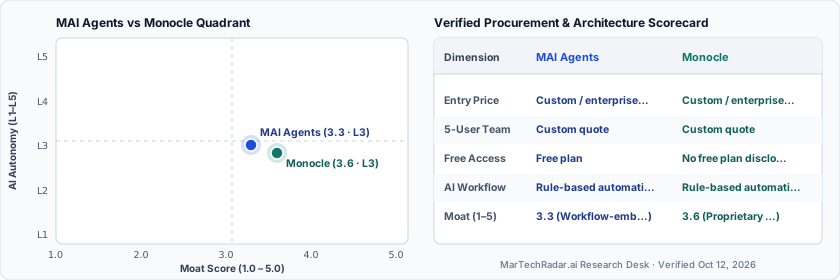
How MAI Agents and Monocle differ
- MAI Agents has a free plan; none is recorded for Monocle.
- Moat tier: Monocle is rated Proprietary moat, MAI Agents Workflow-embedded (strong).
- Monocle was founded earlier (2023) than MAI Agents (2024).
- Headquarters: MAI Agents in Cupertino, CA, Monocle in New York, NY.
- Verified backing: MAI Agents records $25M (Gaorong Capital, Kleiner Perkins); Monocle records $7.5M (F2 Venture Capital, Tiferes Ventures, irrvntVC).
Computed from the fields below. Only editor-verified ratings and vendor-sourced prices are compared.
When to choose MAI Agents vs Monocle (and when to walk away)
Choose MAI Agents if
- Target ICP & Stack Fit: You operate as CRM & Lifecycle Marketers, eCommerce Growth Teams and Customer Experience Directors requiring a Web SaaS deployment for Email Marketing, with verified ecosystem connectivity for Google Ads.
- L3 Architecture & Defensibility: Deep contextual integration across cross-channel ad accounts and email backends, coupled with proprietary algorithmic feedback loops for automated budget allocation and creative iteration.
- Commercial Model Fit: Your procurement budget aligns with Custom / enterprise pricing and want a self-serve free tier for zero-cost initial validation.
Walk away from MAI Agents if
- Walk away if you require transparent self-serve monthly billing or your budget ceiling is under $1,000/mo (MAI Agents requires sales-gated custom quoting).
- Walk away if your workflow cannot tolerate attribution latency degradation: The dynamic budget allocation loop encounters optimization lag when integrated with extended enterprise sales cycles, as attribution signals require days to resolve.
- Walk away if schema drift vulnerability is a deal-breaker for your team: Unannounced API changes or modified data schemas across underlying marketing endpoints disrupt automated workflow execution and demand manual token reconnection.
Choose Monocle if
- Target ICP & Stack Fit: You operate as CRM & Lifecycle Marketers, eCommerce Growth Teams and Customer Experience Directors requiring a Web SaaS deployment for Email Marketing.
- L3 Architecture & Defensibility: Proprietary promotion elasticity scoring and personalized margin-optimizing models embedded into direct-to-consumer email flows, defending profitability against uniform discount discounting.
- Commercial Model Fit: Your procurement budget aligns with Custom / enterprise pricing.
Walk away from Monocle if
- Walk away if you require transparent self-serve monthly billing or your budget ceiling is under $1,000/mo (Monocle requires sales-gated custom quoting).
- Walk away if your workflow cannot tolerate cold-start data insufficiency: The predictive incentive models require continuous historical order volumes and session density to accurately model price elasticity, leading to sub-optimal default incentives on newly acquired or low-intent anonymous cohorts.
- Walk away if CDP and catalog schema latency is a deal-breaker for your team: Real-time offer decisioning relies on low-latency event synchronization; asynchronous data ingestion lags across external catalog pipelines risk distributing outdated pricing or out-of-stock product recommendations.
Side-by-side facts
| Field | MAI Agents | Monocle |
|---|---|---|
| Subtrack | AI Email Marketing & Lifecycle Journeys | AI Email Marketing & Lifecycle Journeys |
| Pricing | Custom / enterprise pricing | Custom / enterprise pricing |
| Pricing model | Enterprise / quote | Enterprise / quote |
| Published pricing tiers | Free / Sandbox ($0) · Enterprise / Custom (Custom quote) | Enterprise / Custom (Custom quote) |
| Free access | Free plan | No free plan disclosed |
| Enterprise plan | Yes | Yes |
| AI autonomy level | L3 · Conditional automation | L3 · Conditional automation |
| Moat tier & score | 3.3 / 5.0 · Workflow-embedded (strong) | 3.6 / 5.0 · Proprietary moat |
| Delivery | Web SaaS | Web SaaS |
| Audience | CRM & Lifecycle Marketers, eCommerce Growth Teams, Customer Experience Directors | CRM & Lifecycle Marketers, eCommerce Growth Teams, Customer Experience Directors |
| Ecosystem integrations | Google Ads | — |
| Compliance & governance | — | SOC 2 |
| Funding & backing | $25M · Backed by Gaorong Capital, Kleiner Perkins | $7.5M · Backed by F2 Venture Capital, Tiferes Ventures, irrvntVC · Acquired by OuterSignal |
| Founders | Yuchen Wu | Mark Lotman, Noam Szpiro |
| Company size | 11-50 employees | 11-50 employees |
| Founded | 2024 | 2023 |
| Headquarters | Cupertino, CA | New York, NY |
| Fact-checked | MarTechRadar Research Desk, Oct 12, 2026 | MarTechRadar Research Desk, Oct 11, 2026 |
| Governance & docs | Terms ↗ · Privacy ↗ | — |
MAI Agents vs Monocle: TCO & constraint stress test
Test how both tools behave under your team size, monthly budget ceiling, CRM ecosystem, and governance guardrails.
MAI Agents
Conditional Fit · Contract & Stack Caveats- Opaque Enterprise Quoting vs. SMB/Mid-Market Budget: MAI Agents does not disclose a public self-serve floor (Custom / enterprise pricing). Buyers with a $800/mo cap face high sales-qualification friction.
- Published Self-Serve Entry Floor: MAI Agents publishes a transparent entry point (Custom / enterprise pricing) with a free tier for initial validation before committing.
- Primary Operational Bottleneck: Attribution Latency Degradation: The dynamic budget allocation loop encounters optimization lag when integrated with extended enterprise sales cycles, as attribution signals require days to resolve.
Walk-Away Rule: Walk away if you require transparent self-serve monthly billing or your budget ceiling is under $1,000/mo (MAI Agents requires sales-gated custom quoting).
Negotiation Lever: Demand a 30- to 60-day paid pilot opt-out clause in the MAI Agents order form before signing a 12-month enterprise commitment.
Monocle
High Deal-Risk · Constraint Mismatch- Opaque Enterprise Quoting vs. SMB/Mid-Market Budget: Monocle does not disclose a public self-serve floor (Custom / enterprise pricing). Buyers with a $800/mo cap face high sales-qualification friction.
- Sales-Gated Contract Terms: Monocle operates under a closed commercial model where software licensing is available on request through tailored enterprise sales quotes based on organizational scale and seats.
- Primary Operational Bottleneck: Cold-start data insufficiency: The predictive incentive models require continuous historical order volumes and session density to accurately model price elasticity, leading to sub-optimal default incentives on newly acquired or low-intent anonymous cohorts.
Walk-Away Rule: Walk away if you require transparent self-serve monthly billing or your budget ceiling is under $1,000/mo (Monocle requires sales-gated custom quoting).
Negotiation Lever: Demand a 30- to 60-day paid pilot opt-out clause in the Monocle order form before signing a 12-month enterprise commitment.
Limitations
MAI Agents
Operational considerations and platform boundaries include: Attribution Latency Degradation: The dynamic budget allocation loop encounters optimization lag when integrated with extended enterprise sales cycles, as attribution signals require days to resolve.Full limitations in the MAI Agents review
Monocle
Operational considerations and platform boundaries include: Cold-start data insufficiency: The predictive incentive models require continuous historical order volumes and session density to accurately model price elasticity, leading to sub-optimal default incentives on newly acquired or low-intent anonymous cohorts.Full limitations in the Monocle review
Official vendor architectural differentiators & migration proof
To help buyers evaluate real-world switching costs, verified founders, solutions architects, and PMMs at both MAI Agents and Monocle can submit up to 3 evidence-backed architectural differentiators or verified customer migration case studies.
Why teams choose MAI Agents over Monocle
Work at MAI Agents? Verify your official domain email to publish 3 technical differentiators, migration benchmarks, or a head-to-head buyer sandbox offer on this comparison page:
+ Submit MAI Agents Official Differentiators & Case Study →Why teams choose Monocle over MAI Agents
Work at Monocle? Verify your official domain email to publish 3 technical differentiators, migration benchmarks, or a head-to-head buyer sandbox offer on this comparison page:
+ Submit Monocle Official Differentiators & Case Study →Pricing notes & tier schedules
MAI Agents: Custom / enterprise pricing
MAI Agents provides an entry tier starting at $0 per month, which supplies $99 in complimentary platform credits valid for a two-month trial window without requiring payment card registration.
- Free / Sandbox ($0, 1–2 seats (Evaluation)): Entry free tier with capped usage or feature quotas for initial workflow testing.
- Enterprise / Custom (Custom quote, 15–50+ seats (Enterprise SLA)): Sales-negotiated annual contract for custom volume, SSO/RBAC governance, and dedicated SLA.
- Credit & Usage Burn Multiplier: Workflows on MAI Agents consume metered credits or usage quotas; high-volume AI generation, batch queries, or recurring automation runs can exhaust base allocations and trigger mid-cycle top-up packs.
- Enterprise Governance & Add-On Gating: Advanced capabilities such as Single Sign-On (SSO), custom role permissions, or specialized analytics modules are gated behind upper tiers or paid add-ons.
Monocle: Custom / enterprise pricing
Monocle operates under a closed commercial model where software licensing is available on request through tailored enterprise sales quotes based on organizational scale and seats.
- Enterprise / Custom (Custom quote, 15–50+ seats (Enterprise SLA)): Sales-negotiated annual contract for custom volume, SSO/RBAC governance, and dedicated SLA.
- Cold-start data insufficiency: The predictive incentive models require continuous historical order volumes and session density to accurately model price elasticity, leading to sub-optimal default incentives on newly acquired or low-intent anonymous cohorts.
- CDP and catalog schema latency: Real-time offer decisioning relies on low-latency event synchronization; asynchronous data ingestion lags across external catalog pipelines risk distributing outdated pricing or out-of-stock product recommendations.
Frequently asked questions: MAI Agents vs Monocle
How does MAI Agents pricing compare to Monocle in 2026?
MAI Agents is listed at Custom / enterprise pricing (enterprise / quote, free plan), whereas Monocle is listed at Custom / enterprise pricing (enterprise / quote, no free plan disclosed).
How do MAI Agents and Monocle compare on AI autonomy and moat depth?
On the MarTechRadar L1–L5 scale, MAI Agents is rated L3 · Conditional automation with a Workflow-embedded (strong) moat (3.3/5.0), while Monocle is rated L3 · Conditional automation with a Proprietary moat moat (3.6/5.0).
Which teams are MAI Agents and Monocle built for?
MAI Agents is a Web SaaS product in AI Email Marketing & Lifecycle Journeys designed for CRM & Lifecycle Marketers, eCommerce Growth Teams, Customer Experience Directors. Monocle is a Web SaaS product in AI Email Marketing & Lifecycle Journeys designed for CRM & Lifecycle Marketers, eCommerce Growth Teams, Customer Experience Directors.
What are the main limitations of MAI Agents vs Monocle?
For MAI Agents: Operational considerations and platform boundaries include: Attribution Latency Degradation: The dynamic budget allocation loop encounters optimization lag when integrated with extended enterprise sales cycles, as attribution signals require days to resolve. For Monocle: Operational considerations and platform boundaries include: Cold-start data insufficiency: The predictive incentive models require continuous historical order volumes and session density to accurately model price elasticity, leading to sub-optimal default incentives on newly acquired or low-intent anonymous cohorts.
What are the hidden TCO drivers and contract negotiation levers for MAI Agents vs Monocle?
For MAI Agents: Credit & Usage Burn Multiplier (Workflows on MAI Agents consume metered credits or usage quotas; high-volume AI generation, batch queries, or recurring automation runs can exhaust base allocations and trigger mid-cycle top-up packs.) Negotiation lever: Demand a 30- to 60-day paid pilot opt-out clause in the MAI Agents order form before signing a 12-month enterprise commitment. For Monocle: Cold-start data insufficiency (The predictive incentive models require continuous historical order volumes and session density to accurately model price elasticity, leading to sub-optimal default incentives on newly acquired or low-intent anonymous cohorts.) Negotiation lever: Demand a 30- to 60-day paid pilot opt-out clause in the Monocle order form before signing a 12-month enterprise commitment.
Excerpts are quoted verbatim from each fact-checked review. Last updated Oct 12, 2026.