Kling AI vs Pika Labs
Reviewed by MarTechRadar Research Desk. Pricing & entity snapshots verified Oct 12, 2026.
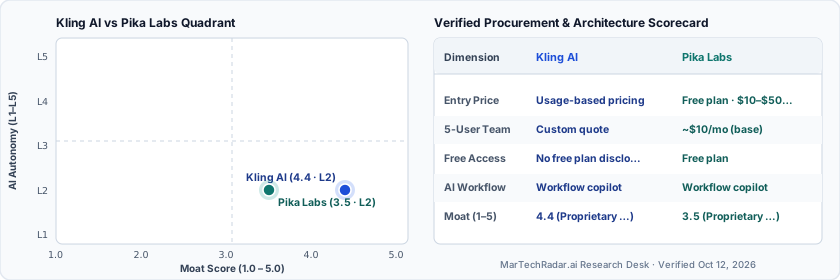
Kling AI (Web SaaS) and Pika Labs (Web SaaS) both compete in Generative Commercial Video & Media. On pricing, Kling AI lists Usage-based pricing (no free plan disclosed), whereas Pika Labs lists Free plan · $10–$50/mo (free plan). Technically, Kling AI is rated L2 · Workflow copilot with a 4.4/5.0 (Proprietary moat (category leader)) moat, while Pika Labs is rated L2 · Workflow copilot with a 3.5/5.0 (Proprietary moat) moat. Corporate profile: Kling AI (founded 2024, HQ /, Singapore, SG, $3B funding) vs. Pika Labs (founded 2023, HQ Palo Alto, California, $135M funding). Verified by the MarTechRadar Research Desk (Oct 12, 2026 for Kling AI; Oct 7, 2026 for Pika Labs). At a 5-seat team baseline, Kling AI starts at Custom quote vs Pika Labs at ~$10/mo (base).
Kling AI
Diffusion transformer video generation model enabling physics-grounded text-to-video, image-to-video, and programmatic commercial media generation.
5-User Team Cost: Custom quote (Usage-based pricing) · Autonomy: L2 · Workflow copilot · Moat: 4.4/5.0 (Proprietary moat (category leader))
Target fit: DTC / eCommerce, Enterprise Brands, Creators / Solo (Web SaaS)
Pika Labs
Generative video diffusion workspace providing camera trajectory manipulation, character motion transfer, and multimodal scene expansion for commercial.
5-User Team Cost: ~$10/mo (base) (Free plan · $10–$50/mo) · Autonomy: L2 · Workflow copilot · Moat: 3.5/5.0 (Proprietary moat)
Target fit: DTC / eCommerce, Creators / Solo (Web SaaS)
How Kling AI and Pika Labs differ
- Pricing model: Kling AI is usage-based, Pika Labs is freemium.
- Pika Labs publishes an entry price (Free plan · $10–$50/mo); Kling AI does not (Usage-based pricing).
- Pika Labs has a free plan; none is recorded for Kling AI.
- Moat tier: Kling AI is rated Proprietary moat (category leader), Pika Labs Proprietary moat.
- Pika Labs was founded earlier (2023) than Kling AI (2024).
- Headquarters: Kling AI in /, Singapore, SG, Pika Labs in Palo Alto, California.
- Verified backing: Kling AI records $3B; Pika Labs records $135M (Spark Capital, Lightspeed Venture Partners).
- Company headcount: Kling AI is 10,001+ employees; Pika Labs is 11-50 employees.
Computed from the fields below. Only editor-verified ratings and vendor-sourced prices are compared.
When to choose Kling AI vs Pika Labs (and when to walk away)
Choose Kling AI if
- Target ICP & Stack Fit: You operate as DTC / eCommerce, Enterprise Brands and Creators / Solo requiring a Web SaaS deployment for AI Video Generation.
- L2 Architecture & Defensibility: Defensibility stems from proprietary 3D Spatio-Temporal VAE architectures paired with large-scale compute infrastructure funded by Kuaishou, yielding superior physical motion realism and native audio-visual synchronization.
- Commercial Model Fit: Your procurement budget aligns with Usage-based pricing.
Walk away from Kling AI if
- Walk away if you require transparent self-serve monthly billing or your budget ceiling is under $1,000/mo (Kling AI requires sales-gated custom quoting).
- Walk away if your workflow cannot tolerate high latency queue overhead: High GPU compute overhead introduces queue wait times during peak generation runs, making interactive real-time editing loops difficult for fast iteration.
- Walk away if anatomical and physics drift is a deal-breaker for your team: Complex multi-agent scenes still suffer from temporal degradation and limb distortion across clips extended beyond basic generation durations.
Choose Pika Labs if
- Target ICP & Stack Fit: You operate as DTC / eCommerce and Creators / Solo requiring a Web SaaS deployment for AI Video Generation, with verified ecosystem connectivity for Zoom, Twilio Segment.
- L2 Architecture & Defensibility: Proprietary spatio-temporal video diffusion models combined with targeted camera manipulation controls, modular character motion transfer, and integrated multi-model inference pipelines.
- Commercial Model Fit: Your procurement budget aligns with Free plan · $10–$50/mo and want a self-serve free tier for zero-cost initial validation.
Walk away from Pika Labs if
- Walk away if your workflow requires uncapped enterprise volume on the Free plan · $10–$50/mo entry plan without upgrading tiers.
- Walk away if your workflow cannot tolerate temporal consistency drift: Complex physical interactions, intricate limb movements, and fine typographic elements frequently suffer from structural morphing and spatial hallucination across extended frame intervals.
- Walk away if inference latency and concurrency is a deal-breaker for your team: High-demand cluster queues generate variable rendering latency, constraining real-time storyboard prototyping and programmatic batch asset rendering workflows.
Side-by-side facts
| Field | Kling AI | Pika Labs |
|---|---|---|
| Subtrack | Generative Commercial Video & Media | Generative Commercial Video & Media |
| Pricing | Usage-based pricing | Free plan · $10–$50/mo |
| Pricing model | Usage-based | Freemium |
| Published pricing tiers | — | Free / Sandbox ($0) · Starter ($10/mo) |
| Free access | No free plan disclosed | Free plan |
| Enterprise plan | Not recorded | Not recorded |
| AI autonomy level | L2 · Workflow copilot | L2 · Workflow copilot |
| Moat tier & score | 4.4 / 5.0 · Proprietary moat (category leader) | 3.5 / 5.0 · Proprietary moat |
| Delivery | Web SaaS | Web SaaS |
| Audience | DTC / eCommerce, Enterprise Brands, Creators / Solo | DTC / eCommerce, Creators / Solo |
| Ecosystem integrations | — | Zoom, Twilio Segment |
| Funding & backing | $3B | $135M · Backed by Spark Capital, Lightspeed Venture Partners |
| Founders | — | Chelin Meng, Demi Guo |
| Company size | 10,001+ employees | 11-50 employees |
| Founded | 2024 | 2023 |
| Headquarters | /, Singapore, SG | Palo Alto, California |
| Fact-checked | MarTechRadar Research Desk, Oct 12, 2026 | MarTechRadar Research Desk, Oct 7, 2026 |
| Governance & docs | API & Docs ↗ · Changelog ↗ · Privacy ↗ | Terms ↗ · Privacy ↗ |
Kling AI vs Pika Labs: TCO & constraint stress test
Test how both tools behave under your team size, monthly budget ceiling, CRM ecosystem, and governance guardrails.
Kling AI
High Deal-Risk · Constraint Mismatch- Opaque Enterprise Quoting vs. SMB/Mid-Market Budget: Kling AI does not disclose a public self-serve floor (Usage-based pricing). Buyers with a $800/mo cap face high sales-qualification friction.
- Sales-Gated Contract Terms: Commercial access operates primarily on a consumption foundation. Programmatic developers and enterprise production pipelines utilize a credit-denominated Video API starting at $0.14 per unit on a pay-as-you-go schedule.
- Usage / Credit Burn Volatility: Kling AI uses credit or usage-metered billing (Usage-based pricing). High-volume automated workflows across 5 seats can trigger mid-cycle overage charges.
- Primary Operational Bottleneck: High Latency Queue Overhead: High GPU compute overhead introduces queue wait times during peak generation runs, making interactive real-time editing loops difficult for fast iteration.
Walk-Away Rule: Walk away if you require transparent self-serve monthly billing or your budget ceiling is under $1,000/mo (Kling AI requires sales-gated custom quoting).
Negotiation Lever: Demand a 30- to 60-day paid pilot opt-out clause in the Kling AI order form before signing a 12-month enterprise commitment.
Pika Labs
Low Procurement Risk · Strong Fit- Published Self-Serve Entry Floor: Pika Labs publishes a transparent entry point (Free plan · $10–$50/mo) with a free tier for initial validation before committing.
- Primary Operational Bottleneck: Temporal Consistency Drift: Complex physical interactions, intricate limb movements, and fine typographic elements frequently suffer from structural morphing and spatial hallucination across extended frame intervals.
Walk-Away Rule: Walk away if your workflow requires uncapped enterprise volume on the Free plan · $10–$50/mo entry plan without upgrading tiers.
Negotiation Lever: Validate exact quota thresholds (seats, credits, or API calls) included in Pika Labs's Free plan · $10–$50/mo tier before converting from monthly to annual billing.
Limitations
Kling AI
Operational considerations and platform boundaries include: High Latency Queue Overhead: High GPU compute overhead introduces queue wait times during peak generation runs, making interactive real-time editing loops difficult for fast iteration.Full limitations in the Kling AI review
Pika Labs
Operational considerations and platform boundaries include: Temporal Consistency Drift: Complex physical interactions, intricate limb movements, and fine typographic elements frequently suffer from structural morphing and spatial hallucination across extended frame intervals.Full limitations in the Pika Labs review
Official vendor architectural differentiators & migration proof
To help buyers evaluate real-world switching costs, verified founders, solutions architects, and PMMs at both Kling AI and Pika Labs can submit up to 3 evidence-backed architectural differentiators or verified customer migration case studies.
Why teams choose Kling AI over Pika Labs
Work at Kling AI? Verify your official domain email to publish 3 technical differentiators, migration benchmarks, or a head-to-head buyer sandbox offer on this comparison page:
+ Submit Kling AI Official Differentiators & Case Study →Why teams choose Pika Labs over Kling AI
Work at Pika Labs? Verify your official domain email to publish 3 technical differentiators, migration benchmarks, or a head-to-head buyer sandbox offer on this comparison page:
+ Submit Pika Labs Official Differentiators & Case Study →Pricing notes & tier schedules
Kling AI: Usage-based pricing
Commercial access operates primarily on a consumption foundation. Programmatic developers and enterprise production pipelines utilize a credit-denominated Video API starting at $0.14 per unit on a pay-as-you-go schedule.
- Credit & Usage Burn Multiplier: Workflows on Kling AI consume metered credits or usage quotas; voice/media minutes, multi-step synthesis, or high-frequency runs can exhaust base allocations and trigger mid-cycle top-up packs.
- High Latency Queue Overhead: High GPU compute overhead introduces queue wait times during peak generation runs, making interactive real-time editing loops difficult for fast iteration.
Pika Labs: Free plan · $10–$50/mo
Pika Labs provisions its compute resources through a tiered subscription architecture structured around monthly generation credits. Beyond an introductory free tier, commercial plans scale from $10 to $50 per month depending on compute allotment, priority queue access, and generation resolution caps.
- Free / Sandbox ($0, 1–2 seats (Evaluation)): Entry free tier with capped usage or feature quotas for initial workflow testing.
- Starter ($10/mo, 1–2 seats): Verified $10/mo Starter tier from vendor pricing schedule.
- Annual Billing Headline vs. Monthly Premium: Headline entry rates reflect annual billing commitments (Save 20%); month-to-month flexibility carries a higher effective monthly rate or requires annual prepayment.
- Credit & Usage Burn Multiplier: Workflows on Pika Labs consume metered credits or usage quotas; voice/media minutes, multi-step synthesis, or high-frequency runs can exhaust base allocations and trigger mid-cycle top-up packs.
Frequently asked questions: Kling AI vs Pika Labs
How does Kling AI pricing compare to Pika Labs in 2026?
Kling AI is listed at Usage-based pricing (usage-based, no free plan disclosed), whereas Pika Labs is listed at Free plan · $10–$50/mo (freemium, free plan).
How do Kling AI and Pika Labs compare on AI autonomy and moat depth?
On the MarTechRadar L1–L5 scale, Kling AI is rated L2 · Workflow copilot with a Proprietary moat (category leader) moat (4.4/5.0), while Pika Labs is rated L2 · Workflow copilot with a Proprietary moat moat (3.5/5.0).
Which teams are Kling AI and Pika Labs built for?
Kling AI is a Web SaaS product in Generative Commercial Video & Media designed for DTC / eCommerce, Enterprise Brands, Creators / Solo. Pika Labs is a Web SaaS product in Generative Commercial Video & Media designed for DTC / eCommerce, Creators / Solo.
What are the main limitations of Kling AI vs Pika Labs?
For Kling AI: Operational considerations and platform boundaries include: High Latency Queue Overhead: High GPU compute overhead introduces queue wait times during peak generation runs, making interactive real-time editing loops difficult for fast iteration. For Pika Labs: Operational considerations and platform boundaries include: Temporal Consistency Drift: Complex physical interactions, intricate limb movements, and fine typographic elements frequently suffer from structural morphing and spatial hallucination across extended frame intervals.
What are the hidden TCO drivers and contract negotiation levers for Kling AI vs Pika Labs?
For Kling AI: Credit & Usage Burn Multiplier (Workflows on Kling AI consume metered credits or usage quotas; voice/media minutes, multi-step synthesis, or high-frequency runs can exhaust base allocations and trigger mid-cycle top-up packs.) Negotiation lever: Demand a 30- to 60-day paid pilot opt-out clause in the Kling AI order form before signing a 12-month enterprise commitment. For Pika Labs: Annual Billing Headline vs. Monthly Premium (Headline entry rates reflect annual billing commitments (Save 20%); month-to-month flexibility carries a higher effective monthly rate or requires annual prepayment.) Negotiation lever: Validate exact quota thresholds (seats, credits, or API calls) included in Pika Labs's Free plan · $10–$50/mo tier before converting from monthly to annual billing.
Excerpts are quoted verbatim from each fact-checked review. Last updated Oct 12, 2026.