Artificial Societies vs Astral
Reviewed by MarTechRadar Research Desk. Pricing & entity snapshots verified Oct 11, 2026.
Artificial Societies (Web SaaS) and Astral (Web SaaS) both compete in Enterprise & Long-Form Brand Content. On pricing, Artificial Societies lists Custom / enterprise pricing (no free plan disclosed), whereas Astral lists $299–$1,199/mo (no free plan disclosed). Technically, Artificial Societies is rated L2 · Workflow copilot with a 3.2/5.0 (Workflow-embedded (strong)) moat, while Astral is rated L2 · Workflow copilot with a 1.8/5.0 (Thin wrapper) moat. Corporate profile: Artificial Societies (founded 2024, HQ London, €4.5M funding) vs. Astral (founded 2024, HQ United States). Both profiles are verified by the MarTechRadar Research Desk (Oct 11, 2026). At a 5-seat team baseline, Artificial Societies starts at Custom quote vs Astral at ~$299/mo (base).
Artificial Societies
Multi-agent simulation platform modeling synthetic audience cohorts and institutional personas to test brand messaging and public relations strategies.
5-User Team Cost: Custom quote (Custom / enterprise pricing) · Autonomy: L2 · Workflow copilot · Moat: 3.2/5.0 (Workflow-embedded (strong))
Target fit: Growth Marketing Teams, Digital Marketing Leaders (Web SaaS)
Astral
Autonomous AI video generation agent that transforms product URLs, code repositories, and interface screenshots into fully rendered commercial launch videos.
5-User Team Cost: ~$299/mo (base) ($299–$1,199/mo) · Autonomy: L2 · Workflow copilot · Moat: 1.8/5.0 (Thin wrapper)
Target fit: Enterprise Content Teams, Brand Marketers, Global Copywriters (Web SaaS)
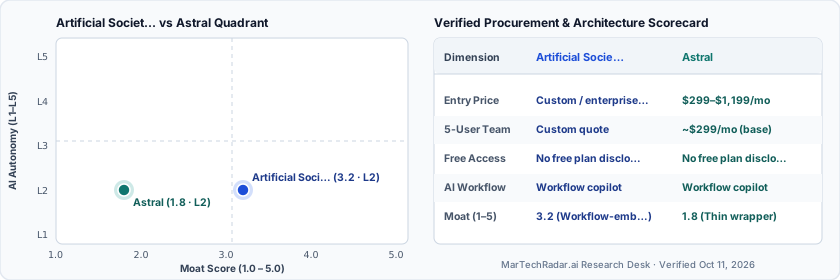
How Artificial Societies and Astral differ
- Pricing model: Artificial Societies is enterprise / quote, Astral is subscription.
- Astral publishes an entry price ($299–$1,199/mo); Artificial Societies does not (Custom / enterprise pricing).
- Moat tier: Artificial Societies is rated Workflow-embedded (strong), Astral Thin wrapper.
- Headquarters: Artificial Societies in London, Astral in United States.
- Funding stage: Artificial Societies is Seed; Astral is Pre-seed.
- Audience: Artificial Societies targets Growth Marketing Teams, Digital Marketing Leaders; Astral targets Enterprise Content Teams, Brand Marketers, Global Copywriters.
Computed from the fields below. Only editor-verified ratings and vendor-sourced prices are compared.
When to choose Artificial Societies vs Astral (and when to walk away)
Choose Artificial Societies if
- Target ICP & Stack Fit: You operate as Growth Marketing Teams and Digital Marketing Leaders requiring a Web SaaS deployment for AI Content Marketing, with verified ecosystem connectivity for Twilio Segment.
- L2 Architecture & Defensibility: Defensibility stems from proprietary agent behavioral calibration algorithms, specialized persona datasets reflecting institutional stakeholders (regulators, journalists, niche demographics), and complex multi-agent interaction dynamics that model message diffusion and consensus shifts.
- Commercial Model Fit: Your procurement budget aligns with Custom / enterprise pricing.
Walk away from Artificial Societies if
- Walk away if you require transparent self-serve monthly billing or your budget ceiling is under $1,000/mo (Artificial Societies requires sales-gated custom quoting).
- Walk away if your workflow cannot tolerate behavioral drift and hallucinated consensus: Synthetic agents can exhibit sycophancy or collective drift, generating synthetic consensus that deviates from true public response if persona temperature parameters and background priors are improperly constrained.
- Walk away if niche domain calibration latency is a deal-breaker for your team: Simulating specialized regulatory bodies or niche professional cohorts requires extensive custom profile engineering and contextual grounding, limiting instant off-the-shelf utility for non-standard industry verticals.
Choose Astral if
- Target ICP & Stack Fit: You operate as Enterprise Content Teams, Brand Marketers and Global Copywriters requiring a Web SaaS deployment for AI Content Marketing.
- L2 Architecture & Defensibility: Multimodal web interpretation coupled with automated UI interaction scripting, enabling direct visual extraction from digital software products into dynamic multi-aspect video assets without manual storyboarding.
- Commercial Model Fit: Your procurement budget aligns with $299–$1,199/mo.
Walk away from Astral if
- Walk away if your team is at early validation stage with a <$250/mo tool budget (Astral starts at $299–$1,199/mo before seat or usage expansion).
- Walk away if your workflow cannot tolerate login and firewall walls: If a software feature sits behind complex enterprise SSO or a local dev firewall, teams must upload screen clips instead of just sharing a public URL.
- Walk away if chat edits vs timeline control is a deal-breaker for your team: Video tweaks happen through plain-English chat prompts rather than a manual keyframe timeline like After Effects or Premiere.
Side-by-side facts
| Field | Artificial Societies | Astral |
|---|---|---|
| Subtrack | Enterprise & Long-Form Brand Content | Enterprise & Long-Form Brand Content |
| Pricing | Custom / enterprise pricing | $299–$1,199/mo |
| Pricing model | Enterprise / quote | Subscription |
| Published pricing tiers | Enterprise / Custom (Custom quote) | — |
| Free access | No free plan disclosed | No free plan disclosed |
| Enterprise plan | Yes | Not recorded |
| AI autonomy level | L2 · Workflow copilot | L2 · Workflow copilot |
| Moat tier & score | 3.2 / 5.0 · Workflow-embedded (strong) | 1.8 / 5.0 · Thin wrapper |
| Delivery | Web SaaS | Web SaaS |
| Audience | Growth Marketing Teams, Digital Marketing Leaders | Enterprise Content Teams, Brand Marketers, Global Copywriters |
| Ecosystem integrations | Twilio Segment | — |
| Funding & backing | €4.5M · Backed by Y Combinator, Transpose Platform | Pre-seed |
| Founders | James He, Patrick Sharpe | — |
| Company size | 11-50 employees | — |
| Founded | 2024 | 2024 |
| Headquarters | London | United States |
| Fact-checked | MarTechRadar Research Desk, Oct 11, 2026 | MarTechRadar Research Desk, Oct 11, 2026 |
| Governance & docs | Trust & Security ↗ · Privacy ↗ | Terms ↗ · Privacy ↗ |
Artificial Societies vs Astral: TCO & constraint stress test
Test how both tools behave under your team size, monthly budget ceiling, CRM ecosystem, and governance guardrails.
Artificial Societies
High Deal-Risk · Constraint Mismatch- Opaque Enterprise Quoting vs. SMB/Mid-Market Budget: Artificial Societies does not disclose a public self-serve floor (Custom / enterprise pricing). Buyers with a $800/mo cap face high sales-qualification friction.
- Sales-Gated Contract Terms: Commercial procurement operates through custom enterprise sales contracts. Pricing is available on request through tailored enterprise sales quotes based on organizational scale and seats.
- Primary Operational Bottleneck: Behavioral drift and hallucinated consensus: Synthetic agents can exhibit sycophancy or collective drift, generating synthetic consensus that deviates from true public response if persona temperature parameters and background priors are improperly constrained.
Walk-Away Rule: Walk away if you require transparent self-serve monthly billing or your budget ceiling is under $1,000/mo (Artificial Societies requires sales-gated custom quoting).
Negotiation Lever: Demand a 30- to 60-day paid pilot opt-out clause in the Artificial Societies order form before signing a 12-month enterprise commitment.
Astral
Low Procurement Risk · Strong Fit- Published Self-Serve Entry Floor: Astral publishes a transparent entry point ($299–$1,199/mo) for initial validation before committing.
- Primary Operational Bottleneck: Login and Firewall Walls: If a software feature sits behind complex enterprise SSO or a local dev firewall, teams must upload screen clips instead of just sharing a public URL.
Walk-Away Rule: Walk away if your team is at early validation stage with a <$250/mo tool budget (Astral starts at $299–$1,199/mo before seat or usage expansion).
Negotiation Lever: Negotiate price-lock protection on additional seats and overage credits above the $299–$1,199/mo entry tier.
Limitations
Artificial Societies
Operational considerations and platform boundaries include: Behavioral drift and hallucinated consensus: Synthetic agents can exhibit sycophancy or collective drift, generating synthetic consensus that deviates from true public response if persona temperature parameters and background priors are improperly constrained.Full limitations in the Artificial Societies review
Astral
Limitations and trade-offs to weigh before choosing Astral: Login and Firewall Walls: If a software feature sits behind complex enterprise SSO or a local dev firewall, teams must upload screen clips instead of just sharing a public URL.Full limitations in the Astral review
Official vendor architectural differentiators & migration proof
To help buyers evaluate real-world switching costs, verified founders, solutions architects, and PMMs at both Artificial Societies and Astral can submit up to 3 evidence-backed architectural differentiators or verified customer migration case studies.
Why teams choose Artificial Societies over Astral
Work at Artificial Societies? Verify your official domain email to publish 3 technical differentiators, migration benchmarks, or a head-to-head buyer sandbox offer on this comparison page:
+ Submit Artificial Societies Official Differentiators & Case Study →Why teams choose Astral over Artificial Societies
Work at Astral? Verify your official domain email to publish 3 technical differentiators, migration benchmarks, or a head-to-head buyer sandbox offer on this comparison page:
+ Submit Astral Official Differentiators & Case Study →Pricing notes & tier schedules
Artificial Societies: Custom / enterprise pricing
Commercial procurement operates through custom enterprise sales contracts. Pricing is available on request through tailored enterprise sales quotes based on organizational scale and seats.
- Enterprise / Custom (Custom quote, 15–50+ seats (Enterprise SLA)): Sales-negotiated annual contract for custom volume, SSO/RBAC governance, and dedicated SLA.
- Credit & Usage Burn Multiplier: Workflows on Artificial Societies consume metered credits or usage quotas; high-volume AI generation, batch queries, or recurring automation runs can exhaust base allocations and trigger mid-cycle top-up packs.
- Behavioral drift and hallucinated consensus: Synthetic agents can exhibit sycophancy or collective drift, generating synthetic consensus that deviates from true public response if persona temperature parameters and background priors are improperly constrained.
Astral: $299–$1,199/mo
Astral publishes transparent self-serve pricing on its homepage (`astral.now/#pricing`) with an auto-refund if the agent cannot deliver the first video. The Starter plan costs a one-time $299 for 1 finished video (including widescreen, vertical, square, and captioned versions).
- Enterprise Governance & Add-On Gating: Advanced capabilities such as Single Sign-On (SSO), custom role permissions, or specialized analytics modules are gated behind upper tiers or paid add-ons.
- Login and Firewall Walls: If a software feature sits behind complex enterprise SSO or a local dev firewall, teams must upload screen clips instead of just sharing a public URL.
Frequently asked questions: Artificial Societies vs Astral
How does Artificial Societies pricing compare to Astral in 2026?
Artificial Societies is listed at Custom / enterprise pricing (enterprise / quote, no free plan disclosed), whereas Astral is listed at $299–$1,199/mo (subscription, no free plan disclosed).
How do Artificial Societies and Astral compare on AI autonomy and moat depth?
On the MarTechRadar L1–L5 scale, Artificial Societies is rated L2 · Workflow copilot with a Workflow-embedded (strong) moat (3.2/5.0), while Astral is rated L2 · Workflow copilot with a Thin wrapper moat (1.8/5.0).
Which teams are Artificial Societies and Astral built for?
Artificial Societies is a Web SaaS product in Enterprise & Long-Form Brand Content designed for Growth Marketing Teams, Digital Marketing Leaders. Astral is a Web SaaS product in Enterprise & Long-Form Brand Content designed for Enterprise Content Teams, Brand Marketers, Global Copywriters.
What are the main limitations of Artificial Societies vs Astral?
For Artificial Societies: Operational considerations and platform boundaries include: Behavioral drift and hallucinated consensus: Synthetic agents can exhibit sycophancy or collective drift, generating synthetic consensus that deviates from true public response if persona temperature parameters and background priors are improperly constrained. For Astral: Limitations and trade-offs to weigh before choosing Astral: Login and Firewall Walls: If a software feature sits behind complex enterprise SSO or a local dev firewall, teams must upload screen clips instead of just sharing a public URL.
What are the hidden TCO drivers and contract negotiation levers for Artificial Societies vs Astral?
For Artificial Societies: Credit & Usage Burn Multiplier (Workflows on Artificial Societies consume metered credits or usage quotas; high-volume AI generation, batch queries, or recurring automation runs can exhaust base allocations and trigger mid-cycle top-up packs.) Negotiation lever: Demand a 30- to 60-day paid pilot opt-out clause in the Artificial Societies order form before signing a 12-month enterprise commitment. For Astral: Enterprise Governance & Add-On Gating (Advanced capabilities such as Single Sign-On (SSO), custom role permissions, or specialized analytics modules are gated behind upper tiers or paid add-ons.) Negotiation lever: Negotiate price-lock protection on additional seats and overage credits above the $299–$1,199/mo entry tier.
Excerpts are quoted verbatim from each fact-checked review. Last updated Oct 11, 2026.