Vaudit (Formerly BlokID) Review (2026): DCO Pricing, Limits & Alternatives
Bottom line
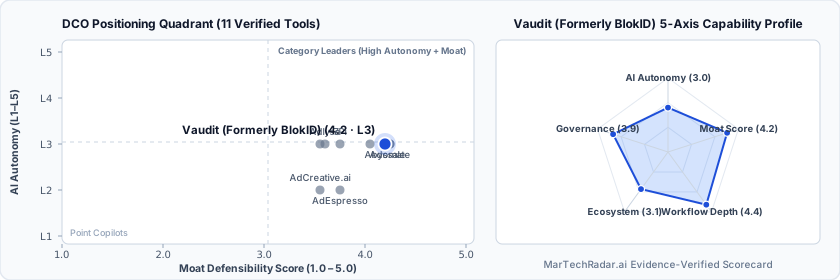
Vaudit (Formerly BlokID) is a Web SaaS tool for DCO (Dynamic Creative Optimization / DCO) in AdTech & Paid Media. Pricing: Custom / enterprise pricing. Best suited to Performance Marketing Directors, Ad Agencies and Retail Media Advertisers. Editor ratings: AI autonomy L3 (conditional automation); moat score 4.2/5.0 (Proprietary moat). Fact-checked by Tim Fenolz on Oct 12, 2026.
Agentic AI verification platform auditing programmatic ad spend and reconciling impression telemetry before vendor invoices are paid.
Vaudit (Formerly BlokID) buyer fit verdict: when to choose vs. when to walk away
Choose Vaudit (Formerly BlokID) if (Best Fit)
- Target ICP & Stack Fit: You operate as Performance Marketing Directors, Ad Agencies and Retail Media Advertisers requiring a Web SaaS deployment for DCO.
- L3 Architecture & Defensibility: Defensibility stems from deterministic ad exchange telemetry reconciliation coupled with automated financial invoice validation, creating pre-settlement friction against fraudulent vendor billing.
- Commercial Model Fit: Your procurement budget aligns with Custom / enterprise pricing.
Walk away from Vaudit (Formerly BlokID) if (Deal-Breakers)
- Walk away if you require transparent self-serve monthly billing or your budget ceiling is under $1,000/mo (Vaudit (Formerly BlokID) requires sales-gated custom quoting).
- Walk away if your workflow cannot tolerate telemetry access restrictions: Walled-garden platforms frequently restrict raw impression-level log exports, limiting reconciliation depth to aggregated reporting APIs rather than deterministic event logs.
- Walk away if invoice ingestion latency is a deal-breaker for your team: Unstandardized vendor billing formats and delayed invoice deliveries can stall automated matching cycles, forcing manual human-in-the-loop schema mapping.
Vaudit (Formerly BlokID) key facts & scorecard
| Pricing | Custom / enterprise pricing |
|---|---|
| Free plan | No / not disclosed |
| Delivery | Web SaaS |
| Audience | Performance Marketing Directors, Ad Agencies, Retail Media Advertisers |
| AI autonomy level | L3 · Conditional automationEditor-verified |
| Moat tier & score | 4.2 / 5.0 · Proprietary moatEditor-verified |
| Funding | Seed |
| Total funding | $8.6MBacked by Plug and Play, Mucker Capital, AppWorks, Kyber Knight Capital, AVV |
| Founders | Michael Hahn, Mike Hahn |
| Company size | 11-50 employees |
| Governance & docs | DPA ↗ · Privacy ↗ |
| Headquarters | San Diego Metropolitan Area |
| Founded | 2023 |
| Last verified |
Vaudit (Formerly BlokID) pros & cons: strengths vs. operational limitations
Pros: core strengths & capabilities
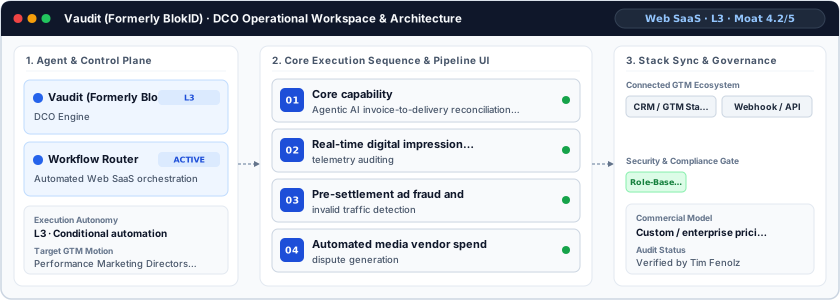
- Core capability: Agentic AI invoice-to-delivery reconciliation engine
- Real-time digital impression and: telemetry auditing
- Pre-settlement ad fraud and: invalid traffic detection
- Automated media vendor spend: dispute generation
Cons: operational limitations & risks
- Telemetry Access Restrictions: Walled-garden platforms frequently restrict raw impression-level log exports, limiting reconciliation depth to aggregated reporting APIs rather than deterministic event logs.
- Invoice Ingestion Latency: Unstandardized vendor billing formats and delayed invoice deliveries can stall automated matching cycles, forcing manual human-in-the-loop schema mapping.
- ERP Integration Overhead: Embedding pre-payment hold workflows into enterprise financial ledgers requires extensive custom connector maintenance and API governance to prevent accounts payable bottlenecks.
Vaudit (Formerly BlokID) TCO & deal-breaker stress test
Simulate 12-month stepped TCO, hidden cost multipliers, contract lock-in exposure, and stack failure modes using only facts verified by Tim Fenolz on · Capture SHA 0a9d1097.
Vaudit (Formerly BlokID) triggers high-severity friction under your 5-seat / $800/mo constraints. Benchmark the verified subtrack alternatives below before committing.
| Plan / Tier | Verified Rate | Scale Fit | Scope & Quota Notes |
|---|---|---|---|
| Enterprise / Custom | Custom quote | 15–50+ seats (Enterprise SLA) | Sales-negotiated annual contract for custom volume, SSO/RBAC governance, and dedicated SLA. |
- Moat Score
- 4.2 / 5.0
- AI Autonomy
- L3
- Free Tier / Trial
- None disclosed
Triggered audit signals & failure modes
- Opaque Enterprise Quoting vs. SMB/Mid-Market BudgetVerified Pricing Ledger
Vaudit (Formerly BlokID) does not disclose a public self-serve floor (Custom / enterprise pricing). Buyers with a $800/mo cap face high sales-qualification friction.
- Sales-Gated Contract TermsFact-checked by Tim Fenolz
Commercial access is available on request through tailored enterprise sales quotes based on organizational scale and seats. The model scales alongside monitored media volume and financial connector complexity, typically structured without publicly published rates.
- Primary Operational Bottleneck: Invoice Ingestion LatencyAudit by Tim Fenolz
Unstandardized vendor billing formats and delayed invoice deliveries can stall automated matching cycles, forcing manual human-in-the-loop schema mapping.
Hidden TCO Multipliers & Quota Gates
- Profile / Workspace Quota Ceilings: Base tiers cap the number of connected profiles, workspaces, or contact records, forcing tier upgrades before seat limits are reached.
- Telemetry Access Restrictions: Walled-garden platforms frequently restrict raw impression-level log exports, limiting reconciliation depth to aggregated reporting APIs rather than deterministic event logs.
- Invoice Ingestion Latency: Unstandardized vendor billing formats and delayed invoice deliveries can stall automated matching cycles, forcing manual human-in-the-loop schema mapping.
When to Walk Away & Negotiation Levers
- Walk away if you require transparent self-serve monthly billing or your budget ceiling is under $1,000/mo (Vaudit (Formerly BlokID) requires sales-gated custom quoting).
- Walk away if your workflow cannot tolerate telemetry access restrictions: Walled-garden platforms frequently restrict raw impression-level log exports, limiting reconciliation depth to aggregated reporting APIs rather than deterministic event logs.
- Walk away if invoice ingestion latency is a deal-breaker for your team: Unstandardized vendor billing formats and delayed invoice deliveries can stall automated matching cycles, forcing manual human-in-the-loop schema mapping.
- Demand a 30- to 60-day paid pilot opt-out clause in the Vaudit (Formerly BlokID) order form before signing a 12-month enterprise commitment.
- Require a sandbox proof-of-concept testing telemetry access restrictions against your live CRM/data schema before annual sign-off.
Ask a custom procurement or TCO stress-test question about Vaudit (Formerly BlokID)
Lower 5-seat floor (~$36/mo vs. Custom Quote) · Transparent self-serve entry without mandatory annual lock-in
Lower 5-seat floor (~$99/mo vs. Custom Quote) · Transparent self-serve entry without mandatory annual lock-in
Vaudit (Formerly BlokID) moat & subtrack positioning
Defensibility stems from deterministic ad exchange telemetry reconciliation coupled with automated financial invoice validation, creating pre-settlement friction against fraudulent vendor billing.
Editorial review
Fact-checked by Tim Fenolz (Lead AdTech, Programmatic & Attribution Analyst) on .
Background
Architectured around pre-payment financial verification, Vaudit (formerly BlokID) was founded in 2023 in the San Diego Metropolitan Area. Backed by $8.6M in venture capital funding, the company engineers autonomous auditing agents for chief marketing officers, procurement leaders, and media finance controllers. The platform intercepts invalid digital media expenditure by validating programmatic delivery metrics directly against vendor line items prior to account settlement.
How Vaudit (Formerly BlokID) works
At the architectural layer, the system autonomy, Vaudit ingests impression telemetry across ad servers, supply-side platforms, and direct publisher tags, pairing raw logs with ingested media invoices. Its agentic processing layer parses vendor contracts and billable event logs, executing discrepancy analysis across click fraud, domain spoofing, and viewability deficits. The system flags billing mismatches automatically and prepares audit-ready clawback documentation before accounting disbursement cycles close.
Limitations
Operational considerations and platform boundaries include:
- Telemetry Access Restrictions: Walled-garden platforms frequently restrict raw impression-level log exports, limiting reconciliation depth to aggregated reporting APIs rather than deterministic event logs.
- Invoice Ingestion Latency: Unstandardized vendor billing formats and delayed invoice deliveries can stall automated matching cycles, forcing manual human-in-the-loop schema mapping.
- ERP Integration Overhead: Embedding pre-payment hold workflows into enterprise financial ledgers requires extensive custom connector maintenance and API governance to prevent accounts payable bottlenecks.
Vaudit (Formerly BlokID) pricing
Commercial access is available on request through tailored enterprise sales quotes based on organizational scale and seats. The model scales alongside monitored media volume and financial connector complexity, typically structured without publicly published rates.
How Vaudit (Formerly BlokID) compares
Within programmatic workflows, creative tools like AdCreative.ai, Abyssale, and 7Pi focus on multivariate generation and dynamic asset assembly rather than financial reconciliation. Vaudit distinguishes its architecture by prioritizing post-impression financial verification over dynamic creative production, making it suitable for enterprise procurement teams managing high-volume external media agency contracts. Enterprise procurement teams evaluating deployment readiness should assess API webhook throughput, role-based access governance, and bilateral data synchronization latency against existing marketing technology infrastructure before committing to multi-year production rollouts.
Direct competitors & market radar
Top algorithmic competitors based on category positioning, capability overlap, and ICP alignment.
Frequently asked questions about Vaudit (Formerly BlokID)
How much does Vaudit (Formerly BlokID) cost and does it require a custom enterprise quote?
Published pricing summary for Vaudit (Formerly BlokID): Custom / enterprise pricing. A permanent free plan is not disclosed for Vaudit (Formerly BlokID). Commercial access is available on request through tailored enterprise sales quotes based on organizational scale and seats. The model scales alongside monitored media volume and financial connector complexity, typically structured without publicly published rates.
How does Vaudit (Formerly BlokID) work and how autonomous is its AI architecture?
Agentic AI verification platform auditing programmatic ad spend and reconciling impression telemetry before vendor invoices are paid. Within DCO (Dynamic Creative Optimization / DCO), MarTechRadar rates its execution architecture at L3 · Conditional automation with a verified Moat Score of 4.2 / 5.0 (Proprietary moat). Defensibility stems from deterministic ad exchange telemetry reconciliation coupled with automated financial invoice validation, creating pre-settlement friction against fraudulent vendor billing. Corporate profile: Founded by Michael Hahn, Mike Hahn, operating at 11-50 employees scale.
What are the main limitations of Vaudit (Formerly BlokID) and when should buyers walk away?
Based on our editorial technical audit, key operational considerations and boundaries for Vaudit (Formerly BlokID) include: (1) Telemetry Access Restrictions: Walled-garden platforms frequently restrict raw impression-level log exports, limiting reconciliation depth to aggregated reporting APIs rather than deterministic event logs. (2) Invoice Ingestion Latency: Unstandardized vendor billing formats and delayed invoice deliveries can stall automated matching cycles, forcing manual human-in-the-loop schema mapping. (3) ERP Integration Overhead: Embedding pre-payment hold workflows into enterprise financial ledgers requires extensive custom connector maintenance and API governance to prevent accounts payable bottlenecks. Primary procurement walk-away rule: Walk away if you require transparent self-serve monthly billing or your budget ceiling is under $1,000/mo (Vaudit (Formerly BlokID) requires sales-gated custom quoting).
What integrations, compliance certifications, and contract terms apply to Vaudit (Formerly BlokID)?
First-party governance and developer endpoints verified on domain include: DPA (https://www.vaudit.com/dpa). Key TCO multiplier to watch: Profile / Workspace Quota Ceilings (Base tiers cap the number of connected profiles, workspaces, or contact records, forcing tier upgrades before seat limits are reached.) Before signing a contract, procurement teams should demand a 30- to 60-day paid pilot opt-out clause in the Vaudit (Formerly BlokID) order form before signing a 12-month enterprise commitment.
What are the best Vaudit (Formerly BlokID) alternatives and head-to-head competitors in 2026?
Top fact-checked alternatives to Vaudit (Formerly BlokID) in DCO (Dynamic Creative Optimization / DCO) include Oriane (Custom / enterprise pricing), Swash (Custom / enterprise pricing), Taiv (Custom / enterprise pricing), datacakes ai (Custom / enterprise pricing). Within programmatic workflows, creative tools like AdCreative.ai, Abyssale, and 7Pi focus on multivariate generation and dynamic asset assembly rather than financial reconciliation.
Verified sources & evidence trail
- Official product domain: https://www.vaudit.com
- Commercial pricing verification: Verified against official vendor pricing policy (Custom / enterprise pricing)
- Verified corporate entity profiles (
sameAs): LinkedIn Company Profile · Crunchbase Entity Record - First-party governance & documentation links: DPA · Privacy
- Editorial audit sign-off: Fact-checked by Tim Fenolz on under the MarTechRadar Evidence-Ledger Protocol.