SurgeGraph Review (2026): GEO Pricing, Pros & Cons
Bottom line
SurgeGraph is a Web SaaS tool for GEO (GEO Brand Tracking & LLM Rank Tracking) in GEO & AI SEO. Pricing: Custom / enterprise pricing. Best suited to Creators / Solo. Editor ratings: AI autonomy L2 (workflow copilot); moat score 2.6/5.0 (Workflow-embedded). Fact-checked by MarTechRadar Research Desk on Oct 15, 2026.
AI engine optimization and long-form content generation platform engineered to monitor, optimize, and rank brand assets within generative search systems.
Is SurgeGraph worth it in 2026? Buyer fit & when to walk away
Choose SurgeGraph if (Best Fit)
- Target ICP & Stack Fit: You operate as Creators / Solo requiring a Web SaaS deployment for GEO, with verified ecosystem connectivity for WordPress.
- L2 Architecture & Defensibility: SurgeGraph builds defensibility through its specialized generative search diagnostic dataset, tracking prompt citation dynamics across ChatGPT, Perplexity, and Google AI Overviews while pairing diagnostic visibility with algorithmic on-page remediation routines.
- Commercial Model Fit: Your procurement budget aligns with Custom / enterprise pricing.
Walk away from SurgeGraph if (Deal-Breakers)
- Walk away if you need published self-serve pricing: SurgeGraph is sold by custom quote.
- Walk away if your workflow cannot tolerate nondeterministic search output volatility: Generative engine answer variance and stochastic temperature settings cause citation tracking results to fluctuate between identical prompt executions, requiring manual verification.
- Walk away if schema and scraping lag is a deal-breaker for your team: Third-party LLM crawler updates and robots.txt protocol shifts introduce latency into citation detection feeds, occasionally missing real-time indexing changes.
SurgeGraph pricing, free plan & scorecard at a glance
| Pricing | Custom / enterprise pricing |
|---|---|
| Free plan | No / not disclosed |
| Delivery | Web SaaS |
| Audience | Creators / Solo |
| AI autonomy level | L2 · Workflow copilotEditor-verified |
| Moat tier & score | 2.6 / 5.0 · Workflow-embeddedEditor-verified |
| Funding | Bootstrapped |
| Company size | 2-10 employees |
| Ecosystem integrations | WordPress |
| Governance & docs | Terms ↗ · Privacy ↗ |
| Headquarters | Malaysia |
| Founded | 2015 |
| Last verified | Oct 15, 2026 |
SurgeGraph pros & cons: strengths vs. operational limitations
Pros: core strengths & capabilities
- Generative AI engine visibility tracking: across ChatGPT, Perplexity, and Google AI Overviews
- Automated prompt discovery identifying: high-value commercial conversational queries
- On-page entity optimization recommendations: for synthetic search answer engines
- Agency client management portal: featuring custom white-label visibility reporting
Cons: operational limitations & risks
- Nondeterministic Search Output Volatility: Generative engine answer variance and stochastic temperature settings cause citation tracking results to fluctuate between identical prompt executions, requiring manual verification.
- Schema and Scraping Lag: Third-party LLM crawler updates and robots.txt protocol shifts introduce latency into citation detection feeds, occasionally missing real-time indexing changes.
- Remediation Governance Overhead: Automated one-click copy fixes require strict human editorial and legal oversight to prevent hallucinated entity associations before publishing to production CMS platforms.
SurgeGraph TCO & deal-breaker stress test
Simulate 12-month stepped TCO, hidden cost multipliers, contract lock-in exposure, and stack failure modes using only facts verified by MarTechRadar Research Desk on 2026-10-15.
SurgeGraph triggers high-severity friction under your 5-seat / $800/mo constraints. Benchmark the verified subtrack alternatives below before committing.
- Moat Score
- 2.6 / 5.0
- AI Autonomy
- L2
- Free Tier / Trial
- None disclosed
Triggered audit signals & failure modes
- Opaque Enterprise Quoting vs. SMB/Mid-Market BudgetVerified Pricing Ledger
SurgeGraph does not disclose a public self-serve floor (Custom / enterprise pricing). Buyers with a $800/mo cap face high sales-qualification friction.
- Sales-Gated Contract TermsFact-checked by MarTechRadar Research Desk
SurgeGraph provisions access through custom enterprise pricing available on request via sales consultation, scaled according to monitored domains, tracked prompt volumes, and agency seat allocations.
- Primary Operational Bottleneck: Nondeterministic Search Output VolatilityAudit by MarTechRadar Research Desk
Generative engine answer variance and stochastic temperature settings cause citation tracking results to fluctuate between identical prompt executions, requiring manual verification.
Test a custom SurgeGraph budget or stack constraint
Lower 5-seat floor (~$99/mo vs. Custom Quote) · Transparent self-serve entry without mandatory annual lock-in
SurgeGraph integrations, API, security & compliance stack
SurgeGraph AI moat & GEO positioning
SurgeGraph builds defensibility through its specialized generative search diagnostic dataset, tracking prompt citation dynamics across ChatGPT, Perplexity, and Google AI Overviews while pairing diagnostic visibility with algorithmic on-page remediation routines.
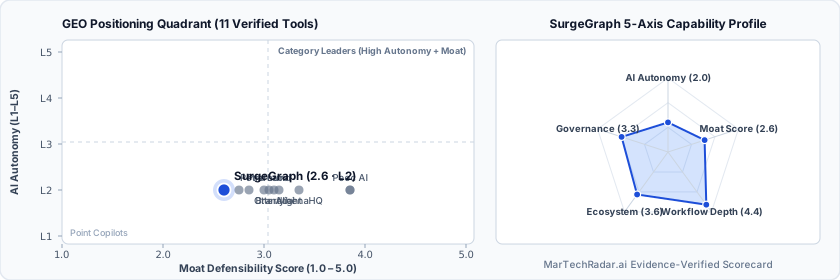
SurgeGraph in-depth review, pricing & architecture analysis
Editor sign-off: Oct 15, 2026. How profiles are made.
What is SurgeGraph? Overview & background
Architectured to capture real estate inside generative answer engines, SurgeGraph functions as an Answer Engine Optimization (AEO) and content production platform. Established in 2015 and headquartered in Malaysia, the vendor targets enterprise SEO directors, agency operators, and digital marketing leaders tasked with securing brand presence within conversational search interfaces. As large language models alter consumer discovery pathways, the software directs visibility programs toward platforms like Perplexity, ChatGPT, and Google AI Overviews.
How SurgeGraph works: architecture & workflow
SurgeGraph operates as an L3 semi-autonomous system that systematically queries prominent generative search platforms against target commercial prompts to map brand citation gaps. Its ingestion engine extracts competitive citations, compares target URLs against cited resources, and calculates information-gain deltas. The platform then generates remediation templates, recommending direct programmatic updates to copy structure, entity references, and technical schema to improve retrieval-augmented generation (RAG) inclusion rates by external crawlers, alongside native workflow integrations for WordPress.
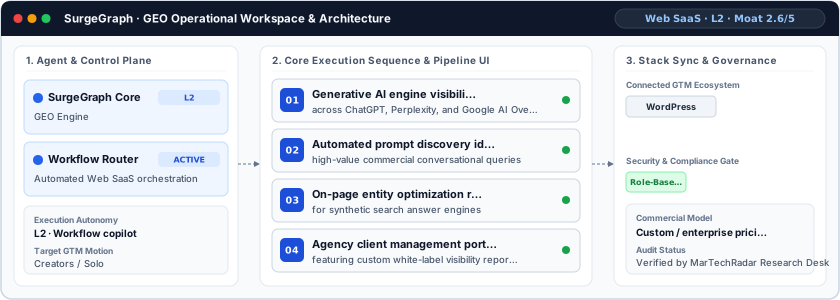
SurgeGraph limitations, drawbacks & risks
Operational considerations and platform boundaries include:
- Nondeterministic Search Output Volatility: Generative engine answer variance and stochastic temperature settings cause citation tracking results to fluctuate between identical prompt executions, requiring manual verification.
- Schema and Scraping Lag: Third-party LLM crawler updates and robots.txt protocol shifts introduce latency into citation detection feeds, occasionally missing real-time indexing changes.
- Remediation Governance Overhead: Automated one-click copy fixes require strict human editorial and legal oversight to prevent hallucinated entity associations before publishing to production CMS platforms.
SurgeGraph pricing, plans & cost breakdown
SurgeGraph provisions access through custom enterprise pricing available on request via sales consultation, scaled according to monitored domains, tracked prompt volumes, and agency seat allocations. Enterprise contracts bundle white-label client reporting capabilities, continuous crawler monitoring quotas, dedicated account governance, and volume-adjusted programmatic optimization credits.
| Plan / Tier | Verified Price & Billing | Included Scope & Contract Terms | |
|---|---|---|---|
| Enterprise / Custom | Custom quote | Custom-quoted plan; terms come from the vendor's sales team. | |
| Contract Watchout: Annual Billing Headline vs. Monthly Premium | The vendor pricing page advertises an annual-billing discount (save $78); month-to-month billing carries a higher effective monthly rate. | ||
How SurgeGraph compares vs. competitors & alternatives
Compared to direct category competitors like Typeface and Amdahl, SurgeGraph functions as an alternative focused on reliable workflow execution and transparent unit economics within the AI Content Marketing segment.
Frequently asked questions about SurgeGraph
Does SurgeGraph publish pricing or require an enterprise quote?
SurgeGraph pricing: Custom / enterprise pricing. No free plan is publicly disclosed. SurgeGraph provisions access through custom enterprise pricing available on request via sales consultation, scaled according to monitored domains, tracked prompt volumes, and agency seat allocations.
What are the top SurgeGraph alternatives in GEO?
Verified GEO alternatives include GrowByData (Custom / enterprise pricing), Unveilr AI (Custom / enterprise pricing), ContentMonk ($99–$449/mo), HeyAmos (Custom / enterprise pricing). Compared to direct category competitors like Typeface and Amdahl, SurgeGraph functions as an alternative focused on reliable workflow execution and transparent unit economics within the AI Content Marketing segment.
What are the main limitations and trade-offs of SurgeGraph?
Operational considerations and platform boundaries include: Nondeterministic Search Output Volatility: Generative engine answer variance and stochastic temperature settings cause citation tracking results to fluctuate between identical prompt executions, requiring manual verification. Walk away if you need published self-serve pricing: SurgeGraph is sold by custom quote.
Verified sources & evidence trail
- Official product domain: https://surgegraph.io
- Commercial pricing verification: Verified against official vendor pricing policy (Custom / enterprise pricing)
- Verified corporate entity profiles (
sameAs): LinkedIn Company Profile · Crunchbase Entity Record - First-party governance & documentation links: Terms · Privacy
- Editor sign-off: Oct 15, 2026 (how profiles are made).
