Senso Review (2026): GEO Pricing, Limits & Alternatives
Bottom line
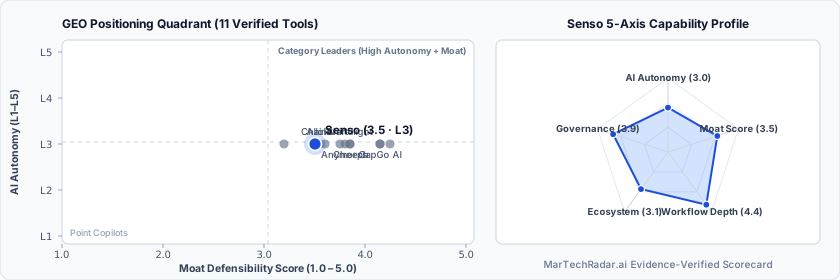
Senso is a Web SaaS tool for GEO (GEO Brand Tracking & LLM Rank Tracking) in GEO & AI SEO. Pricing: Pricing not disclosed. Best suited to B2B SaaS and Marketing & Growth Teams. Editor ratings: AI autonomy L3 (conditional automation); moat score 3.5/5.0 (Proprietary moat). Fact-checked by Jiacky Lee on Oct 16, 2026.
Enterprise GEO and agentic knowledge infrastructure controlling how AI search engines and autonomous agents interpret and recommend brands.
Senso buyer fit verdict: when to choose vs. when to walk away
Choose Senso if (Best Fit)
- Target ICP & Stack Fit: You operate as B2B SaaS and Marketing & Growth Teams requiring a Web SaaS deployment for GEO.
- L3 Architecture & Defensibility: Structuring verified enterprise ground-truth knowledge directly for LLM retrieval and agentic web consumption creates strong data-layer stickiness across regulated industries.
- Commercial Model Fit: Your procurement budget aligns with Pricing not disclosed.
Walk away from Senso if (Deal-Breakers)
- Walk away if you require transparent self-serve monthly billing or your budget ceiling is under $1,000/mo (Senso requires sales-gated custom quoting).
- Walk away if your workflow cannot tolerate source knowledge curation bottleneck: A primary implementation limitation is that output accuracy depends heavily on clean upstream documentation; organizations with fragmented or outdated internal wikis face a data preparation bottleneck during onboarding.
- Walk away if external model retrieval latency is a deal-breaker for your team: Because third-party foundation models update their retrieval indices and training weights asynchronously, correcting deeply embedded model hallucinations introduces propagation latency outside Senso's direct control.
Senso key facts & scorecard
| Pricing | Pricing not disclosed |
|---|---|
| Free plan | No / not disclosed |
| Delivery | Web SaaS |
| Audience | B2B SaaS, Marketing & Growth Teams |
| AI autonomy level | L3 · Conditional automationEditor-verified |
| Moat tier & score | 3.5 / 5.0 · Proprietary moatEditor-verified |
| Funding | AcquiredAcquired by Zeta Global |
| Total funding | $5.5M |
| Founders | Nick Seelert, Saroop Bharwani |
| Company size | 11-50 employees |
| Governance & docs | API & Docs ↗ · Terms ↗ · Privacy ↗ |
| Headquarters | Toronto, Ontario |
| Founded | 2018 |
| Last verified |
Senso pros & cons: strengths vs. operational limitations
Pros: core strengths & capabilities
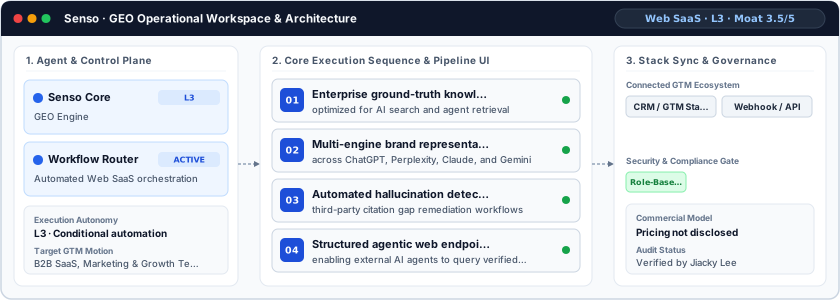
- Enterprise ground-truth knowledge publishing: optimized for AI search and agent retrieval
- Multi-engine brand representation auditing: across ChatGPT, Perplexity, Claude, and Gemini
- Automated hallucination detection and: third-party citation gap remediation workflows
- Structured agentic web endpoints: enabling external AI agents to query verified brand facts
Cons: operational limitations & risks
- Source Knowledge Curation Bottleneck: A primary implementation limitation is that output accuracy depends heavily on clean upstream documentation; organizations with fragmented or outdated internal wikis face a data preparation bottleneck during onboarding.
- External Model Retrieval Latency: Because third-party foundation models update their retrieval indices and training weights asynchronously, correcting deeply embedded model hallucinations introduces propagation latency outside Senso's direct control.
- Enterprise Procurement Governance Barrier: Deploying authoritative knowledge endpoints in regulated financial or enterprise environments requires legal and compliance sign-off, creating an initial learning curve and governance barrier compared to lightweight keyword rank trackers.
Senso TCO & deal-breaker stress test
Simulate 12-month stepped TCO, hidden cost multipliers, contract lock-in exposure, and stack failure modes using only facts verified by Jiacky Lee on · Capture SHA 87db922b.
Senso triggers high-severity friction under your 5-seat / $800/mo constraints. Benchmark the verified subtrack alternatives below before committing.
| Plan / Tier | Verified Rate | Scale Fit | Scope & Quota Notes |
|---|---|---|---|
| Enterprise / Custom | Custom quote | 15–50+ seats (Enterprise SLA) | Sales-negotiated annual contract for custom volume, SSO/RBAC governance, and dedicated SLA. |
- Moat Score
- 3.5 / 5.0
- AI Autonomy
- L3
- Free Tier / Trial
- None disclosed
Triggered audit signals & failure modes
- Opaque Enterprise Quoting vs. SMB/Mid-Market BudgetVerified Pricing Ledger
Senso does not disclose a public self-serve floor (Pricing not disclosed). Buyers with a $800/mo cap face high sales-qualification friction.
- Sales-Gated Contract TermsFact-checked by Jiacky Lee
Pricing is available on request through enterprise sales quotes, with customized tiers based on seat counts or usage volume.
- Primary Operational Bottleneck: Source Knowledge Curation BottleneckAudit by Jiacky Lee
A primary implementation limitation is that output accuracy depends heavily on clean upstream documentation; organizations with fragmented or outdated internal wikis face a data preparation bottleneck during onboarding.
Hidden TCO Multipliers & Quota Gates
- Source Knowledge Curation Bottleneck: A primary implementation limitation is that output accuracy depends heavily on clean upstream documentation; organizations with fragmented or outdated internal wikis face a data preparation bottleneck during onboarding.
- External Model Retrieval Latency: Because third-party foundation models update their retrieval indices and training weights asynchronously, correcting deeply embedded model hallucinations introduces propagation latency outside Senso's direct control.
When to Walk Away & Negotiation Levers
- Walk away if you require transparent self-serve monthly billing or your budget ceiling is under $1,000/mo (Senso requires sales-gated custom quoting).
- Walk away if your workflow cannot tolerate source knowledge curation bottleneck: A primary implementation limitation is that output accuracy depends heavily on clean upstream documentation; organizations with fragmented or outdated internal wikis face a data preparation bottleneck during onboarding.
- Walk away if external model retrieval latency is a deal-breaker for your team: Because third-party foundation models update their retrieval indices and training weights asynchronously, correcting deeply embedded model hallucinations introduces propagation latency outside Senso's direct control.
- Demand a 30- to 60-day paid pilot opt-out clause in the Senso order form before signing a 12-month enterprise commitment.
- Require a sandbox proof-of-concept testing source knowledge curation bottleneck against your live CRM/data schema before annual sign-off.
Ask a custom procurement or TCO stress-test question about Senso
Lower 5-seat floor (~$15/mo vs. Custom Quote) · Transparent self-serve entry without mandatory annual lock-in
Lower 5-seat floor (~$24/mo vs. Custom Quote) · Transparent self-serve entry without mandatory annual lock-in
Senso moat & subtrack positioning
Structuring verified enterprise ground-truth knowledge directly for LLM retrieval and agentic web consumption creates strong data-layer stickiness across regulated industries.
Editorial review
Fact-checked by Jiacky Lee (Managing Editor, AI Autonomy & Moat Methodology) on .
Background
Founded in 2018 by Saroop Bharwani, Thomas Nelson, and Nick Seelert and headquartered in Toronto, Ontario, Canada, Senso (senso.ai) is an enterprise Generative Engine Optimization (GEO) and agentic web knowledge platform built for B2B marketing leaders, financial services institutions, and corporate communications teams. Operating with a team of 11 to 50 employees and backed by $5.5M in Seed funding from Y Combinator (W24), Inovia Capital, Techstars, Rebel Fund, and Mendoza Ventures (alongside strategic transaction history referenced with Zeta Global), the company addresses how enterprises control their narrative as AI agents replace traditional search portals. Senso structures verified corporate ground truth so large language models accurately cite, evaluate, and recommend a brand's products.
How Senso works
Senso operates at Level 3 autonomy by ingesting dispersed internal documentation, product specifications, compliance disclosures, and customer FAQs into a curated knowledge base purpose-built for machine consumption. The platform continuously evaluates how foundation models—including OpenAI ChatGPT, Perplexity, Anthropic Claude, and Google Gemini—describe the brand across high-intent buyer prompts, flagging factual inaccuracies and competitor biases. Senso then transforms authoritative enterprise data into structured, citation-ready assets and agentic web endpoints that both first-party customer agents and third-party discovery engines can query with high retrieval fidelity.
Limitations
Operational limitations and technical trade-offs include:
- Source Knowledge Curation Bottleneck: A primary implementation limitation is that output accuracy depends heavily on clean upstream documentation; organizations with fragmented or outdated internal wikis face a data preparation bottleneck during onboarding.
- External Model Retrieval Latency: Because third-party foundation models update their retrieval indices and training weights asynchronously, correcting deeply embedded model hallucinations introduces propagation latency outside Senso's direct control.
- Enterprise Procurement Governance Barrier: Deploying authoritative knowledge endpoints in regulated financial or enterprise environments requires legal and compliance sign-off, creating an initial learning curve and governance barrier compared to lightweight keyword rank trackers.
Senso pricing
Pricing is available on request through enterprise sales quotes, with customized tiers based on seat counts or usage volume. Senso structures its commercial contracts around enterprise workspace deployments calibrated to the volume of managed knowledge assets, monitored prompt matrices, and dedicated agentic API endpoints.
How Senso compares
Within the GEO Brand Tracking & LLM Rank Tracking category, Senso competes against AI search visibility platforms such as AthenaHQ, Unusual, and Profound. Whereas many GEO tools operate purely as passive prompt-monitoring dashboards that chart share of voice without modifying underlying data availability, Senso differentiates itself by acting as an active knowledge publishing and alignment layer for the agentic web. Regulated enterprises and complex B2B organizations adopt Senso to govern factual accuracy across AI assistants, while smaller growth teams seeking self-serve blog keyword tracking often choose lighter AEO suites.
Frequently asked questions about Senso
How much does Senso cost and does it require a custom enterprise quote?
Published pricing summary for Senso: Pricing not disclosed. A permanent free plan is not disclosed for Senso. Pricing is available on request through enterprise sales quotes, with customized tiers based on seat counts or usage volume.
How does Senso work and how autonomous is its AI architecture?
Enterprise GEO and agentic knowledge infrastructure controlling how AI search engines and autonomous agents interpret and recommend brands. Within GEO (GEO Brand Tracking & LLM Rank Tracking), MarTechRadar rates its execution architecture at L3 · Conditional automation with a verified Moat Score of 3.5 / 5.0 (Proprietary moat). Structuring verified enterprise ground-truth knowledge directly for LLM retrieval and agentic web consumption creates strong data-layer stickiness across regulated industries. Corporate profile: Founded by Nick Seelert, Saroop Bharwani, operating at 11-50 employees scale, acquired by Zeta Global.
What are the main limitations of Senso and when should buyers walk away?
Based on our editorial technical audit, key operational considerations and boundaries for Senso include: (1) Source Knowledge Curation Bottleneck: A primary implementation limitation is that output accuracy depends heavily on clean upstream documentation; organizations with fragmented or outdated internal wikis face a data preparation bottleneck during onboarding. (2) External Model Retrieval Latency: Because third-party foundation models update their retrieval indices and training weights asynchronously, correcting deeply embedded model hallucinations introduces propagation latency outside Senso's direct control. (3) Enterprise Procurement Governance Barrier: Deploying authoritative knowledge endpoints in regulated financial or enterprise environments requires legal and compliance sign-off, creating an initial learning curve and governance barrier compared to lightweight keyword rank trackers. Primary procurement walk-away rule: Walk away if you require transparent self-serve monthly billing or your budget ceiling is under $1,000/mo (Senso requires sales-gated custom quoting).
What integrations, compliance certifications, and contract terms apply to Senso?
First-party governance and developer endpoints verified on domain include: API Docs (https://docs.senso.ai). Key TCO multiplier to watch: Source Knowledge Curation Bottleneck (A primary implementation limitation is that output accuracy depends heavily on clean upstream documentation; organizations with fragmented or outdated internal wikis face a data preparation bottleneck during onboarding.) Before signing a contract, procurement teams should demand a 30- to 60-day paid pilot opt-out clause in the Senso order form before signing a 12-month enterprise commitment.
What are the best Senso alternatives and head-to-head competitors in 2026?
Top fact-checked alternatives to Senso in GEO (GEO Brand Tracking & LLM Rank Tracking) include Unusual (Pricing not disclosed), ShopMentions (From $15/mo), GeoRanking.ai (Custom / enterprise pricing), Novela Simulations (Custom / enterprise pricing). Within the GEO Brand Tracking & LLM Rank Tracking category, Senso competes against AI search visibility platforms such as AthenaHQ, Unusual, and Profound.
Verified sources & evidence trail
- Official product domain: http://www.senso.ai
- Commercial pricing verification: Verified against official vendor pricing policy (Pricing not disclosed)
- Verified corporate entity profiles (
sameAs): LinkedIn Company Profile · Crunchbase Entity Record - First-party governance & documentation links: API & Docs · Terms · Privacy
- Editorial audit sign-off: Fact-checked by Jiacky Lee on under the MarTechRadar Evidence-Ledger Protocol.