Perceptiq Review (2026): GEO Pricing, Limits & Alternatives
Bottom line
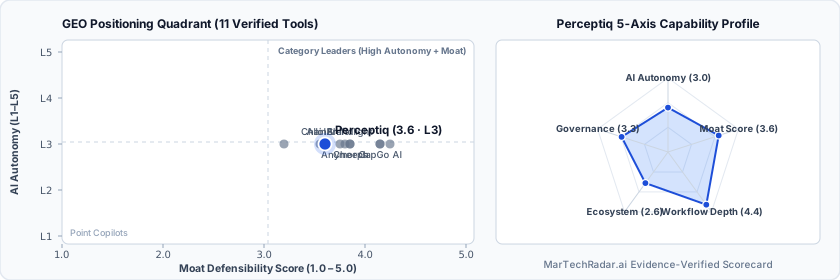
Perceptiq is a Web SaaS tool for GEO (GEO Brand Tracking & LLM Rank Tracking) in GEO & AI SEO. Pricing: Custom / enterprise pricing. Best suited to SEO Directors, Brand Strategy Leaders and Growth Marketers. Editor ratings: AI autonomy L3 (conditional automation); moat score 3.6/5.0 (Proprietary moat). Fact-checked by Tim Fenolz on Oct 15, 2026.
Generative engine optimization and LLM visibility platform monitoring enterprise brand citations and synthetic search query performance.
Perceptiq buyer fit verdict: when to choose vs. when to walk away
Choose Perceptiq if (Best Fit)
- Target ICP & Stack Fit: You operate as SEO Directors, Brand Strategy Leaders and Growth Marketers requiring a Web SaaS deployment for GEO.
- L3 Architecture & Defensibility: Proprietary prompt dispatch matrix and multi-LLM citation graph mapping across major commercial inference endpoints.
- Commercial Model Fit: Your procurement budget aligns with Custom / enterprise pricing.
Walk away from Perceptiq if (Deal-Breakers)
- Walk away if you require transparent self-serve monthly billing or your budget ceiling is under $1,000/mo (Perceptiq requires sales-gated custom quoting).
- Walk away if your workflow cannot tolerate nondeterministic model drift: LLM response volatility and temperature settings across upstream provider updates can generate inconsistent citation data across identical prompt runs.
- Walk away if scraping latency and rate ceilings is a deal-breaker for your team: High-volume synthetic query sampling encounters external API throttling, creating reporting lag during rapid multi-model audit cycles.
Perceptiq key facts & scorecard
| Pricing | Custom / enterprise pricing |
|---|---|
| Free plan | No / not disclosed |
| Delivery | Web SaaS |
| Audience | SEO Directors, Brand Strategy Leaders, Growth Marketers |
| AI autonomy level | L3 · Conditional automationEditor-verified |
| Moat tier & score | 3.6 / 5.0 · Proprietary moatEditor-verified |
| Funding | Pre-seed |
| Headquarters | United States |
| Founded | 2025 |
| Last verified |
Perceptiq pros & cons: strengths vs. operational limitations
Pros: core strengths & capabilities
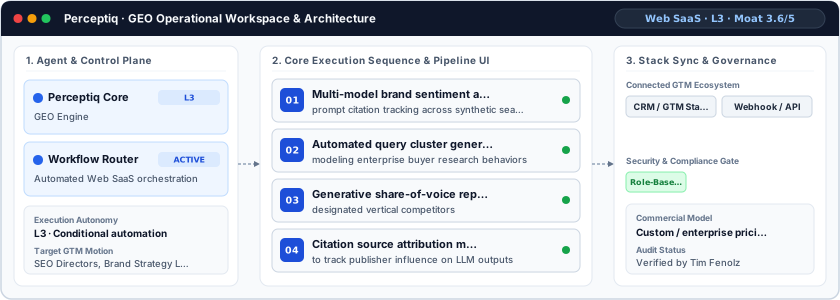
- Multi-model brand sentiment and: prompt citation tracking across synthetic search engines
- Automated query cluster generation: modeling enterprise buyer research behaviors
- Generative share-of-voice reporting against: designated vertical competitors
- Citation source attribution mapping: to track publisher influence on LLM outputs
Cons: operational limitations & risks
- Nondeterministic model drift: LLM response volatility and temperature settings across upstream provider updates can generate inconsistent citation data across identical prompt runs.
- Scraping latency and rate ceilings: High-volume synthetic query sampling encounters external API throttling, creating reporting lag during rapid multi-model audit cycles.
- Corpus attribution opacity: The system infers source authority from output citations but cannot directly access internal retrieval-augmented generation vector indexes managed by closed frontier engines.
Perceptiq TCO & deal-breaker stress test
Simulate 12-month stepped TCO, hidden cost multipliers, contract lock-in exposure, and stack failure modes using only facts verified by Tim Fenolz on .
Perceptiq triggers high-severity friction under your 5-seat / $800/mo constraints. Benchmark the verified subtrack alternatives below before committing.
| Plan / Tier | Verified Rate | Scale Fit | Scope & Quota Notes |
|---|---|---|---|
| Enterprise / Custom | Custom quote | 15–50+ seats (Enterprise SLA) | Sales-negotiated annual contract for custom volume, SSO/RBAC governance, and dedicated SLA. |
- Moat Score
- 3.6 / 5.0
- AI Autonomy
- L3
- Free Tier / Trial
- None disclosed
Triggered audit signals & failure modes
- Opaque Enterprise Quoting vs. SMB/Mid-Market BudgetVerified Pricing Ledger
Perceptiq does not disclose a public self-serve floor (Custom / enterprise pricing). Buyers with a $800/mo cap face high sales-qualification friction.
- Sales-Gated Contract TermsFact-checked by Tim Fenolz
Pricing is available on request through tailored enterprise sales quotes, with custom enterprise tiers structured around organizational scale, user seats, and workflow volume.
- Primary Operational Bottleneck: Nondeterministic model driftAudit by Tim Fenolz
LLM response volatility and temperature settings across upstream provider updates can generate inconsistent citation data across identical prompt runs.
Hidden TCO Multipliers & Quota Gates
- Nondeterministic model drift: LLM response volatility and temperature settings across upstream provider updates can generate inconsistent citation data across identical prompt runs.
- Scraping latency and rate ceilings: High-volume synthetic query sampling encounters external API throttling, creating reporting lag during rapid multi-model audit cycles.
When to Walk Away & Negotiation Levers
- Walk away if you require transparent self-serve monthly billing or your budget ceiling is under $1,000/mo (Perceptiq requires sales-gated custom quoting).
- Walk away if your workflow cannot tolerate nondeterministic model drift: LLM response volatility and temperature settings across upstream provider updates can generate inconsistent citation data across identical prompt runs.
- Walk away if scraping latency and rate ceilings is a deal-breaker for your team: High-volume synthetic query sampling encounters external API throttling, creating reporting lag during rapid multi-model audit cycles.
- Demand a 30- to 60-day paid pilot opt-out clause in the Perceptiq order form before signing a 12-month enterprise commitment.
- Require a sandbox proof-of-concept testing nondeterministic model drift against your live CRM/data schema before annual sign-off.
Ask a custom procurement or TCO stress-test question about Perceptiq
Lower 5-seat floor (~$24/mo vs. Custom Quote) · Transparent self-serve entry without mandatory annual lock-in
Lower 5-seat floor (~$799/mo vs. Custom Quote) · Transparent self-serve entry without mandatory annual lock-in
Perceptiq moat & subtrack positioning
Proprietary prompt dispatch matrix and multi-LLM citation graph mapping across major commercial inference endpoints.
Editorial review
Fact-checked by Tim Fenolz (Lead AdTech, Programmatic & Attribution Analyst) on .
Background
Based in the United States, Perceptiq addresses generative engine optimization and artificial intelligence brand visibility tracking for digital marketing directors and search strategists. Enterprise marketing teams face a critical shift as prospective buyers transition from standard search engine results pages to conversational answer engines. Perceptiq monitors how commercial large language models perceive, cite, and rank corporate entities across synthetic search environments, delivering structured visibility metrics to preserve organic digital discovery.
How Perceptiq works
Under the hood, Perceptiq deploys an automated multi-model prompt dispatch pipeline to sample commercial reasoning engines, including OpenAI, Anthropic, and Google Gemini endpoints. The ingestion architecture feeds synthesized customer journey queries across categorical intent clusters, capturing raw model completions at scheduled intervals. Extracted responses pass through natural language entity-resolution models that parse brand mentions, citation URLs, and contextual sentiment. The system compiles these artifacts into normalized generative share-of-voice indices and citation provenance graphs without manual human intervention.
Limitations
Operational considerations and platform boundaries include:
- Nondeterministic model drift: LLM response volatility and temperature settings across upstream provider updates can generate inconsistent citation data across identical prompt runs.
- Scraping latency and rate ceilings: High-volume synthetic query sampling encounters external API throttling, creating reporting lag during rapid multi-model audit cycles.
- Corpus attribution opacity: The system infers source authority from output citations but cannot directly access internal retrieval-augmented generation vector indexes managed by closed frontier engines.
Perceptiq pricing
Pricing is available on request through tailored enterprise sales quotes, with custom enterprise tiers structured around organizational scale, user seats, and workflow volume.
How Perceptiq compares
Perceptiq competes against specialized visibility platforms including Anymorph, AthenaHQ, and Brandlight. While AthenaHQ targets executive-level reputation scoring and Brandlight prioritizes localized brand governance, Perceptiq focuses on continuous programmatic prompt sampling and citation graph discovery. Conversely, Anymorph emphasizes synthetic web retrieval dynamics over deep entity-level sentiment tracking. Perceptiq fits mid-market and enterprise brands requiring structured competitive share-of-voice auditing across black-box conversational interfaces. It is best suited for enterprise marketing teams and growth practitioners seeking disciplined workflow orchestration.
Frequently asked questions about Perceptiq
How much does Perceptiq cost and does it require a custom enterprise quote?
Published pricing summary for Perceptiq: Custom / enterprise pricing. A permanent free plan is not disclosed for Perceptiq. Pricing is available on request through tailored enterprise sales quotes, with custom enterprise tiers structured around organizational scale, user seats, and workflow volume.
How does Perceptiq work and how autonomous is its AI architecture?
Generative engine optimization and LLM visibility platform monitoring enterprise brand citations and synthetic search query performance. Within GEO (GEO Brand Tracking & LLM Rank Tracking), MarTechRadar rates its execution architecture at L3 · Conditional automation with a verified Moat Score of 3.6 / 5.0 (Proprietary moat). Proprietary prompt dispatch matrix and multi-LLM citation graph mapping across major commercial inference endpoints.
What are the main limitations of Perceptiq and when should buyers walk away?
Based on our editorial technical audit, key operational considerations and boundaries for Perceptiq include: (1) Nondeterministic model drift: LLM response volatility and temperature settings across upstream provider updates can generate inconsistent citation data across identical prompt runs. (2) Scraping latency and rate ceilings: High-volume synthetic query sampling encounters external API throttling, creating reporting lag during rapid multi-model audit cycles. (3) Corpus attribution opacity: The system infers source authority from output citations but cannot directly access internal retrieval-augmented generation vector indexes managed by closed frontier engines. Primary procurement walk-away rule: Walk away if you require transparent self-serve monthly billing or your budget ceiling is under $1,000/mo (Perceptiq requires sales-gated custom quoting).
What integrations, compliance certifications, and contract terms apply to Perceptiq?
Key TCO multiplier to watch: Nondeterministic model drift (LLM response volatility and temperature settings across upstream provider updates can generate inconsistent citation data across identical prompt runs.) Before signing a contract, procurement teams should demand a 30- to 60-day paid pilot opt-out clause in the Perceptiq order form before signing a 12-month enterprise commitment.
What are the best Perceptiq alternatives and head-to-head competitors in 2026?
Top fact-checked alternatives to Perceptiq in GEO (GEO Brand Tracking & LLM Rank Tracking) include Petra Labs (Custom / enterprise pricing), Unusual (Pricing not disclosed), Brand UP (Custom / enterprise pricing), GeoRanking.ai (Custom / enterprise pricing). Perceptiq competes against specialized visibility platforms including Anymorph, AthenaHQ, and Brandlight. While AthenaHQ targets executive-level reputation scoring and Brandlight prioritizes localized brand governance, Perceptiq focuses on continuous programmatic prompt sampling and citation graph discovery.
Verified sources & evidence trail
- Official product domain: https://perceptiq.io
- Commercial pricing verification: Verified against official vendor pricing policy (Custom / enterprise pricing)
- Editorial audit sign-off: Fact-checked by Tim Fenolz on under the MarTechRadar Evidence-Ledger Protocol.