NativeAds Review (2026): DCO Pricing, Limits & Alternatives
Bottom line
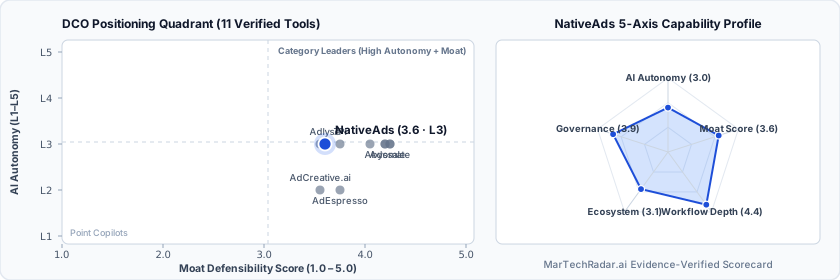
NativeAds is a Web SaaS tool for DCO (Dynamic Creative Optimization / DCO) in AdTech & Paid Media. Pricing: Custom / enterprise pricing. Best suited to Performance Marketing Directors, Ad Agencies and Retail Media Advertisers. Editor ratings: AI autonomy L3 (conditional automation); moat score 3.6/5.0 (Proprietary moat). Fact-checked by Sarah Per on Oct 14, 2026.
Automated ad generation engine transforming raw creative briefs into dynamic, brand-compliant native ad variants via programmatic rendering and API-driven.
NativeAds buyer fit verdict: when to choose vs. when to walk away
Choose NativeAds if (Best Fit)
- Target ICP & Stack Fit: You operate as Performance Marketing Directors, Ad Agencies and Retail Media Advertisers requiring a Web SaaS deployment for DCO.
- L3 Architecture & Defensibility: Defensibility stems from its NewsroomMCP protocol integration and on-brand creative parsing engine, though barrier to entry remains modest given early seed-stage development against established DCO platforms.
- Commercial Model Fit: Your procurement budget aligns with Custom / enterprise pricing.
Walk away from NativeAds if (Deal-Breakers)
- Walk away if you require transparent self-serve monthly billing or your budget ceiling is under $1,000/mo (NativeAds requires sales-gated custom quoting).
- Walk away if your workflow cannot tolerate brand token parsing failure: The automated engine frequently misinterprets nuanced style guides, requiring manual operator intervention when processing complex multi-layered brand books or non-standard typography systems.
- Walk away if API rate throttling is a deal-breaker for your team: High-throughput asset generation triggers severe latency bottlenecks across external rendering APIs during simultaneous multi-region campaign deployments.
NativeAds key facts & scorecard
| Pricing | Custom / enterprise pricing |
|---|---|
| Free plan | No / not disclosed |
| Delivery | Web SaaS |
| Audience | Performance Marketing Directors, Ad Agencies, Retail Media Advertisers |
| AI autonomy level | L3 · Conditional automationEditor-verified |
| Moat tier & score | 3.6 / 5.0 · Proprietary moatEditor-verified |
| Funding | Pre-seed |
| Total funding | $500K |
| Founders | Al Kallel, Priti Goel, Wael Abid |
| Company size | 2-10 employees |
| Governance & docs | API & Docs ↗ · Terms ↗ |
| Headquarters | Palo Alto, California |
| Founded | 2024 |
| Last verified |
NativeAds pros & cons: strengths vs. operational limitations
Pros: core strengths & capabilities
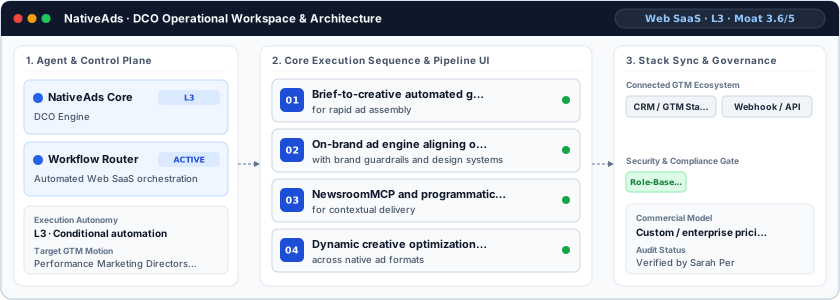
- Brief-to-creative automated generation pipeline: for rapid ad assembly
- On-brand ad engine aligning output: with brand guardrails and design systems
- NewsroomMCP and programmatic API connectors: for contextual delivery
- Dynamic creative optimization workflows: across native ad formats
Cons: operational limitations & risks
- Brand Token Parsing Failure: The automated engine frequently misinterprets nuanced style guides, requiring manual operator intervention when processing complex multi-layered brand books or non-standard typography systems.
- API Rate Throttling: High-throughput asset generation triggers severe latency bottlenecks across external rendering APIs during simultaneous multi-region campaign deployments.
- Downstream Attribution Lag: The platform lacks real-time bidirectional feedback loops from ad exchanges, delaying creative variant re-indexing until postback events reconcile over multi-day windows.
NativeAds TCO & deal-breaker stress test
Simulate 12-month stepped TCO, hidden cost multipliers, contract lock-in exposure, and stack failure modes using only facts verified by Sarah Per on · Capture SHA 9bb756cd.
NativeAds triggers high-severity friction under your 5-seat / $800/mo constraints. Benchmark the verified subtrack alternatives below before committing.
| Plan / Tier | Verified Rate | Scale Fit | Scope & Quota Notes |
|---|---|---|---|
| Enterprise / Custom | Custom quote | 15–50+ seats (Enterprise SLA) | Sales-negotiated annual contract for custom volume, SSO/RBAC governance, and dedicated SLA. |
- Moat Score
- 3.6 / 5.0
- AI Autonomy
- L3
- Free Tier / Trial
- None disclosed
Triggered audit signals & failure modes
- Opaque Enterprise Quoting vs. SMB/Mid-Market BudgetVerified Pricing Ledger
NativeAds does not disclose a public self-serve floor (Custom / enterprise pricing). Buyers with a $800/mo cap face high sales-qualification friction.
- Sales-Gated Contract TermsFact-checked by Sarah Per
NativeAds structures its commercial engagement under direct sales agreements. Commercial pricing is available on request through tailored enterprise sales quotes based on organizational scale and seats.
- Primary Operational Bottleneck: Brand Token Parsing FailureAudit by Sarah Per
The automated engine frequently misinterprets nuanced style guides, requiring manual operator intervention when processing complex multi-layered brand books or non-standard typography systems.
Hidden TCO Multipliers & Quota Gates
- Credit & Usage Burn Multiplier: Automated workflows consume metered credits/usage quotas; multi-step enrichment, voice minutes, or high-frequency agent runs can trigger mid-cycle top-up packs.
- Brand Token Parsing Failure: The automated engine frequently misinterprets nuanced style guides, requiring manual operator intervention when processing complex multi-layered brand books or non-standard typography systems.
- API Rate Throttling: High-throughput asset generation triggers severe latency bottlenecks across external rendering APIs during simultaneous multi-region campaign deployments.
When to Walk Away & Negotiation Levers
- Walk away if you require transparent self-serve monthly billing or your budget ceiling is under $1,000/mo (NativeAds requires sales-gated custom quoting).
- Walk away if your workflow cannot tolerate brand token parsing failure: The automated engine frequently misinterprets nuanced style guides, requiring manual operator intervention when processing complex multi-layered brand books or non-standard typography systems.
- Walk away if API rate throttling is a deal-breaker for your team: High-throughput asset generation triggers severe latency bottlenecks across external rendering APIs during simultaneous multi-region campaign deployments.
- Demand a 30- to 60-day paid pilot opt-out clause in the NativeAds order form before signing a 12-month enterprise commitment.
- Require a sandbox proof-of-concept testing brand token parsing failure against your live CRM/data schema before annual sign-off.
Ask a custom procurement or TCO stress-test question about NativeAds
Lower 5-seat floor (~$99/mo vs. Custom Quote) · Transparent self-serve entry without mandatory annual lock-in
Lower 5-seat floor (~$36/mo vs. Custom Quote) · Transparent self-serve entry without mandatory annual lock-in
NativeAds moat & subtrack positioning
Defensibility stems from its NewsroomMCP protocol integration and on-brand creative parsing engine, though barrier to entry remains modest given early seed-stage development against established DCO platforms.
Editorial review
Fact-checked by Sarah Per (Principal Content Systems & Generative Media Editor) on .
Background
Architected as a dedicated creative generation engine for dynamic creative optimization workflows, NativeAds converts structured marketing briefs into deployment-ready ad units. Headquartered in Palo Alto, California, and established in 2024, the enterprise software company raised $500K in seed-stage capital. The platform is targeted at growth marketing leaders, programmatic acquisition teams, and performance agency directors seeking to systematically bypass manual graphic production pipelines while maintaining brand governance.
How NativeAds works
At its architectural core, NativeAds operates an L3 autonomous pipeline driven by its proprietary On-Brand Ad Engine and NewsroomMCP interface. The system ingests structured marketing inputs, style parameters, and external context feeds via REST APIs, subsequently parsing them through generative vision and layout models. By decomposing campaign briefs into modular copy and visual elements, the engine compiles native banner and contextual ad variants programmatically. It validates each asset against ingested brand constraints before surfacing final creatives for automated syndication across native ad inventory exchanges.
Limitations
Operational considerations and platform boundaries include:
- Brand Token Parsing Failure: The automated engine frequently misinterprets nuanced style guides, requiring manual operator intervention when processing complex multi-layered brand books or non-standard typography systems.
- API Rate Throttling: High-throughput asset generation triggers severe latency bottlenecks across external rendering APIs during simultaneous multi-region campaign deployments.
- Downstream Attribution Lag: The platform lacks real-time bidirectional feedback loops from ad exchanges, delaying creative variant re-indexing until postback events reconcile over multi-day windows.
NativeAds pricing
NativeAds structures its commercial engagement under direct sales agreements. Commercial pricing is available on request through tailored enterprise sales quotes based on organizational scale and seats. Contracts typically encompass custom onboarding tiers, dynamic template libraries, dedicated creative engineering support, and platform API throughput quotas.
How NativeAds compares
Within the dynamic creative optimization ecosystem, NativeAds competes directly against platforms such as AdCreative.ai, Abyssale, and 7Pi. While AdCreative.ai emphasizes consumer conversion scoring and Abyssale targets high-volume static template automation, NativeAds differentiates on contextual newsroom integration and programmatic brief-to-ad flows. It is best aligned for mid-market and enterprise performance marketing units that require brand-aligned native ad variants without maintaining dedicated in-house design engineering teams.
Direct competitors & market radar
Top algorithmic competitors based on category positioning, capability overlap, and ICP alignment.
Frequently asked questions about NativeAds
How much does NativeAds cost and does it require a custom enterprise quote?
Published pricing summary for NativeAds: Custom / enterprise pricing. A permanent free plan is not disclosed for NativeAds. NativeAds structures its commercial engagement under direct sales agreements. Commercial pricing is available on request through tailored enterprise sales quotes based on organizational scale and seats.
How does NativeAds work and how autonomous is its AI architecture?
Automated ad generation engine transforming raw creative briefs into dynamic, brand-compliant native ad variants via programmatic rendering and API-driven. Within DCO (Dynamic Creative Optimization / DCO), MarTechRadar rates its execution architecture at L3 · Conditional automation with a verified Moat Score of 3.6 / 5.0 (Proprietary moat). Defensibility stems from its NewsroomMCP protocol integration and on-brand creative parsing engine, though barrier to entry remains modest given early seed-stage development against established DCO platforms. Corporate profile: Founded by Al Kallel, Priti Goel, Wael Abid, operating at 2-10 employees scale.
What are the main limitations of NativeAds and when should buyers walk away?
Based on our editorial technical audit, key operational considerations and boundaries for NativeAds include: (1) Brand Token Parsing Failure: The automated engine frequently misinterprets nuanced style guides, requiring manual operator intervention when processing complex multi-layered brand books or non-standard typography systems. (2) API Rate Throttling: High-throughput asset generation triggers severe latency bottlenecks across external rendering APIs during simultaneous multi-region campaign deployments. (3) Downstream Attribution Lag: The platform lacks real-time bidirectional feedback loops from ad exchanges, delaying creative variant re-indexing until postback events reconcile over multi-day windows. Primary procurement walk-away rule: Walk away if you require transparent self-serve monthly billing or your budget ceiling is under $1,000/mo (NativeAds requires sales-gated custom quoting).
What integrations, compliance certifications, and contract terms apply to NativeAds?
First-party governance and developer endpoints verified on domain include: API Docs (https://docs.nativeads.ai/developers/getting-started). Key TCO multiplier to watch: Credit & Usage Burn Multiplier (Automated workflows consume metered credits/usage quotas; multi-step enrichment, voice minutes, or high-frequency agent runs can trigger mid-cycle top-up packs.) Before signing a contract, procurement teams should demand a 30- to 60-day paid pilot opt-out clause in the NativeAds order form before signing a 12-month enterprise commitment.
What are the best NativeAds alternatives and head-to-head competitors in 2026?
Top fact-checked alternatives to NativeAds in DCO (Dynamic Creative Optimization / DCO) include Omneky (Custom / enterprise pricing), Lapis (From $99/mo), Metric (Custom / enterprise pricing), Stardust (Custom / enterprise pricing). Within the dynamic creative optimization ecosystem, NativeAds competes directly against platforms such as AdCreative.ai, Abyssale, and 7Pi.
Verified sources & evidence trail
- Official product domain: https://www.nativeads.ai
- Commercial pricing verification: Verified against official vendor pricing policy (Custom / enterprise pricing)
- Verified corporate entity profiles (
sameAs): LinkedIn Company Profile · Crunchbase Entity Record - First-party governance & documentation links: API & Docs · Terms
- Editorial audit sign-off: Fact-checked by Sarah Per on under the MarTechRadar Evidence-Ledger Protocol.