Mega Review (2026): GEO Pricing, Limits & Alternatives
Bottom line
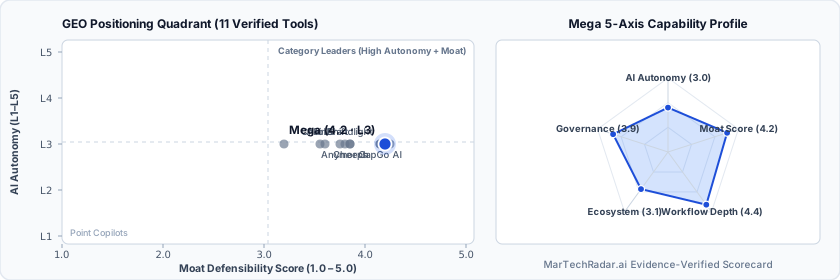
Mega is a Web SaaS tool for GEO (GEO Brand Tracking & LLM Rank Tracking) in GEO & AI SEO. Pricing: From $148/mo. Best suited to SEO Directors, Brand Strategy Leaders and Growth Marketers. Editor ratings: AI autonomy L3 (conditional automation); moat score 4.2/5.0 (Proprietary moat). Fact-checked by Sarah Per on Oct 11, 2026.
Autonomous multi-agent system combining generative engine optimization, technical SEO, and expert human review to monitor and scale search engine visibility.
Mega buyer fit verdict: when to choose vs. when to walk away
Choose Mega if (Best Fit)
- Target ICP & Stack Fit: You operate as SEO Directors, Brand Strategy Leaders and Growth Marketers requiring a Web SaaS deployment for GEO.
- L3 Architecture & Defensibility: Mega pairs automated multi-agent LLM crawling and citation analysis with a essential human expert supervisory loop, preventing hallucinations while optimizing for generative answer engines.
- Commercial Model Fit: Your procurement budget aligns with From $148/mo.
Walk away from Mega if (Deal-Breakers)
- Walk away if your workflow requires uncapped enterprise volume on the From $148/mo entry plan without upgrading tiers.
- Walk away if your workflow cannot tolerate LLM sampling volatility: Probabilistic outputs across non-deterministic chat interfaces yield noisy visibility baselines, demanding repeated prompt queries to establish statistically valid citation share.
- Walk away if supervisory throughput bottlenecks is a deal-breaker for your team: Relying on manual expert approvals slows down continuous deployment cycles when executing large-scale, automated programmatic SEO updates across complex domains.
Mega key facts & scorecard
| Pricing | From $148/moVendor pricing page |
|---|---|
| Free plan | No / not disclosed |
| Delivery | Web SaaS |
| Audience | SEO Directors, Brand Strategy Leaders, Growth Marketers |
| AI autonomy level | L3 · Conditional automationEditor-verified |
| Moat tier & score | 4.2 / 5.0 · Proprietary moatEditor-verified |
| Funding | Series A |
| Total funding | $11.5MBacked by Andreessen Horowitz |
| Founders | Lucas Pellan |
| Company size | 11-50 employees |
| Governance & docs | Terms ↗ · Privacy ↗ |
| Headquarters | Seattle, Washington |
| Founded | 2024 |
| Last verified |
Mega pros & cons: strengths vs. operational limitations
Pros: core strengths & capabilities
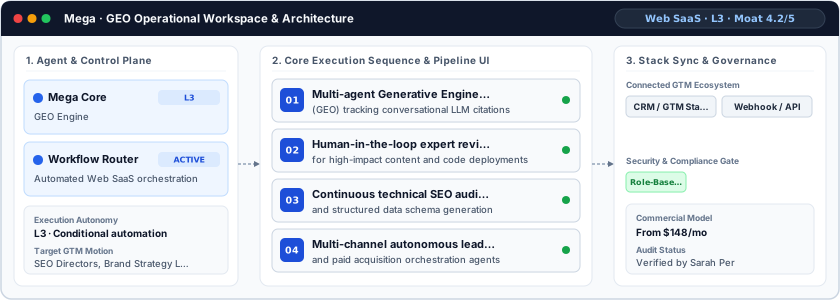
- Multi-agent Generative Engine Optimization: (GEO) tracking conversational LLM citations
- Human-in-the-loop expert review workflow: for high-impact content and code deployments
- Continuous technical SEO auditing: and structured data schema generation
- Multi-channel autonomous lead response: and paid acquisition orchestration agents
Cons: operational limitations & risks
- LLM Sampling Volatility: Probabilistic outputs across non-deterministic chat interfaces yield noisy visibility baselines, demanding repeated prompt queries to establish statistically valid citation share.
- Supervisory Throughput Bottlenecks: Relying on manual expert approvals slows down continuous deployment cycles when executing large-scale, automated programmatic SEO updates across complex domains.
- CMS Integration Friction: Direct production deployments require granular webhook access and rigid schema synchronization, which regularly fail inside custom enterprise content repositories.
Mega TCO & deal-breaker stress test
Simulate 12-month stepped TCO, hidden cost multipliers, contract lock-in exposure, and stack failure modes using only facts verified by Sarah Per on · Capture SHA c77802c8.
Mega aligns with your 5-seat / $800/mo profile. Review the walk-away triggers and contract levers below before deployment.
| Plan / Tier | Verified Rate | Scale Fit | Scope & Quota Notes |
|---|---|---|---|
| Entry / Starter | $148/mo | 1–2 seats | Instant call handling, lead qualification, real-time booking |
| Growth / Professional | $524/mo | 5 seats | Verified $524/mo tier from vendor pricing schedule. |
| Scale / Advanced | $840/mo | 15 seats | Billed $840 every month |
- Moat Score
- 4.2 / 5.0
- AI Autonomy
- L3
- Free Tier / Trial
- None disclosed
Triggered audit signals & failure modes
- Published Self-Serve Entry FloorVerified Pricing Ledger
Mega publishes a transparent entry point (From $148/mo) for initial validation before committing.
- Tier Fit for 5-Seat Scale: Growth / Professional ($524/mo)Verified Tier Schedule
Verified $524/mo tier from vendor pricing schedule.
- Primary Operational Bottleneck: LLM Sampling VolatilityAudit by Sarah Per
Probabilistic outputs across non-deterministic chat interfaces yield noisy visibility baselines, demanding repeated prompt queries to establish statistically valid citation share.
Hidden TCO Multipliers & Quota Gates
- Annual Billing Headline vs. Monthly Premium: Headline entry rates reflect annual billing commitments (save up to 48%); month-to-month flexibility carries a higher effective monthly rate or requires annual prepayment.
- Credit & Usage Burn Multiplier: Automated workflows consume metered credits/usage quotas; multi-step enrichment, voice minutes, or high-frequency agent runs can trigger mid-cycle top-up packs.
When to Walk Away & Negotiation Levers
- Walk away if your workflow requires uncapped enterprise volume on the From $148/mo entry plan without upgrading tiers.
- Walk away if your workflow cannot tolerate LLM sampling volatility: Probabilistic outputs across non-deterministic chat interfaces yield noisy visibility baselines, demanding repeated prompt queries to establish statistically valid citation share.
- Walk away if supervisory throughput bottlenecks is a deal-breaker for your team: Relying on manual expert approvals slows down continuous deployment cycles when executing large-scale, automated programmatic SEO updates across complex domains.
- Validate exact quota thresholds (seats, credits, or API calls) included in Mega's From $148/mo tier before converting from monthly to annual billing.
- Require a sandbox proof-of-concept testing LLM sampling volatility against your live CRM/data schema before annual sign-off.
Ask a custom procurement or TCO stress-test question about Mega
Lower 5-seat floor (~$49/mo vs. $524 / mo)
Lower 5-seat floor (~$99/mo vs. $524 / mo)
Mega moat & subtrack positioning
Mega pairs automated multi-agent LLM crawling and citation analysis with a essential human expert supervisory loop, preventing hallucinations while optimizing for generative answer engines.
Editorial review
Fact-checked by Sarah Per (Principal Content Systems & Generative Media Editor) on .
Background
Founded in 2024 in Seattle, Washington, Mega closed $11.5M in early-stage venture funding to address the shift from traditional search indexing to generative AI answer engines. Operating in the GEO brand tracking and LLM rank tracking domain, the company equips growth marketing leads and digital acquisition teams with dedicated software agents that balance algorithmic optimization against human governance.
How Mega works
Mega deploys an L3 autonomous architecture organized across specialized marketing agents covering technical SEO, generative search visibility, paid campaigns, and on-site conversions. The pipeline continuously queries major conversational AI systems and conventional search engines to map brand mentions, semantic authority, and prompt rankings. When producing structured schema, digital PR assets, or technical updates, deterministic rules enforce human-in-the-loop validation, requiring dedicated domain specialists to approve high-impact changes before live execution.
Limitations
Operational considerations and platform boundaries include:
- LLM Sampling Volatility: Probabilistic outputs across non-deterministic chat interfaces yield noisy visibility baselines, demanding repeated prompt queries to establish statistically valid citation share.
- Supervisory Throughput Bottlenecks: Relying on manual expert approvals slows down continuous deployment cycles when executing large-scale, automated programmatic SEO updates across complex domains.
- CMS Integration Friction: Direct production deployments require granular webhook access and rigid schema synchronization, which regularly fail inside custom enterprise content repositories.
Mega pricing
Commercial access operates on a tiered subscription structure starting from $148 per month. Pricing scales dynamically according to the number of active autonomous agents deployed, supervisory review allocations, and brand tracking monitoring quotas across generative search engines.
How Mega compares
While competitors like AthenaHQ, Brandlight, and Anymorph emphasize pure-play LLM citation analytics and observational tracking dashboards, Mega embeds multi-agent content execution paired with dedicated human verification. This architectural hybrid serves mid-market growth organizations seeking automated organic search remediation over passive intelligence feeds. Enterprise procurement teams evaluating deployment readiness should assess API webhook throughput, role-based access governance, and bilateral data synchronization latency against existing marketing technology infrastructure before committing to multi-year production rollouts.
Frequently asked questions about Mega
How much does Mega cost and what pricing tiers are available?
Published pricing summary for Mega: From $148/mo. A permanent free plan is not disclosed for Mega. Verified tier schedule: Entry / Starter ($148/mo for 1–2 seats); Growth / Professional ($524/mo for 5 seats); Scale / Advanced ($840/mo for 15 seats). Commercial access operates on a tiered subscription structure starting from $148 per month. Pricing scales dynamically according to the number of active autonomous agents deployed, supervisory review allocations, and brand tracking monitoring quotas across generative search engines.
How does Mega work and how autonomous is its AI architecture?
Autonomous multi-agent system combining generative engine optimization, technical SEO, and expert human review to monitor and scale search engine visibility. Within GEO (GEO Brand Tracking & LLM Rank Tracking), MarTechRadar rates its execution architecture at L3 · Conditional automation with a verified Moat Score of 4.2 / 5.0 (Proprietary moat). Mega pairs automated multi-agent LLM crawling and citation analysis with a essential human expert supervisory loop, preventing hallucinations while optimizing for generative answer engines. Corporate profile: Founded by Lucas Pellan, operating at 11-50 employees scale.
What are the main limitations of Mega and when should buyers walk away?
Based on our editorial technical audit, key operational considerations and boundaries for Mega include: (1) LLM Sampling Volatility: Probabilistic outputs across non-deterministic chat interfaces yield noisy visibility baselines, demanding repeated prompt queries to establish statistically valid citation share. (2) Supervisory Throughput Bottlenecks: Relying on manual expert approvals slows down continuous deployment cycles when executing large-scale, automated programmatic SEO updates across complex domains. (3) CMS Integration Friction: Direct production deployments require granular webhook access and rigid schema synchronization, which regularly fail inside custom enterprise content repositories. Primary procurement walk-away rule: Walk away if your workflow requires uncapped enterprise volume on the From $148/mo entry plan without upgrading tiers.
What integrations, compliance certifications, and contract terms apply to Mega?
Key TCO multiplier to watch: Annual Billing Headline vs. Monthly Premium (Headline entry rates reflect annual billing commitments (save up to 48%); month-to-month flexibility carries a higher effective monthly rate or requires annual prepayment.) Before signing a contract, procurement teams should validate exact quota thresholds (seats, credits, or API calls) included in Mega's From $148/mo tier before converting from monthly to annual billing.
What are the best Mega alternatives and head-to-head competitors in 2026?
Top fact-checked alternatives to Mega in GEO (GEO Brand Tracking & LLM Rank Tracking) include Meteoria (Custom / enterprise pricing), BrightEdge Generative Parser (Custom / enterprise pricing), Passionfruit (Custom / enterprise pricing), Wispra (Free plan · $0/mo · Enterprise plan). While competitors like AthenaHQ, Brandlight, and Anymorph emphasize pure-play LLM citation analytics and observational tracking dashboards, Mega embeds multi-agent content execution paired with dedicated human verification.
Verified sources & evidence trail
- Official product domain: https://megaseo.ai/
- Commercial pricing verification: https://megaseo.ai/pricing/
- Verified corporate entity profiles (
sameAs): LinkedIn Company Profile · Crunchbase Entity Record - First-party governance & documentation links: Terms · Privacy
- Editorial audit sign-off: Fact-checked by Sarah Per on under the MarTechRadar Evidence-Ledger Protocol.