MediaBook Review (2026): DCO Pricing, Limits & Alternatives
Bottom line
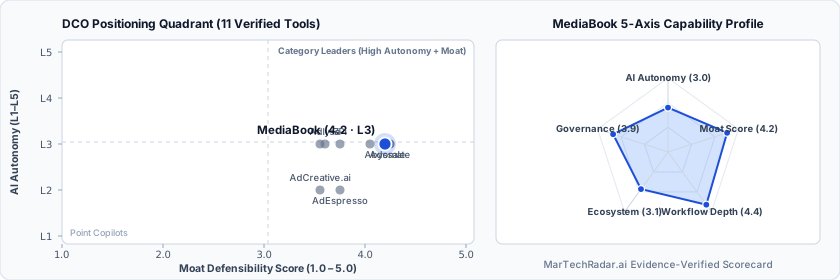
MediaBook is a Web SaaS tool for DCO (Dynamic Creative Optimization / DCO) in AdTech & Paid Media. Pricing: Custom / enterprise pricing. Best suited to Performance Marketing Directors, Ad Agencies and Retail Media Advertisers. Editor ratings: AI autonomy L3 (conditional automation); moat score 4.2/5.0 (Proprietary moat). Fact-checked by Julie Brot on Oct 11, 2026.
Integrated hardware-software video production solution combining portable illuminated pop-up studios with real-time background replacement and cloud.
MediaBook buyer fit verdict: when to choose vs. when to walk away
Choose MediaBook if (Best Fit)
- Target ICP & Stack Fit: You operate as Performance Marketing Directors, Ad Agencies and Retail Media Advertisers requiring a Web SaaS deployment for DCO.
- L3 Architecture & Defensibility: Proprietary coupling of turn-key physical pop-up studio hardware with automated computer vision segmentation and remote cloud production, establishing a hybrid physical-digital operational moat.
- Commercial Model Fit: Your procurement budget aligns with Custom / enterprise pricing.
Walk away from MediaBook if (Deal-Breakers)
- Walk away if you require transparent self-serve monthly billing or your budget ceiling is under $1,000/mo (MediaBook requires sales-gated custom quoting).
- Walk away if your workflow cannot tolerate hardware logistical dependency: Deployment scales with the physical distribution and shipping of portable studio kits, impeding instant software-only rollout across distributed teams.
- Walk away if edge compute constraints is a deal-breaker for your team: Real-time background extraction relies on mobile device thermal and hardware performance, presenting frame-rate throttling risks during sustained live broadcasts.
MediaBook key facts & scorecard
| Pricing | Custom / enterprise pricing |
|---|---|
| Free plan | No / not disclosed |
| Delivery | Web SaaS |
| Audience | Performance Marketing Directors, Ad Agencies, Retail Media Advertisers |
| AI autonomy level | L3 · Conditional automationEditor-verified |
| Moat tier & score | 4.2 / 5.0 · Proprietary moatEditor-verified |
| Funding | Seed |
| Total funding | $1MBacked by Angel Investors |
| Founders | Rock Scharer |
| Company size | 11-50 employees |
| Governance & docs | Privacy ↗ |
| Headquarters | Beverly Hills, California, United States |
| Founded | 2024 |
| Last verified |
MediaBook pros & cons: strengths vs. operational limitations
Pros: core strengths & capabilities
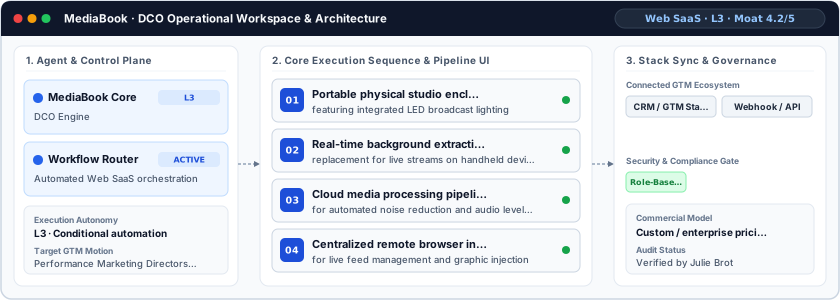
- Portable physical studio enclosures: featuring integrated LED broadcast lighting
- Real-time background extraction and: replacement for live streams on handheld devices
- Cloud media processing pipeline: for automated noise reduction and audio leveling
- Centralized remote browser interface: for live feed management and graphic injection
Cons: operational limitations & risks
- Hardware logistical dependency: Deployment scales with the physical distribution and shipping of portable studio kits, impeding instant software-only rollout across distributed teams.
- Edge compute constraints: Real-time background extraction relies on mobile device thermal and hardware performance, presenting frame-rate throttling risks during sustained live broadcasts.
- Bandwidth volatility sensitivity: Simultaneous edge matting and multi-channel cloud feed injection require stable uplink bitrates, resulting in artifacting under fluctuating network conditions.
MediaBook TCO & deal-breaker stress test
Simulate 12-month stepped TCO, hidden cost multipliers, contract lock-in exposure, and stack failure modes using only facts verified by Julie Brot on · Capture SHA ab0deb79.
MediaBook triggers high-severity friction under your 5-seat / $800/mo constraints. Benchmark the verified subtrack alternatives below before committing.
| Plan / Tier | Verified Rate | Scale Fit | Scope & Quota Notes |
|---|---|---|---|
| Enterprise / Custom | Custom quote | 15–50+ seats (Enterprise SLA) | Sales-negotiated annual contract for custom volume, SSO/RBAC governance, and dedicated SLA. |
- Moat Score
- 4.2 / 5.0
- AI Autonomy
- L3
- Free Tier / Trial
- None disclosed
Triggered audit signals & failure modes
- Opaque Enterprise Quoting vs. SMB/Mid-Market BudgetVerified Pricing Ledger
MediaBook does not disclose a public self-serve floor (Custom / enterprise pricing). Buyers with a $800/mo cap face high sales-qualification friction.
- Sales-Gated Contract TermsFact-checked by Julie Brot
Commercial pricing is available on request through tailored enterprise sales quotes based on organizational scale and seats.
- Primary Operational Bottleneck: Hardware logistical dependencyAudit by Julie Brot
Deployment scales with the physical distribution and shipping of portable studio kits, impeding instant software-only rollout across distributed teams.
Hidden TCO Multipliers & Quota Gates
- Hardware logistical dependency: Deployment scales with the physical distribution and shipping of portable studio kits, impeding instant software-only rollout across distributed teams.
- Edge compute constraints: Real-time background extraction relies on mobile device thermal and hardware performance, presenting frame-rate throttling risks during sustained live broadcasts.
When to Walk Away & Negotiation Levers
- Walk away if you require transparent self-serve monthly billing or your budget ceiling is under $1,000/mo (MediaBook requires sales-gated custom quoting).
- Walk away if your workflow cannot tolerate hardware logistical dependency: Deployment scales with the physical distribution and shipping of portable studio kits, impeding instant software-only rollout across distributed teams.
- Walk away if edge compute constraints is a deal-breaker for your team: Real-time background extraction relies on mobile device thermal and hardware performance, presenting frame-rate throttling risks during sustained live broadcasts.
- Demand a 30- to 60-day paid pilot opt-out clause in the MediaBook order form before signing a 12-month enterprise commitment.
- Require a sandbox proof-of-concept testing hardware logistical dependency against your live CRM/data schema before annual sign-off.
Ask a custom procurement or TCO stress-test question about MediaBook
Lower 5-seat floor (~$36/mo vs. Custom Quote) · Transparent self-serve entry without mandatory annual lock-in
Lower 5-seat floor (~$99/mo vs. Custom Quote) · Transparent self-serve entry without mandatory annual lock-in
MediaBook moat & subtrack positioning
Proprietary coupling of turn-key physical pop-up studio hardware with automated computer vision segmentation and remote cloud production, establishing a hybrid physical-digital operational moat.
Editorial review
Fact-checked by Julie Brot (Enterprise SaaS Governance & Procurement Editor) on .
Background
Backed by $1M in seed financing, MediaBook was founded in 2024 in Beverly Hills, California, United States, to address the infrastructure bottlenecks associated with high-fidelity distributed video capture. Built for enterprise communications leaders, digital media broadcasters, and distributed marketing teams, the company pairs physical capture units with automated production software. By uniting dedicated portable hardware enclosures with cloud video infrastructure, MediaBook targets organizations seeking broadcast-grade creative output without deploying traditional studio crews or physical production facilities.
How MediaBook works
MediaBook operates via a hybrid capture-and-cloud architecture. Physical pop-up units provide calibrated, built-in LED lighting arrays to standardize visual input at the edge before mobile devices capture raw footage. Ingested video streams pass through real-time computer vision models that execute background matting and dynamic replacement directly on handheld endpoints. Media assets route to a cloud control plane that applies automated audio normalization and noise suppression, allowing distributed production operators to remotely trigger graphics, manage feeds, and stage dynamic creative assets under Level 3 operational autonomy.
Limitations
Operational considerations and platform boundaries include:
- Hardware logistical dependency: Deployment scales with the physical distribution and shipping of portable studio kits, impeding instant software-only rollout across distributed teams.
- Edge compute constraints: Real-time background extraction relies on mobile device thermal and hardware performance, presenting frame-rate throttling risks during sustained live broadcasts.
- Bandwidth volatility sensitivity: Simultaneous edge matting and multi-channel cloud feed injection require stable uplink bitrates, resulting in artifacting under fluctuating network conditions.
MediaBook pricing
Commercial pricing is available on request through tailored enterprise sales quotes based on organizational scale and seats. MediaBook structures contracts through custom enterprise packages that encompass physical studio hardware procurement alongside annual software licensing tiers. Engagements bundle hardware kit fulfillment, cloud media processing volume, and dedicated technical onboarding.
How MediaBook compares
Within programmatic and automated creative workflows, MediaBook diverges from pure-play creative generation engines like AdCreative.ai, Abyssale, and 7Pi. While Abyssale and AdCreative.ai rely on template-driven image APIs and algorithmic ad variations, MediaBook solves raw live-action capture at the source via integrated hardware and real-time matting. It is tailored for enterprise media teams that require broadcast-grade executive video capture across distributed locations, whereas pure-play dynamic creative optimization platforms better serve high-velocity programmatic display teams.
Direct competitors & market radar
Top algorithmic competitors based on category positioning, capability overlap, and ICP alignment.
Frequently asked questions about MediaBook
How much does MediaBook cost and does it require a custom enterprise quote?
Published pricing summary for MediaBook: Custom / enterprise pricing. A permanent free plan is not disclosed for MediaBook. Commercial pricing is available on request through tailored enterprise sales quotes based on organizational scale and seats. MediaBook structures contracts through custom enterprise packages that encompass physical studio hardware procurement alongside annual software licensing tiers.
How does MediaBook work and how autonomous is its AI architecture?
Integrated hardware-software video production solution combining portable illuminated pop-up studios with real-time background replacement and cloud. Within DCO (Dynamic Creative Optimization / DCO), MarTechRadar rates its execution architecture at L3 · Conditional automation with a verified Moat Score of 4.2 / 5.0 (Proprietary moat). Proprietary coupling of turn-key physical pop-up studio hardware with automated computer vision segmentation and remote cloud production, establishing a hybrid physical-digital operational moat. Corporate profile: Founded by Rock Scharer, operating at 11-50 employees scale.
What are the main limitations of MediaBook and when should buyers walk away?
Based on our editorial technical audit, key operational considerations and boundaries for MediaBook include: (1) Hardware logistical dependency: Deployment scales with the physical distribution and shipping of portable studio kits, impeding instant software-only rollout across distributed teams. (2) Edge compute constraints: Real-time background extraction relies on mobile device thermal and hardware performance, presenting frame-rate throttling risks during sustained live broadcasts. (3) Bandwidth volatility sensitivity: Simultaneous edge matting and multi-channel cloud feed injection require stable uplink bitrates, resulting in artifacting under fluctuating network conditions. Primary procurement walk-away rule: Walk away if you require transparent self-serve monthly billing or your budget ceiling is under $1,000/mo (MediaBook requires sales-gated custom quoting).
What integrations, compliance certifications, and contract terms apply to MediaBook?
Key TCO multiplier to watch: Hardware logistical dependency (Deployment scales with the physical distribution and shipping of portable studio kits, impeding instant software-only rollout across distributed teams.) Before signing a contract, procurement teams should demand a 30- to 60-day paid pilot opt-out clause in the MediaBook order form before signing a 12-month enterprise commitment.
What are the best MediaBook alternatives and head-to-head competitors in 2026?
Top fact-checked alternatives to MediaBook in DCO (Dynamic Creative Optimization / DCO) include Trellis.co (Custom / enterprise pricing), AIChief (Custom / enterprise pricing), Prorata.AI (Custom / enterprise pricing), LEAPFROG A.I. (Custom / enterprise pricing). Within programmatic and automated creative workflows, MediaBook diverges from pure-play creative generation engines like AdCreative.ai, Abyssale, and 7Pi.
Verified sources & evidence trail
- Official product domain: https://mediabook.us
- Commercial pricing verification: Verified against official vendor pricing policy (Custom / enterprise pricing)
- Verified corporate entity profiles (
sameAs): Crunchbase Entity Record - First-party governance & documentation links: Privacy
- Editorial audit sign-off: Fact-checked by Julie Brot on under the MarTechRadar Evidence-Ledger Protocol.