LEAPFROG A.I. Review (2026): DCO Pricing, Limits & Alternatives
Bottom line
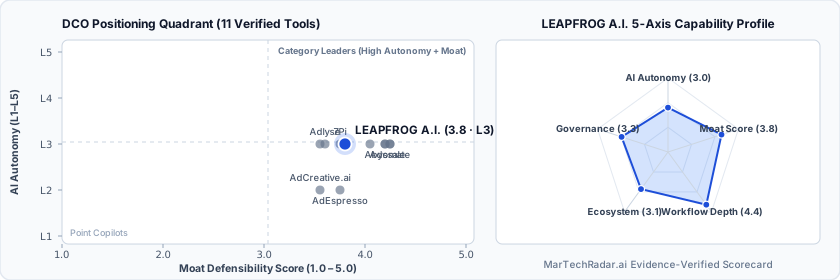
LEAPFROG A.I. is a Web SaaS tool for DCO (Dynamic Creative Optimization / DCO) in AdTech & Paid Media. Pricing: Custom / enterprise pricing. Best suited to Performance Marketing Directors, Ad Agencies and Retail Media Advertisers. Editor ratings: AI autonomy L3 (conditional automation); moat score 3.8/5.0 (Proprietary moat). Fact-checked by Jiacky Lee on Oct 11, 2026.
Enterprise generative creative platform operationalizing dynamic digital talent, automated asset variations, and AI-driven quality assurance for retail brands.
LEAPFROG A.I. buyer fit verdict: when to choose vs. when to walk away
Choose LEAPFROG A.I. if (Best Fit)
- Target ICP & Stack Fit: You operate as Performance Marketing Directors, Ad Agencies and Retail Media Advertisers requiring a Web SaaS deployment for DCO.
- L3 Architecture & Defensibility: Defensibility stems from its integrated production architecture pairing specialized visual diffusion pipelines with containerized custom builds and Oracle AI QA/QC governance.
- Commercial Model Fit: Your procurement budget aligns with Custom / enterprise pricing.
Walk away from LEAPFROG A.I. if (Deal-Breakers)
- Walk away if you require transparent self-serve monthly billing or your budget ceiling is under $1,000/mo (LEAPFROG A.I. requires sales-gated custom quoting).
- Walk away if your workflow cannot tolerate custom microservice dependency: Deployment relies heavily on containerized pipelines and bespoke pipeline configurations, introducing significant engineering lead times during corporate onboarding compared to off-the-shelf software.
- Walk away if high rendering latency on video variants is a deal-breaker for your team: Processing image-to-video and digital twin adaptations across multi-SKU retail catalogs causes computational queuing overhead that constrains true real-time programmatic ad serving.
LEAPFROG A.I. key facts & scorecard
| Pricing | Custom / enterprise pricing |
|---|---|
| Free plan | No / not disclosed |
| Delivery | Web SaaS |
| Audience | Performance Marketing Directors, Ad Agencies, Retail Media Advertisers |
| AI autonomy level | L3 · Conditional automationEditor-verified |
| Moat tier & score | 3.8 / 5.0 · Proprietary moatEditor-verified |
| Funding | Pre-seed |
| Total funding | Pre-seedBacked by Bootstrapped |
| Company size | 2-10 employees |
| Governance & docs | Terms ↗ · Privacy ↗ |
| Headquarters | London, England |
| Founded | 2024 |
| Last verified |
LEAPFROG A.I. pros & cons: strengths vs. operational limitations
Pros: core strengths & capabilities
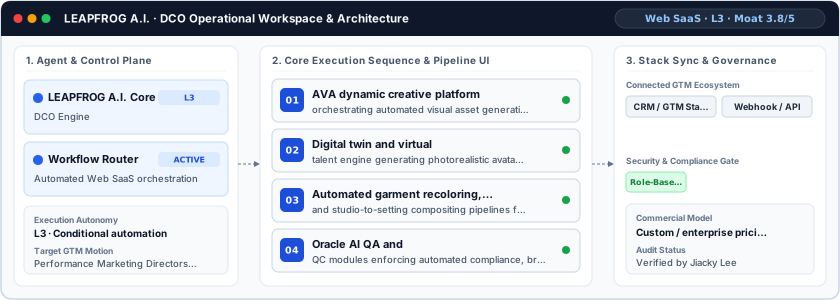
- AVA dynamic creative platform: orchestrating automated visual asset generation and cross-channel campaign adaptation
- Digital twin and virtual: talent engine generating photorealistic avatar-to-PDP assets and custom brand models
- Automated garment recoloring, reposing,: and studio-to-setting compositing pipelines for apparel retail
- Oracle AI QA and: QC modules enforcing automated compliance, brand consistency, and asset defect detection
Cons: operational limitations & risks
- Custom Microservice Dependency: Deployment relies heavily on containerized pipelines and bespoke pipeline configurations, introducing significant engineering lead times during corporate onboarding compared to off-the-shelf software.
- High Rendering Latency on Video Variants: Processing image-to-video and digital twin adaptations across multi-SKU retail catalogs causes computational queuing overhead that constrains true real-time programmatic ad serving.
- Domain-Specific Training Overhead: Achieving acceptable fidelity in apparel reposing and studio compositing requires intensive initial model calibration against specific product geometries, limiting immediate horizontal applicability.
LEAPFROG A.I. TCO & deal-breaker stress test
Simulate 12-month stepped TCO, hidden cost multipliers, contract lock-in exposure, and stack failure modes using only facts verified by Jiacky Lee on · Capture SHA c8f34778.
LEAPFROG A.I. triggers high-severity friction under your 5-seat / $800/mo constraints. Benchmark the verified subtrack alternatives below before committing.
| Plan / Tier | Verified Rate | Scale Fit | Scope & Quota Notes |
|---|---|---|---|
| Enterprise / Custom | Custom quote | 15–50+ seats (Enterprise SLA) | Sales-negotiated annual contract for custom volume, SSO/RBAC governance, and dedicated SLA. |
- Moat Score
- 3.8 / 5.0
- AI Autonomy
- L3
- Free Tier / Trial
- None disclosed
Triggered audit signals & failure modes
- Opaque Enterprise Quoting vs. SMB/Mid-Market BudgetVerified Pricing Ledger
LEAPFROG A.I. does not disclose a public self-serve floor (Custom / enterprise pricing). Buyers with a $800/mo cap face high sales-qualification friction.
- Sales-Gated Contract TermsFact-checked by Jiacky Lee
LEAPFROG A.I. delivers its software through custom enterprise pricing available on request via sales engagements.
- Primary Operational Bottleneck: Custom Microservice DependencyAudit by Jiacky Lee
Deployment relies heavily on containerized pipelines and bespoke pipeline configurations, introducing significant engineering lead times during corporate onboarding compared to off-the-shelf software.
Hidden TCO Multipliers & Quota Gates
- Custom Microservice Dependency: Deployment relies heavily on containerized pipelines and bespoke pipeline configurations, introducing significant engineering lead times during corporate onboarding compared to off-the-shelf software.
- High Rendering Latency on Video Variants: Processing image-to-video and digital twin adaptations across multi-SKU retail catalogs causes computational queuing overhead that constrains true real-time programmatic ad serving.
When to Walk Away & Negotiation Levers
- Walk away if you require transparent self-serve monthly billing or your budget ceiling is under $1,000/mo (LEAPFROG A.I. requires sales-gated custom quoting).
- Walk away if your workflow cannot tolerate custom microservice dependency: Deployment relies heavily on containerized pipelines and bespoke pipeline configurations, introducing significant engineering lead times during corporate onboarding compared to off-the-shelf software.
- Walk away if high rendering latency on video variants is a deal-breaker for your team: Processing image-to-video and digital twin adaptations across multi-SKU retail catalogs causes computational queuing overhead that constrains true real-time programmatic ad serving.
- Demand a 30- to 60-day paid pilot opt-out clause in the LEAPFROG A.I. order form before signing a 12-month enterprise commitment.
- Require a sandbox proof-of-concept testing custom microservice dependency against your live CRM/data schema before annual sign-off.
Ask a custom procurement or TCO stress-test question about LEAPFROG A.I.
Lower 5-seat floor (~$36/mo vs. Custom Quote) · Transparent self-serve entry without mandatory annual lock-in
Lower 5-seat floor (~$49/mo vs. Custom Quote) · Transparent self-serve entry without mandatory annual lock-in
LEAPFROG A.I. moat & subtrack positioning
Defensibility stems from its integrated production architecture pairing specialized visual diffusion pipelines with containerized custom builds and Oracle AI QA/QC governance.
Editorial review
Fact-checked by Jiacky Lee (Managing Editor, AI Autonomy & Moat Methodology) on .
Background
Architectured around modular generative workflows rather than rigid template libraries, LEAPFROG A.I. operates as a dynamic creative optimization platform for global enterprise brands. Headquartered in London, England, and established in 2024, the company engineers its proprietary AVA platform to resolve the throughput bottlenecks that marketing organizations encounter when managing high-volume variant production across fragmented digital display channels. Designed primarily for enterprise creative directors, digital marketing operations leaders, and retail brand teams, LEAPFROG A.I. shifts content operations from manual studio shoots to programmatically governed synthetic creative pipelines.
How LEAPFROG A.I. works
At its technical foundation, LEAPFROG A.I. operates an L3 conditional automation environment split into two interconnected core engines: The Production Brain and The Research Brain. Raw brand assets, product specifications, and lifestyle photography enter containerized services that deploy image-to-video pipelines, digital twin rendering, and semantic apparel manipulation—including automated garment recoloring and model reposing. Creative variations are programmatically assembled via customizable workflow builders that bridge avatar models with product display pages (PDPs) and multi-format advertisement layouts. Output verification is enforced upstream by Oracle, an autonomous AI-driven quality assurance and quality control system that evaluates every visual rendering against chromatic thresholds, spatial proportions, and predefined brand compliance rules before distribution.
Limitations
Operational considerations and platform boundaries include:
- Custom Microservice Dependency: Deployment relies heavily on containerized pipelines and bespoke pipeline configurations, introducing significant engineering lead times during corporate onboarding compared to off-the-shelf software.
- High Rendering Latency on Video Variants: Processing image-to-video and digital twin adaptations across multi-SKU retail catalogs causes computational queuing overhead that constrains true real-time programmatic ad serving.
- Domain-Specific Training Overhead: Achieving acceptable fidelity in apparel reposing and studio compositing requires intensive initial model calibration against specific product geometries, limiting immediate horizontal applicability.
LEAPFROG A.I. pricing
LEAPFROG A.I. delivers its software through custom enterprise pricing available on request via sales engagements. Contracts are tailored to individual enterprise requirements, reflecting infrastructure compute demands, bespoke containerized deployments, visual rendering volume quotas, and seat allocations for global creative teams. The commercial agreement covers access to the core AVA orchestrator, dedicated production pipeline configurations, and enterprise support frameworks.
How LEAPFROG A.I. compares
Within dynamic creative optimization, LEAPFROG A.I. sits apart from template-driven automation platforms like Abyssale and performance-oriented ad generators like AdCreative.ai or 7Pi. While Abyssale relies primarily on fixed SVG, HTML5, and banner layout APIs, LEAPFROG A.I. introduces deep generative rendering, digital twins, and automated garment reposing directly into the asset pipeline. Conversely, platforms like AdCreative.ai prioritize rapid multivariate ad copy and display scoring for performance marketers, whereas LEAPFROG A.I. emphasizes end-to-end creative integrity via its Oracle quality control layer. The platform is best suited for high-volume retail and consumer enterprise brands requiring photorealistic visual adaptation across extensive SKU catalogs without repeated studio production overhead.
Frequently asked questions about LEAPFROG A.I.
How much does LEAPFROG A.I. cost and does it require a custom enterprise quote?
Published pricing summary for LEAPFROG A.I.: Custom / enterprise pricing. A permanent free plan is not disclosed for LEAPFROG A.I.. LEAPFROG A.I. delivers its software through custom enterprise pricing available on request via sales engagements.
How does LEAPFROG A.I. work and how autonomous is its AI architecture?
Enterprise generative creative platform operationalizing dynamic digital talent, automated asset variations, and AI-driven quality assurance for retail brands. Within DCO (Dynamic Creative Optimization / DCO), MarTechRadar rates its execution architecture at L3 · Conditional automation with a verified Moat Score of 3.8 / 5.0 (Proprietary moat). Defensibility stems from its integrated production architecture pairing specialized visual diffusion pipelines with containerized custom builds and Oracle AI QA/QC governance. Corporate profile: operating at 2-10 employees scale.
What are the main limitations of LEAPFROG A.I. and when should buyers walk away?
Based on our editorial technical audit, key operational considerations and boundaries for LEAPFROG A.I. include: (1) Custom Microservice Dependency: Deployment relies heavily on containerized pipelines and bespoke pipeline configurations, introducing significant engineering lead times during corporate onboarding compared to off-the-shelf software. (2) High Rendering Latency on Video Variants: Processing image-to-video and digital twin adaptations across multi-SKU retail catalogs causes computational queuing overhead that constrains true real-time programmatic ad serving. (3) Domain-Specific Training Overhead: Achieving acceptable fidelity in apparel reposing and studio compositing requires intensive initial model calibration against specific product geometries, limiting immediate horizontal applicability. Primary procurement walk-away rule: Walk away if you require transparent self-serve monthly billing or your budget ceiling is under $1,000/mo (LEAPFROG A.I. requires sales-gated custom quoting).
What integrations, compliance certifications, and contract terms apply to LEAPFROG A.I.?
Key TCO multiplier to watch: Custom Microservice Dependency (Deployment relies heavily on containerized pipelines and bespoke pipeline configurations, introducing significant engineering lead times during corporate onboarding compared to off-the-shelf software.) Before signing a contract, procurement teams should demand a 30- to 60-day paid pilot opt-out clause in the LEAPFROG A.I. order form before signing a 12-month enterprise commitment.
What are the best LEAPFROG A.I. alternatives and head-to-head competitors in 2026?
Top fact-checked alternatives to LEAPFROG A.I. in DCO (Dynamic Creative Optimization / DCO) include Lumian (Custom / enterprise pricing), MediaBook (Custom / enterprise pricing), Nativo (Custom / enterprise pricing), Bobsled Marketing (Custom / enterprise pricing). Within dynamic creative optimization, LEAPFROG A.I. sits apart from template-driven automation platforms like Abyssale and performance-oriented ad generators like AdCreative.ai or 7Pi.
Verified sources & evidence trail
- Official product domain: https://www.leapfrogai.com/
- Commercial pricing verification: Verified against official vendor pricing policy (Custom / enterprise pricing)
- Verified corporate entity profiles (
sameAs): LinkedIn Company Profile - First-party governance & documentation links: Terms · Privacy
- Editorial audit sign-off: Fact-checked by Jiacky Lee on under the MarTechRadar Evidence-Ledger Protocol.