Helium Review (2026): AI Landing Page Pricing, Limits & Alternatives
Bottom line
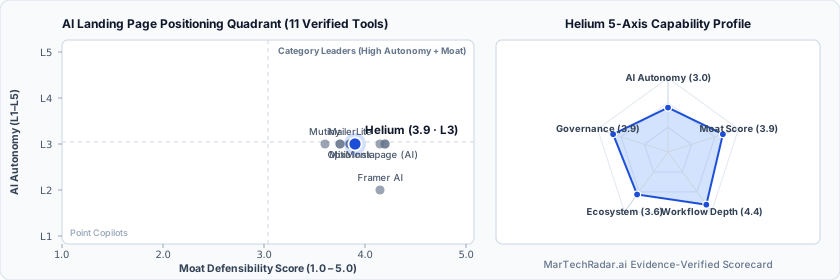
Helium is a Web SaaS tool for AI Landing Page (Landing Page Builders & Autonomous CRO) in Lifecycle & CDP. Pricing: Pricing not disclosed. Best suited to B2B SaaS and Marketing & Growth Teams. Editor ratings: AI autonomy L3 (conditional automation); moat score 3.9/5.0 (Proprietary moat). Fact-checked by Jagmeet Sine on Oct 16, 2026.
Self-improving mobile and web app monetization platform that autonomously generates and tests paywalls, pricing flows, and app-to-web checkout experiments.
Helium buyer fit verdict: when to choose vs. when to walk away
Choose Helium if (Best Fit)
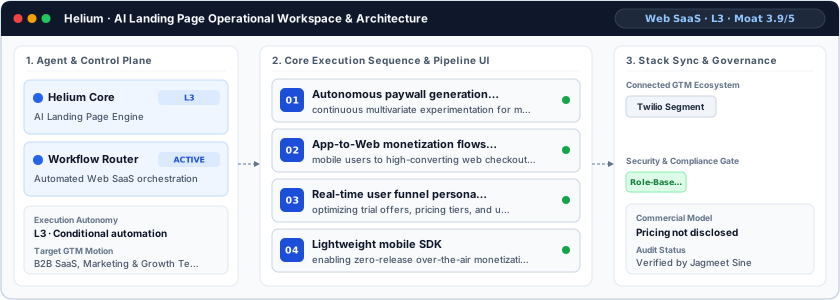
- Target ICP & Stack Fit: You operate as B2B SaaS and Marketing & Growth Teams requiring a Web SaaS deployment for AI Landing Page, with verified ecosystem connectivity for Twilio Segment.
- L3 Architecture & Defensibility: Continuously training reinforcement-learning paywall and app-to-web checkout experiments on live subscription conversion telemetry creates compounding revenue lift for mobile apps.
- Commercial Model Fit: Your procurement budget aligns with Pricing not disclosed.
Walk away from Helium if (Deal-Breakers)
- Walk away if you require transparent self-serve monthly billing or your budget ceiling is under $1,000/mo (Helium requires sales-gated custom quoting).
- Walk away if your workflow cannot tolerate traffic volume statistical bottleneck: Continuous multi-variant paywall and pricing experimentation requires substantial daily active user (DAU) traffic to reach statistical significance rapidly; pre-launch apps with low install velocity struggle with a sample-size bottleneck.
- Walk away if app store policy governance barrier is a deal-breaker for your team: Implementing App-to-Web payment routing across iOS and Android ecosystems requires strict adherence to evolving Apple App Store and Google Play billing guidelines, creating a legal and platform governance barrier.
Helium key facts & scorecard
| Pricing | Pricing not disclosed |
|---|---|
| Free plan | No / not disclosed |
| Delivery | Web SaaS |
| Audience | B2B SaaS, Marketing & Growth Teams |
| AI autonomy level | L3 · Conditional automationEditor-verified |
| Moat tier & score | 3.9 / 5.0 · Proprietary moatEditor-verified |
| Funding | Seed |
| Total funding | $7.4M |
| Founders | Anish Doshi, Shishir Jakati, Zach Witzel |
| Company size | 2-10 employees |
| Ecosystem integrations | Twilio Segment |
| Governance & docs | DPA ↗ · Privacy ↗ |
| Headquarters | San Francisco, California |
| Founded | 2024 |
| Last verified |
Helium pros & cons: strengths vs. operational limitations
Pros: core strengths & capabilities
- Autonomous paywall generation and: continuous multivariate experimentation for mobile apps
- App-to-Web monetization flows routing: mobile users to high-converting web checkout experiences
- Real-time user funnel personalization: optimizing trial offers, pricing tiers, and upsell moments
- Lightweight mobile SDK: enabling zero-release over-the-air monetization testing in minutes
Cons: operational limitations & risks
- Traffic Volume Statistical Bottleneck: Continuous multi-variant paywall and pricing experimentation requires substantial daily active user (DAU) traffic to reach statistical significance rapidly; pre-launch apps with low install velocity struggle with a sample-size bottleneck.
- App Store Policy Governance Barrier: Implementing App-to-Web payment routing across iOS and Android ecosystems requires strict adherence to evolving Apple App Store and Google Play billing guidelines, creating a legal and platform governance barrier.
- SDK Event Instrumentation Learning Curve: Mapping granular in-app entitlement states, subscription renewals, and cohort LTV metrics into Helium's optimization loop introduces an initial engineering integration learning curve.
Helium TCO & deal-breaker stress test
Simulate 12-month stepped TCO, hidden cost multipliers, contract lock-in exposure, and stack failure modes using only facts verified by Jagmeet Sine on · Capture SHA 387692ae.
Helium triggers high-severity friction under your 5-seat / $800/mo constraints. Benchmark the verified subtrack alternatives below before committing.
| Plan / Tier | Verified Rate | Scale Fit | Scope & Quota Notes |
|---|---|---|---|
| Enterprise / Custom | Custom quote | 15–50+ seats (Enterprise SLA) | Sales-negotiated annual contract for custom volume, SSO/RBAC governance, and dedicated SLA. |
- Moat Score
- 3.9 / 5.0
- AI Autonomy
- L3
- Free Tier / Trial
- None disclosed
Triggered audit signals & failure modes
- Opaque Enterprise Quoting vs. SMB/Mid-Market BudgetVerified Pricing Ledger
Helium does not disclose a public self-serve floor (Pricing not disclosed). Buyers with a $800/mo cap face high sales-qualification friction.
- Sales-Gated Contract TermsFact-checked by Jagmeet Sine
Pricing is available on request through enterprise sales quotes, with customized tiers based on seat counts or usage volume.
- Primary Operational Bottleneck: App Store Policy Governance BarrierAudit by Jagmeet Sine
Implementing App-to-Web payment routing across iOS and Android ecosystems requires strict adherence to evolving Apple App Store and Google Play billing guidelines, creating a legal and platform governance barrier.
Hidden TCO Multipliers & Quota Gates
- Traffic Volume Statistical Bottleneck: Continuous multi-variant paywall and pricing experimentation requires substantial daily active user (DAU) traffic to reach statistical significance rapidly; pre-launch apps with low install velocity struggle with a sample-size bottleneck.
- App Store Policy Governance Barrier: Implementing App-to-Web payment routing across iOS and Android ecosystems requires strict adherence to evolving Apple App Store and Google Play billing guidelines, creating a legal and platform governance barrier.
When to Walk Away & Negotiation Levers
- Walk away if you require transparent self-serve monthly billing or your budget ceiling is under $1,000/mo (Helium requires sales-gated custom quoting).
- Walk away if your workflow cannot tolerate traffic volume statistical bottleneck: Continuous multi-variant paywall and pricing experimentation requires substantial daily active user (DAU) traffic to reach statistical significance rapidly; pre-launch apps with low install velocity struggle with a sample-size bottleneck.
- Walk away if app store policy governance barrier is a deal-breaker for your team: Implementing App-to-Web payment routing across iOS and Android ecosystems requires strict adherence to evolving Apple App Store and Google Play billing guidelines, creating a legal and platform governance barrier.
- Demand a 30- to 60-day paid pilot opt-out clause in the Helium order form before signing a 12-month enterprise commitment.
- Require a sandbox proof-of-concept testing traffic volume statistical bottleneck against your live CRM/data schema before annual sign-off.
Ask a custom procurement or TCO stress-test question about Helium
Lower 5-seat floor (~$10/mo vs. Custom Quote) · Transparent self-serve entry without mandatory annual lock-in
Lower 5-seat floor (~$79/mo vs. Custom Quote) · Transparent self-serve entry without mandatory annual lock-in
Helium key entities, modules & ecosystem stack
Helium moat & subtrack positioning
Continuously training reinforcement-learning paywall and app-to-web checkout experiments on live subscription conversion telemetry creates compounding revenue lift for mobile apps.
Editorial review
Fact-checked by Jagmeet Sine (Senior MarTech Infrastructure & Agentic Workflow Architect) on .
Background
Founded in 2024 by Zach Witzel, Shishir Jakati, and Anish Doshi and headquartered in San Francisco, California, Helium (tryhelium.com) is a self-improving app monetization and autonomous conversion experimentation platform built for consumer mobile applications, subscription software teams, and growth engineers. Operating with a team of 2 to 10 employees and backed by $7.4M in Seed funding led by Y Combinator (S24), Gradient, Daybreak Ventures, and Henry Shi, the founding team draws on prior growth experimentation and machine learning leadership at Uber, Amazon Alexa, and Meta to automate in-app revenue optimization.
How Helium works
Helium operates at Level 3 autonomy by embedding a lightweight mobile and web SDK that decouples paywall UI, pricing presentation, and checkout routing from slow App Store binary release cycles. Once integrated, Helium's AI experimentation engine continuously designs, deploys, and evaluates new paywall layouts, trial structures, and App-to-Web checkout flows across critical moments in the user journey. Using contextual bandit and reinforcement-learning allocation, the platform shifts live traffic toward the highest-converting variants for each user segment—proven in production across consumer social apps scaling to 20 million monthly active users.
Limitations
Operational limitations and technical trade-offs include:
- Traffic Volume Statistical Bottleneck: Continuous multi-variant paywall and pricing experimentation requires substantial daily active user (DAU) traffic to reach statistical significance rapidly; pre-launch apps with low install velocity struggle with a sample-size bottleneck.
- App Store Policy Governance Barrier: Implementing App-to-Web payment routing across iOS and Android ecosystems requires strict adherence to evolving Apple App Store and Google Play billing guidelines, creating a legal and platform governance barrier.
- SDK Event Instrumentation Learning Curve: Mapping granular in-app entitlement states, subscription renewals, and cohort LTV metrics into Helium's optimization loop introduces an initial engineering integration learning curve.
Helium pricing
Pricing is available on request through enterprise sales quotes, with customized tiers based on seat counts or usage volume. Mobile app studios and growth teams can start for free via the Helium website and scale into custom commercial tiers aligned with monthly active users and tracked subscription volume.
How Helium compares
Within the Landing Page Builders & Autonomous CRO category, Helium competes against mobile monetization and experimentation alternatives such as Superwall, RevenueCat, and Adapty. Versus static subscription infrastructure SDKs like RevenueCat or manual paywall builders like Superwall, Helium differentiates itself by combining autonomous AI experiment generation with native App-to-Web monetization flows. High-growth consumer mobile apps choose Helium to maximize subscriber conversion without waiting on engineering sprints.
Frequently asked questions about Helium
How much does Helium cost and does it require a custom enterprise quote?
Published pricing summary for Helium: Pricing not disclosed. A permanent free plan is not disclosed for Helium. Pricing is available on request through enterprise sales quotes, with customized tiers based on seat counts or usage volume. Mobile app studios and growth teams can start for free via the Helium website and scale into custom commercial tiers aligned with monthly active users and tracked subscription volume.
How does Helium work and how autonomous is its AI architecture?
Self-improving mobile and web app monetization platform that autonomously generates and tests paywalls, pricing flows, and app-to-web checkout experiments. Within AI Landing Page (Landing Page Builders & Autonomous CRO), MarTechRadar rates its execution architecture at L3 · Conditional automation with a verified Moat Score of 3.9 / 5.0 (Proprietary moat). Continuously training reinforcement-learning paywall and app-to-web checkout experiments on live subscription conversion telemetry creates compounding revenue lift for mobile apps. Corporate profile: Founded by Anish Doshi, Shishir Jakati, Zach Witzel, operating at 2-10 employees scale.
What are the main limitations of Helium and when should buyers walk away?
Based on our editorial technical audit, key operational considerations and boundaries for Helium include: (1) Traffic Volume Statistical Bottleneck: Continuous multi-variant paywall and pricing experimentation requires substantial daily active user (DAU) traffic to reach statistical significance rapidly; pre-launch apps with low install velocity struggle with a sample-size bottleneck. (2) App Store Policy Governance Barrier: Implementing App-to-Web payment routing across iOS and Android ecosystems requires strict adherence to evolving Apple App Store and Google Play billing guidelines, creating a legal and platform governance barrier. (3) SDK Event Instrumentation Learning Curve: Mapping granular in-app entitlement states, subscription renewals, and cohort LTV metrics into Helium's optimization loop introduces an initial engineering integration learning curve. Primary procurement walk-away rule: Walk away if you require transparent self-serve monthly billing or your budget ceiling is under $1,000/mo (Helium requires sales-gated custom quoting).
What integrations, compliance certifications, and contract terms apply to Helium?
Verified ecosystem and stack integrations include Twilio Segment. First-party governance and developer endpoints verified on domain include: DPA (https://tryhelium.com/support-pages/sub-processors). Key TCO multiplier to watch: Traffic Volume Statistical Bottleneck (Continuous multi-variant paywall and pricing experimentation requires substantial daily active user (DAU) traffic to reach statistical significance rapidly; pre-launch apps with low install velocity struggle with a sample-size bottleneck.) Before signing a contract, procurement teams should demand a 30- to 60-day paid pilot opt-out clause in the Helium order form before signing a 12-month enterprise commitment.
What are the best Helium alternatives and head-to-head competitors in 2026?
Top fact-checked alternatives to Helium in AI Landing Page (Landing Page Builders & Autonomous CRO) include Superwall ($0/mo · Enterprise plan), Yieldify (Custom / enterprise pricing), Sitekick (Custom / enterprise pricing), RowFlow (Pricing not disclosed). Within the Landing Page Builders & Autonomous CRO category, Helium competes against mobile monetization and experimentation alternatives such as Superwall, RevenueCat, and Adapty.
Verified sources & evidence trail
- Official product domain: https://tryhelium.com
- Commercial pricing verification: Verified against official vendor pricing policy (Pricing not disclosed)
- Verified corporate entity profiles (
sameAs): LinkedIn Company Profile · Crunchbase Entity Record - First-party governance & documentation links: DPA · Privacy
- Editorial audit sign-off: Fact-checked by Jagmeet Sine on under the MarTechRadar Evidence-Ledger Protocol.