Dploy Review (2026): DCO Pricing, Limits & Alternatives
Bottom line
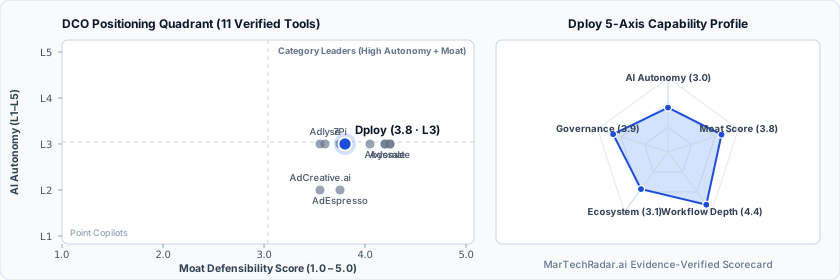
Dploy is a Web SaaS tool for DCO (Dynamic Creative Optimization / DCO) in AdTech & Paid Media. Pricing: Custom / enterprise pricing. Best suited to Performance Marketing Directors, Ad Agencies and Retail Media Advertisers. Editor ratings: AI autonomy L3 (conditional automation); moat score 3.8/5.0 (Proprietary moat). Fact-checked by Julie Brot on Oct 11, 2026.
AI-driven in-store programmatic audio advertising platform transforming retail soundscapes into dynamic media networks for brands and retailers.
Dploy buyer fit verdict: when to choose vs. when to walk away
Choose Dploy if (Best Fit)
- Target ICP & Stack Fit: You operate as Performance Marketing Directors, Ad Agencies and Retail Media Advertisers requiring a Web SaaS deployment for DCO.
- L3 Architecture & Defensibility: Proprietary physical-store audio programmatic injection engine coupled with real-time generative audio synthesis optimized for retail acoustic environments.
- Commercial Model Fit: Your procurement budget aligns with Custom / enterprise pricing.
Walk away from Dploy if (Deal-Breakers)
- Walk away if you require transparent self-serve monthly billing or your budget ceiling is under $1,000/mo (Dploy requires sales-gated custom quoting).
- Walk away if your workflow cannot tolerate hardware-level acoustic variability: Legacy speaker systems across disparate retail real estate portfolios cause non-standardized volume decibels and distorted frequency outputs that degrade synthetic voice clarity.
- Walk away if store connectivity disruptions is a deal-breaker for your team: Loss of localized store internet connectivity interrupts programmatic ad queues, requiring robust local device caching to avoid dead air or stale promotional announcements.
Dploy key facts & scorecard
| Pricing | Custom / enterprise pricing |
|---|---|
| Free plan | No / not disclosed |
| Delivery | Web SaaS |
| Audience | Performance Marketing Directors, Ad Agencies, Retail Media Advertisers |
| AI autonomy level | L3 · Conditional automationEditor-verified |
| Moat tier & score | 3.8 / 5.0 · Proprietary moatEditor-verified |
| Funding | Undisclosed |
| Total funding | €500KBacked by Angel Investors |
| Founders | Adrien Fournis, Charles Noirclerc |
| Company size | 2-10 employees |
| Headquarters | Paris, Île-de-France |
| Founded | 2025 |
| Last verified |
Dploy pros & cons: strengths vs. operational limitations
Pros: core strengths & capabilities
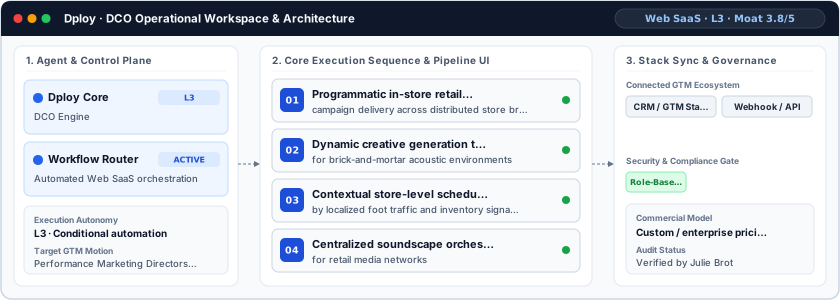
- Programmatic in-store retail audio: campaign delivery across distributed store branches
- Dynamic creative generation tailored: for brick-and-mortar acoustic environments
- Contextual store-level scheduling driven: by localized foot traffic and inventory signals
- Centralized soundscape orchestration: for retail media networks
Cons: operational limitations & risks
- Hardware-level acoustic variability: Legacy speaker systems across disparate retail real estate portfolios cause non-standardized volume decibels and distorted frequency outputs that degrade synthetic voice clarity.
- Store connectivity disruptions: Loss of localized store internet connectivity interrupts programmatic ad queues, requiring robust local device caching to avoid dead air or stale promotional announcements.
- Point-of-sale attribution latency: Reconciling offline checkout inventory telemetry with specific audio spot delivery windows introduces complex attribution lag and noisy matching models.
Dploy TCO & deal-breaker stress test
Simulate 12-month stepped TCO, hidden cost multipliers, contract lock-in exposure, and stack failure modes using only facts verified by Julie Brot on · Capture SHA b7884f04.
Dploy triggers high-severity friction under your 5-seat / $800/mo constraints. Benchmark the verified subtrack alternatives below before committing.
| Plan / Tier | Verified Rate | Scale Fit | Scope & Quota Notes |
|---|---|---|---|
| Enterprise / Custom | Custom quote | 15–50+ seats (Enterprise SLA) | Sales-negotiated annual contract for custom volume, SSO/RBAC governance, and dedicated SLA. |
- Moat Score
- 3.8 / 5.0
- AI Autonomy
- L3
- Free Tier / Trial
- None disclosed
Triggered audit signals & failure modes
- Opaque Enterprise Quoting vs. SMB/Mid-Market BudgetVerified Pricing Ledger
Dploy does not disclose a public self-serve floor (Custom / enterprise pricing). Buyers with a $800/mo cap face high sales-qualification friction.
- Sales-Gated Contract TermsFact-checked by Julie Brot
Dploy utilizes a direct-to-enterprise subscription and usage model.
- Primary Operational Bottleneck: Hardware-level acoustic variabilityAudit by Julie Brot
Legacy speaker systems across disparate retail real estate portfolios cause non-standardized volume decibels and distorted frequency outputs that degrade synthetic voice clarity.
Hidden TCO Multipliers & Quota Gates
- Hardware-level acoustic variability: Legacy speaker systems across disparate retail real estate portfolios cause non-standardized volume decibels and distorted frequency outputs that degrade synthetic voice clarity.
- Store connectivity disruptions: Loss of localized store internet connectivity interrupts programmatic ad queues, requiring robust local device caching to avoid dead air or stale promotional announcements.
When to Walk Away & Negotiation Levers
- Walk away if you require transparent self-serve monthly billing or your budget ceiling is under $1,000/mo (Dploy requires sales-gated custom quoting).
- Walk away if your workflow cannot tolerate hardware-level acoustic variability: Legacy speaker systems across disparate retail real estate portfolios cause non-standardized volume decibels and distorted frequency outputs that degrade synthetic voice clarity.
- Walk away if store connectivity disruptions is a deal-breaker for your team: Loss of localized store internet connectivity interrupts programmatic ad queues, requiring robust local device caching to avoid dead air or stale promotional announcements.
- Demand a 30- to 60-day paid pilot opt-out clause in the Dploy order form before signing a 12-month enterprise commitment.
- Require a sandbox proof-of-concept testing hardware-level acoustic variability against your live CRM/data schema before annual sign-off.
Ask a custom procurement or TCO stress-test question about Dploy
Lower 5-seat floor (~$36/mo vs. Custom Quote) · Transparent self-serve entry without mandatory annual lock-in
Lower 5-seat floor (~$49/mo vs. Custom Quote) · Transparent self-serve entry without mandatory annual lock-in
Dploy moat & subtrack positioning
Proprietary physical-store audio programmatic injection engine coupled with real-time generative audio synthesis optimized for retail acoustic environments.
Editorial review
Fact-checked by Julie Brot (Enterprise SaaS Governance & Procurement Editor) on .
Background
For retail media operators and consumer brand marketers aiming to capture physical store shoppers at the point of sale, Dploy converts brick-and-mortar soundscapes into programmatic advertising channels. Headquartered in Paris, Île-de-France, and founded in 2025, the company secured €500K in seed capital to resolve audio fragmentation across physical storefronts. Dploy serves retail media network directors and FMCG marketing leaders who need dynamic creative execution inside high-intent retail environments.
How Dploy works
At an architectural level, Dploy operates as a centralized audio delivery engine that pairs generative synthetic voice rendering with programmatic retail ad insertion. The ingestion pipeline accepts catalog feeds, promotional schedules, and localized inventory updates, orchestrating contextual audio spots directly to connected in-store acoustic hardware. Functioning at an L3 autonomy profile, the platform generates localized script variants and automatically balances promotional messaging with ambient sound design across distributed physical locations.
Limitations
Operational considerations and platform boundaries include:
- Hardware-level acoustic variability: Legacy speaker systems across disparate retail real estate portfolios cause non-standardized volume decibels and distorted frequency outputs that degrade synthetic voice clarity.
- Store connectivity disruptions: Loss of localized store internet connectivity interrupts programmatic ad queues, requiring robust local device caching to avoid dead air or stale promotional announcements.
- Point-of-sale attribution latency: Reconciling offline checkout inventory telemetry with specific audio spot delivery windows introduces complex attribution lag and noisy matching models.
Dploy pricing
Dploy utilizes a direct-to-enterprise subscription and usage model. Commercial pricing is available on request through tailored enterprise sales quotes based on organizational scale and seats, encompassing the number of physical store locations onboarded, audio stream volume, and programmatic transaction throughput without standard self-serve tiers.
How Dploy compares
While horizontal dynamic creative optimization tools like Abyssale and AdCreative.ai concentrate strictly on static social banners or display ads, and 7Pi focuses on algorithmic visual digital displays, Dploy addresses the sonic dimension of physical retail media. The platform is best matched for national grocery networks, department stores, and retail media syndicates seeking automated in-store audio inventory monetization.
Frequently asked questions about Dploy
How much does Dploy cost and does it require a custom enterprise quote?
Published pricing summary for Dploy: Custom / enterprise pricing. A permanent free plan is not disclosed for Dploy. Dploy utilizes a direct-to-enterprise subscription and usage model.
How does Dploy work and how autonomous is its AI architecture?
AI-driven in-store programmatic audio advertising platform transforming retail soundscapes into dynamic media networks for brands and retailers. Within DCO (Dynamic Creative Optimization / DCO), MarTechRadar rates its execution architecture at L3 · Conditional automation with a verified Moat Score of 3.8 / 5.0 (Proprietary moat). Proprietary physical-store audio programmatic injection engine coupled with real-time generative audio synthesis optimized for retail acoustic environments. Corporate profile: Founded by Adrien Fournis, Charles Noirclerc, operating at 2-10 employees scale.
What are the main limitations of Dploy and when should buyers walk away?
Based on our editorial technical audit, key operational considerations and boundaries for Dploy include: (1) Hardware-level acoustic variability: Legacy speaker systems across disparate retail real estate portfolios cause non-standardized volume decibels and distorted frequency outputs that degrade synthetic voice clarity. (2) Store connectivity disruptions: Loss of localized store internet connectivity interrupts programmatic ad queues, requiring robust local device caching to avoid dead air or stale promotional announcements. (3) Point-of-sale attribution latency: Reconciling offline checkout inventory telemetry with specific audio spot delivery windows introduces complex attribution lag and noisy matching models. Primary procurement walk-away rule: Walk away if you require transparent self-serve monthly billing or your budget ceiling is under $1,000/mo (Dploy requires sales-gated custom quoting).
What integrations, compliance certifications, and contract terms apply to Dploy?
Key TCO multiplier to watch: Hardware-level acoustic variability (Legacy speaker systems across disparate retail real estate portfolios cause non-standardized volume decibels and distorted frequency outputs that degrade synthetic voice clarity.) Before signing a contract, procurement teams should demand a 30- to 60-day paid pilot opt-out clause in the Dploy order form before signing a 12-month enterprise commitment.
What are the best Dploy alternatives and head-to-head competitors in 2026?
Top fact-checked alternatives to Dploy in DCO (Dynamic Creative Optimization / DCO) include Polynomic (Custom / enterprise pricing), datacakes ai (Custom / enterprise pricing), FLUX (Custom / enterprise pricing), Kampania (Custom / enterprise pricing). While horizontal dynamic creative optimization tools like Abyssale and AdCreative.ai concentrate strictly on static social banners or display ads, and 7Pi focuses on algorithmic visual digital displays, Dploy addresses the sonic dimension of physical retail media.
Verified sources & evidence trail
- Official product domain: https://www.dploy.audio/
- Commercial pricing verification: Verified against official vendor pricing policy (Custom / enterprise pricing)
- Verified corporate entity profiles (
sameAs): LinkedIn Company Profile · Crunchbase Entity Record - Editorial audit sign-off: Fact-checked by Julie Brot on under the MarTechRadar Evidence-Ledger Protocol.