deece Review (2026): DCO Pricing, Limits & Alternatives
Bottom line
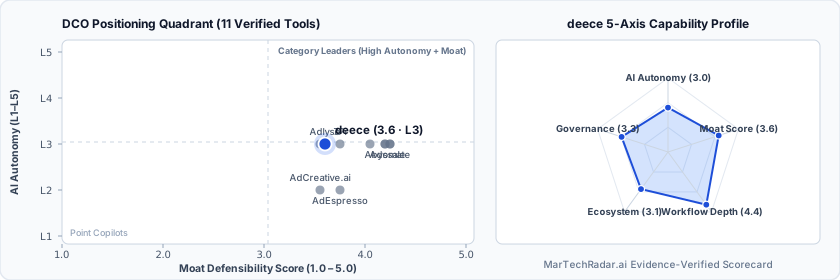
deece is a Web SaaS tool for DCO (Dynamic Creative Optimization / DCO) in AdTech & Paid Media. Pricing: Custom / enterprise pricing. Best suited to Performance Marketing Directors, Ad Agencies and Retail Media Advertisers. Editor ratings: AI autonomy L3 (conditional automation); moat score 3.6/5.0 (Proprietary moat). Fact-checked by Jagmeet Sine on Oct 14, 2026.
AI-driven campaign briefing and dynamic creative optimization engine designed to streamline creative production and ad delivery workflows.
deece buyer fit verdict: when to choose vs. when to walk away
Choose deece if (Best Fit)
- Target ICP & Stack Fit: You operate as Performance Marketing Directors, Ad Agencies and Retail Media Advertisers requiring a Web SaaS deployment for DCO.
- L3 Architecture & Defensibility: Deece couples structured marketing briefing frameworks with dynamic creative optimization algorithms, reducing upstream brief misalignment before automated ad generation.
- Commercial Model Fit: Your procurement budget aligns with Custom / enterprise pricing.
Walk away from deece if (Deal-Breakers)
- Walk away if you require transparent self-serve monthly billing or your budget ceiling is under $1,000/mo (deece requires sales-gated custom quoting).
- Walk away if your workflow cannot tolerate taxonomy ingestion rigidity: The brief-to-asset parsing engine falters when campaigns deviate from standard multi-variant matrix formats, requiring manual key-value field remapping.
- Walk away if downstream attribution lag is a deal-breaker for your team: Creative rotation adjustments suffer from external DSP reporting delays, preventing real-time intra-hour bidding reallocations.
deece key facts & scorecard
| Pricing | Custom / enterprise pricing |
|---|---|
| Free plan | No / not disclosed |
| Delivery | Web SaaS |
| Audience | Performance Marketing Directors, Ad Agencies, Retail Media Advertisers |
| AI autonomy level | L3 · Conditional automationEditor-verified |
| Moat tier & score | 3.6 / 5.0 · Proprietary moatEditor-verified |
| Funding | Pre-seed |
| Company size | 2-10 employees |
| Governance & docs | Privacy ↗ |
| Headquarters | Dublin |
| Founded | 2025 |
| Last verified |
deece pros & cons: strengths vs. operational limitations
Pros: core strengths & capabilities
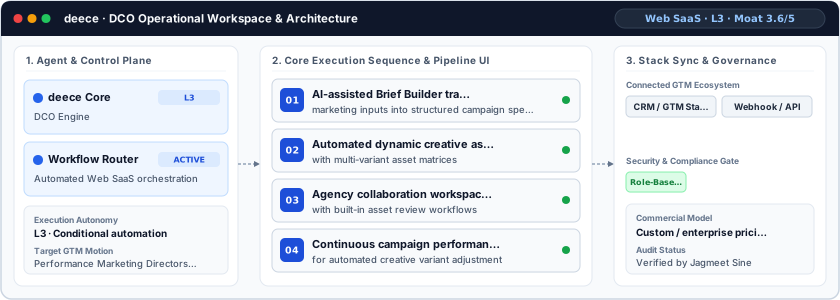
- AI-assisted Brief Builder transforming: marketing inputs into structured campaign specifications
- Automated dynamic creative assembly aligned: with multi-variant asset matrices
- Agency collaboration workspaces: with built-in asset review workflows
- Continuous campaign performance ingestion: for automated creative variant adjustment
Cons: operational limitations & risks
- Taxonomy Ingestion Rigidity: The brief-to-asset parsing engine falters when campaigns deviate from standard multi-variant matrix formats, requiring manual key-value field remapping.
- Downstream Attribution Lag: Creative rotation adjustments suffer from external DSP reporting delays, preventing real-time intra-hour bidding reallocations.
- Template Structural Constraints: Custom ad units with dynamic HTML5 animations exceed the platform's templating guardrails, requiring external developer intervention.
deece TCO & deal-breaker stress test
Simulate 12-month stepped TCO, hidden cost multipliers, contract lock-in exposure, and stack failure modes using only facts verified by Jagmeet Sine on · Capture SHA 198bfb3f.
deece triggers high-severity friction under your 5-seat / $800/mo constraints. Benchmark the verified subtrack alternatives below before committing.
| Plan / Tier | Verified Rate | Scale Fit | Scope & Quota Notes |
|---|---|---|---|
| Enterprise / Custom | Custom quote | 15–50+ seats (Enterprise SLA) | Sales-negotiated annual contract for custom volume, SSO/RBAC governance, and dedicated SLA. |
- Moat Score
- 3.6 / 5.0
- AI Autonomy
- L3
- Free Tier / Trial
- None disclosed
Triggered audit signals & failure modes
- Opaque Enterprise Quoting vs. SMB/Mid-Market BudgetVerified Pricing Ledger
deece does not disclose a public self-serve floor (Custom / enterprise pricing). Buyers with a $800/mo cap face high sales-qualification friction.
- Sales-Gated Contract TermsFact-checked by Jagmeet Sine
Commercial pricing is available on request through tailored enterprise sales quotes based on organizational scale and seats.
- Primary Operational Bottleneck: Taxonomy Ingestion RigidityAudit by Jagmeet Sine
The brief-to-asset parsing engine falters when campaigns deviate from standard multi-variant matrix formats, requiring manual key-value field remapping.
Hidden TCO Multipliers & Quota Gates
- Taxonomy Ingestion Rigidity: The brief-to-asset parsing engine falters when campaigns deviate from standard multi-variant matrix formats, requiring manual key-value field remapping.
- Downstream Attribution Lag: Creative rotation adjustments suffer from external DSP reporting delays, preventing real-time intra-hour bidding reallocations.
When to Walk Away & Negotiation Levers
- Walk away if you require transparent self-serve monthly billing or your budget ceiling is under $1,000/mo (deece requires sales-gated custom quoting).
- Walk away if your workflow cannot tolerate taxonomy ingestion rigidity: The brief-to-asset parsing engine falters when campaigns deviate from standard multi-variant matrix formats, requiring manual key-value field remapping.
- Walk away if downstream attribution lag is a deal-breaker for your team: Creative rotation adjustments suffer from external DSP reporting delays, preventing real-time intra-hour bidding reallocations.
- Demand a 30- to 60-day paid pilot opt-out clause in the deece order form before signing a 12-month enterprise commitment.
- Require a sandbox proof-of-concept testing taxonomy ingestion rigidity against your live CRM/data schema before annual sign-off.
Ask a custom procurement or TCO stress-test question about deece
Lower 5-seat floor (~$36/mo vs. Custom Quote) · Transparent self-serve entry without mandatory annual lock-in
Lower 5-seat floor (~$99/mo vs. Custom Quote) · Transparent self-serve entry without mandatory annual lock-in
deece moat & subtrack positioning
Deece couples structured marketing briefing frameworks with dynamic creative optimization algorithms, reducing upstream brief misalignment before automated ad generation.
Editorial review
Fact-checked by Jagmeet Sine (Senior MarTech Infrastructure & Agentic Workflow Architect) on .
Background
Marketing directors face significant budget waste when ambiguous upstream briefs cause production delays and mismatched ad creatives. Headquartered in Dublin and founded in 2025, deece addresses this coordination problem by unifying brief generation with automated creative optimization workflows. The platform targets agency brand planners, performance marketing directors, and creative production teams who require programmatic alignment between strategic briefing parameters and downstream ad execution.
How deece works
Operating with Level 3 conditional autonomy, the core mechanism centers on an algorithmic Brief Builder that parses natural-language campaign objectives into structured, machine-readable asset schemas. This taxonomy pipeline feeds directly into a dynamic creative rendering engine, mapping headline variations, visual components, and call-to-action modules into pre-validated digital display templates. The system ingests programmatic engagement signals and postback metrics from integrated DSPs to calibrate live variant weights, automatically pausing underperforming asset configurations within bounded optimization thresholds.
Limitations
Operational considerations and platform boundaries include:
- Taxonomy Ingestion Rigidity: The brief-to-asset parsing engine falters when campaigns deviate from standard multi-variant matrix formats, requiring manual key-value field remapping.
- Downstream Attribution Lag: Creative rotation adjustments suffer from external DSP reporting delays, preventing real-time intra-hour bidding reallocations.
- Template Structural Constraints: Custom ad units with dynamic HTML5 animations exceed the platform's templating guardrails, requiring external developer intervention.
deece pricing
Commercial pricing is available on request through tailored enterprise sales quotes based on organizational scale and seats. Contracts typically require annual software licensing agreements with tiered commitments that scale based on active campaign volume, workspace seats, and connected media endpoints. Onboarding packages include dedicated agency provisioning, custom template configuration, and hands-on integration assistance for media-buying pipelines.
How deece compares
Within dynamic creative optimization, deece bridges strategy and programmatic assembly, unlike pure render-pipeline engines such as Abyssale or automated social copy generators like AdCreative.ai. While 7Pi emphasizes algorithmic bid routing, deece enforces governance at the briefing phase to curb downstream creative waste. The software fits mid-market and enterprise marketing agencies that prioritize structured brief governance alongside automated asset generation across complex multi-channel media plans.
Frequently asked questions about deece
How much does deece cost and does it require a custom enterprise quote?
Published pricing summary for deece: Custom / enterprise pricing. A permanent free plan is not disclosed for deece. Commercial pricing is available on request through tailored enterprise sales quotes based on organizational scale and seats. Contracts typically require annual software licensing agreements with tiered commitments that scale based on active campaign volume, workspace seats, and connected media endpoints.
How does deece work and how autonomous is its AI architecture?
AI-driven campaign briefing and dynamic creative optimization engine designed to streamline creative production and ad delivery workflows. Within DCO (Dynamic Creative Optimization / DCO), MarTechRadar rates its execution architecture at L3 · Conditional automation with a verified Moat Score of 3.6 / 5.0 (Proprietary moat). Deece couples structured marketing briefing frameworks with dynamic creative optimization algorithms, reducing upstream brief misalignment before automated ad generation. Corporate profile: operating at 2-10 employees scale.
What are the main limitations of deece and when should buyers walk away?
Based on our editorial technical audit, key operational considerations and boundaries for deece include: (1) Taxonomy Ingestion Rigidity: The brief-to-asset parsing engine falters when campaigns deviate from standard multi-variant matrix formats, requiring manual key-value field remapping. (2) Downstream Attribution Lag: Creative rotation adjustments suffer from external DSP reporting delays, preventing real-time intra-hour bidding reallocations. (3) Template Structural Constraints: Custom ad units with dynamic HTML5 animations exceed the platform's templating guardrails, requiring external developer intervention. Primary procurement walk-away rule: Walk away if you require transparent self-serve monthly billing or your budget ceiling is under $1,000/mo (deece requires sales-gated custom quoting).
What integrations, compliance certifications, and contract terms apply to deece?
Key TCO multiplier to watch: Taxonomy Ingestion Rigidity (The brief-to-asset parsing engine falters when campaigns deviate from standard multi-variant matrix formats, requiring manual key-value field remapping.) Before signing a contract, procurement teams should demand a 30- to 60-day paid pilot opt-out clause in the deece order form before signing a 12-month enterprise commitment.
What are the best deece alternatives and head-to-head competitors in 2026?
Top fact-checked alternatives to deece in DCO (Dynamic Creative Optimization / DCO) include Adlyse (Custom / enterprise pricing), Atmospherik (Custom / enterprise pricing), ConvertedIn (Custom / enterprise pricing), Kargo (Custom / enterprise pricing). Within dynamic creative optimization, deece bridges strategy and programmatic assembly, unlike pure render-pipeline engines such as Abyssale or automated social copy generators like AdCreative.ai.
Verified sources & evidence trail
- Official product domain: https://deece.ai
- Commercial pricing verification: Verified against official vendor pricing policy (Custom / enterprise pricing)
- Verified corporate entity profiles (
sameAs): LinkedIn Company Profile · Crunchbase Entity Record - First-party governance & documentation links: Privacy
- Editorial audit sign-off: Fact-checked by Jagmeet Sine on under the MarTechRadar Evidence-Ledger Protocol.