Adwave Review (2026): DCO Pricing, Limits & Alternatives
Bottom line
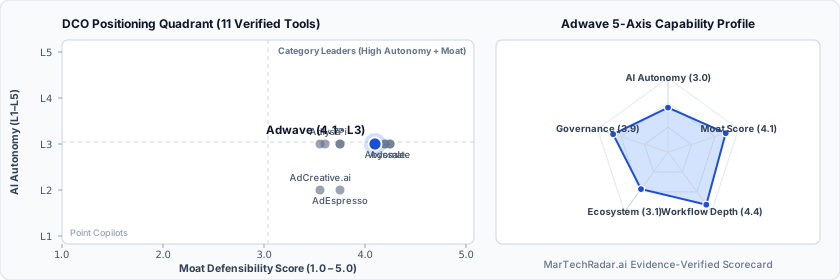
Adwave is a Web SaaS tool for DCO (Dynamic Creative Optimization / DCO) in AdTech & Paid Media. Pricing: Free plan · $0/mo · Enterprise plan. Best suited to Performance Marketing Directors, Ad Agencies and Retail Media Advertisers. Editor ratings: AI autonomy L3 (conditional automation); moat score 4.1/5.0 (Proprietary moat). Fact-checked by Anthony Hay on Oct 12, 2026.
Automated cross-channel creative generation and media delivery platform converting website assets into Connected TV, search, and social ad campaigns.
Adwave buyer fit verdict: when to choose vs. when to walk away
Choose Adwave if (Best Fit)
- Target ICP & Stack Fit: You operate as Performance Marketing Directors, Ad Agencies and Retail Media Advertisers requiring a Web SaaS deployment for DCO.
- L3 Architecture & Defensibility: Proprietary URL-to-creative multimodal extraction pipeline paired with direct programmatic Connected TV inventory access for SMB ad units.
- Commercial Model Fit: Your procurement budget aligns with Free plan · $0/mo · Enterprise plan and want a self-serve free tier for zero-cost initial validation.
Walk away from Adwave if (Deal-Breakers)
- Walk away if your workflow requires uncapped enterprise volume on the Free plan · $0/mo · Enterprise plan entry plan without upgrading tiers.
- Walk away if your workflow cannot tolerate website asset dependency: The system depends entirely on crawlable HTML and structured imagery, producing degraded dynamic creatives when parsing single-page JavaScript applications or low-resolution web pages.
- Walk away if algorithmic media control constraints is a deal-breaker for your team: Media allocation across channels occurs through centralized daily budget inputs, limiting manual bidding granularity and direct private marketplace deal configurations on Connected TV inventory.
Adwave key facts & scorecard
| Pricing | Free plan · $0/mo · Enterprise planVendor pricing page |
|---|---|
| Free plan | Yes |
| Delivery | Web SaaS |
| Audience | Performance Marketing Directors, Ad Agencies, Retail Media Advertisers |
| AI autonomy level | L3 · Conditional automationEditor-verified |
| Moat tier & score | 4.1 / 5.0 · Proprietary moatEditor-verified |
| Funding | Pre-seed |
| Total funding | $1MBacked by Aurelia Ventures |
| Founders | David Naffis |
| Company size | 11-50 employees |
| Governance & docs | Terms ↗ · Privacy ↗ |
| Headquarters | Frederick, Maryland, United States |
| Founded | 2024 |
| Last verified |
Adwave pros & cons: strengths vs. operational limitations
Pros: core strengths & capabilities
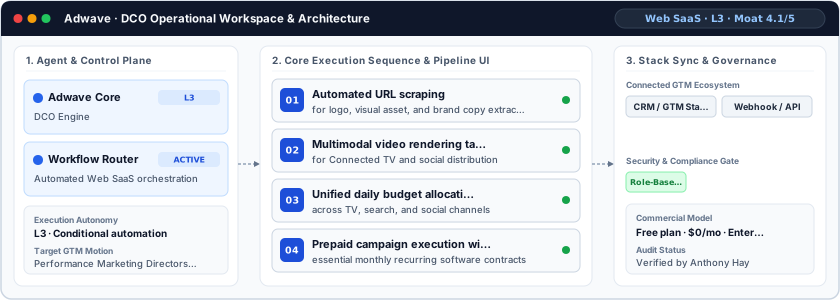
- Automated URL scraping: for logo, visual asset, and brand copy extraction
- Multimodal video rendering tailored: for Connected TV and social distribution
- Unified daily budget allocation: across TV, search, and social channels
- Prepaid campaign execution without: essential monthly recurring software contracts
Cons: operational limitations & risks
- Website Asset Dependency: The system depends entirely on crawlable HTML and structured imagery, producing degraded dynamic creatives when parsing single-page JavaScript applications or low-resolution web pages.
- Algorithmic Media Control Constraints: Media allocation across channels occurs through centralized daily budget inputs, limiting manual bidding granularity and direct private marketplace deal configurations on Connected TV inventory.
- Creative Component Customization Latency: Iterating synthesized video spots requires re-rendering brand parameters across the multimodal generation queue rather than enabling sub-frame vector edits in a timeline canvas.
Adwave TCO & deal-breaker stress test
Simulate 12-month stepped TCO, hidden cost multipliers, contract lock-in exposure, and stack failure modes using only facts verified by Anthony Hay on · Capture SHA 009a260c.
Adwave is viable for 5 seats, but requires commercial or technical verification on the flagged items below.
| Plan / Tier | Verified Rate | Scale Fit | Scope & Quota Notes |
|---|---|---|---|
| Free / Sandbox | $0 | 1–2 seats (Evaluation) | Entry free tier with capped usage or feature quotas for initial workflow testing. |
| Entry / Starter | $0.38/mo | 1–2 seats | For individual business signups. Credit is available at signup. Unused credit expires after 14 |
| Growth / Professional | $6/mo | 5 seats | For individual business signups. Credit is available at signup. Unused credit expires after 14 |
| Scale / Advanced | $12/mo | 15 seats | For individual business signups. Credit is available at signup. Unused credit expires after 14 |
- Moat Score
- 4.1 / 5.0
- AI Autonomy
- L3
- Free Tier / Trial
- Free plan
Triggered audit signals & failure modes
- Opaque Enterprise Quoting vs. SMB/Mid-Market BudgetVerified Pricing Ledger
Adwave does not disclose a public self-serve floor (Free plan · $0/mo · Enterprise plan). Buyers with a $800/mo cap face high sales-qualification friction.
- Published Self-Serve Entry FloorVerified Pricing Ledger
Adwave publishes a transparent entry point (Free plan · $0/mo · Enterprise plan) with a free tier for initial validation before committing.
- Tier Fit for 5-Seat Scale: Entry / Starter ($0.38/mo)Verified Tier Schedule
For individual business signups. Credit is available at signup. Unused credit expires after 14
- Primary Operational Bottleneck: Algorithmic Media Control ConstraintsAudit by Anthony Hay
Media allocation across channels occurs through centralized daily budget inputs, limiting manual bidding granularity and direct private marketplace deal configurations on Connected TV inventory.
Hidden TCO Multipliers & Quota Gates
- Credit & Usage Burn Multiplier: Automated workflows consume metered credits/usage quotas; multi-step enrichment, voice minutes, or high-frequency agent runs can trigger mid-cycle top-up packs.
- Website Asset Dependency: The system depends entirely on crawlable HTML and structured imagery, producing degraded dynamic creatives when parsing single-page JavaScript applications or low-resolution web pages.
- Algorithmic Media Control Constraints: Media allocation across channels occurs through centralized daily budget inputs, limiting manual bidding granularity and direct private marketplace deal configurations on Connected TV inventory.
When to Walk Away & Negotiation Levers
- Walk away if your workflow requires uncapped enterprise volume on the Free plan · $0/mo · Enterprise plan entry plan without upgrading tiers.
- Walk away if your workflow cannot tolerate website asset dependency: The system depends entirely on crawlable HTML and structured imagery, producing degraded dynamic creatives when parsing single-page JavaScript applications or low-resolution web pages.
- Walk away if algorithmic media control constraints is a deal-breaker for your team: Media allocation across channels occurs through centralized daily budget inputs, limiting manual bidding granularity and direct private marketplace deal configurations on Connected TV inventory.
- Validate exact quota thresholds (seats, credits, or API calls) included in Adwave's Free plan · $0/mo · Enterprise plan tier before converting from monthly to annual billing.
- Require a sandbox proof-of-concept testing website asset dependency against your live CRM/data schema before annual sign-off.
Ask a custom procurement or TCO stress-test question about Adwave
Lower 5-seat floor (~$99/mo vs. Custom Quote)
Lower 5-seat floor (~$36/mo vs. Custom Quote)
Adwave moat & subtrack positioning
Proprietary URL-to-creative multimodal extraction pipeline paired with direct programmatic Connected TV inventory access for SMB ad units.
Editorial review
Fact-checked by Anthony Hay (Senior SEO, Search Intelligence & Content Operations Editor) on .
Background
Established with $1M in initial venture capitalization, Adwave was founded in 2024 in Frederick, Maryland, United States, to automate cross-channel creative asset generation and programmatic campaign execution. Targeting growth agency operators and performance marketers handling distributed local accounts, the platform converts raw domain URLs into functional ad collateral. Within dynamic creative optimization workflows, Adwave targets cross-channel multi-format distribution by programmatically assembling video spots and visual placements for Connected TV, social networks, and paid search without manual studio overhead.
How Adwave works
Adwave functions through an automated ingestion pipeline that parses brand domains via a headless crawler to extract color palettes, typography, image assets, value propositions, and social proof. An asset orchestration layer compiles these inputs into structured commercial video scripts and static variants formatted for programmatic specs. The engine automates dynamic creative generation and programmatic ad routing across Connected TV, social channels, and search environments, operating at Level 3 conditional autonomy where users review and confirm creatives prior to automated media activation.
Limitations
Operational considerations and platform boundaries include:
- Website Asset Dependency: The system depends entirely on crawlable HTML and structured imagery, producing degraded dynamic creatives when parsing single-page JavaScript applications or low-resolution web pages.
- Algorithmic Media Control Constraints: Media allocation across channels occurs through centralized daily budget inputs, limiting manual bidding granularity and direct private marketplace deal configurations on Connected TV inventory.
- Creative Component Customization Latency: Iterating synthesized video spots requires re-rendering brand parameters across the multimodal generation queue rather than enabling sub-frame vector edits in a timeline canvas.
Adwave pricing
Adwave structures its commercial packaging around prepaid media consumption, waiving base software platform subscription fees at a $0 entry commitment. Teams initiate campaign generation without upfront fees, deploying funds directly toward distribution where daily media parameters span from $30 up to $10000. Operational models illustrate representative allocations such as a $75 daily threshold totaling $2250 across thirty active billing days, complemented by custom contract arrangements for high-volume enterprise organizations requiring managed governance.
How Adwave compares
In the DCO landscape, compared to template-governed dynamic creative optimization platforms like Abyssale and AdCreative.ai, Adwave bundles programmatic channel execution directly with asset synthesis. While Abyssale emphasizes high-velocity API banner production and AdCreative.ai generates static conversion displays for social networks, Adwave isolates Connected TV and multi-network ad buying natively. Conversely, algorithmic design platforms like 7Pi offer deeper brand guideline controls, positioning Adwave primarily for performance agencies needing low-touch, automated creative-to-media delivery across cross-channel footprints.
Direct competitors & market radar
Top algorithmic competitors based on category positioning, capability overlap, and ICP alignment.
Frequently asked questions about Adwave
How much does Adwave cost and what pricing tiers are available?
Published pricing summary for Adwave: Free plan · $0/mo · Enterprise plan. Adwave includes a free tier or sandbox entry point. Verified tier schedule: Free / Sandbox ($0 for 1–2 seats (Evaluation)); Entry / Starter ($0.38/mo for 1–2 seats); Growth / Professional ($6/mo for 5 seats); Scale / Advanced ($12/mo for 15 seats). Adwave structures its commercial packaging around prepaid media consumption, waiving base software platform subscription fees at a $0 entry commitment. Teams initiate campaign generation without upfront fees, deploying funds directly toward distribution where daily media parameters span from $30 up to $10000.
How does Adwave work and how autonomous is its AI architecture?
Automated cross-channel creative generation and media delivery platform converting website assets into Connected TV, search, and social ad campaigns. Within DCO (Dynamic Creative Optimization / DCO), MarTechRadar rates its execution architecture at L3 · Conditional automation with a verified Moat Score of 4.1 / 5.0 (Proprietary moat). Proprietary URL-to-creative multimodal extraction pipeline paired with direct programmatic Connected TV inventory access for SMB ad units. Corporate profile: Founded by David Naffis, operating at 11-50 employees scale.
What are the main limitations of Adwave and when should buyers walk away?
Based on our editorial technical audit, key operational considerations and boundaries for Adwave include: (1) Website Asset Dependency: The system depends entirely on crawlable HTML and structured imagery, producing degraded dynamic creatives when parsing single-page JavaScript applications or low-resolution web pages. (2) Algorithmic Media Control Constraints: Media allocation across channels occurs through centralized daily budget inputs, limiting manual bidding granularity and direct private marketplace deal configurations on Connected TV inventory. (3) Creative Component Customization Latency: Iterating synthesized video spots requires re-rendering brand parameters across the multimodal generation queue rather than enabling sub-frame vector edits in a timeline canvas. Primary procurement walk-away rule: Walk away if your workflow requires uncapped enterprise volume on the Free plan · $0/mo · Enterprise plan entry plan without upgrading tiers.
What integrations, compliance certifications, and contract terms apply to Adwave?
Key TCO multiplier to watch: Credit & Usage Burn Multiplier (Automated workflows consume metered credits/usage quotas; multi-step enrichment, voice minutes, or high-frequency agent runs can trigger mid-cycle top-up packs.) Before signing a contract, procurement teams should validate exact quota thresholds (seats, credits, or API calls) included in Adwave's Free plan · $0/mo · Enterprise plan tier before converting from monthly to annual billing.
What are the best Adwave alternatives and head-to-head competitors in 2026?
Top fact-checked alternatives to Adwave in DCO (Dynamic Creative Optimization / DCO) include Adomate (From $99/mo), Connecty (Free plan · $0/mo · Enterprise plan), Hookmill (Free plan · $0/mo · Enterprise plan), Icon (Free plan · $0/mo · Enterprise plan). In the DCO landscape, compared to template-governed dynamic creative optimization platforms like Abyssale and AdCreative.ai, Adwave bundles programmatic channel execution directly with asset synthesis.
Verified sources & evidence trail
- Official product domain: http://www.adwave.com
- Commercial pricing verification: https://adwave.com/pricing
- Verified corporate entity profiles (
sameAs): LinkedIn Company Profile · Crunchbase Entity Record - First-party governance & documentation links: Terms · Privacy
- Editorial audit sign-off: Fact-checked by Anthony Hay on under the MarTechRadar Evidence-Ledger Protocol.