Openmart vs Pond
Reviewed by MarTechRadar Research Desk. Pricing & entity snapshots verified Oct 16, 2026.
Openmart (Web SaaS) and Pond (Web SaaS) both compete in Lead Enrichment & Waterfall Orchestration. On pricing, Openmart lists Free plan · $105–$209/mo (free plan), whereas Pond lists Custom / enterprise pricing (no free plan disclosed). Technically, Openmart is rated L3 · Conditional automation with a 3.3/5.0 (Workflow-embedded (strong)) moat, while Pond is rated L3 · Conditional automation with a 3.6/5.0 (Proprietary moat) moat. Corporate profile: Openmart (founded 2023, HQ San Francisco, California, $3.3M funding) vs. Pond (founded 2023, HQ San Francisco, $7.5M funding). Verified by the MarTechRadar Research Desk (Oct 16, 2026 for Openmart; Oct 14, 2026 for Pond). At a 5-seat team baseline, Openmart starts at ~$105/mo (base) vs Pond at Custom quote.
Openmart
AI local business and SMB data intelligence platform indexing 50M+ merchants for B2B outbound sales teams.
5-User Team Cost: ~$105/mo (base) (Free plan · $105–$209/mo) · Autonomy: L3 · Conditional automation · Moat: 3.3/5.0 (Workflow-embedded (strong))
Target fit: B2B SaaS, Marketing & Growth Teams (Web SaaS)
Pond
Autonomous B2B lead enrichment and waterfall orchestration platform coordinating agentic workflows to verify, score, and append account intelligence.
5-User Team Cost: Custom quote (Custom / enterprise pricing) · Autonomy: L3 · Conditional automation · Moat: 3.6/5.0 (Proprietary moat)
Target fit: B2B Sales Leaders, SDR/BDR Teams, Revenue Operations (RevOps) (Web SaaS)
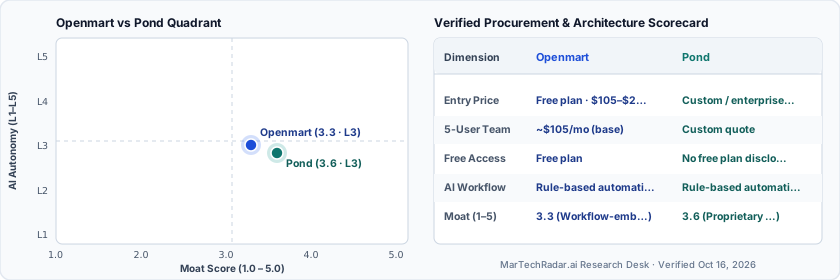
How Openmart and Pond differ
- Pricing model: Openmart is freemium, Pond is enterprise / quote.
- Openmart publishes an entry price (Free plan · $105–$209/mo); Pond does not (Custom / enterprise pricing).
- Openmart has a free plan; none is recorded for Pond.
- Moat tier: Pond is rated Proprietary moat, Openmart Workflow-embedded (strong).
- Headquarters: Openmart in San Francisco, California, Pond in San Francisco.
- Verified backing: Openmart records $3.3M; Pond records $7.5M.
- Audience: Openmart targets B2B SaaS, Marketing & Growth Teams; Pond targets B2B Sales Leaders, SDR/BDR Teams, Revenue Operations (RevOps).
- Ecosystem stack: Openmart connects with Slack, LinkedIn, Webflow; Pond connects with Twilio Segment, n8n.
Computed from the fields below. Only editor-verified ratings and vendor-sourced prices are compared.
When to choose Openmart vs Pond (and when to walk away)
Choose Openmart if
- Target ICP & Stack Fit: You operate as B2B SaaS and Marketing & Growth Teams requiring a Web SaaS deployment for Sales Intelligence, with verified ecosystem connectivity for Slack, LinkedIn, Webflow.
- L3 Architecture & Defensibility: Openmart builds a vertical data moat by aggregating 50M+ local business records across Google Maps, Yelp, state business registries, POS tech stacks, and review signals that LinkedIn-centric B2B databases miss.
- Commercial Model Fit: Your procurement budget aligns with Free plan · $105–$209/mo and want a self-serve free tier for zero-cost initial validation.
Walk away from Openmart if
- Walk away if your workflow requires uncapped enterprise volume on the Free plan · $105–$209/mo entry plan without upgrading tiers.
- Walk away if your workflow cannot tolerate brick-and-mortar smb scope boundary: Openmart is purpose-built for local merchants, restaurants, clinics, and franchises rather than white-collar enterprise software or Fortune 500 IT departments, making it unsuitable for enterprise SaaS ABM teams targeting corporate knowledge workers.
- Walk away if phone-first smb channel dependency is a deal-breaker for your team: Main-street business owners check email far less frequently than corporate executives, meaning GTM teams that rely solely on Openmart email exports without pairing direct phone dialer workflows face lower response rates.
Choose Pond if
- Target ICP & Stack Fit: You operate as B2B Sales Leaders, SDR/BDR Teams and Revenue Operations (RevOps) requiring a Web SaaS deployment for Sales Intelligence, with verified ecosystem connectivity for Twilio Segment, n8n.
- L3 Architecture & Defensibility: Pond leverages an agentic orchestration layer combining multi-provider waterfall routing with automated output verification, backed by strategic seed funding.
- Commercial Model Fit: Your procurement budget aligns with Custom / enterprise pricing.
Walk away from Pond if
- Walk away if you require transparent self-serve monthly billing or your budget ceiling is under $1,000/mo (Pond requires sales-gated custom quoting).
- Walk away if your workflow cannot tolerate attribution window lag: Waterfall queries spanning multiple asynchronous third-party data providers introduce latency bottlenecks that complicate real-time webhook ingestion during high-volume ingest spikes.
- Walk away if schema maintenance overhead is a deal-breaker for your team: Unifying heterogeneous data payloads from disparate providers requires continuous schema mapping maintenance to prevent field corruption across downstream enterprise CRMs.
Side-by-side facts
| Field | Openmart | Pond |
|---|---|---|
| Subtrack | Lead Enrichment & Waterfall Orchestration | Lead Enrichment & Waterfall Orchestration |
| Pricing | Free plan · $105–$209/mo | Custom / enterprise pricing |
| Pricing model | Freemium | Enterprise / quote |
| Published pricing tiers | Free / Sandbox ($0) · Starter ($105/mo) · Pro ($209/mo) | Enterprise / Custom (Custom quote) |
| Free access | Free plan | No free plan disclosed |
| Enterprise plan | Not recorded | Yes |
| AI autonomy level | L3 · Conditional automation | L3 · Conditional automation |
| Moat tier & score | 3.3 / 5.0 · Workflow-embedded (strong) | 3.6 / 5.0 · Proprietary moat |
| Delivery | Web SaaS | Web SaaS |
| Audience | B2B SaaS, Marketing & Growth Teams | B2B Sales Leaders, SDR/BDR Teams, Revenue Operations (RevOps) |
| Ecosystem integrations | Slack, LinkedIn, Webflow | Twilio Segment, n8n |
| Compliance & governance | GDPR, CCPA | — |
| Funding & backing | $3.3M | $7.5M |
| Founders | Kathryn Wu, Richard He | Dylan Zhang |
| Company size | 11-50 employees | 11-50 employees |
| Founded | 2023 | 2023 |
| Headquarters | San Francisco, California | San Francisco |
| Fact-checked | MarTechRadar Research Desk, Oct 16, 2026 | MarTechRadar Research Desk, Oct 14, 2026 |
| Governance & docs | API & Docs ↗ · Terms ↗ · Privacy ↗ | API & Docs ↗ · Terms ↗ · Privacy ↗ |
Openmart vs Pond: TCO & constraint stress test
Test how both tools behave under your team size, monthly budget ceiling, CRM ecosystem, and governance guardrails.
Openmart
Low Procurement Risk · Strong Fit- Published Self-Serve Entry Floor: Openmart publishes a transparent entry point (Free plan · $105–$209/mo) with a free tier for initial validation before committing.
- Tier Fit for 5-Seat Scale: Pro ($209/mo): For teams needing higher volume and integrations
- Primary Operational Bottleneck: Brick-and-Mortar SMB Scope Boundary: Openmart is purpose-built for local merchants, restaurants, clinics, and franchises rather than white-collar enterprise software or Fortune 500 IT departments, making it unsuitable for enterprise SaaS ABM teams targeting corporate knowledge workers.
Walk-Away Rule: Walk away if your workflow requires uncapped enterprise volume on the Free plan · $105–$209/mo entry plan without upgrading tiers.
Negotiation Lever: Validate exact quota thresholds (seats, credits, or API calls) included in Openmart's Free plan · $105–$209/mo tier before converting from monthly to annual billing.
Pond
High Deal-Risk · Constraint Mismatch- Opaque Enterprise Quoting vs. SMB/Mid-Market Budget: Pond does not disclose a public self-serve floor (Custom / enterprise pricing). Buyers with a $800/mo cap face high sales-qualification friction.
- Sales-Gated Contract Terms: Pond delivers its commercial licensing through direct enterprise agreements, with pricing available on request via tailored sales proposals based on organizational scale and seat allocations.
- Primary Operational Bottleneck: Attribution Window Lag: Waterfall queries spanning multiple asynchronous third-party data providers introduce latency bottlenecks that complicate real-time webhook ingestion during high-volume ingest spikes.
Walk-Away Rule: Walk away if you require transparent self-serve monthly billing or your budget ceiling is under $1,000/mo (Pond requires sales-gated custom quoting).
Negotiation Lever: Demand a 30- to 60-day paid pilot opt-out clause in the Pond order form before signing a 12-month enterprise commitment.
Limitations
Openmart
Operational limitations and technical trade-offs include: Brick-and-Mortar SMB Scope Boundary: Openmart is purpose-built for local merchants, restaurants, clinics, and franchises rather than white-collar enterprise software or Fortune 500 IT departments, making it unsuitable for enterprise SaaS ABM teams targeting corporate knowledge workers.Full limitations in the Openmart review
Pond
Operational considerations and platform boundaries include: Attribution Window Lag: Waterfall queries spanning multiple asynchronous third-party data providers introduce latency bottlenecks that complicate real-time webhook ingestion during high-volume ingest spikes.Full limitations in the Pond review
Official vendor architectural differentiators & migration proof
To help buyers evaluate real-world switching costs, verified founders, solutions architects, and PMMs at both Openmart and Pond can submit up to 3 evidence-backed architectural differentiators or verified customer migration case studies.
Why teams choose Openmart over Pond
Work at Openmart? Verify your official domain email to publish 3 technical differentiators, migration benchmarks, or a head-to-head buyer sandbox offer on this comparison page:
+ Submit Openmart Official Differentiators & Case Study →Why teams choose Pond over Openmart
Work at Pond? Verify your official domain email to publish 3 technical differentiators, migration benchmarks, or a head-to-head buyer sandbox offer on this comparison page:
+ Submit Pond Official Differentiators & Case Study →Pricing notes & tier schedules
Openmart: Free plan · $105–$209/mo
Openmart publishes transparent self-serve pricing on its official pricing page (`openmart.com/pricing`).
- Free / Sandbox ($0, 1–2 seats (Evaluation)): Entry free tier with capped usage or feature quotas for initial workflow testing.
- Starter ($105/mo, 1–2 seats): For users building a scalable outreach workflow
- Pro ($209/mo, 5 seats): For teams needing higher volume and integrations
- Annual Billing Headline vs. Monthly Premium: Headline entry rates reflect annual billing commitments (SAVE 30%); month-to-month flexibility carries a higher effective monthly rate or requires annual prepayment.
- Credit & Usage Burn Multiplier: Workflows on Openmart consume metered credits or usage quotas; voice/media minutes, multi-step synthesis, or high-frequency runs can exhaust base allocations and trigger mid-cycle top-up packs.
Pond: Custom / enterprise pricing
Pond delivers its commercial licensing through direct enterprise agreements, with pricing available on request via tailored sales proposals based on organizational scale and seat allocations.
- Enterprise / Custom (Custom quote, 15–50+ seats (Enterprise SLA)): Sales-negotiated annual contract for custom volume, SSO/RBAC governance, and dedicated SLA.
- Credit & Usage Burn Multiplier: Workflows on Pond consume metered credits or usage quotas; multi-provider enrichment lookups, scraping runs, or bulk batch jobs can exhaust base allocations and trigger mid-cycle top-up packs.
- Attribution Window Lag: Waterfall queries spanning multiple asynchronous third-party data providers introduce latency bottlenecks that complicate real-time webhook ingestion during high-volume ingest spikes.
Frequently asked questions: Openmart vs Pond
How does Openmart pricing compare to Pond in 2026?
Openmart is listed at Free plan · $105–$209/mo (freemium, free plan), whereas Pond is listed at Custom / enterprise pricing (enterprise / quote, no free plan disclosed).
How do Openmart and Pond compare on AI autonomy and moat depth?
On the MarTechRadar L1–L5 scale, Openmart is rated L3 · Conditional automation with a Workflow-embedded (strong) moat (3.3/5.0), while Pond is rated L3 · Conditional automation with a Proprietary moat moat (3.6/5.0).
Which teams are Openmart and Pond built for?
Openmart is a Web SaaS product in Lead Enrichment & Waterfall Orchestration designed for B2B SaaS, Marketing & Growth Teams. Pond is a Web SaaS product in Lead Enrichment & Waterfall Orchestration designed for B2B Sales Leaders, SDR/BDR Teams, Revenue Operations (RevOps).
What are the main limitations of Openmart vs Pond?
For Openmart: Operational limitations and technical trade-offs include: Brick-and-Mortar SMB Scope Boundary: Openmart is purpose-built for local merchants, restaurants, clinics, and franchises rather than white-collar enterprise software or Fortune 500 IT departments, making it unsuitable for enterprise SaaS ABM teams targeting corporate knowledge workers. For Pond: Operational considerations and platform boundaries include: Attribution Window Lag: Waterfall queries spanning multiple asynchronous third-party data providers introduce latency bottlenecks that complicate real-time webhook ingestion during high-volume ingest spikes.
What are the hidden TCO drivers and contract negotiation levers for Openmart vs Pond?
For Openmart: Annual Billing Headline vs. Monthly Premium (Headline entry rates reflect annual billing commitments (SAVE 30%); month-to-month flexibility carries a higher effective monthly rate or requires annual prepayment.) Negotiation lever: Validate exact quota thresholds (seats, credits, or API calls) included in Openmart's Free plan · $105–$209/mo tier before converting from monthly to annual billing. For Pond: Credit & Usage Burn Multiplier (Workflows on Pond consume metered credits or usage quotas; multi-provider enrichment lookups, scraping runs, or bulk batch jobs can exhaust base allocations and trigger mid-cycle top-up packs.) Negotiation lever: Demand a 30- to 60-day paid pilot opt-out clause in the Pond order form before signing a 12-month enterprise commitment.
Excerpts are quoted verbatim from each fact-checked review. Last updated Oct 16, 2026.