Mutiny vs OptiMonk
Reviewed by MarTechRadar Research Desk. Pricing & entity snapshots verified Oct 12, 2026.
Mutiny (Web SaaS) and OptiMonk (Web SaaS) both compete in Landing Page Builders & Autonomous CRO. On pricing, Mutiny lists Custom / enterprise pricing (no free plan disclosed), whereas OptiMonk lists From $19/mo (no free plan disclosed). Technically, Mutiny is rated L3 · Conditional automation with a 4.6/5.0 (Proprietary moat (category leader)) moat, while OptiMonk is rated L2 · Workflow copilot with a 3.2/5.0 (Workflow-embedded (strong)) moat. Corporate profile: Mutiny (founded 2018, HQ United States) vs. OptiMonk (founded 2014, HQ Debrecen, Hajdú-Bihar). Verified by the MarTechRadar Research Desk (Oct 7, 2026 for Mutiny; Oct 12, 2026 for OptiMonk). At a 5-seat team baseline, Mutiny starts at Custom quote vs OptiMonk at ~$19/mo (base).
Mutiny
Autonomous conversion rate optimization and B2B web personalization platform applying contextual machine learning to dynamic page components.
5-User Team Cost: Custom quote (Custom / enterprise pricing) · Autonomy: L3 · Conditional automation · Moat: 4.6/5.0 (Proprietary moat (category leader))
Target fit: B2B SaaS (Web SaaS)
OptiMonk
Autonomous conversion rate optimization platform and on-site overlay generator powered by agentic design mechanics and MCP integrations.
5-User Team Cost: ~$19/mo (base) (From $19/mo) · Autonomy: L2 · Workflow copilot · Moat: 3.2/5.0 (Workflow-embedded (strong))
Target fit: DTC / eCommerce (Web SaaS)
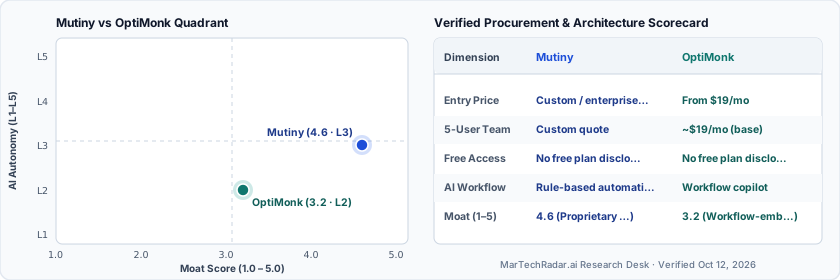
How Mutiny and OptiMonk differ
- Pricing model: Mutiny is enterprise / quote, OptiMonk is subscription.
- OptiMonk publishes an entry price (From $19/mo); Mutiny does not (Custom / enterprise pricing).
- AI autonomy: Mutiny is rated L3 · Conditional automation, OptiMonk L2 · Workflow copilot on the MarTechRadar scale.
- Moat tier: Mutiny is rated Proprietary moat (category leader), OptiMonk Workflow-embedded (strong).
- OptiMonk was founded earlier (2014) than Mutiny (2018).
- Headquarters: Mutiny in United States, OptiMonk in Debrecen, Hajdú-Bihar.
- Funding stage: Mutiny is Venture-backed; OptiMonk is Bootstrapped.
- Audience: Mutiny targets B2B SaaS; OptiMonk targets DTC / eCommerce.
- Ecosystem stack: Mutiny connects with Salesforce, Salesloft, Slack; OptiMonk connects with Twilio Segment, Google Ads, Model Context Protocol (MCP).
Computed from the fields below. Only editor-verified ratings and vendor-sourced prices are compared.
When to choose Mutiny vs OptiMonk (and when to walk away)
Choose Mutiny if
- Target ICP & Stack Fit: You operate as B2B SaaS requiring a Web SaaS deployment for AI Landing Page, with verified ecosystem connectivity for Salesforce, Salesloft, Slack.
- L3 Architecture & Defensibility: Defensibility stems from account-level behavioral telemetry coupled with multi-armed bandit algorithmic experimentation directly injected into live digital storefronts without manual engineering overhead.
- Commercial Model Fit: Your procurement budget aligns with Custom / enterprise pricing.
Walk away from Mutiny if
- Walk away if your inbound web traffic volume is too low to achieve statistical significance across multi-armed bandit algorithmic models.
- Walk away if your target audience predominantly browses through corporate VPNs or consumer ISPs that degrade reverse-IP firmographic enrichment accuracy.
- Walk away if your site performance mandates cannot tolerate client-side DOM flickering or cumulative layout shifts caused by asynchronous script injection.
Choose OptiMonk if
- Target ICP & Stack Fit: You operate as DTC / eCommerce requiring a Web SaaS deployment for AI Landing Page, with verified ecosystem connectivity for Twilio Segment, Google Ads, Model Context Protocol (MCP).
- L2 Architecture & Defensibility: Defensibility stems from a mature behavioral event-triggering engine integrated with real-time DOM telemetry, coupled with programmatic Model Context Protocol (MCP) connectivity that exposes campaign generation directly to external developer workflows.
- Commercial Model Fit: Your procurement budget aligns with From $19/mo.
Walk away from OptiMonk if
- Walk away if your workflow requires uncapped enterprise volume on the From $19/mo entry plan without upgrading tiers.
- Walk away if your workflow cannot tolerate client-side script overhead: Injecting complex behavioral DOM observers and real-time cursor trajectory listeners introduces synthetic rendering delays, threatening Core Web Vitals such as Interaction to Next Paint (INP) if script execution is unthrottled.
- Walk away if LLM generative drift is a deal-breaker for your team: Relying on autonomous agent generation for front-end layouts can yield CSS collisions, erratic brand-token alignment, or inconsistent mobile viewport responsiveness requiring manual developer mediation.
Side-by-side facts
| Field | Mutiny | OptiMonk |
|---|---|---|
| Subtrack | Landing Page Builders & Autonomous CRO | Landing Page Builders & Autonomous CRO |
| Pricing | Custom / enterprise pricing | From $19/mo |
| Pricing model | Enterprise / quote | Subscription |
| Published pricing tiers | Enterprise / Custom (Custom quote) | Essential ($19/mo) |
| Free access | No free plan disclosed | No free plan disclosed |
| Enterprise plan | Yes | Not recorded |
| AI autonomy level | L3 · Conditional automation | L2 · Workflow copilot |
| Moat tier & score | 4.6 / 5.0 · Proprietary moat (category leader) | 3.2 / 5.0 · Workflow-embedded (strong) |
| Delivery | Web SaaS | Web SaaS |
| Audience | B2B SaaS | DTC / eCommerce |
| Ecosystem integrations | Salesforce, Salesloft, Slack | Twilio Segment, Google Ads, Model Context Protocol (MCP) |
| Funding & backing | Venture-backed | Bootstrapped · Backed by Founders |
| Founders | Jaleh Rezaei, Nikhil Mathew | Csaba Zajdó, Nicole Mezei |
| Company size | 51-200 employees | 51-200 employees |
| Founded | 2018 | 2014 |
| Headquarters | United States | Debrecen, Hajdú-Bihar |
| Fact-checked | MarTechRadar Research Desk, Oct 7, 2026 | MarTechRadar Research Desk, Oct 12, 2026 |
| Governance & docs | DPA ↗ · Terms ↗ · Privacy ↗ | Privacy ↗ |
Mutiny vs OptiMonk: TCO & constraint stress test
Test how both tools behave under your team size, monthly budget ceiling, CRM ecosystem, and governance guardrails.
Mutiny
High Deal-Risk · Constraint Mismatch- Opaque Enterprise Quoting vs. SMB/Mid-Market Budget: Mutiny does not disclose a public self-serve floor (Custom / enterprise pricing). Buyers with a $800/mo cap face high sales-qualification friction.
- Sales-Gated Contract Terms: Commercial procurement for Mutiny operates via custom enterprise licensing frameworks. Prospective buyers obtain specialized sales proposals structured around monthly unique visitor volume, domain scale, seat access, and algorithmic execution units.
- Primary Operational Bottleneck: DOM flickering and layout shift: Client-side script execution introduces cumulative layout shift risks and browser rendering latency if tag managers process payload bundles asynchronously.
Walk-Away Rule: Walk away if your inbound web traffic volume is too low to achieve statistical significance across multi-armed bandit algorithmic models.
Negotiation Lever: Tie annual contract commitments to minimum reverse-IP firmographic match rates and verified conversion lift benchmarks across traffic cohorts.
OptiMonk
Low Procurement Risk · Strong Fit- Published Self-Serve Entry Floor: OptiMonk publishes a transparent entry point (From $19/mo) for initial validation before committing.
- Primary Operational Bottleneck: Traffic Tier Enforcement: The strict reliance on monthly pageview thresholds penalizes high-traffic, low-margin e-commerce stores whose visitor volume surges rapidly without generating commensurate conversion gains.
Walk-Away Rule: Walk away if your workflow requires uncapped enterprise volume on the From $19/mo entry plan without upgrading tiers.
Negotiation Lever: Validate exact quota thresholds (seats, credits, or API calls) included in OptiMonk's From $19/mo tier before converting from monthly to annual billing.
Limitations
Mutiny
Operational considerations and platform boundaries include: DOM flickering and layout shift: Client-side script execution introduces cumulative layout shift risks and browser rendering latency if tag managers process payload bundles asynchronously.Full limitations in the Mutiny review
OptiMonk
Operational considerations and platform boundaries include: Client-Side Script Overhead: Injecting complex behavioral DOM observers and real-time cursor trajectory listeners introduces synthetic rendering delays, threatening Core Web Vitals such as Interaction to Next Paint (INP) if script execution is unthrottled.Full limitations in the OptiMonk review
Official vendor architectural differentiators & migration proof
To help buyers evaluate real-world switching costs, verified founders, solutions architects, and PMMs at both Mutiny and OptiMonk can submit up to 3 evidence-backed architectural differentiators or verified customer migration case studies.
Why teams choose Mutiny over OptiMonk
Work at Mutiny? Verify your official domain email to publish 3 technical differentiators, migration benchmarks, or a head-to-head buyer sandbox offer on this comparison page:
+ Submit Mutiny Official Differentiators & Case Study →Why teams choose OptiMonk over Mutiny
Work at OptiMonk? Verify your official domain email to publish 3 technical differentiators, migration benchmarks, or a head-to-head buyer sandbox offer on this comparison page:
+ Submit OptiMonk Official Differentiators & Case Study →Pricing notes & tier schedules
Mutiny: Custom / enterprise pricing
Commercial procurement for Mutiny operates via custom enterprise licensing frameworks. Prospective buyers obtain specialized sales proposals structured around monthly unique visitor volume, domain scale, seat access, and algorithmic execution units.
- Enterprise / Custom (Custom quote, 15–50+ seats (Enterprise SLA)): Sales-negotiated annual contract for custom volume, SSO/RBAC governance, and dedicated SLA.
- Visitor Volume and Execution Unit Scaling: Contract pricing expands with increases in monthly unique visitor volume, domain count, seat allocations, and algorithmic execution units, driving compounding costs as site traffic grows.
- Enterprise Integration and Feature Gating: Critical enterprise capabilities such as Salesforce integration, single sign-on (SSO), custom MSA/DPA terms, and dedicated growth onboarding are restricted to custom enterprise tier agreements.
OptiMonk: From $19/mo
The commercial licensing model combines traffic volume metrics with generative compute allocations.
- Essential ($19/mo, 1–2 seats): For stores finding their first wins.
- Annual Billing Headline vs. Monthly Premium: Headline entry rates reflect annual billing commitments (Save 25%); month-to-month flexibility carries a higher effective monthly rate or requires annual prepayment.
- Credit & Usage Burn Multiplier: Workflows on OptiMonk consume metered credits or usage quotas; high-volume AI generation, batch queries, or recurring automation runs can exhaust base allocations and trigger mid-cycle top-up packs.
Frequently asked questions: Mutiny vs OptiMonk
How does Mutiny pricing compare to OptiMonk in 2026?
Mutiny is listed at Custom / enterprise pricing (enterprise / quote, no free plan disclosed), whereas OptiMonk is listed at From $19/mo (subscription, no free plan disclosed).
How do Mutiny and OptiMonk compare on AI autonomy and moat depth?
On the MarTechRadar L1–L5 scale, Mutiny is rated L3 · Conditional automation with a Proprietary moat (category leader) moat (4.6/5.0), while OptiMonk is rated L2 · Workflow copilot with a Workflow-embedded (strong) moat (3.2/5.0).
Which teams are Mutiny and OptiMonk built for?
Mutiny is a Web SaaS product in Landing Page Builders & Autonomous CRO designed for B2B SaaS. OptiMonk is a Web SaaS product in Landing Page Builders & Autonomous CRO designed for DTC / eCommerce.
What are the main limitations of Mutiny vs OptiMonk?
For Mutiny: Operational considerations and platform boundaries include: DOM flickering and layout shift: Client-side script execution introduces cumulative layout shift risks and browser rendering latency if tag managers process payload bundles asynchronously. For OptiMonk: Operational considerations and platform boundaries include: Client-Side Script Overhead: Injecting complex behavioral DOM observers and real-time cursor trajectory listeners introduces synthetic rendering delays, threatening Core Web Vitals such as Interaction to Next Paint (INP) if script execution is unthrottled.
What are the hidden TCO drivers and contract negotiation levers for Mutiny vs OptiMonk?
For Mutiny: Visitor Volume and Execution Unit Scaling (Contract pricing expands with increases in monthly unique visitor volume, domain count, seat allocations, and algorithmic execution units, driving compounding costs as site traffic grows.) Negotiation lever: Tie annual contract commitments to minimum reverse-IP firmographic match rates and verified conversion lift benchmarks across traffic cohorts. For OptiMonk: Annual Billing Headline vs. Monthly Premium (Headline entry rates reflect annual billing commitments (Save 25%); month-to-month flexibility carries a higher effective monthly rate or requires annual prepayment.) Negotiation lever: Validate exact quota thresholds (seats, credits, or API calls) included in OptiMonk's From $19/mo tier before converting from monthly to annual billing.
Excerpts are quoted verbatim from each fact-checked review. Last updated Oct 12, 2026.